All posts by Barbara Nevins Taylor

Immigration Fasters Get Visit From Labor Secretary


We’re reposting a blog from the U.S. Department of Labor because we think that Labor Secretary Tom Perez’s commitment to immigration reform is really important.

Here’s what Secretary Tom Perez has to say.

“In 1968, in the thick of the farmworkers’ struggle to gain basic rights and relief from brutal mistreatment, Cesar Chavez didn’t just march or strike or demonstrate − he fasted in order to raise awareness about his movement and highlight the importance of nonviolent resistance.

Today, a new generation of activists is going without all food except water – this time to bring attention to the urgent need for comprehensive immigration reform.

I visited the fasters yesterday on the National Mall, where they are camped out in tents. I was moved by their conviction and their moral clarity. They regard their discomfort as a mere inconvenience compared to the suffering of those living on the margins, often separated from their families and stripped of basic dignity.

One man who’s been fasting for 10 days told me: “This is a way to pay back my parents’ sacrifices.” Fasting, he explained, is “the only way I can look into my parents’ and community’s eyes and tell them I did everything I could to pass comprehensive immigration reform.”

With 11 million people living in the shadows, toiling in an underground, exploitative economy that depresses wages and working conditions for everyone, the immigration status quo is intolerable and unconscionable. Fixing it is a humanitarian and economic imperative.

We are indeed a nation of immigrants. People who choose to come to America have always been one of our greatest sources of national vitality. They keep our economy strong and our communities dynamic. They are some of our greatest patriots. My parents, fleeing a repressive regime in the Dominican Republic, were embraced by this country and taught us to love it in return. After my father served proudly in the U.S. Army, they settled in Buffalo, N.Y., and were able to live the American Dream. They taught me and my four siblings to work hard, to aim high and also to make sure the ladder is down for others.

Eliseo Medina, a stalwart of the labor movement who was an associate of Cesar Chavez and is now one of the leaders of this “Fast for Families” effort, has said: “I fast not out of anger or despair, but out of faith, of hope and love.” For him and others, this fast is an act of empowerment, fueled by a belief that our nation’s leaders will rise to this moment and give us an immigration system worthy of America and consistent with our values.

“Paciencia y fe,” my mother always used to say − patience and faith. I believe, because of the passion and the resilience of the fasters I met today, and so many others acting with courage and conviction across our country, we will get there.”

 

Fake IRS Calls

Beware of this one.  Email and phone scams aims to get people to shell out money for taxes they don’t owe.  The scammers cast a wide net targeting a lot of us, but many of their victims are immigrants.

HERE’S HOW IT WORKS

It starts with fake IRS calls. Someone calls and tells you they are from the IRS or your state’s tax department like the  New York State Department of Taxation and Finance. They say you owe back taxes and if you don’t pay immediately you’ll be fined, deported or arrested.

IRS LogoIn some cases after they call they send an email with the fake claim that you owe money. They instruct you to wire the money through a pre-loaded debit card. If you hesitate, sometimes they have another scammer call up and pretend to be a law enforcement agent.

Many calls come from the 530 area code in California. Others use “spoofing’ techniques to mask their identity and they are good at it.

So the numbers that come up on caller ID are the real phone numbers of the IRS, the New York State Department of Motor Vehicles, and local police departments. Scammers also used fake names and IRS badge numbers, and may be able to recite the last four digits of a victim’s Social Security Number.  

THINGS TO KNOW TO AVOID THE SCAM

1. The IRS does not call to threaten or demand money.

2. The state tax department does not call to threaten or demand money.

3. The IRS sends all requests by mail, not email.

4. The state tax department sends all request by mail, not email.


Photo by Don Hankins


READ OUR LATEST STORY ON THE IRS SCAM HERE

WHAT TO DO IF YOU GET A CALL OR EMAIL

1. Hang up the phone immediately if someone claiming to be from the Tax Department or IRS unexpectedly calls and threatens police arrest, deportation or license revocation.

2. Report fraud to the IRS by calling 1-800-829-0433.

3. Report the fraud to New York State.

4.  Contact the State Tax Department at 518-435-8523,  the New York State Department of State’s Division of Consumer Protection at 518-474-8583. 5. File a complaint online.

Governor Andrew Cuomo says, “These criminals are posing as public officials and using fear to dupe taxpayers into forfeiting their money. I urge all New Yorkers to be mindful of these scam artists and encourage anyone who thinks they may have been targeted to immediately contact the proper authorities.”  

Listen to a Fake IRS call and read an update here

 readmoreFacebook Costco Scam

Military Payday Victims Get Payback


Cash America, a payday lender and financial services company, will pay up for ripping off military members and their families who turned to the company when they were strapped for cash.

Cash America will pay back as much as  $14 million because of illegal overcharges and robo-signing.

CFPBThe Consumer Financial Protection Bureau (CFPB), in its first enforcement action against a payday lender, ordered Texas-based Cash America to refund money to military members and their families and pay a $5 million dollar fine for destroying records.


The CFPB review of Cash America’s transactions found the company violated the Military Lending Act when it charged 300 service members or their dependents  more than the legally allowed 36 percent interest rate.

In addition, employees at Cash America’s debt collection subsidiary in Ohio, Cashland Financial Services Inc., illegally manually stamped attorney signatures on legal pleadings, military-status affidavits, and consumer account paperwork without reviewing them.

This is considered robo-signing and is against the law because it doesn’t allow a thorough check to make sure the documents are properly prepared and contain accurate information.


Courtesy Creative Commons via Flickr

As part of the deal with the CFPB, Cash America voluntarily repaid about $6 million to military borrowers and victims of the robo-signing practices.

Through today’s CFPB order, they have committed to offer an additional $8 million to consumers, for a total refund of up to $14 million.

Consumers who were subject to debt collection lawsuits in the state of Ohio from 2008 through January 2013 are eligible. More information is available at: www.consumerfinance.gov/blog/our-first-enforcement-action-against-a-payday-lender

Cash America also dismissed pending collections lawsuits, terminated all post-judgment collections activities, cancelled all judgments obtained, and corrected information it furnished to credit bureaus for the nearly 14,000 wrongful cases filed in Ohio.


If you’re thinking about a payday loan watchmore


$4 Billion for Homeowners from JPMorgan Settlement

Underwater homeowners and potential homebuyers will get something out of the Justice Department’s $13 billion settlement with JPMorgan. More than 100,000 homeowners are expected to benefit from a $4 billion pot of money set aside for them.

Courtesy Creative Commons, via Flickr


The settlement resolves federal and civil lawsuits generated after the 2008 financial crisis when it was discovered that JP Morgan and companies it acquired, Bear Stearns and Washington Mutual, packaged risky home loans and sold them as safe mortgage-backed securities.


The $4 billion will be used in a variety of ways by JPMorgan including:

  • Principal forgiveness.
  • Loan modification.
  • New loans.
  • Efforts to reduce blight.

The Justice department plans to appoint an independent monitor to make sure the money goes to the right places. If it doesn’t by the end of 2017, it must pay the money to an affordable housing not-for-profit called NeighborWorks America.

A large portion of the $13 billion will go back to several states. It’s possible that will also benefit homeowners.

$298.9 million to California.

$19.7 million to Delaware.

$100 million to Illinois

$34.4 million to Massachusetts

$613.8 million to settle claims by the State of New York.

Attorney General Eric Holder said, “Without a doubt, the conduct uncovered in this investigation helped sow the seeds of the mortgage meltdown. JPMorgan was not the only financial institution during this period to knowingly bundle toxic loans and sell them to unsuspecting investors, but that is no excuse for the firm’s behavior.”


Baby Boomers Big Social Security Decisions

Remember 1969 and we were that young?  Today Baby Boomers wrestle with the tough decision about when to take Social Security. Do you take it at 62, or 65, 66 or 70?  

Mike Katz is grappling with that big question now. He works for a government agency and is almost 65. His wife Irene is about to turn 64. Like many of us, Mike and Irene are concerned about their retirement finances and Mike shared their story with us:

Savings and Retirement Sign“We’re both going to retire in two years or so.  I will have a small pension from the Feds and Irene will have a small pension from a previous job. 

We rent out a ground floor apartment in our house.  Adding these annuities, we are about $30,000 short of our current yearly expenditures (everything, necessities and optionals). 

So, we need Social Security to fill the gap, but if we take our benefit at full retirement age, we are more than covered.  Our retirement savings are more than enough to cover us if we decided to wait until 70 to begin collecting Social Security. In a serious pinch, we have scads of equity in our house.


Here’s the twist. 

Our younger daughter, Sara, has autistic spectrum disorder and receives SSI.  My understanding is that when we start to collect Social Security, she is entitled to receive Social Security Disability Insurance (SSDI) at half the amount that either Irene or I collect, whichever is greater. 

Courtesy Creative Commons via Flickr


Our decision about Social Security affects Sara.  Sara is a lovely girl and is relatively high functioning but she will never be able to support herself and will need SSDI for the rest of her life.


My current thinking is that Irene should take her SS at full retirement age, 66, so that Sara can receive SSDI.  I’ll wait until 70 to collect to maximize my benefit and Sara’s. This assumes that the program continues and that Sara is still deemed eligible to receive benefits.

I don’t think our situation is that unusual.  I wonder what other people know about the relationship of SSDI to Social Security.  I know I still have a lot to learn.


readmoreWill Social Security Be There For Me and My Family? 

ConsumerMojo.com Mortgage Guide


Download our free

E Book -Your Mortgage Guide

Obamacare Gets More Users and Upgrades

Healthcare.gov, the troubled Obamacare website, is getting better every day. But it’s still not up-to-speed and may be slow for some users because of the increasing number of people logging on.

On a conference call with reporters Friday, Jeff Zients, the tech wiz brought to overhaul the site, said, “…we clearly need the system to perform reliably with fast response times at higher volumes. This is a key focus of our work now, which we are addressing with additional hardware and infrastructure upgrades, starting this weekend.”

The technical team apparently is on target to make the  website function as it should by the end of November. And this weekend’s work will go a long way to making that happen, according to Zients. He said, “We will be bringing additional servers online, as well as additional database capacity and data storage. With these upgrades, we will significantly increase the system’s capacity and allow us to maintain good speed and response times at higher volumes.”

KFF

In the meantime, the Kaiser Family Foundation is moving along with its wholehearted embrace of Obamacare. It launched a Spanish-language consumer resource center  that explains the ins-and-outs of the Affordable Care Act and offers a Spanish-language subsidy calculator. You can use the calculator to estimate health insurance premiums and tax credits according to your zip code, income, family size, age and tobacco use.


What’s Wrong With Payday Loans?


Attorney Sarah Ludwig, Founder and Co-Director of The New Economy Project, formerly NEDAP, the Neighborhood Economic Development Advocacy Project, warns against taking payday loans, or borrowing money using your car title. Lenders often charge 400% interest for these loans.

While they seem like an easy answer to help pay a bill,  they can trap you in a cycle of debt that may lead to financial ruin.

A Pew Center for the States study found 12 million Americans borrow something like $7.4 billion using pay day loans. Most take out 8 loans for $375 each and spend $520 on interest per year. 

The good news is that pay day loans are banned in the Arizona, Arkansas, Connecticut, the District of Columbia, Georgia, Maryland, Massachusetts,  Montana, New Hampshire, New Jersey, New York, North Carolina, Pennsylvania, Vermont and West Virginia according to the National Conference of State Legislatures. 

Sarah and NEDAP worked tirelessly to get the practice banned in New York. But that leaves many states where storefront offices and online sites lure you into a deal that’s potentially dangerous to your financial well-being.

The financial interests in the pay day lending business aggressive lobby state politicians so that they can remain in business. Recently, Missouri’s Secretary of State scuttled an initiative to put a proposal to cap interest rates on the November ballot. The Kansas City Star and others had a lot to say about it, but pay day loans remain a real threat in Missouri and elsewhere.

So protect yourself. Instead of taking a pay day loan consider:

1. Borrowing from a credit union.

2. Getting a cash advance from your employer.

3. Getting emergency assistance from a community group, or social service organization.

4. Working out a payment plan with the creditor.

5. Visiting a not-for-profit counseling agency to help you develop a strategy.


watchmore Avoid Debt Settlement and Credit Repair Companies


Veterans Day Reminder to Skip Payday Loans

One day a year we pause to honor the service of military members and it’s the least we can do.

The Veterans Day National Ceremony is held each year on November 11th at Arlington National Cemetery . The ceremony begins at 11:00 a.m. with a wreath laying at the Tomb of the Unknowns and continues inside the Memorial Amphitheater with a parade of colors by veterans’ organizations. This is the nation’s effort to honor and thank all who served in the United States Armed Forces.

But wouldn’t it be wonderful if we also helped veterans by protecting them from scams like payday loans and for-profit colleges?

Avoid Payday Loans: Payday loans solve short-term cash problems and often charge up to 600 percent interest. Online sites promise quick cash and suck you deeper into debt with outrageous charges and interest. We recently discovered a payday loan site with a name similar to ConsumerMojo that connects you to companies that actually make the loans.

All of this adds up to the same shady business where high interest keeps you in debt, ruins your credit and makes it tough to achieve your dreams. The bottom line is: skip payday loans.

For profit-colleges often take advantage of veterans in the same way. The G.I. Bill provides rich benefits and that makes you a prime target.

Ads in subways, online and on the radio tout for-profit, unaccredited colleges that will use up all of your G.I. benefits and leave you with a worthless degree.

Maybe even worse, congressional investigators found that some not-for-profit colleges get you to use up your G.I. benefits and then convince you to take out loans to pay the rest of the bill.

We salute veterans and current service members on this day and hope that you hold your money as close as you might hold your weapon in battle.


How I Found the Right Medicare Part D Plan

by Barbara Nevins Taylor

I’m relatively new to Medicare Part B and when I chose an insurer I made assumptions about its drug plan. That was my mistake.

I automatically assumed that the only medication I use, an estrogen replacement called the Vivelle-dot, would be covered under the drug plan. Bad assumption. It was not covered.

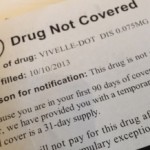
The first time I used the plan, insurance paid for part of the prescription. Soon after, I received a letter and a notice that explained while the drug wasn’t covered under my plan, the insurer provided courtesy coverage because I’d been in the plan less than 90 days.


Photo by ConsumerMojo.com

The insurer didn’t offer alternatives, but suggested that I choose another medication.

This set me on a time-consuming, frustrating search. The company’s list of approved drugs for the particular Medicare Advantage plan I had didn’t turn up anything that I can use.

I realized that I’d have to take advantage of the Open Enrollment period and switch to a Medicare Supplemental or Medi-gap plan and purchase a separate Part D plan to get what I wanted.

I reviewed other insurers’ plans, and looked at those that my current insurer offered.  Despite the fact that I’ve researched and written about Medicare, it was incredibly confusing when it came to taking care of myself.

The information from the insurer’s customer service and sales people conflicted with the information on the website. I wasted hours trying to get this right.

A GOVERNMENT WEBSITE THAT WORKS

Then I went back to basics and found the easiest way to compare insurance companies, their drug costs and their plan.

It’s right there in plain sight on a government website that works: MEDICARE.GOV.

Here’s what to do.

1. Go to Medicare.gov

2. On the home page click on FIND HEALTH AND DRUG  PLANS


Name of Drug Medicare

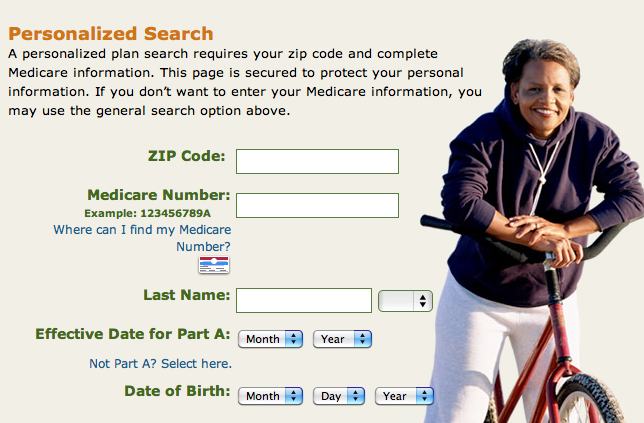
3. On the second page fill out the personal section. It’s easier and quicker than the generic.

 Medicare.gov enter your drug


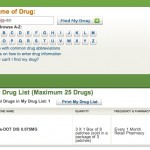
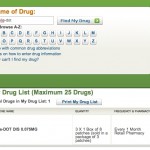
4. On the third page fill in the information about the drug you want. You get results quickly. A new screen shows a comparison of  insurers’ plans, the drugs they offer, the prices and Medicare’s rating of the drug plans.

I found my medication listed in a Part D prescription drug plan offered by my insurer, UnitedHealthcare. The insurer and its Part D plan received a good rating from Medicare and that made me feel comfortable about my decision. Switching to a Medicare Supplemental plan, or Medi-gap, also gives me a wider choice of doctors and healthcare providers. So it was a win, win situation.

APPLAUSE FOR MEDICARE.gov

The look-up process is so easy that I kicked myself for not using this handy tool sooner.

There is one more thing. Because I pushed the insurer, they put me in touch with a local broker named Rae-Carole Fischer.  She was incredibly patient and went over all of the choices with me again, made sure that I had the right paperwork and submitted it for me.

Finding a local insurance broker to help you is also a good way to confirm your decisions.

Insurance companies pay the brokers or agents according to a fee schedule set by the Centers for Medicare and Medicaid Services. Brokers must be licensed by the states where they work and before you deal with one, make sure they are licensed and have affiliations with the companies that they say they represent.


watchmoreFiguring Out Medicare Choices


readmore  3Tips for Choosing a Medicare Plan D 


readmore Why Boomers Continue to Play Sports

Fee Scam Targets New York Homeowners

The latest scam aimed at new homeowners involves a legitimate New York State property tax relief program. This fee scam targets New York homeowners who are eligible to apply for the School Tax Relief (STAR) property tax exemption. The trick here is that you don’t need anyone to help you do this. You can apply for FREE.


Photo by ConsumerMojo.com

The scam came to light when new homeowners reported they received letters with offers to enroll them in the STAR program for a substantial fee that, in some cases, equals the full amount of the first-year savings.  


Generally, homeowners will save from $700 to $3,000 annually through STAR. Senior Citizens in the Lower Hudson Valley and on Long Island benefit the most from this tax exemption.


Courtesy Wikimedia
Courtesy Wikimedia


New York Governor Andrew Cuomo said, “New Yorkers should not be fooled: registration to the STAR Program is free, convenient, and provides taxpayers with hundreds, and sometimes thousands, of dollars in property tax relief each year. I encourage any homeowner not receiving a STAR exemption to apply on their own and avoid disingenuous schemes that seek to charge you for the tax relief that is rightfully yours.”


WHO QUALIFIES:

STAR exemptions are the only property tax exemptions funded by New York State and the program includes two types of exemptions:

  • Basic STAR for homeowners with incomes under $500,000.
  • Enhanced STAR for senior citizens with incomes under $81,900.

REGISTRATION DEADLINE

The deadline to register for the STAR Program is December 31, 2013. 

To apply for STAR:

  • Outside of New York City, homeowners should submit an application to their local assessor’s office.
  • New York City has a separate form, which homeowners can request by calling 311 if they do not have Internet access.

ALREADY ENROLLED?  YOU NEED TO REGISTER AGAIN.

Even if you are already enrolled, to get the tax break you need to check back in with the New York State Tax Department.  
In a study, the Tax Department found that while the law allows tax breaks only to homeowners for their primary residences, thousands of owners of multiple properties are receiving more than one STAR exemption. So the state is trying to clean up the problem. And that means you have to do a little work.

REGISTRATION: 

  • Register online at www.tax.ny.gov. The material is available in seven languages.
  • Call 518-457-2036 to register by phone.


Affordable Colleges

Everything costs something. But some things are better values than others and that applies to your college or university education. This info-graphic highlights the unbelievably high cost of a college education and  makes a great case for state schools and taking advantage of in-state tuition breaks.

If you’re a parent or grandparent and want to help a young person save for college this may be a great time to think about opening a tax-free, or tax-deferred account to contribute to a fund that will pay for that education. There’s a special program called the 529 plan that allows you to set up a 529 account through a bank, broker or insurance company. Gerry Chamber writes about what he did in his his story Grandfather’s 529 Plan-Helping Kids Pay For College.


readmore   Impact of Student Loan Debt


How to Pay Down Your Student Loanwatchmore

New Rules for Debt Collectors and Payday Loans


Consumers who feel harassed by debt collectors, or have gotten stuck in the payday loan cycle may get some relief from the Consumer Financial Protection Bureau (CFPB).

The bureau wants to set new rules for the multi-billion dollar debt collection business and the 4500 companies that operate in the U.S.  It also wants to hear complaints about the payday lending business so that it can consider new rules.

PAYDAY LOANS

If you had to turn to a payday lender for quick cash and found yourself deeper in debt, the CFPB wants to hear from you. It’s asking consumers with complaints to speak to directly to the bureau about their experiences with:

  • Unexpected fees or interest.
  • Unauthorized or incorrect charges to their bank account.
  • Payments not being credited to their loan.
  • Problems contacting the lender.
  • Receiving a loan they did not apply for.
  • Not receiving money after they applied for a loan.


watchmore

What’s Wrong With Payday Loans?


The CFPB already collected more than 5,000 complaints about debt collectors from many who feel threatened and harassed.

CFPB Director Richard Cordray said, “For decades, many consumers have reported various unacceptable practices in the debt collection industry. We want to ensure that all players in the industry are working with correct information, that consumers are fully informed, and that consumers are treated fairly and with dignity.”

Based on the complaints the bureau will consider new rules that regulate some of the bad practices including:

  • Harassing early morning, late evening and at work phone calls.
  • Calls for debts not owed.
  • Some debt collectors try to collect more than is actually owed.
  • Many debt collectors work from outdated lists and information after debtor lists are purchased from other   companies.
  • Some debt collectors make false threats about damaging a consumer’s credit, getting them fired, having property seized or sending a consumer to jail.

watchmore

Debt Collectors What are My Rights?


HERE’S HOW TO SUBMIT A COMPLAINT ABOUT PAYDAY LOANS, OR DEBT COLLECTORS

  • Go online at www.consumerfinance.gov/Complaint
  • Call the toll-free phone number at 1-855-411-CFPB (2372) or TTY/TDD phone number at 1-855-729-CFPB (2372)
  • Fax the CFPB at 1-855-237-2392
  • Mail a letter to: Consumer Financial Protection Bureau, P.O. Box 4503, Iowa City, Iowa 52244


Banks Get Costly Lesson About Mortgage Lending Discrimination

by Barbara Nevins Taylor

If you are African-American, Hispanic or a woman on maternity leave and looking for a mortgage, you can take some comfort from the latest settlements between the U.S. Department of Housing and Urban Development (HUD) and two banking giants. The banks received a costly lesson about mortgage lending discrimination.

In separate cases, MortgageIT, a Deutsche Bank subsidiary, agreed to pay $12.1 million for allegedly discriminating against African-American and Hispanic borrowers and Bank of America agreed to pay $45,000 for allegedly discriminating against women on maternity leave.

In the MortgageIT case, a HUD review alleged that in 2007 and 2008 African-American and Hispanic borrowers paid interest rates that were 8 percentage points higher than white borrowers.

In addition, HUD alleged African-American borrowers were 65 percent more likely to receive higher priced loans than white borrowers with the same financial backgrounds, and Hispanic borrowers were 72 percent more likely. In addition, African-American and Hispanic borrowers allegedly paid higher fees. On average, African-Americans paid $707 more and Hispanics paid $906 more.
 HUD also alleged that African-American applicants were 45 percent more likely to be denied a mortgage loan than white borrowers with the same financial backgrounds.  Hispanic applicants were allegedly 35 percent more likely to be denied.
The settlement requires MortgageIT to set up a $12.1 million fund to compensate borrowers nationwide who were unfairly denied a loan or whose loans may have contained unfair fees.

Bryan Greene, HUD’s Acting Assistant Secretary for Fair Housing and Equal Opportunity said, “It’s creditworthiness and ability to pay that matter when you apply for a loan, not your race or where you come from.”

PREGNANCY DISCRIMINATION

In the maternity leave case, Bank of America will pay $45,000 to settle charges that it refused to refinance the mortgages of two couples in California and Texas because the women were on maternity leave.

One couple, from San Jose, California, said Bank of America delayed the closing on their  mortgage refinancing because the woman was on maternity leave. The other couple, from Humble, Texas, alleged that Bank of America refused to consider the wife’s employment income and denied their application for a mortgage loan because she was on maternity leave. The couple also alleged that after their real estate agent told the loan officer that denying the loan because of the woman’s maternity status violated the Fair Housing Act, the loan officer changed his reasons for denying the loan. The couple ultimately obtained a mortgage from a different lender.

Bank of America will pay $25,000 to the California couple and $15,000 to the Texas couple. According to the agreement it will also revise its policies to allow applicants on parental leave to be approved for mortgage loans without first returning to active work status. Bank of America will also hold fair lending training for its employees.

If you think you’ve been the victim of this type of discrimination by any lender contact HUD  (800) 669-9777 (voice) or (800) 927-9275 (TTY).  Housing discrimination complaints may also be filed at www.hud.gov/fairhousing or by downloading HUD’s free housing discrimination mobile application, which can be accessed through Apple devices, such as the iPhone, iPad, and iPod Touch.


watchmore      7 Tips to Get the Best Mortgage Deal

Myths about the Older Worker

by Ronald Louis Peterson

 My career as an award-winning broadcast journalist and public relations counselor ended with a corporate downsizing the year I turned 57, which coincided with the start of the Great Recession. Since then, I’ve had a few interviews in my field but there was always someone who was a “better fit.” So, I reinvented myself as a new car salesman for eight months until that position was eliminated when the auto industry tanked.

facebook


I reinvented myself again to start a pharmacist recruitment company. But despite 60-hour work weeks for a year, that didn’t work out either because the healthcare recruitment business was another casualty of the economic downturn.

Next, I landed a part-time position as an English composition instructor at a local community college, with the hope that it would lead to a fulltime position. But because there was a long waiting line to fill those jobs and because I was paid minimum wage, I left to work with a former colleague until he closed his small public relations firm.

After assessing the job market at 63, I turned to writing novels with the hope of making money one day. So, I’m following my passion because there are still too many myths about older workers that prevent me from landing another paying job in my field.

Myth: Employers don’t discriminate against older workers

  • According to a 2013 AARP survey, 64 percent of older workers between 45 and 74 say they have seen or experienced age discrimination in the workplace and 93 percent say it is very or somewhat common.


  • According to a 2012 Investors Group survey of small business owners in Canada, 79 percent said it was not likely that they would fill their open positions with someone older than 65.


  • According to a 2012 survey by Adecco of hiring managers at 500 U.S. companies, 72 percent think mature workers need more technological know-how and 33 percent think mature workers resist taking direction from younger managers.


Myth: Most workers 65 and older are less productive than younger workers

According to a 2012 Investors Group survey of small business owners in Canada:

  • 85 percent said that workers 65 years and older are just as productive as younger workers.
  • 79 percent think that senior workers have the required level of energy and ambition for their jobs.


Myth: Workers don’t want or need to work until they’re 65

According to a 2013 Gallup survey:

  • 37 percent of non-retired Americans say they expect to retire after age 65.
  • 26 percent at age 65.
  • 26 percent before age 65.


Gallup found that the big change is an increase in the number of people who expect to work past age 65. It rose to 37 percent in 2013 from:

  • 22 percent in 2003.
  • 14 percent percent in 1995.


However, older workers are apparently being forced to retire before reaching 65 since the average age of U.S. retirees today is 61. 


Myth: Older workers are not go getters

According to a 2013 Kauffman Index of Entrepreneurial Activity, an aging population and increasing rate of entrepreneurship among older workers has led to a rising share of new entrepreneurs in the 55 to 64 age group. And that’s an increase from:

  •  23.3 percent in 2012.
  •  14.3 percent in 1996.


Myth: Older workers have a poor work ethic

According to a 2009 Pew survey of people aged 16 and older, 74 percent believe that older adults have the best work ethic. Even young people think their parents’ and grandparents’ generations have a better work ethic:

  • 68 percent for those under 30.
  • 73 percent for those 50 and older.
  • This sentiment rises to 80 percent among 30 to 49-year-olds.

Myth: It is cost effective to replace experienced workers

A 2005 analysis of Towers Perrin data indicates that replacing an experienced worker of any age can cost 50 percent or more of the individual’s annual salary in turnover-related costs. 

Where does this leave me?

Where does this leave me? As I pursue my passion for creative writing, I’m thankful that my wife has a job and that she’s six years younger than me. And, while I regret that I did not “retire” from my public relations-marketing communications profession on my terms, I’m now working at becoming a great novelist–my real “dream” job.


watchmoreWhy Boomers Continue to Play Sports


watchmore Tips for Older Job Seekers


readmoreMedicare Advantage Rates Go Up in 2014