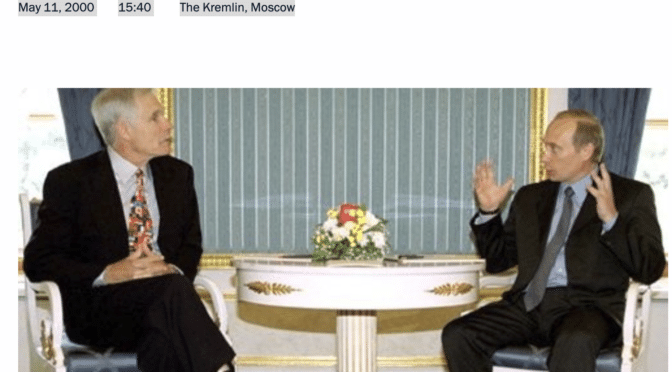
I am in a New York taxi with Ted Turner. It’s May 1982, nine in the morning, and we just arrived from Atlanta on a Delta flight. Ted is all angles, his 6’2″ frame folded into the compact cab’s back seat. He’s tired of talking, something he does prodigiously. He’s already told me American TV networks will fail and their owners should be tried for treason, that Turner Broadcasting will soon be “the world leader in communications,” that humanity is on the brink of collapse, that being drafted “to save the country” is the only way he’d enter politics, and that he is on the verge of physical collapse.
Then he thinks of another extinction event that requires his attention. At the lake at his farm north of Atlanta, the catfish are eating all the bass and bream. There’s only one solution: “I’m gonna fish for catfish until I catch ’em all.”
I dutifully make a note of this. I’m writing a story on Ted for Atlanta magazine, which is why on I’m on this trip to New York with him. He’s here to speak to the National Academy of Television Arts and Sciences and — more importantly — drum up advertising support for CNN, the 24-hour news channel he’d founded just two years earlier, and his Atlanta “superstation” WTBS –the TBS standing for Turner Broadcasting System — beamed nationwide by satellite. A staple of WTBS programming is Atlanta Braves’ baseball games, rebranded as “America’s Team” now that WTBS reaches every crevice of the country. In the winter it broadcasts Atlanta Hawks’ basketball games. Turner owns both teams.
He is not just an owner, he’s a fan. At Braves’ games, he sits behind the dugout, chewing tobacco and spitting in a cup. If they win, he’ll vault onto the field to congratulate the players. For one game, he put on a uniform and managed them. They lost.
Turner allows that another baseball owner, shipping millionaire George Steinbrenner, has “done okay” but says his own influence is greater. “I’ll tell you what I want to do,” he says, and says no when I bring out my tape recorder. “I want to set the all-time greatest personal achievement record, greater than Alexander Graham Bell or Thomas Edison, Napoleon or Alexander the Great. And I’m in a position to do it, too.”
Our cab rattles along a cobblestone street and I wonder if I heard any hint of irony or jest in what he said. No. His blue eyes and his expression said he was perfectly serious. Turner was 43 then, almost half the age he’d reach before he died on May 6 at 87. He was just talking about more fields he wished, and expected, to conquer.
And why shouldn’t he? He’d introduced himself to the world outside Atlanta by winning the famous America’s Cup yacht race in 1977, beating an Australian yacht in four straight races. His boat was named Courageous, and the pundit world rhymed a name for him: Captain Outrageous. It didn’t help that viewers saw him conspicuously sloshed at the nationally televised victory news conference, but the name would have stuck anyway. He looked at the world, saw things he thought needed changing, and said so. Often.
If words were solutions, our problems would have disappeared. Little things like population control, world hunger, and nuclear disarmament were on his agenda. On the plane to New York, he talked about what humans have done to the environment: “Like a bunch of termites, we’re just going across the world, cutting down the trees, changing the ecology, siphoning coal and oil out of the earth’s surface and burning it in massive quantities and messing up the ozone layer and stopping the salmon going upstream and chopping down the forests and planting corn and the topsoil is no longer held and it’s going down the Mississippi River and we just . . . if you just look at it, we’ve done it all in 200 years, which is a snap!
“And on top of that, now we’ve gone into nuclear weapons. We oughta be in daily communications with the Russians about disarmament. We oughta be working like beavers on alternate energy.
“We got to the moon. We should learn to live on this beautiful planet we’ve got here until the sun burns out . . .”
It turned out viewers liked news broken out of set time slots the way the networks did it, and the movies and cartoons WTBS offered. As CNN and Turner Broadcasting grew more successful, Turner made more money, and he put his money where his mouth was. He became one of the country’s largest landowners with 2 million acres on ranches in Kansas, Montana, Nebraska, New Mexico and South Dakota, and he promised they’d stay undeveloped. He helped bring the American bison back from the verge of extinction and had herds totaling 45,000 of them. He donated a billion dollars to the United Nations to aid refugees and children, fight disease and to clear land mines.
His candor never failed him. Turner was diagnosed with Lewy body dementia, a progressive brain disease, in 2018 and announced it himself on a CBS Sunday morning show. He said it made him tired, exhausted, and forgetful, then groped unsuccessfully to remember what he had beyond the word “dementia.”
His death triggered a cascade of prominent obituaries, including the front page of The New York Times. “The Mouth of the South,” as he was also known, would have been famous for any one of his remarkable triumphs. but he had a lot of them. That early morning on our taxi ride his concerns sounded insurmountable, his ambitions far-fetched and fantastical. But what did I know?
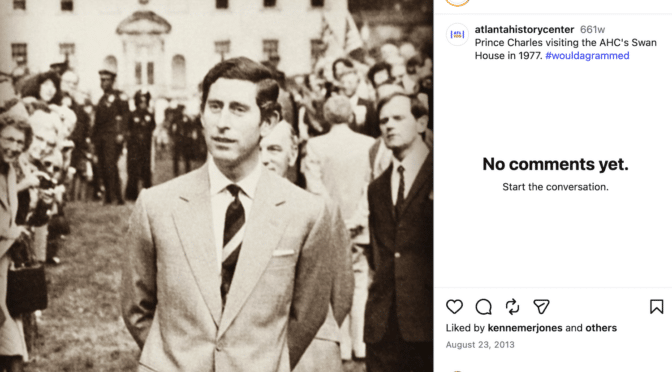
The visit of Britain’s King Charles III to Washington and New York this week jogged memories of a close brush with the king-to-be nearly fifty years ago.
Charles, then 29 and still the Prince of Wales, swung through Georgia in October 1977 as part of an eleven-day, twelve-city U.S. tour. I had a talk show on Georgia public TV at the time and was tapped to do live commentary on his address to an A-list crowd in the State House Chamber.
It was the first royal visit to the former crown colony in its long history and lawmakers rolled out the welcome mat as only they knew how. Ashtrays that doubled as spittoons for the likes of House Speaker Tom Murphy, a tobacco chewer, were emptied and filled with clean sand. And if Charles wanted to see what they were used for, Murphy offered tutoring.
“If he wants to learn to chew, I’ll teach him how,” Murphy told Atlanta Constitution reporter David Morrison as he spat a brown stream.
It’s doubtful Murphy’s offer reached his ears. That afternoon Charles climbed a red carpet up the steps of the gold-domed Georgia capitol as a thousand onlookers applauded and an army band played “The Star Spangled Banner” and “God Save the Queen.” A standing ovation greeted him in the House Chamber, where legislators mingled the city council members and judges and their spouses.
Gov. George Busbee and Lt. Gov. Zell Miller applauded him at the podium of the state house chamber. They all looked as if they were enjoying one another’s company.
Georgia’s powers that be had tried to school the locals in royal behavior, They weren’t to expect handshakes with the prince. When he heard that, former Atlanta Hawks center Walt Bellamy and now the doorkeeper of the Georgia Senate, recalled that his Boston Celtics rival Bill Russell “don’t shake hands either. That’s business as usual for me.”
As I sat in the press area at the back of the room, earphones on and a microphone in front of me, it became clear as he spoke that the young prince was a natural. He mixed gravitas with humor, congratulating Georgia on a new British tobacco plant in Macon “to my horror as a non-smoker,” and promoted new air routes from Atlanta to London even though flyers “may never be able to get out again.”
He talked diplomatically of the threads linking his ancestor King George III, who ruled during the American revolution, with the United States and the state that bears his name. “I am utterly convinced,” he said, “that he would have been delighted to see what has happened — for once he realized that independence was inevitable, he was wise and sensible enough to appreciate that the two nations should live and work together in a growing spirit of mutual respect and harmony.”
There was the ritual gift-giving. Atlanta Mayor Maynard Jackson gave the prince a ceramic key to the city made of Georgia red clay. Speaker Murphy might have been expected to offer a pouch of Levi Garrett, his favorite chewing tobacco, but his gift instead was a pair of bobwhite quail, stuffed and mounted in a glass case. One wonders if they’re still in a dusty corner of the Windsor Castle basement.
Charles would be a king-in-waiting for a long time still to come. He finally acceded to the throne in 2022, upon the death of his mother, Queen Elizabeth II.
But when he spoke to Congress this recent Tuesday, April 28, — the first British king to address Congress in our nearly 250-year history — he still had “mutual respect and harmony” in mind. His remarks were diplomatic but pointed, a gentle rebuke to the combative pugilism preferred by President Trump and his top deputies. Charles reminded Congress and the rest of us that the alliance between the United States and the United Kingdom has been “one of the most consequential in human history.” He mentioned the roots of democracy in the Magna Carta. He cited the importance of NATO to a stable and democratic Europe. He spoke of the “unyielding resolve needed for the defense of Ukraine and her most courageous people.” He said the climate crisis is a threat that shouldn’t be moved to a back burner.
He spoke as a leader should speak, to bring people together, not to divide them.
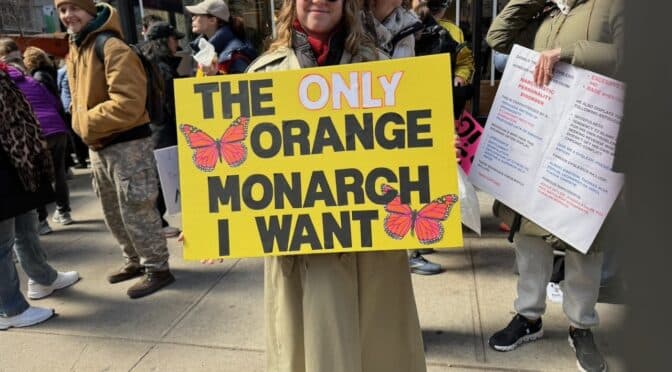
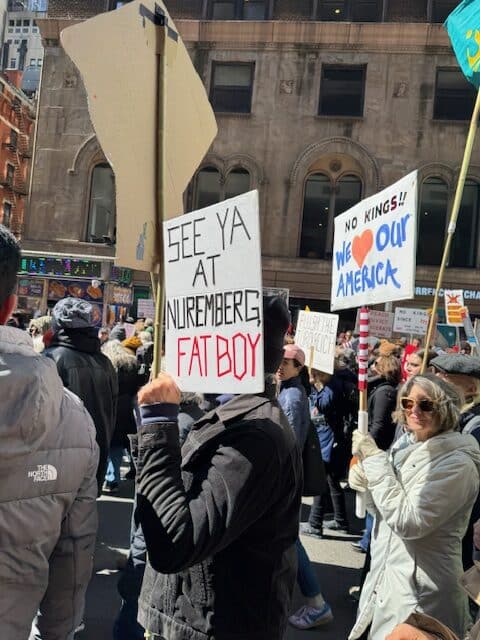
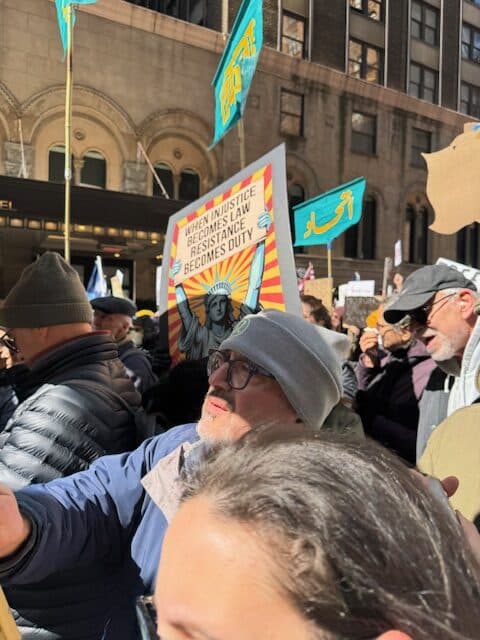
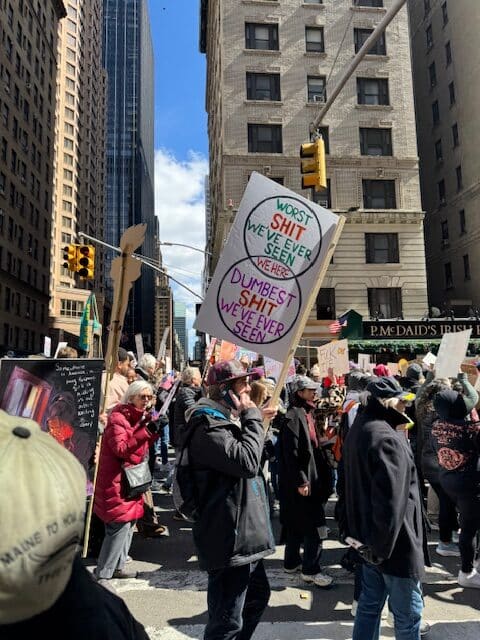
I’ve been to every No Kings march here in New York, but I wouldn’t mind this one.
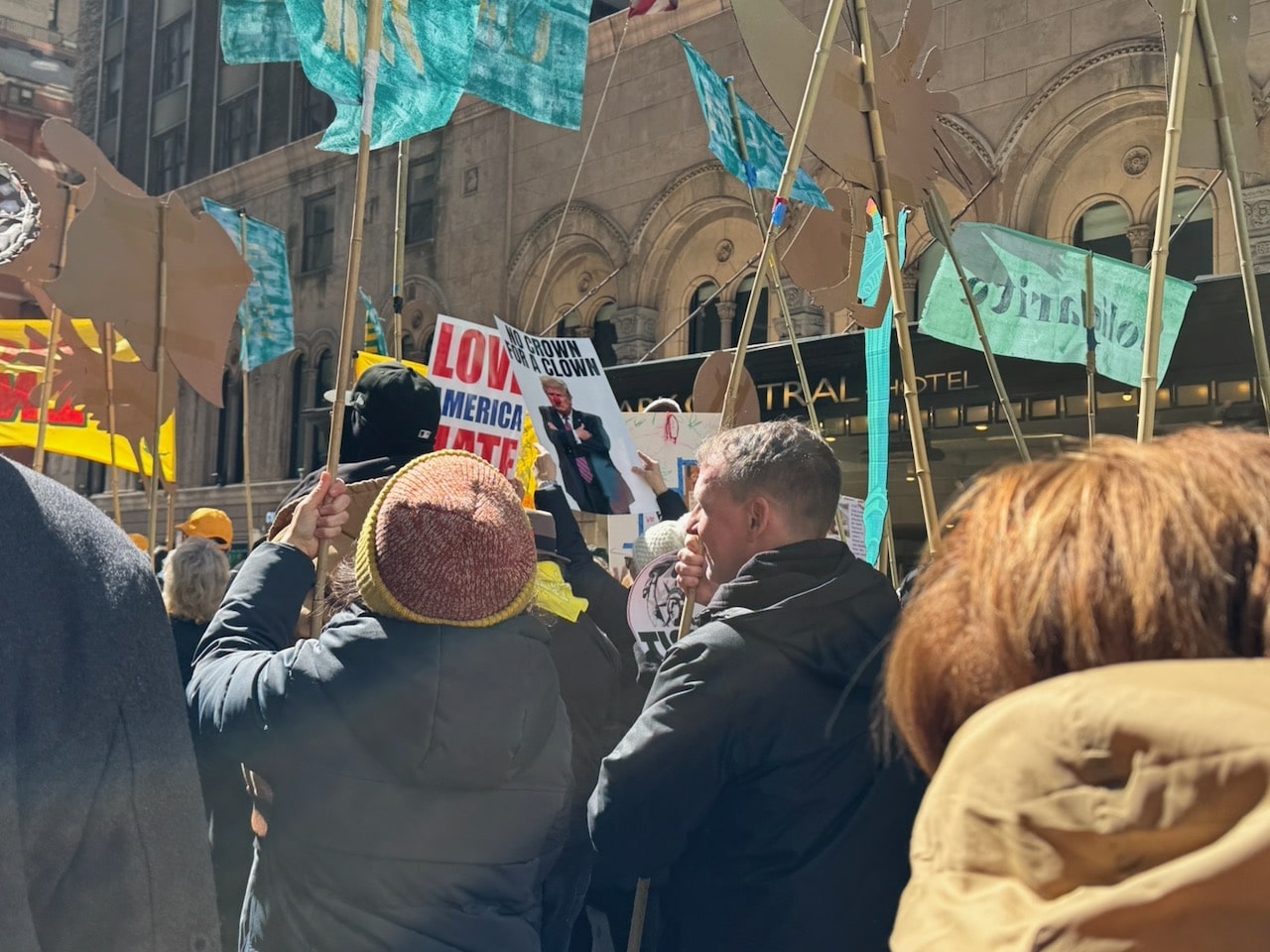
Barbara and I bundled into a crowded subway car on Saturday morning headed for the start of the No Kings march in Midtown Manhattan. Fellow riders, carrying signs, some with No Fascist buttons pinned to their parkas, headed there too. We got out near Central Park South and Seventh Avenue and joined a growing crowd that already filled the streets.
The growing crowd was ready to March.
We all turned south and started down Seventh Avenue, more like a shuffle than a march given that everyone pressed close together. Robert de Niro, along with New York attorney general Letitia James and Rev. Al Sharpton, led the way. We found ourselves two or three rows behind them.
But the celebrities and politicians didn’t matter as much as the real people. The signs they carried left no doubt where their owners stood politically. We felt good being among people who cared enough about democracy and the U.S. Constitution to rebuke Trump and his cabinet of misfits.
It felt exhilarating and it made us feel even better when we learned that 8 or 9 million protesters chanted and carried anti-Trump signs in cities and towns throughout the U.S. and around the world.
Now we hope that people will remember what it feels like to standup for decency, principles and the rule of law. It will take voters in the U.S. to really make a difference and we can start in the midterm elections in November. Let us know what you think.
Time to celebrate the Year of the Fire Horse. Chinese astrologers say to get set for a year of change, turmoil and the need to hang on to a sense of balance. If you’re an American expecting that already, the Chinese stargazers are telling us it could get worse.
In the Lunar calendar, which marks the beginning of spring in Asia, the Year of the Fire Horse occurs only once every 60 years. You may ask how that’s possible when the 12 animals in the Chinese Zodiac — rat, ox, tiger, rabbit, dragon, snake, horse, goat, monkey, rooster, dog and pig — rotate through a 12-year cycle.
The Chinese calendar uses the 60-year Sexagenary Cycle and combines five elements — wood, fire, earth, metal and water — with each of the animals. So while the horse returns every 12 years, the fire horse returns only every 60 years.
The horse itself is the seventh animal in the cycle and represents freedom and passion. But adding the fire element suggests innovation and change and maybe upheaval. The China Morning Post reports the Fire Horse can bring chaos, as it did in 1966 when the Cultural Revolution created a decade of turmoil and violence and the Vietnam War raged.
In Taiwan, the Tapei Times interviewed Wisdom Tsai, who reads the omens and offers predications. He too spoke of turmoil and cautioned the importance of balancing bad energy with “inner balance,” Tsai told the Times that “luck-boosting is really a form of life management.”
Seems like we might need a lot of luck-boosting life management this year.
You may have seen the ads for lung cancer screening and thought about it, or not. I’m here to tell you, it’s a good idea. Screening saved my life once and I hope that a recent CT scan, which revealed a cancerous tumor, will help me live a little longer.
I’m scheduled for surgery and am optimistic that the thoracic surgeon, Andrew Kaufman at Mount Sinai Medical Center, will successfully remove the newest discovery in my right lung. He is a second timer with me. In 2018, I volunteered for a study, at Montefiore-Albert Einstein College of Medicine, and agreed to have a scan of my heart. Two days later, the doctor Ana Bortnick called and said, “I have some information for you. The scan showed that you have what radiologists call ground glass in your lungs. It’s a good idea to check with your primary doctor and a pulmonologist.”
Ground glass rang a bell with me. The term connected to 9/11 first responders who had been diagnosed with lung cancer. Ground glass – a reference to what the image looks like in the scan — was found in their lungs before cancer was confirmed. I wasn’t heroic like them, but I was a TV reporter and had raced to the World Trade Center minutes after the first terrorist-driven plane slammed into North Tower.
We live in Greenwich Village, and our house shook when the plane flew low over it heading directly south. Seconds later, neighbors saw the crash and from street level we all saw the flames spurting from the building. I had to go. My husband, Nick Taylor, came with me, and we walked against the human tide moving quickly up Varick Street trying to get away. I pounded my analog phone over and over fruitlessly trying to reach the assignment desk to let them know I was ready to report.
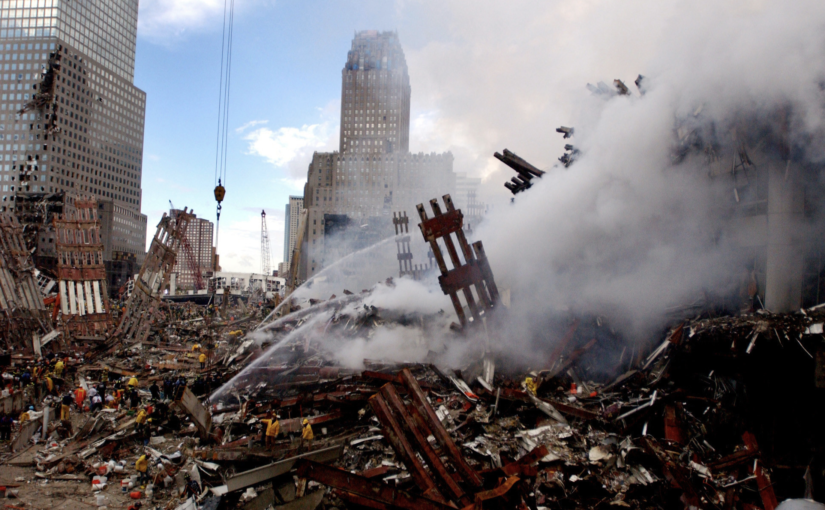
When we got to the towers, it was chaos. People crying. People running. People trying to help. We stood under the North Tower staring up watching the flames, stunned, frustrated, unable to do anything useful. Some on the top floors waved white somethings from broken windows, begging for rescue. Men and women driven by the flames plummeted from those high floors. Some of them held hands.
After a few minutes, a long-screeching creaking sound gained strength against noise of sirens and tumult. It got louder and louder. A man standing next to us — an NYPD detective who like us had come when he saw the flames — heard the creaking and yelled, “She’s coming down. Run.” We ran north as the South Tower fell into itself and sent a volcano of toxic debris sprinkling down upon the neighborhood. It was weirdly pretty; what we saw through the smoke were dancing strips of paper falling in the morning breeze.
Unable to stand still, I went looking for a phone. I banged on the glass window, and a manager at a nearby McDonald’s let me use his fax phone to reach my office. The assistant news director told me a crew was waiting a few blocks away and I would be the first reporter live. I spent the day interviewing survivors and others looking for loved ones. The next week, and for many weeks after, I visited sites near the collapsed towers interviewing, reporting, and breathing the smokey toxic air. That’s why I wasn’t surprised when the cancer in my lung was officially linked to 9/11 by the World Trade Center Health Registry at NYU and in Washington, D.C.
After the first surgery, CT scans became an official part of my life. Every six months, I made the trip to the radiology department, waited my turn to slide into the machine, and then waited anxiously for the results in the doctor’s office.
All was good, until it wasn’t. That brings me back to screening. Lung cancer is the leading cause of cancer death, according to the American Cancer Society. It is generally symptomless in the initial stage. Just like it was for me. But the good news is that patients diagnosed by CT scans have a 20-year survival rate of 81%. Even better, there was a 95% survival rate if the cancer was found in the early stages, according to an international study led by Claudia Henschke, professor of radiology and director of the Early Lung and Cardiac Action Program at the Icahn School of Medicine at Mount Sinai Medical Center. Although I’ve never met her, my case and my scans are part of the study and continue in studies conducted by Henschke and her team.
Henschke, and the first scan and the surgeon helped me lead a healthy life for five and half years longer than I might have. Now I hope that the latest scan will keep me in that 95% survival group.
During our visit to southern Italy, we decided drives of about four to five hours with a stop or two between destinations seemed right. From Matera, where we had spent three nights, Taranto on the Ionian Sea looked ideal. We knew that the seaside city would offer a starkly different experience than the interior cave-life of Matera. Happily we found that the beauty of the Ionian sea, the old port town and its National Archeological Museum, and the food surpassed our expectations.
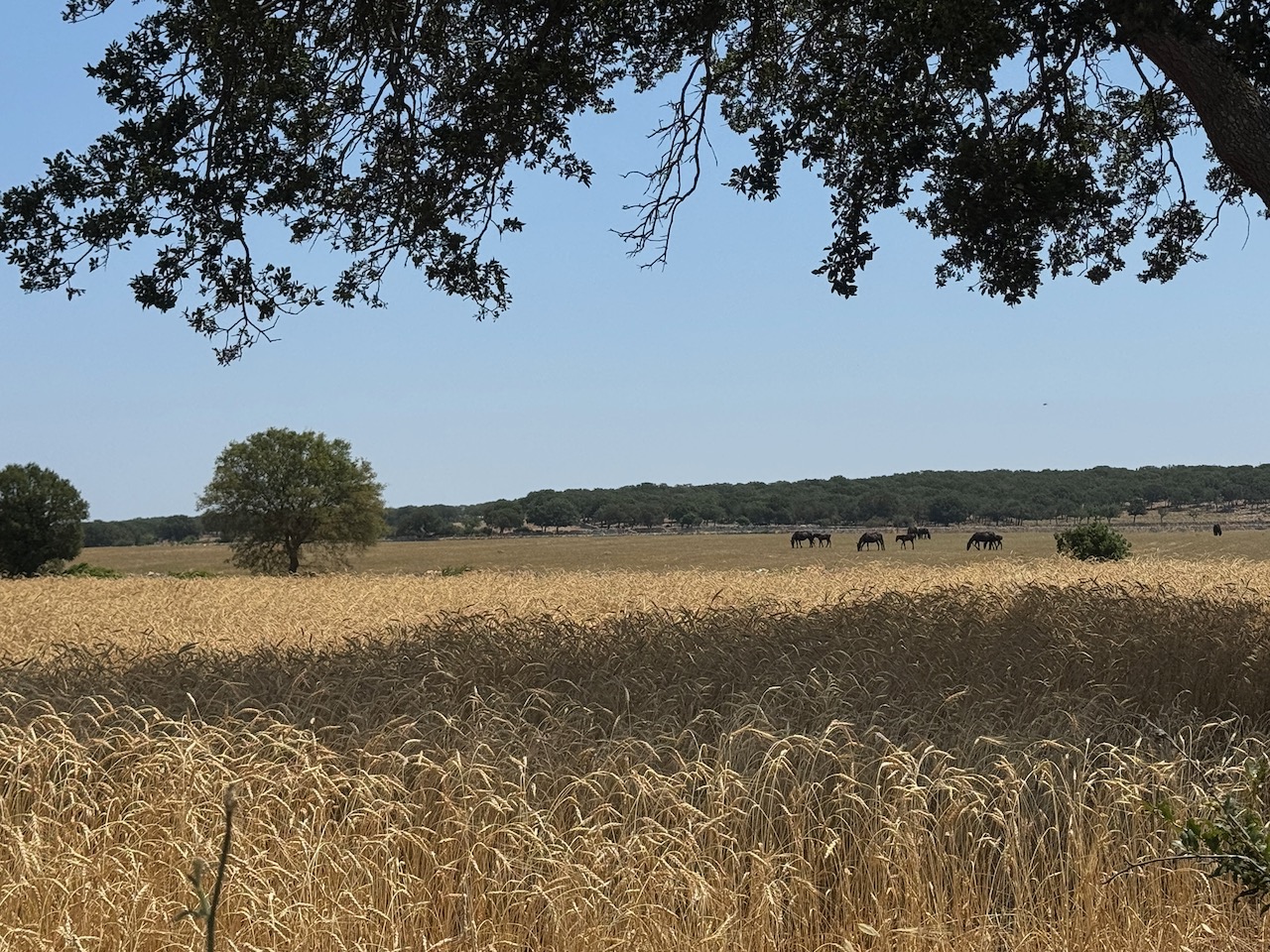
We left Matera in Basilicata in our rental car on a sunny morning and headed northeast through farmland renowned for growing wheat and beans. We headed to the neighboring Apulia region, or Puglia, as it’s known in the original Italian. Puglia is also the way our Italian friends and neighbors in New York refer to the region. Whatever your preference, it is Italy’s boot heel as you’re looking at a map.
We looked forward to good food, local wine, the Ionian and Adriatic seas and the discovery of local history that predates ancient Greek trading settlements. We planned to visit Taranto, Gallipoli, Lecce and Bari with short stops in interesting places on the way. And coming out of Basilicata, we headed to the Ionian Sea and the city of Taranto.
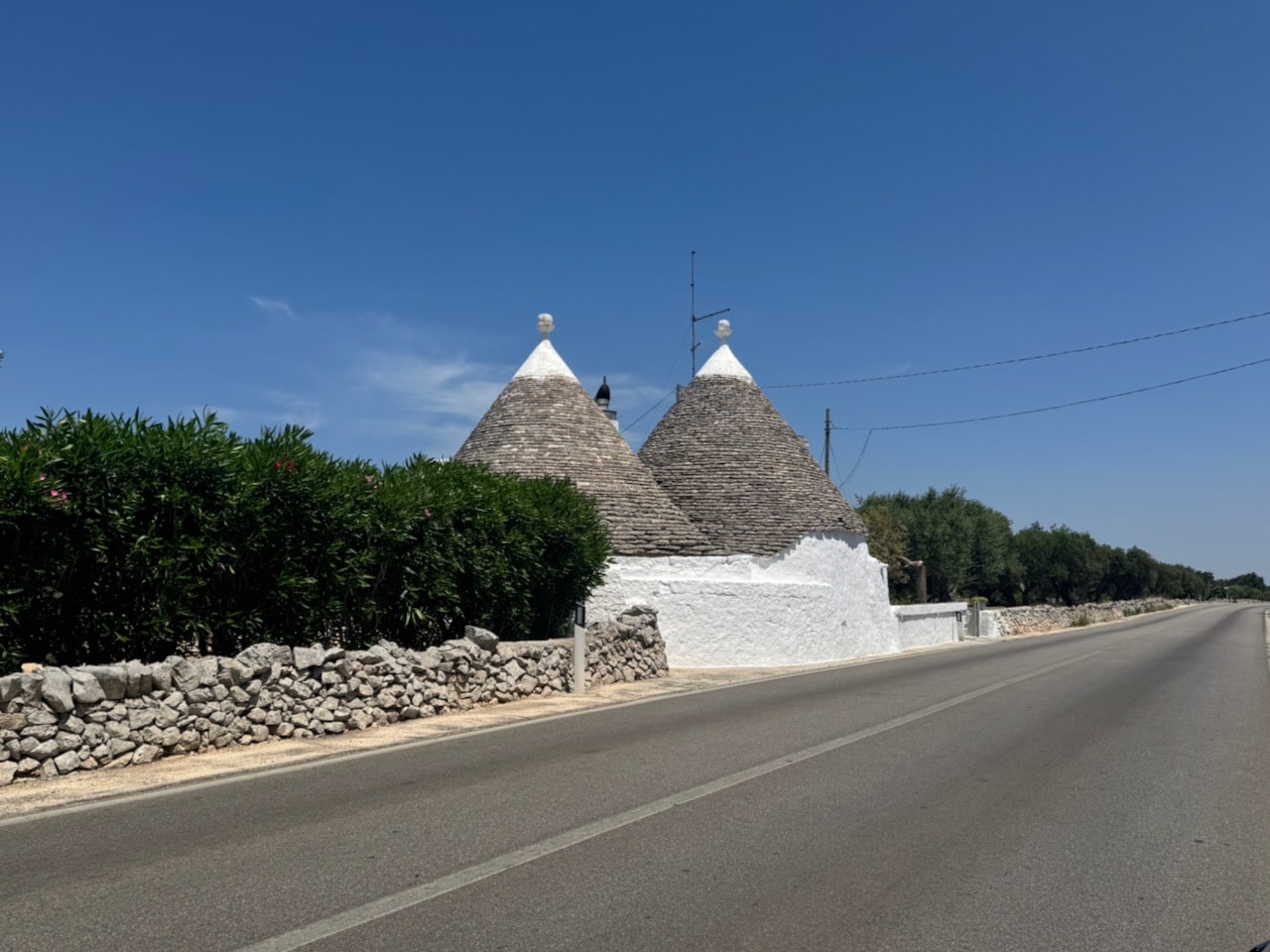
We mapped out a twisty route to make sure that we would travel through the part of Puglia dotted with the cone-capped trulli houses whose design and construction date back to the fourteenth century.
Trulli Houses Outside of Alberobello, Photo by ConsumerMojo.com
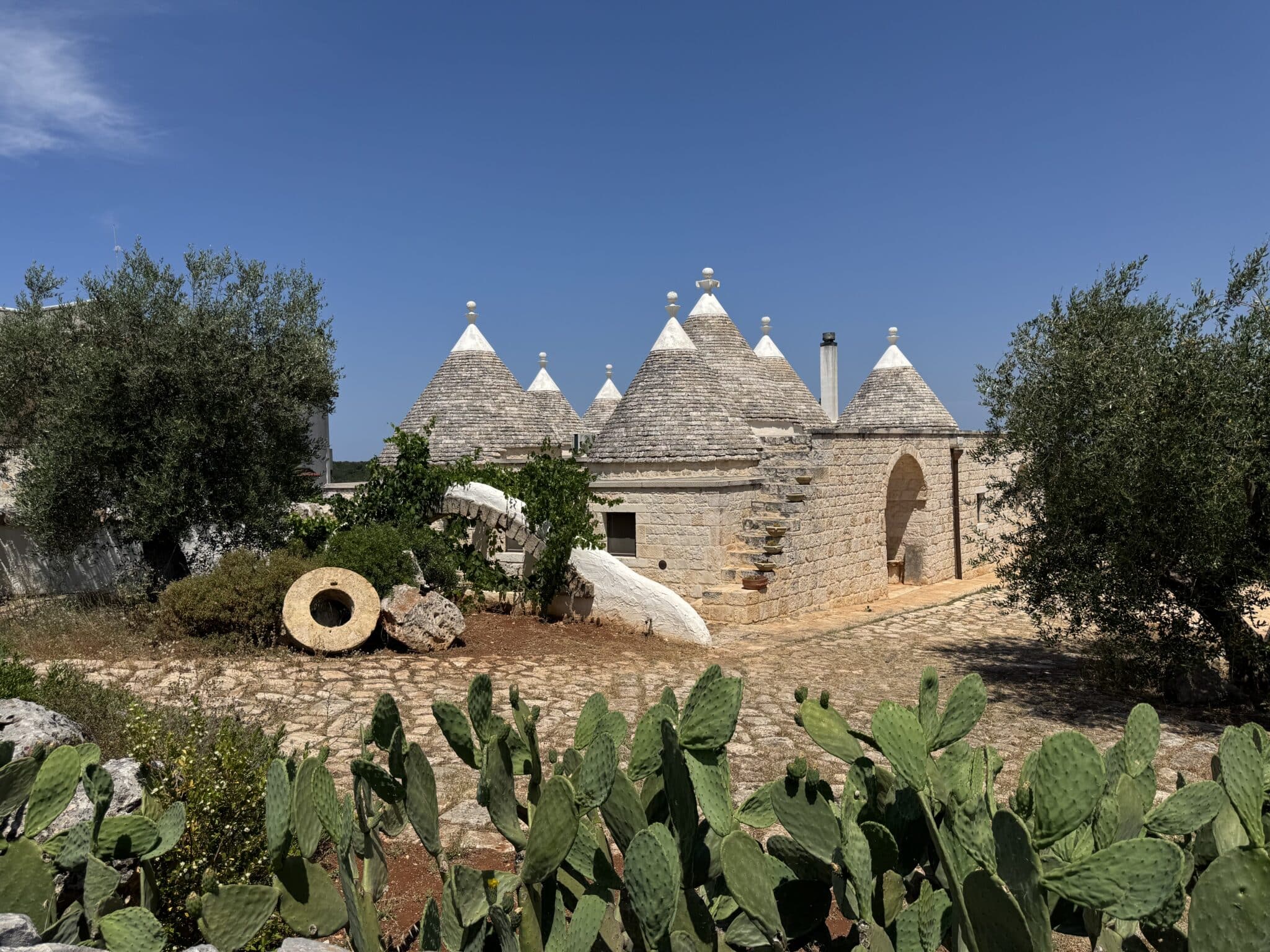
The trulli — plural of trullo — originally were built like sheds where people working the land would sleep and store their tools. A typical trullo is built with the area’s white limestone and gray stones are used for the pointy roofs. They are built without mortar. Instead, they rely on gravity, with the interlocked circles of tile growing smaller as they rise. The white lime tips that top them off are called pinnacoli.
Trulli compounds grew with families and now a central trullo is usually surrounded by others.
Cone-roofed trulli houses near Cisternino. Photo by ConsumerMojo.com.
We saw a surprising number of them in the countryside. But the town of Alberobello is the heart of Trulli culture.
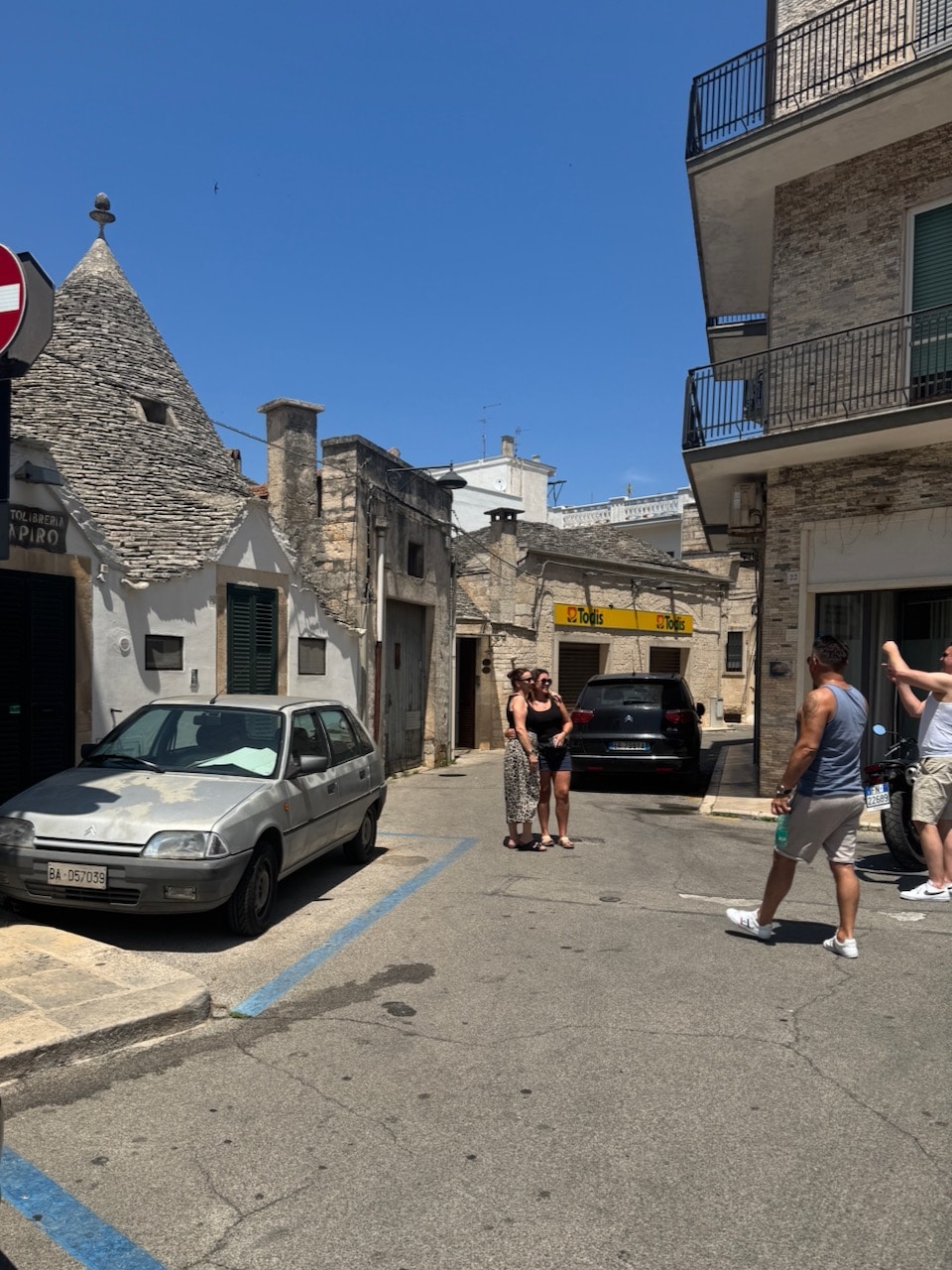
It is also a spot that feels like another real-life Disneyland. Tourists wandered around happily gaping and taking photos. Just like us.
ourists taking photos in Alberobello
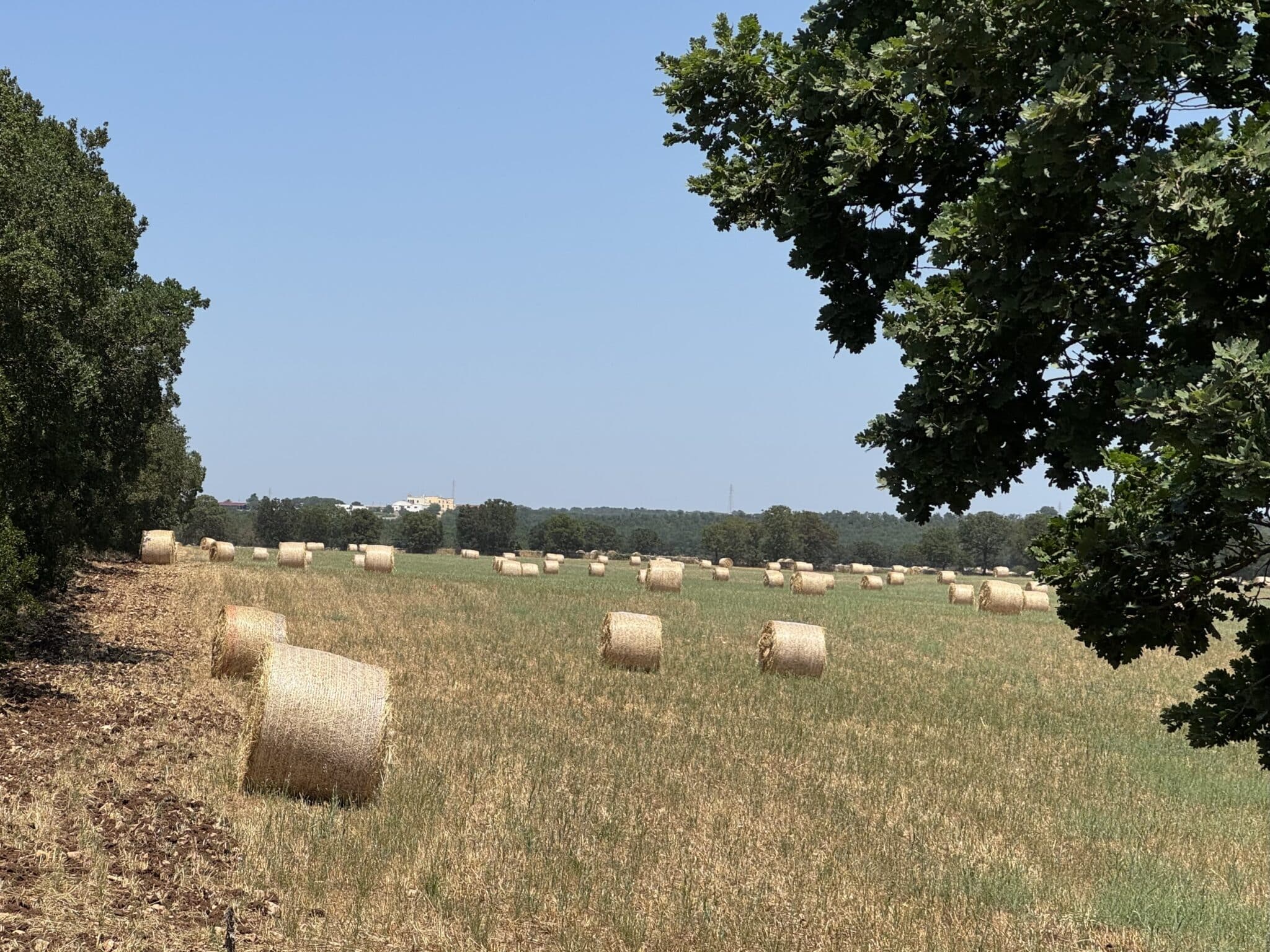
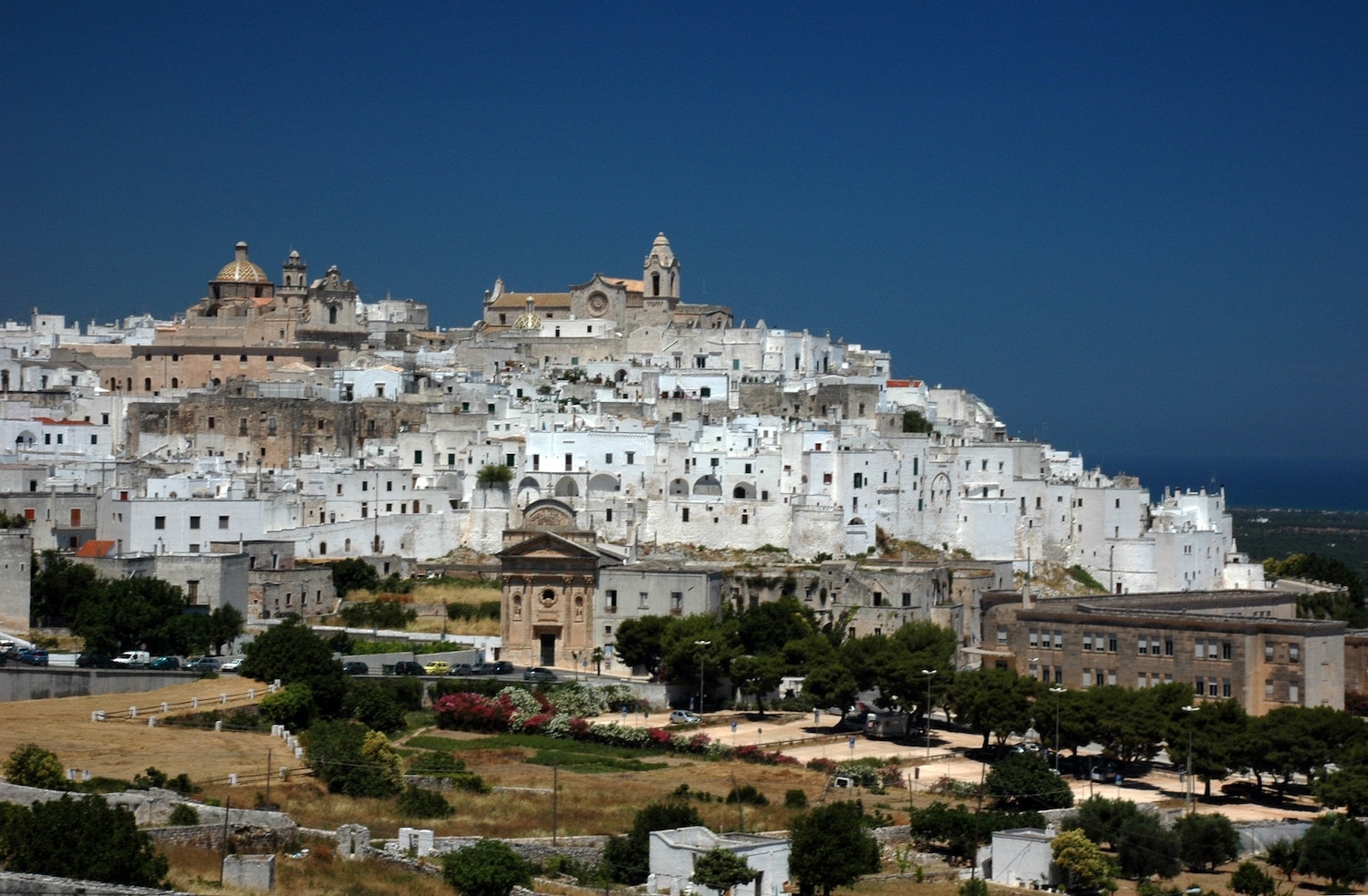
We had planned to lunch in Alberobello, but there were so many tourists that we decided to keep going. We went south through more fields of rolled up wheat to see the white village of Ostuni
Rolled up hay bales in farm country north of Taranto. Photo by ConsumerMojo.com.Hillside view of Ostuni in Apulia, Italy. Photo by PugGirl via Flickr. Creative Commons License.
We circled through the hillside town and back down to the road leading south on the E 90 and the 50-minute drive to Taranto.
Older travel guides don’t recommend visiting Taranto, if they mention it at all. Too dirty and industrial, they say. Much of the blame went to the ILVA steelworks, one of Europe’s largest steel producers, for hazardous waste and unchecked air and water pollution. But the Italian government took it over in 2012, and the company’s former owners went to jail in 2021 for allowing it to contaminate the city. ILVA still operates, but Taranto’s not a toxic waste dump anymore.
The city’s long history dates back to the Bronze Age. Mycenean settlers were there fifteen centuries before the Christian era. Spartans followed the Greek Mycenaeans in the eighth century BCE and turned the island of Taras into Sparta’s only colony. The Romans conquered the city in 272 BCE and Tarentum become part of the Roman empire.
Connected to Rome by the Appian Way in the second century BCE, the city over time became a commercial port and shipbuilding center.
Byzantines, Lombards, and Normans had periods of rule in the Christian era. The Kingdom of Naples ruled Taranto in the 14th century, beginning a period of culture and prosperity that continued through the Renaissance and Baroque eras with a flurry of church-building. The 19th and 20th centuries brought the industrialization that Italy and Taranto now are cleaning up.
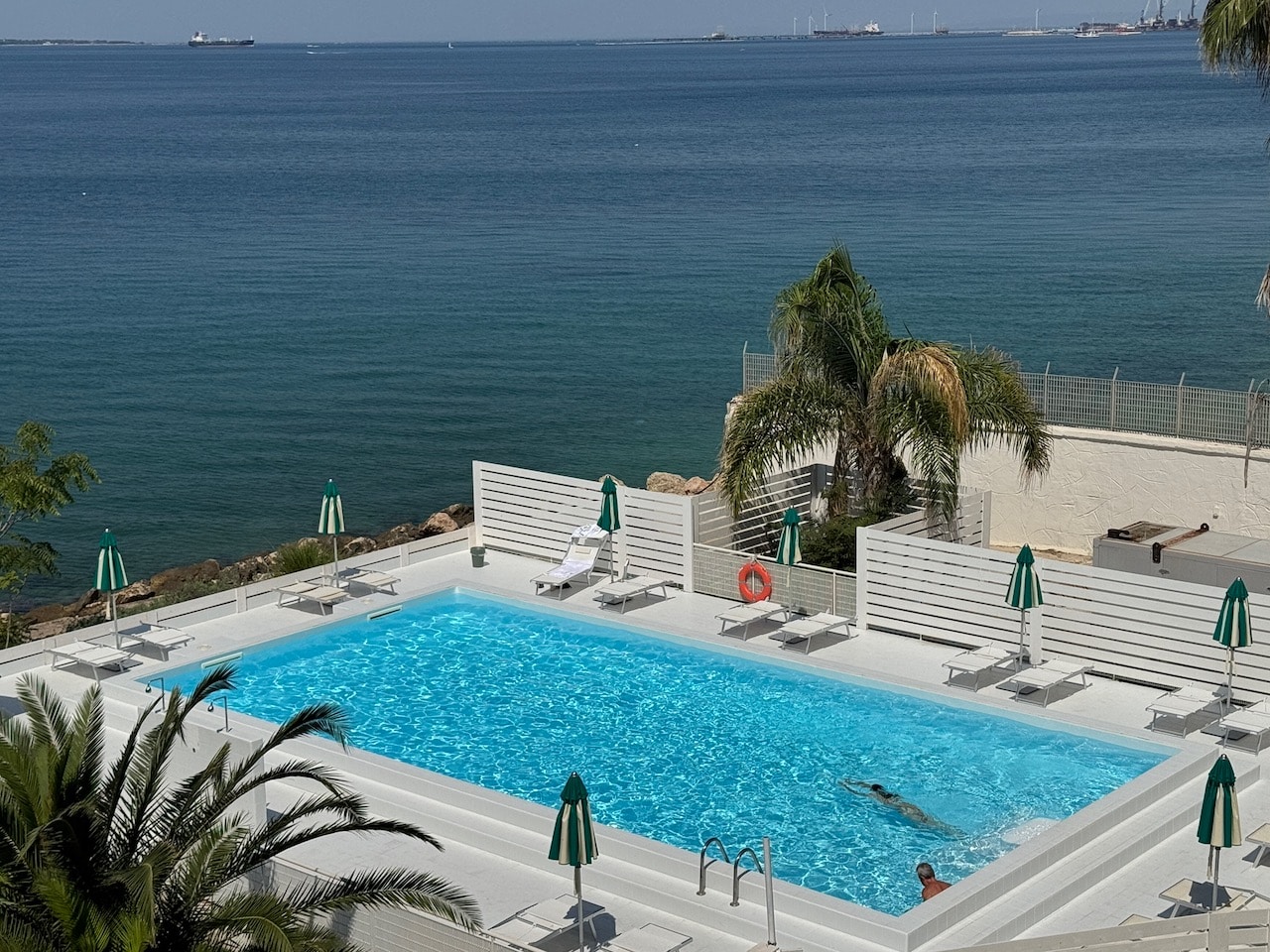
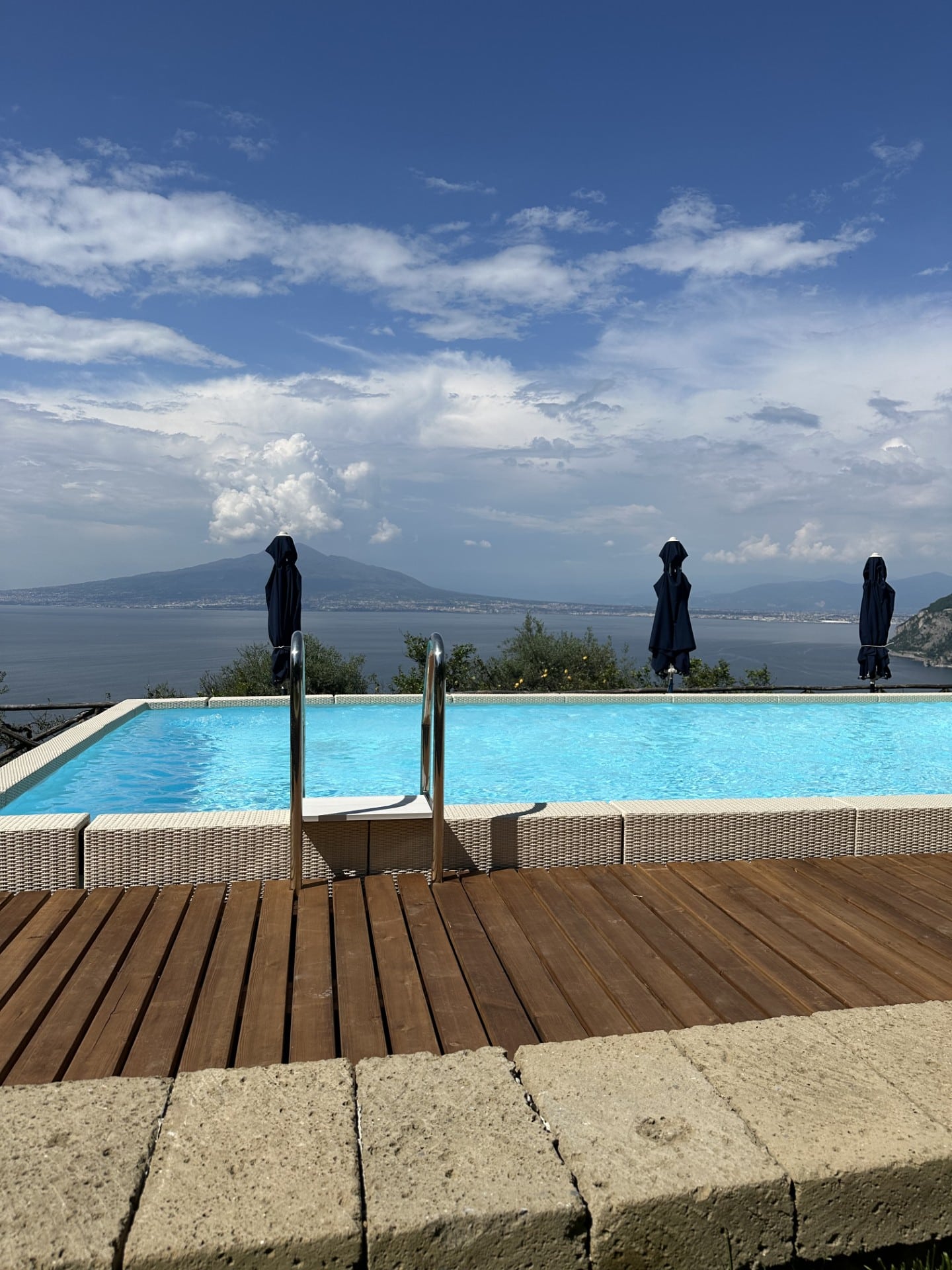
We had reservations at Taranto’s Delfino Hotel. It’s a high-rise right on the water that, wonder of wonders, had on-site parking and a beautiful swimming pool on the Ionian Sea. It beckoned to us after a day of driving. It was time for diving in.
Delfino Hotel Swimming Pool.
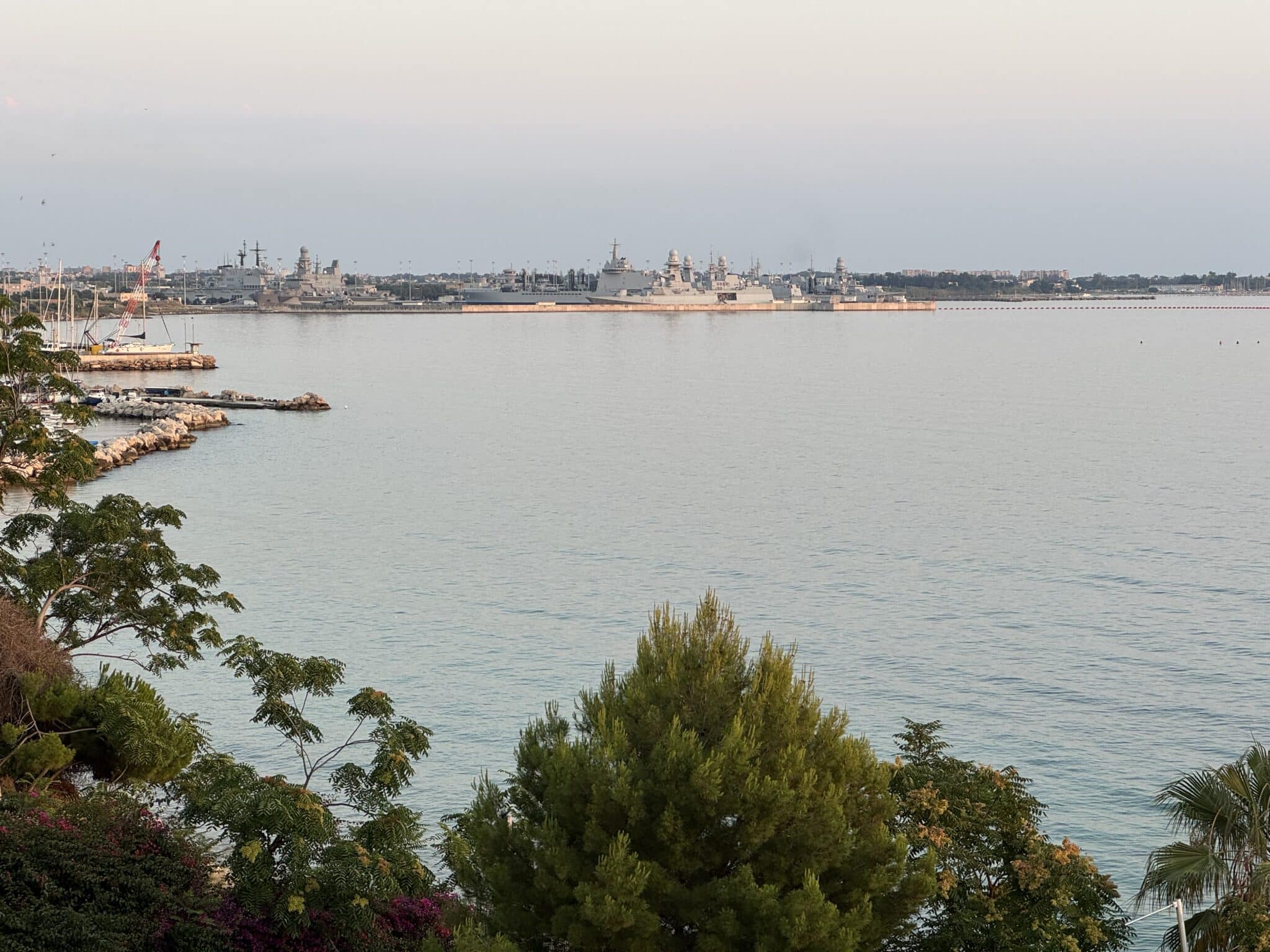
Once we shed the driving fatigue with a great swim, we stepped out on the terrace of our room to enjoy the almost sundown view. Looking east we saw Stazione Navale Mar Grande, the Italian naval base.
The Italian naval base at Taranto. Photo by ConsumerMojo.com.
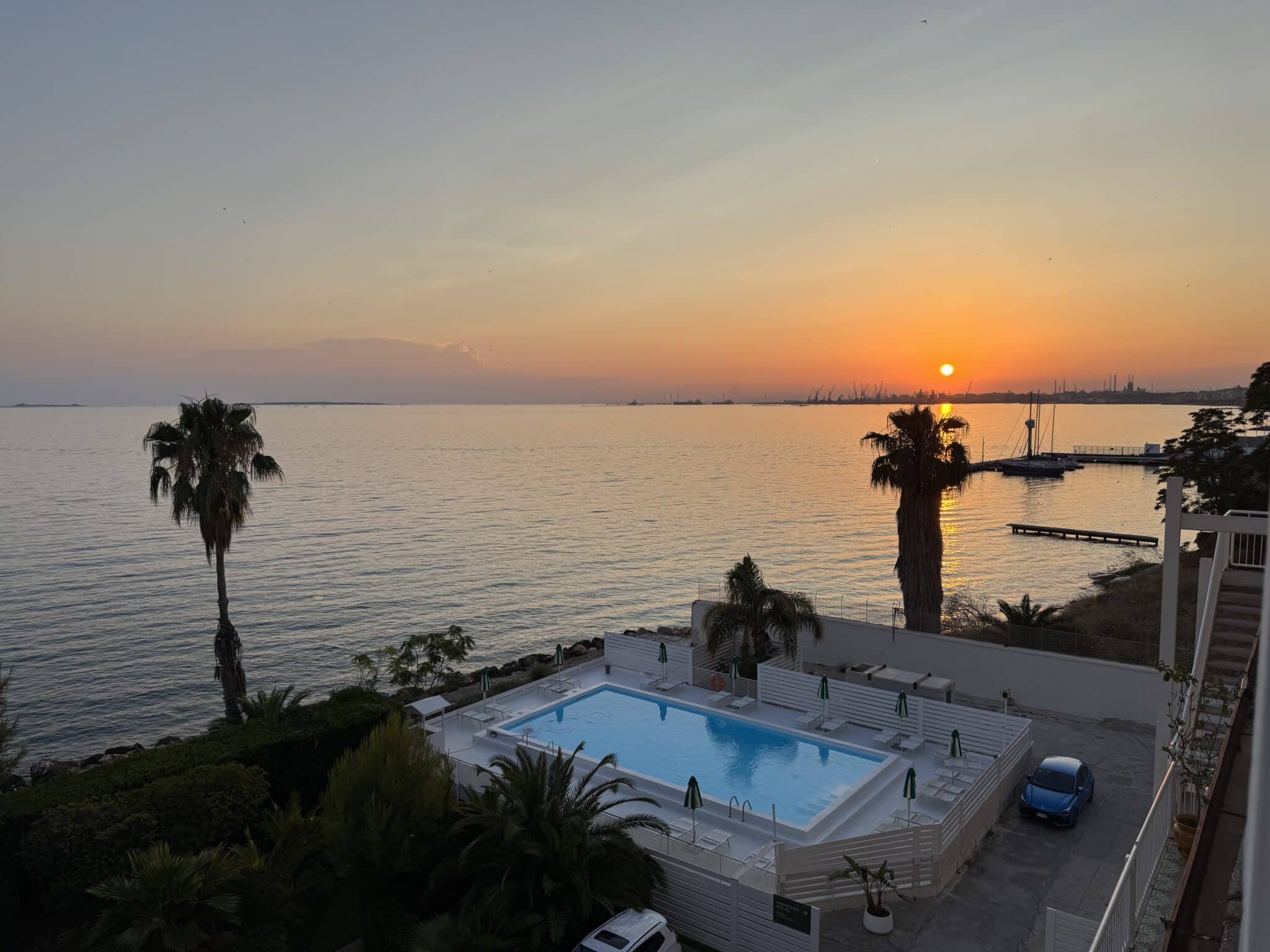
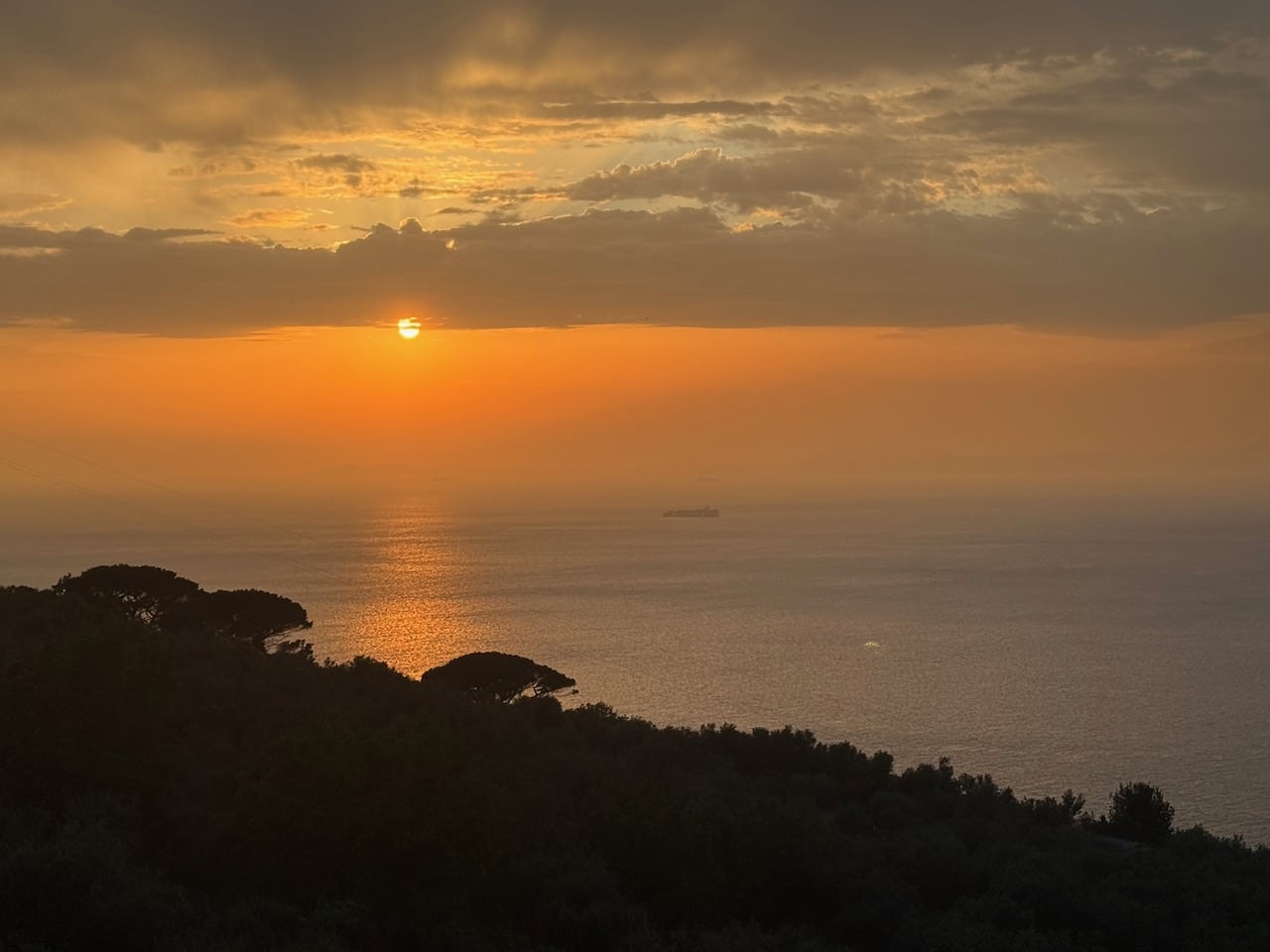
Looking to the west, we caught the skyline of Taranto’s commercial port backlit by the setting sun.
The Hotel Delfino’s pool and Taranto’s commercial port across the water. Photo by ConsumerMojo.com.
We had booked at a Gatto Rosso, a Michelin recommended restaurant that specialized in seafood. We took a taxi to the old part of the city through the dense industrial housing built for steel workers in the 1960s. The contrasts in the city are great, but our focus that evening was on food.
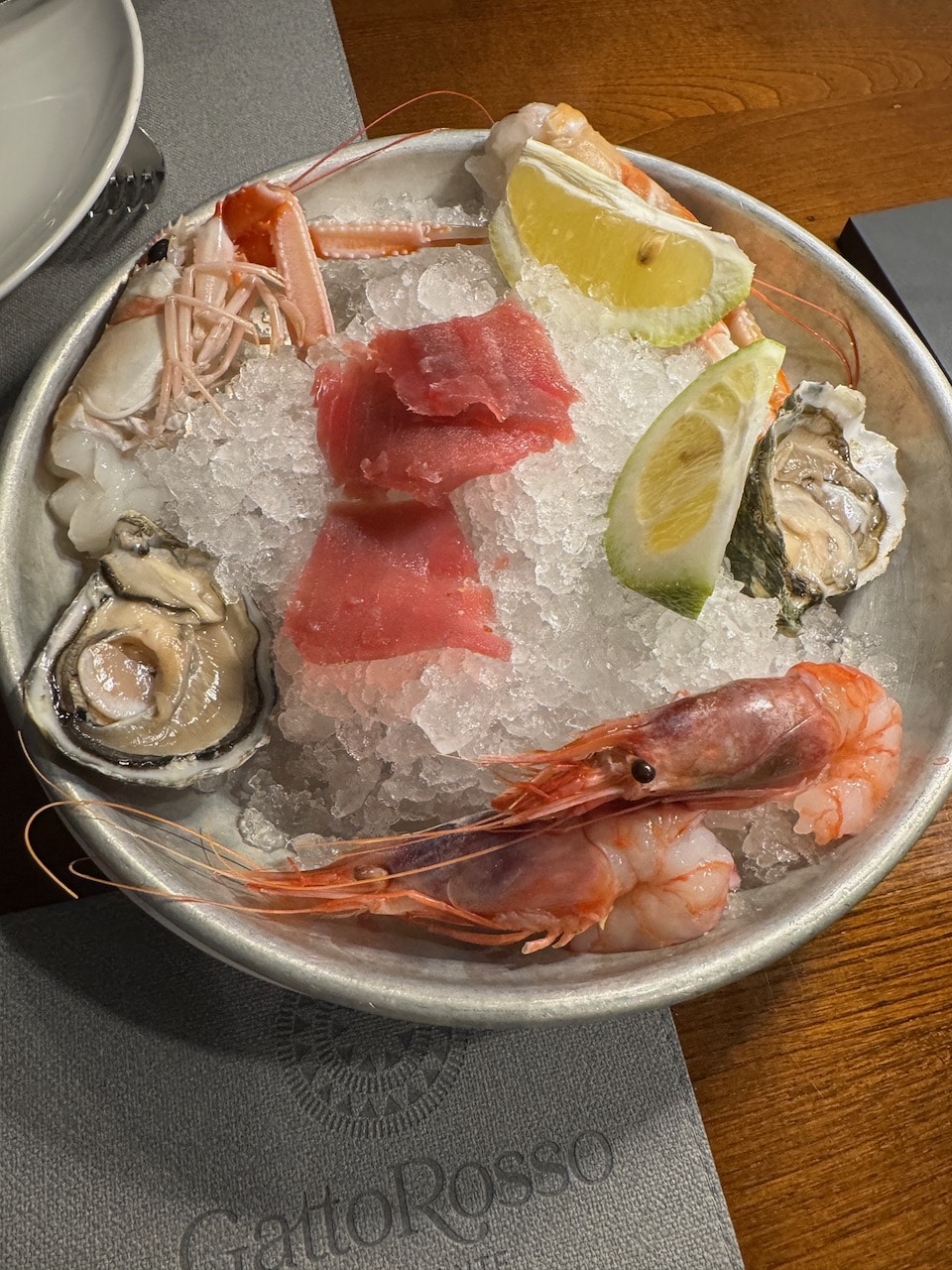
Gatto Rosso has a family history dating back to 1952 and a love story between a Tuscan chef, a young woman from Taranto, and her father who staked them in a restaurant called “The Cellar.” As it expanded and became Gatto Rosso, or the red cat, it developed a loyal following. Now Chef Agostino Bartoli specializes in seafood and we dove in beginning with a seafood platter.
Seafood Crudo at Gatto Rosso. Photo by ConsumerMojo.com
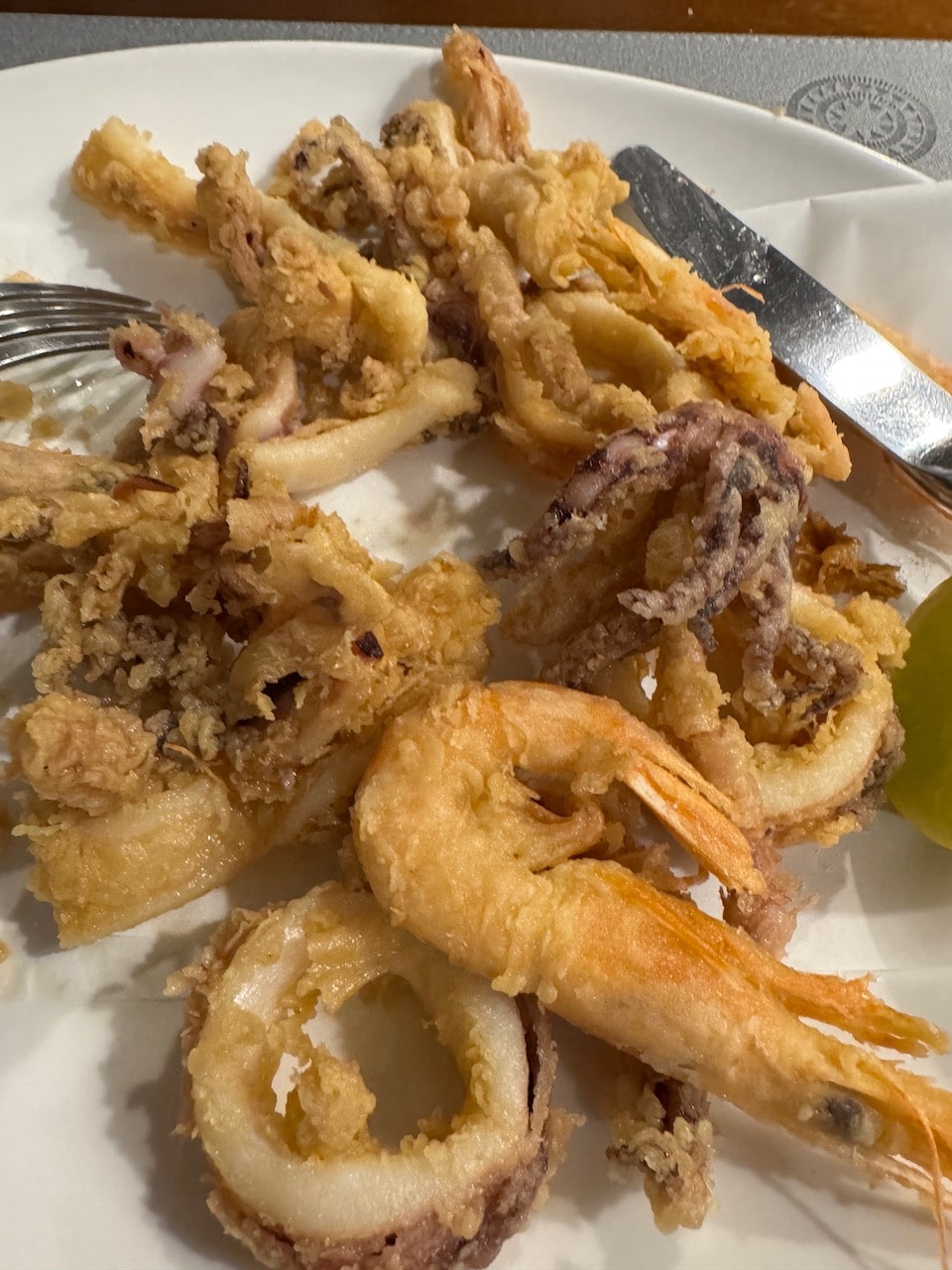
Because we are big frito misto fans, we tried it here.
In Italy with multi-courses, we usually split all of the dishes. That allows us to order starters and a primi course.
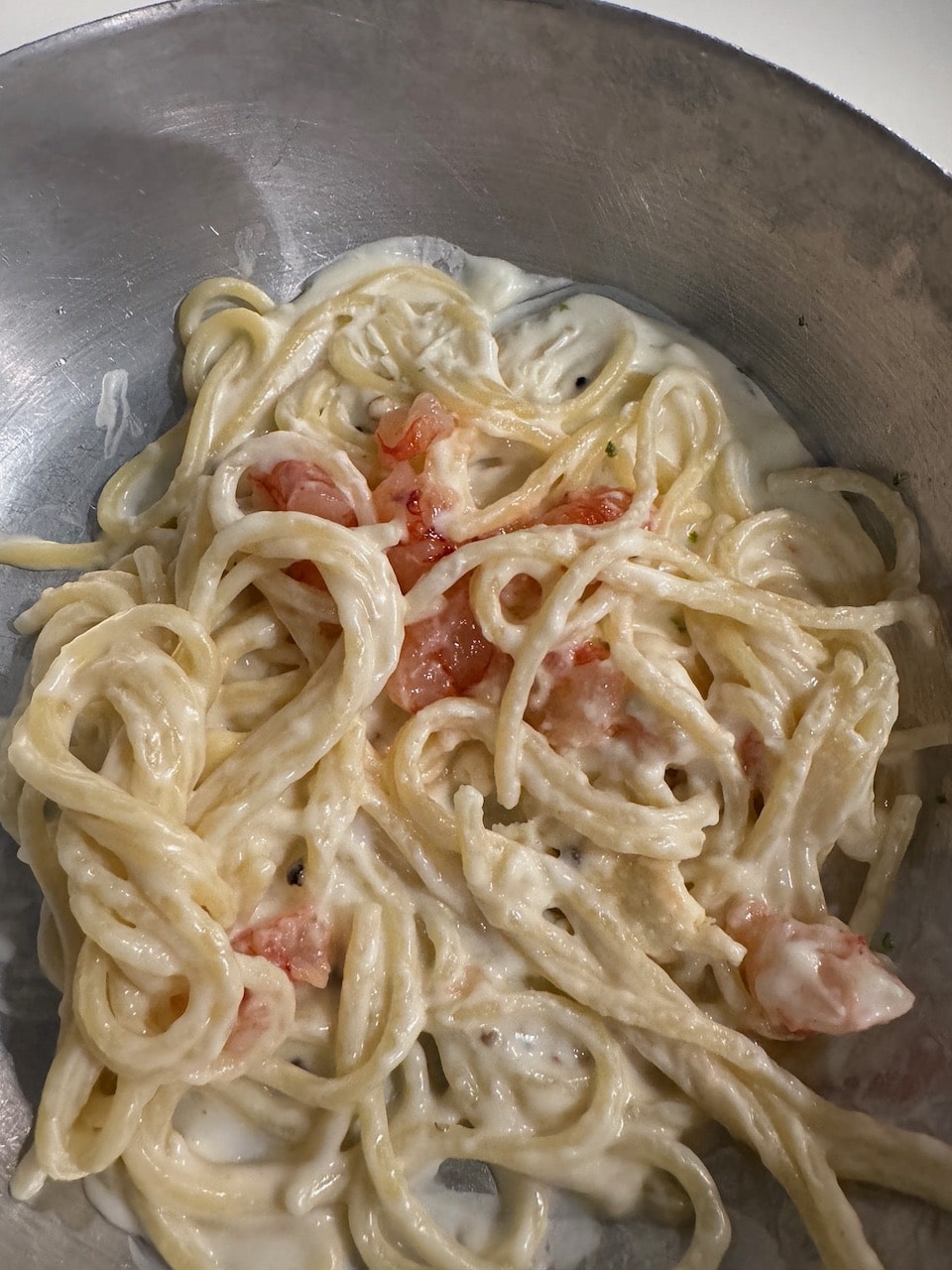
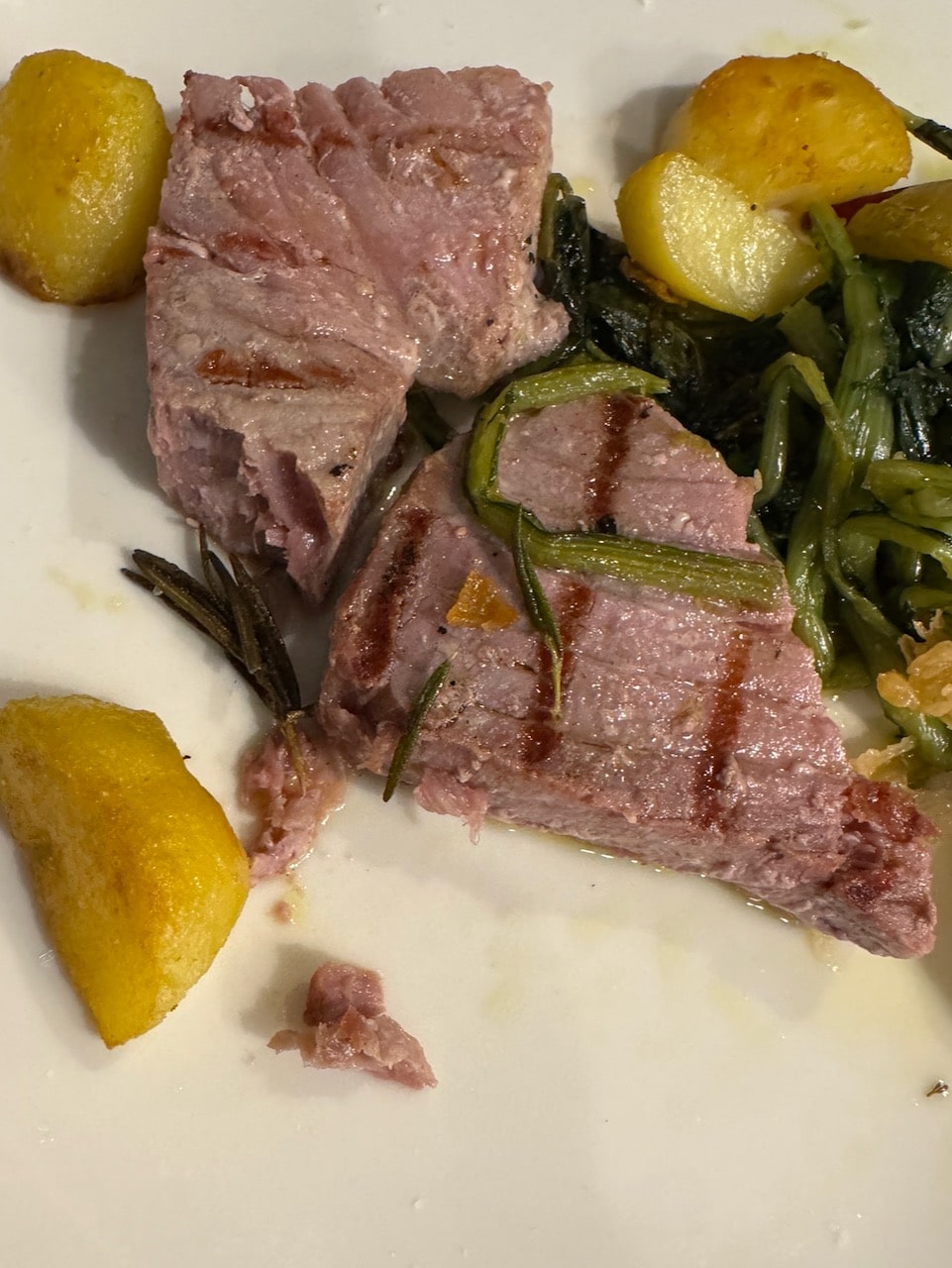
We loved the chef’s take on cacio e pepe made with red prawns and lime and we followed that with a main of tuna. It really was a lot of food!
Tuna at Gatto Rosso
The next day we walked along the seafront promenade which opens onto a tree-shaded pedestrian plaza. We enjoy learning about the history of the towns we visit and always try to explore the local museums. Scanning our options in Taranto, we had seen that it’s home to Italy’s National Archeological Museum, and it’s a great reason to visit Taranto and make it a destination.
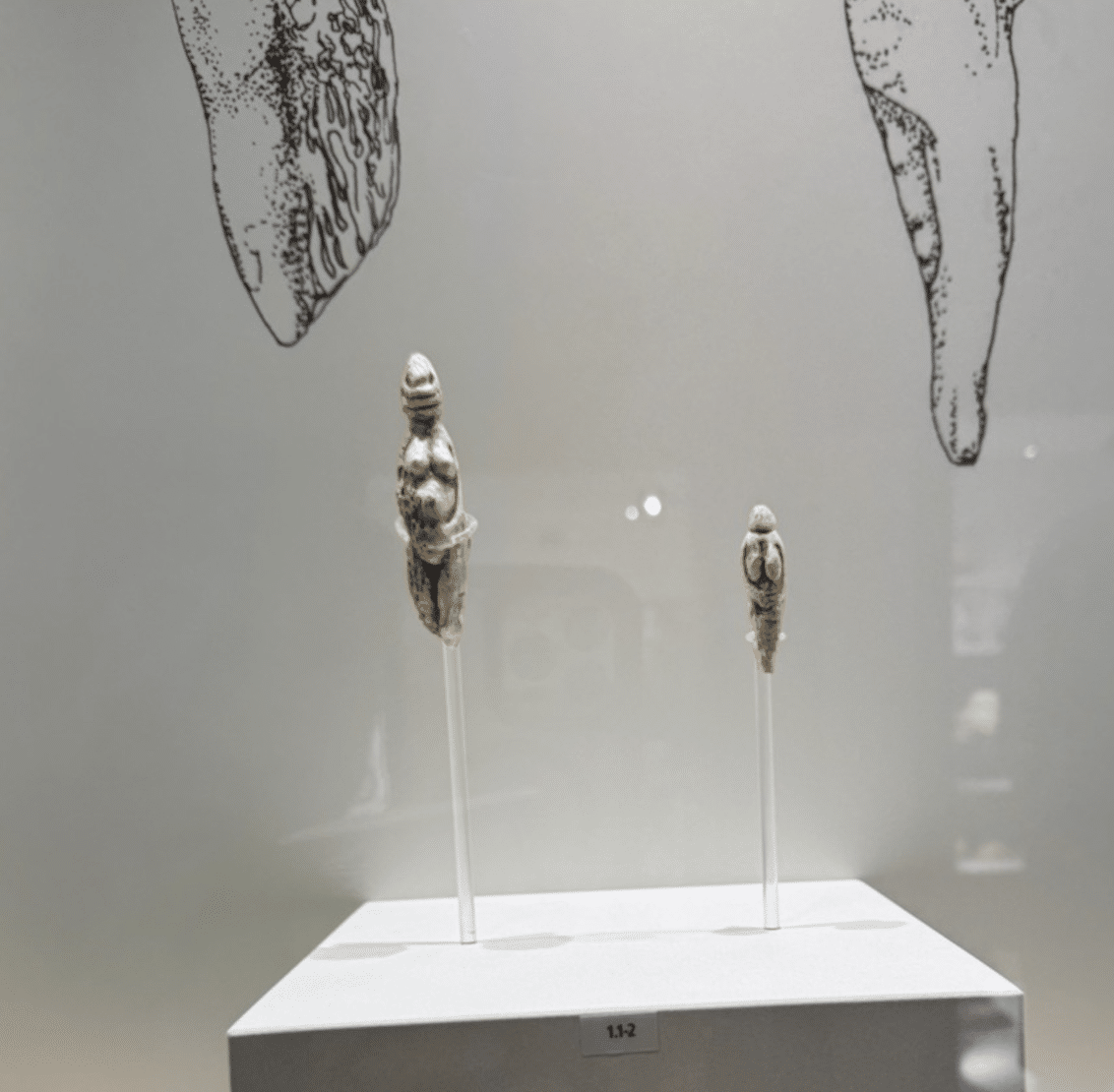
Founded in 1887 in a former convent on Via Cavour, it’s one of Italy’s most important museums yet it’s small and intimate. Curators have thoughtfully and artfully arranged the collection that includes artifacts from the Paleolithic era when people began using stone tools. These tiny female figures below were found in a cave with over 400 artifacts of stone and bone fragments.
Paleolithic female figurines made from a bone splinter of an ox or horse. Photo by ConsumerMojo.com
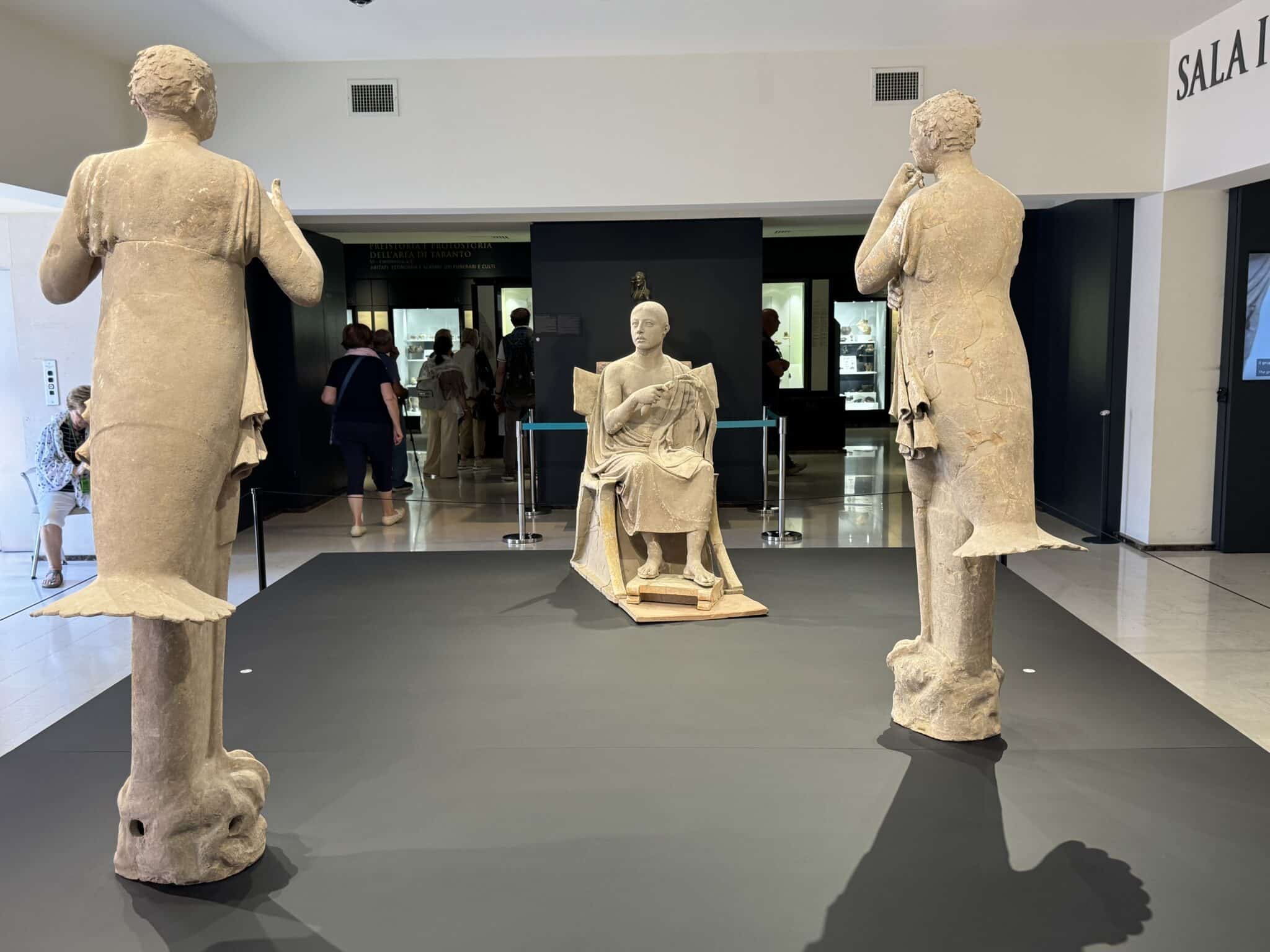
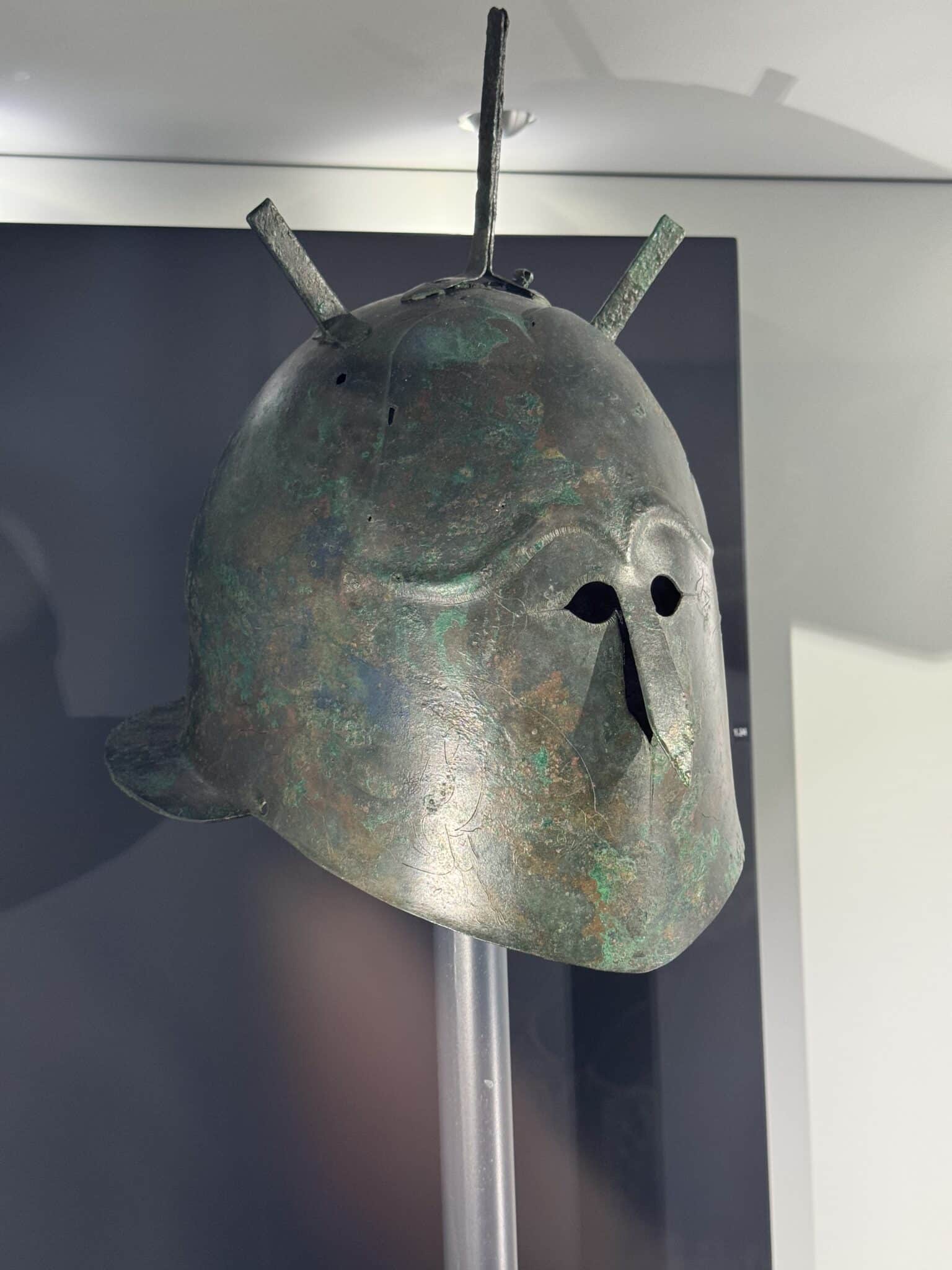
Other work dates to the Bronze and Iron ages and many are from the period when the Dorians from Sparta settled the area. The grouping of sculptures of seated Orpheus and the Sirens from the 4th century BCE commands attention and invites you into the story.
Orpheus and the Sirens. Photo by ConsumerMojo.com.
The sirens were legendary island temptresses who sang songs so beautifully that passing sailors couldn’t resist them and jumped into the water to their deaths.
Read the story below about how the Sirens were found. Photo by ConsumerMojo.com
Legend has it that Jason and the men aboard the Argo, searching for the golden fleece, sailed within earshot of the sirens’ island but luckily they had Orpheus aboard.
He began to sing and strum his lyre and his music drowned out the sirens, letting Jason and the Argonauts continue on their quest and avoid fatal temptation.
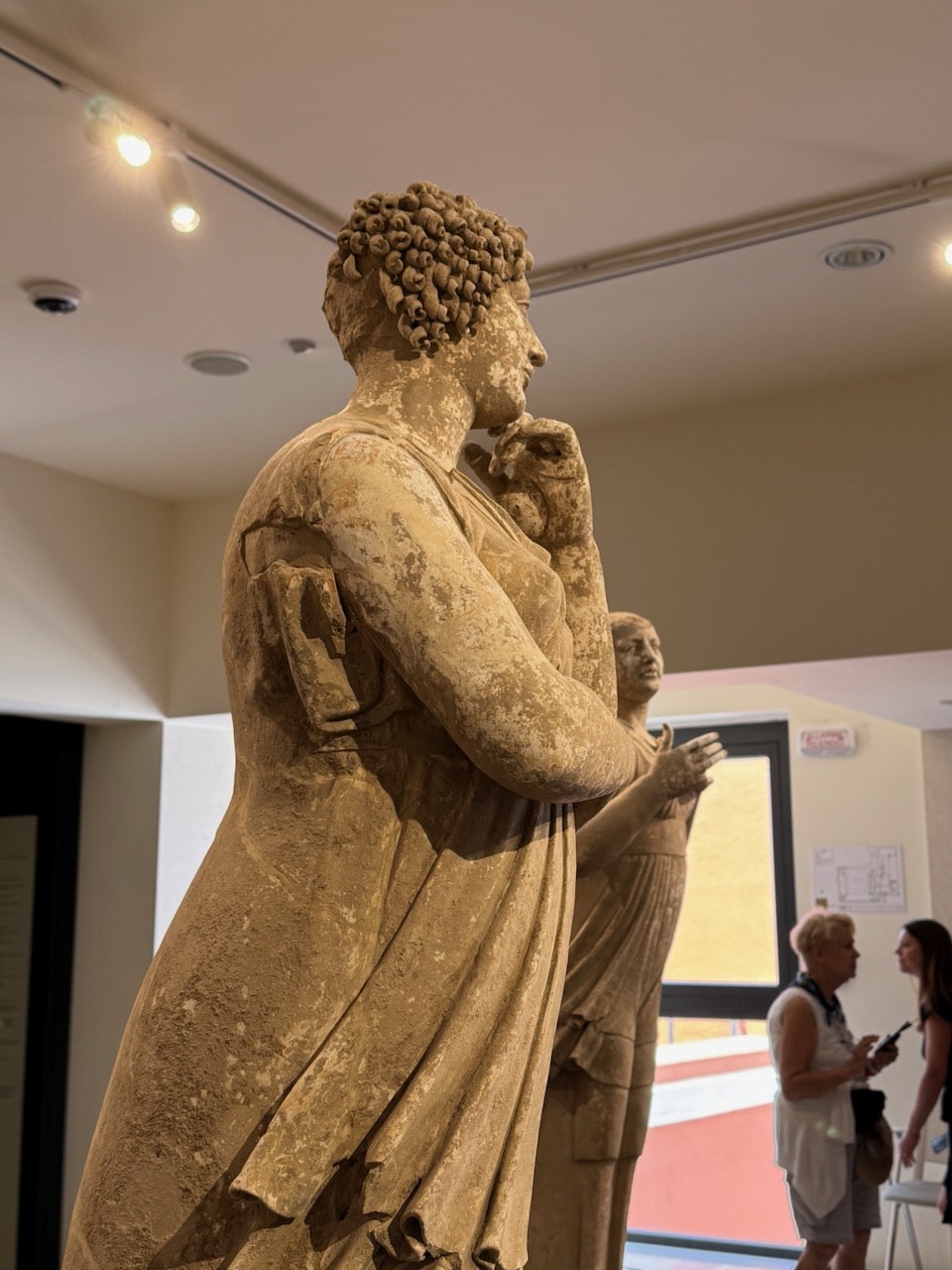
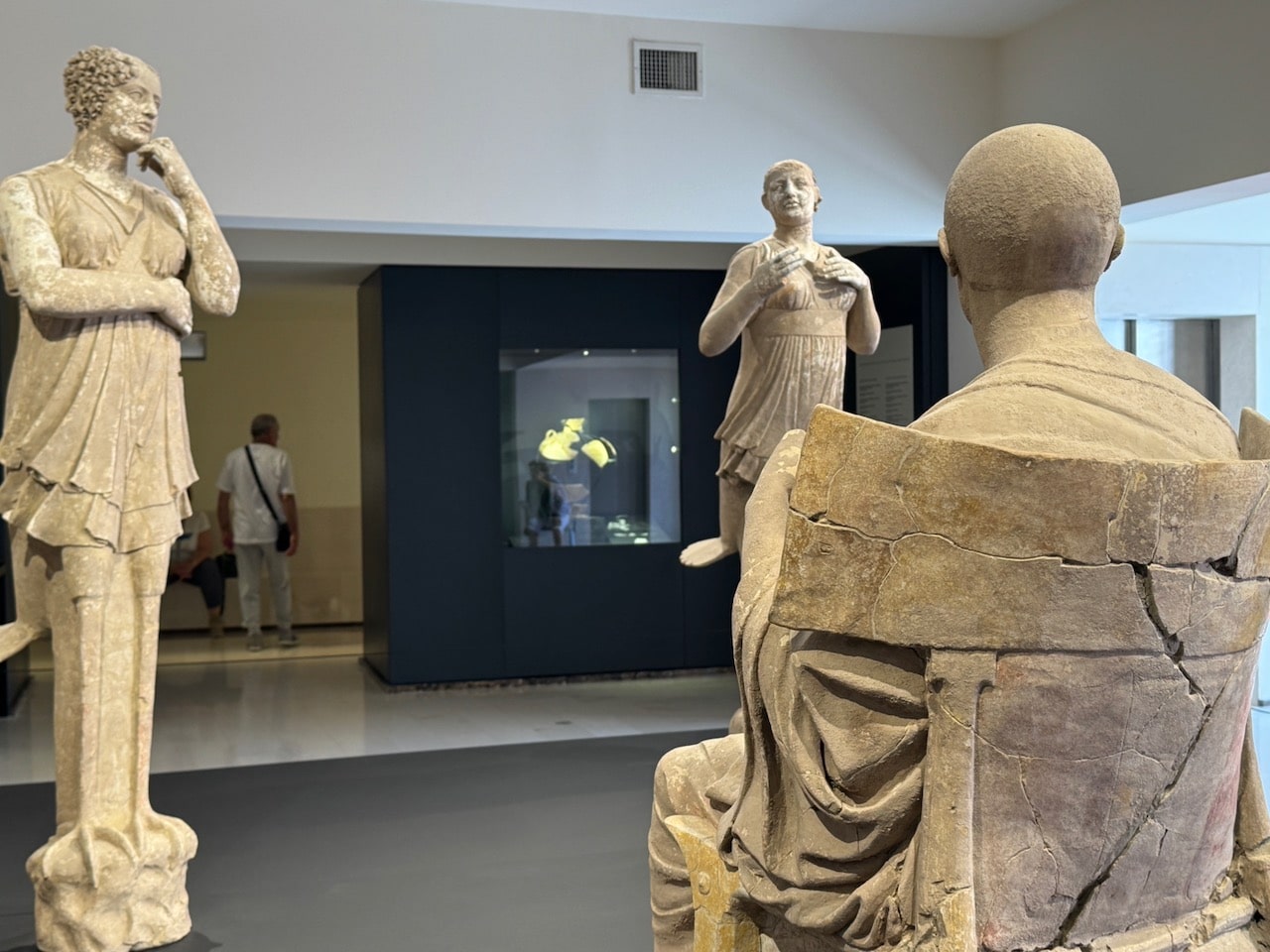
Sirens tempting Orpheus. Taranto Archeological Museum. Photo by ConsumerMojo.Com
The terracotta figures themselves endured a journey at least as harrowing as Jason and his crew. They were looted by tomb robbers in the Taranto area in the early 1970s and surfaced at the J. Paul Getty Museum in Los Angeles. It took the sharp eye and historical knowledge of Assistant District Attorney Matthew Bogdanos, Chief of the Antiquities Trafficking Unit, to trace the theft.
His investigation found that known Italian art traffickers bought the Poet and Sirens days after the sculptures were stolen by locals from a tomb near Taranto. The sculptures were in pieces and the traffickers smuggled them into Switzerland, paid to have them restored and ultimately put them up for sale through a Swiss art dealer.
In 2022 the statues were on display in Los Angeles when Italy’s carabinieri art theft division provided proof provided by Bogdanos and his team that they’d been looted, and the museum agreed to return them. The statues were returned to Rome, first, for a formal ceremony that honored the investigators and then traveled back to Taranto.
But while Orpheus and the Sirens are the center piece of the collection there is so much more to see. What you see, and the wonderful descriptions fuel the imagination and fill in pieces of history.
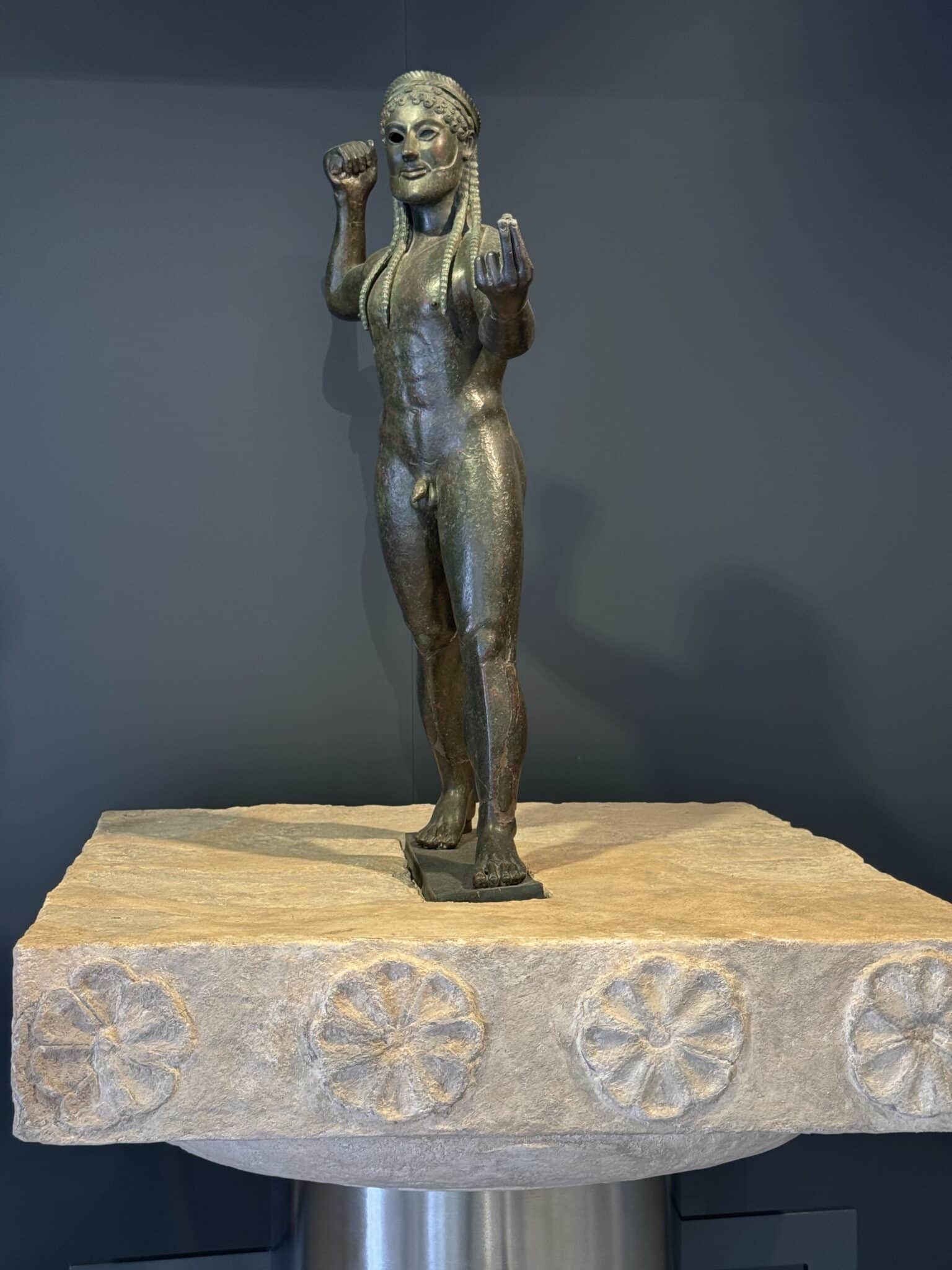
Zeus of Ugento. Photo by ConsumerMojo.com.
This bronze statue is the Zeus of Ugento, depicting Zeus ready to hurl a (missing) lightning bolt, and it dates to 530 BCE. It was discovered in 1961 by workmen on a private home construction project, who found it in a hole covered by the stone tablet on which it’s now displayed.
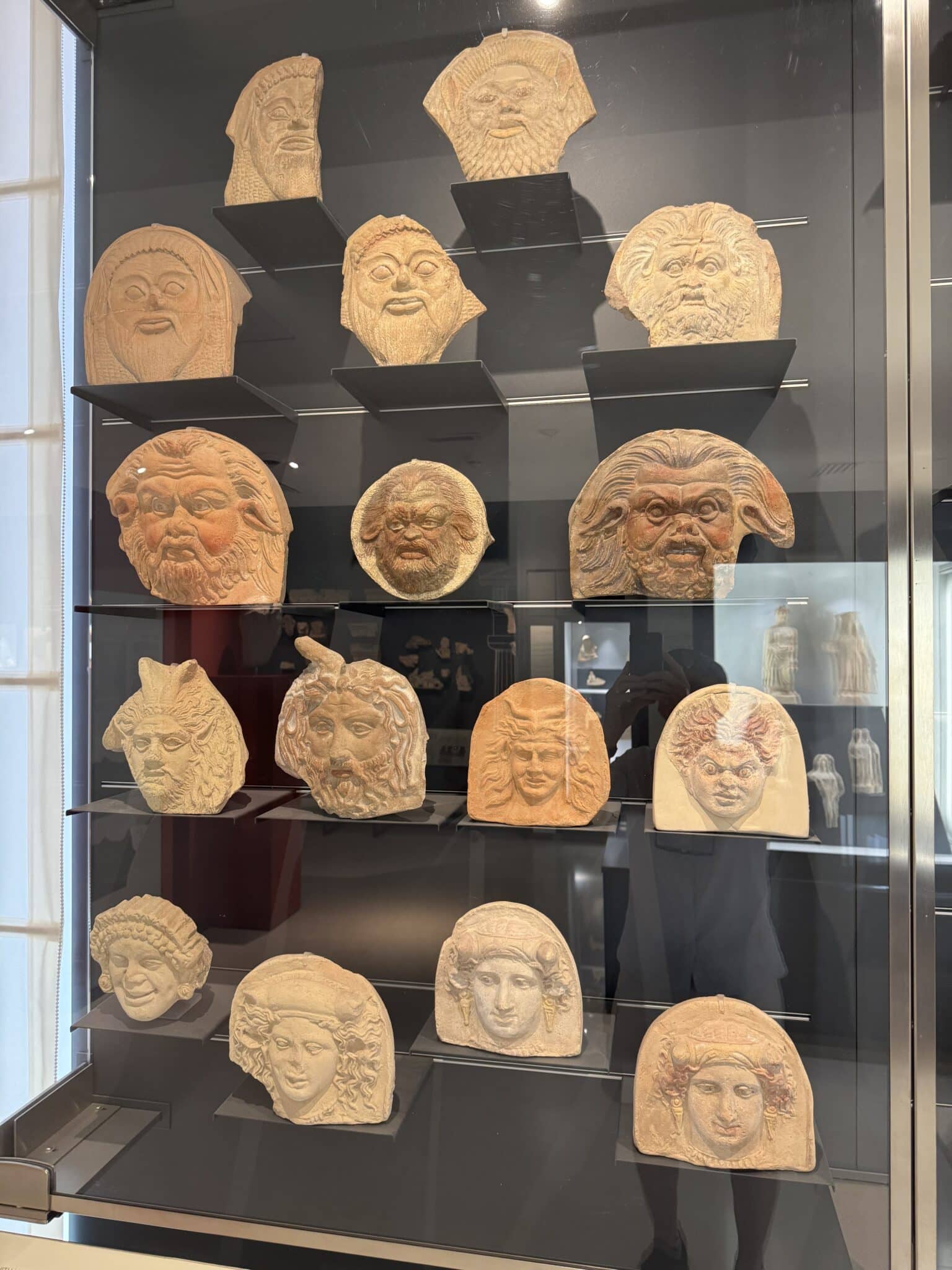
Depictions of Pan, the flute-playing god of nature, have evolved over the years from the half-man, half-goat original. The Taranto museum groups a display of Pan’s changing face, as if he discovered barbers and shaving and even waxing as he aged.
Depictions of the god Pan. Photo by ConsumerMojo.com.
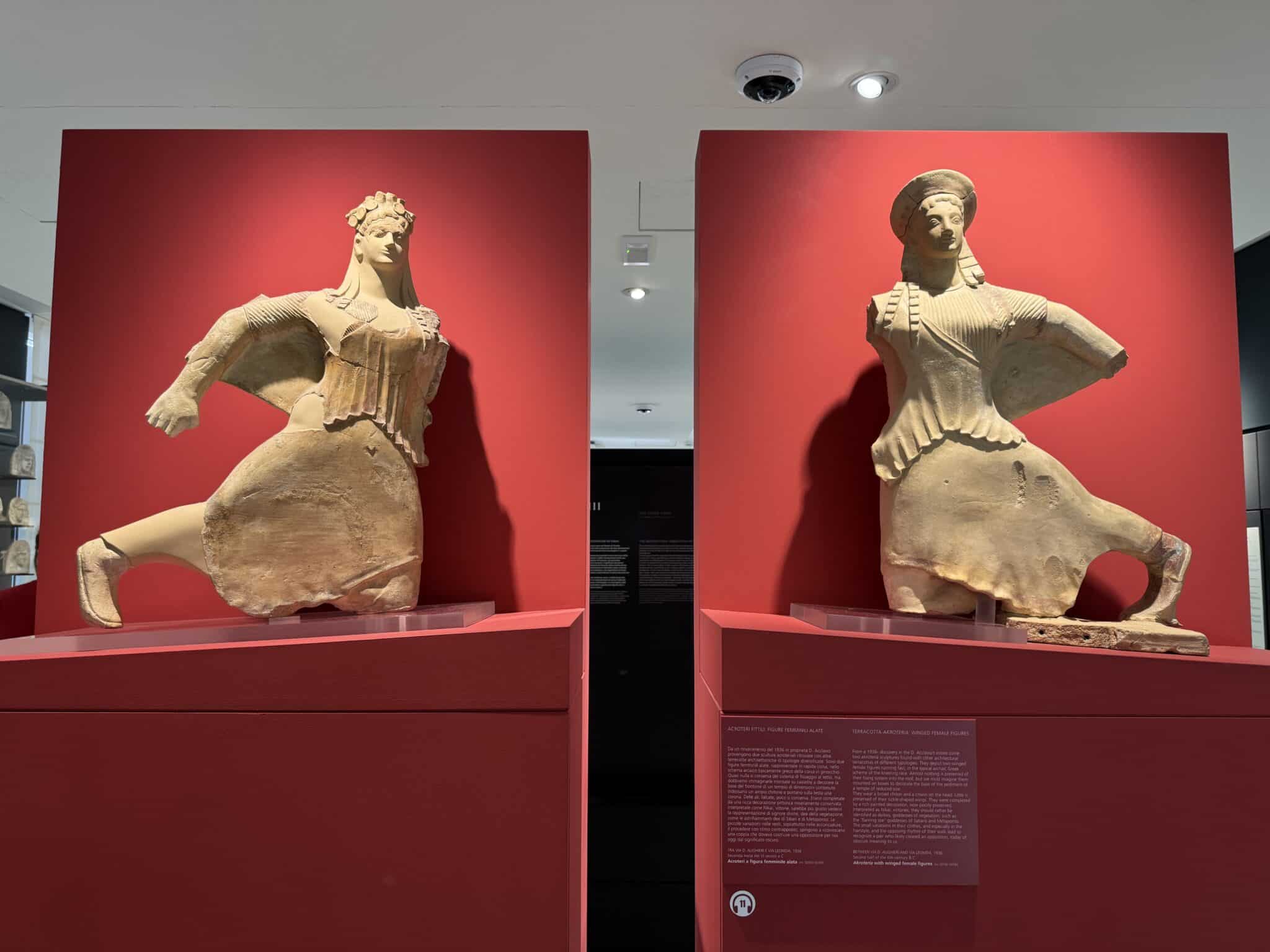
These terracotta figures are akroteria, meaning they once crowned the high points atop temples and other public buildings. These two have wings, and they seem to be running and kneeling at the same time. They date to the 6th century BCE and were discovered in 1936.
Winged female figures discovered in 1936. Photo by ConsumerMojo.com.
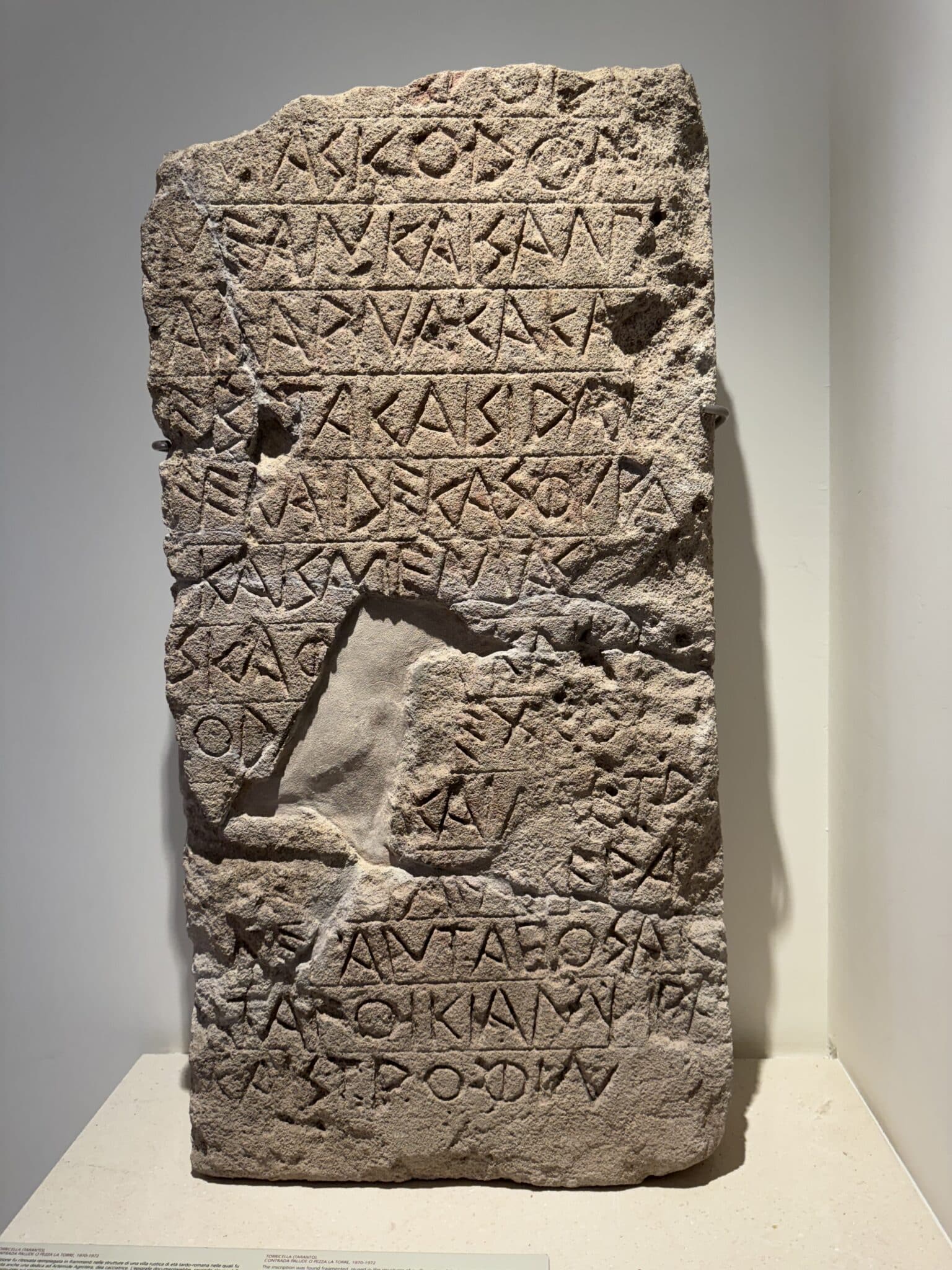
This sandstone slab from the 6th century BCE describes in Greek an offering to the hunting goddess Artemis of tools and weapons and “all the terracotta furnishings needed in a household and a bandage.”
A tablet inscribed with Greek letters describing goods consecrated to the hunting goddess Artemis.. Photo by ConsumerMojo.com
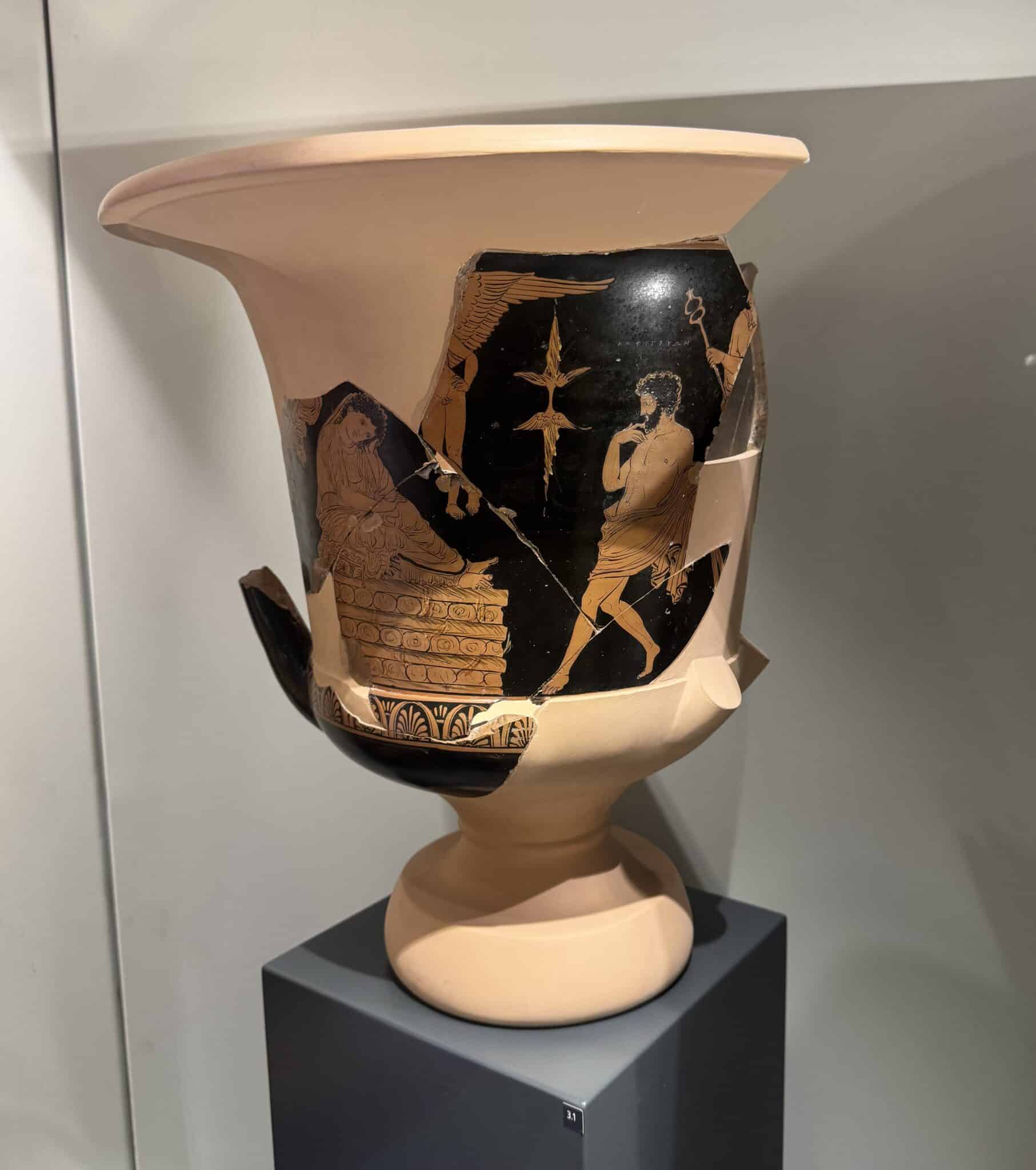
Even the shards of a Greek vase tell an archeological story. This one, from around 400 BCE, illustrates a Greek myth that sounds snatched from a divorce court of the time. Amphitryon, Alcmene’s husband, went on an expedition and, apparently forgetting that Zeus was a serial rapist, left her in Zeus’s care. He returned to learn that Zeus had slept with her but she hadn’t known it was Zeus because he had taken Amphitryon’s form to do so. Amphitryon put her on a funeral pyre and lit it to see if she was telling the truth. The flames were rising when Zeus brought down rain to put the fire out, leaving her husband to conclude that her story was true and she was innocent.
Shards of a Greek vase tells a story of faith and suspicion. Photo by ConsumerMojo.com.
We didn’t find out what this mask is, we just liked it. If anyone who sees it has a clue, please let us know. Thanks in advance.
An interesting mask. That’s all we know. Photo by ConsumerMojo.com.
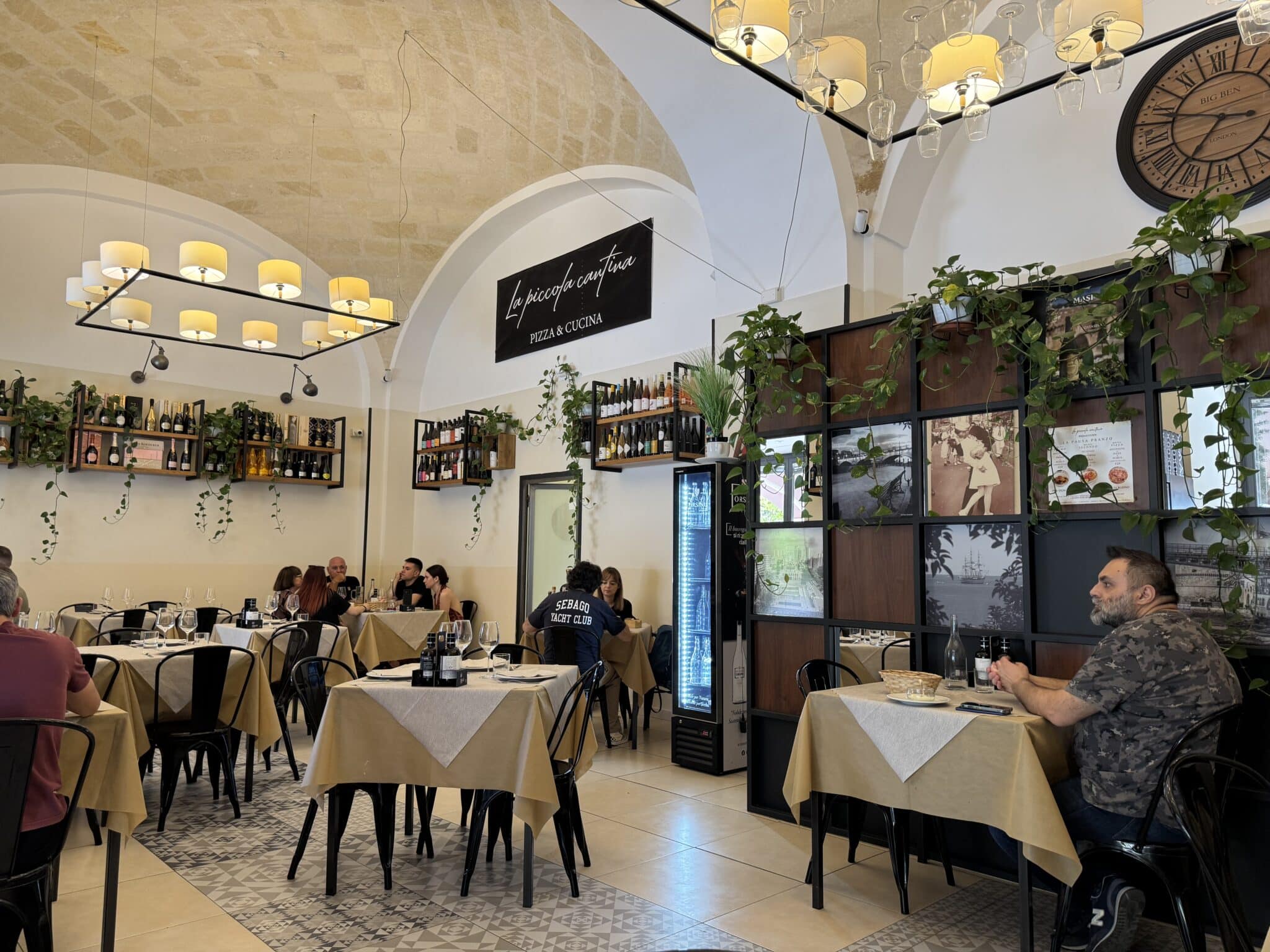
This guy seemed to tell us it was time for lunch, so we found a nearby restaurant/pizzeria.
Pizza/Cucina in Taranto.
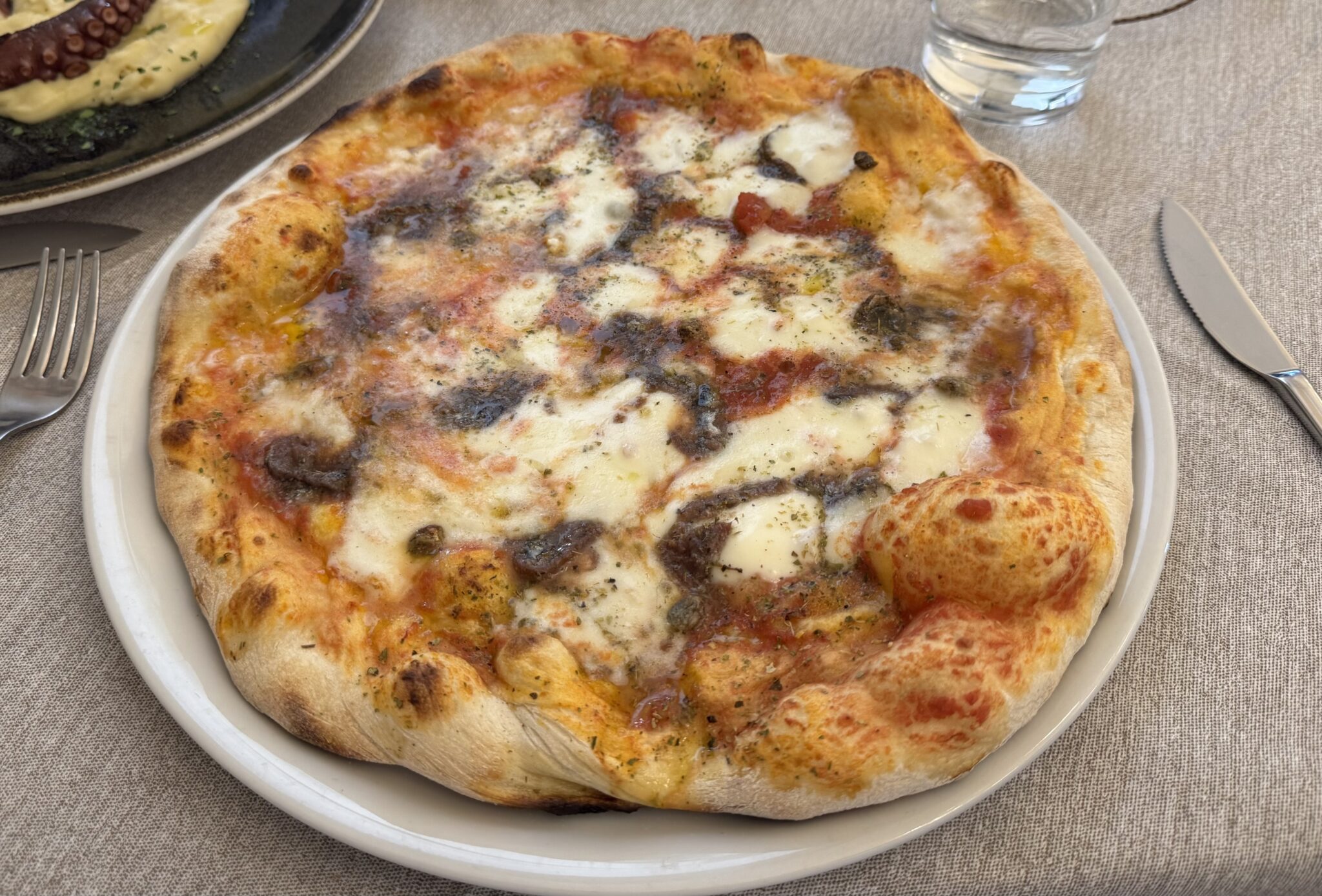
In this simple place, the food was excellent
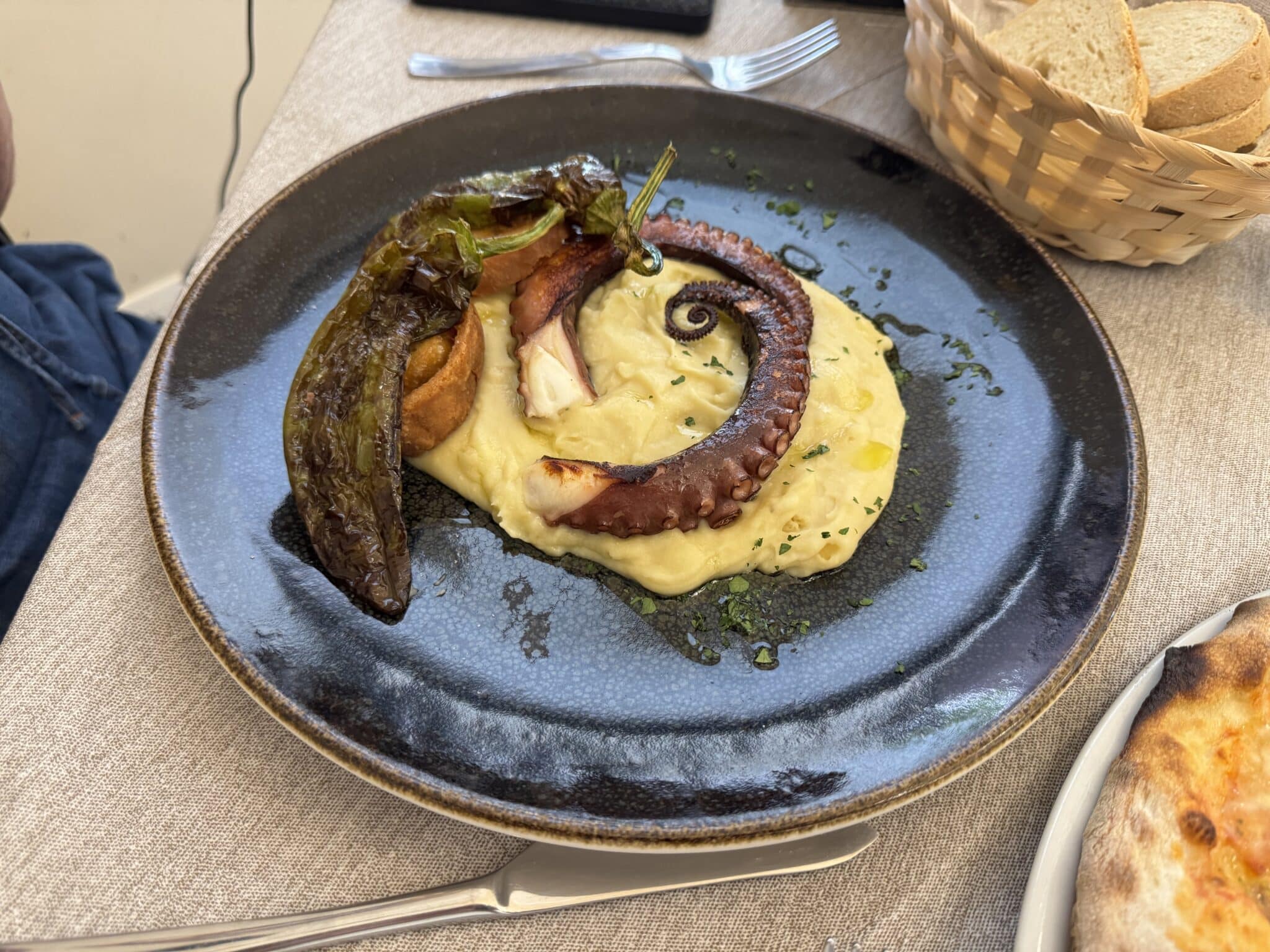
Good pizza in Taranto.Barbara’s octopus.
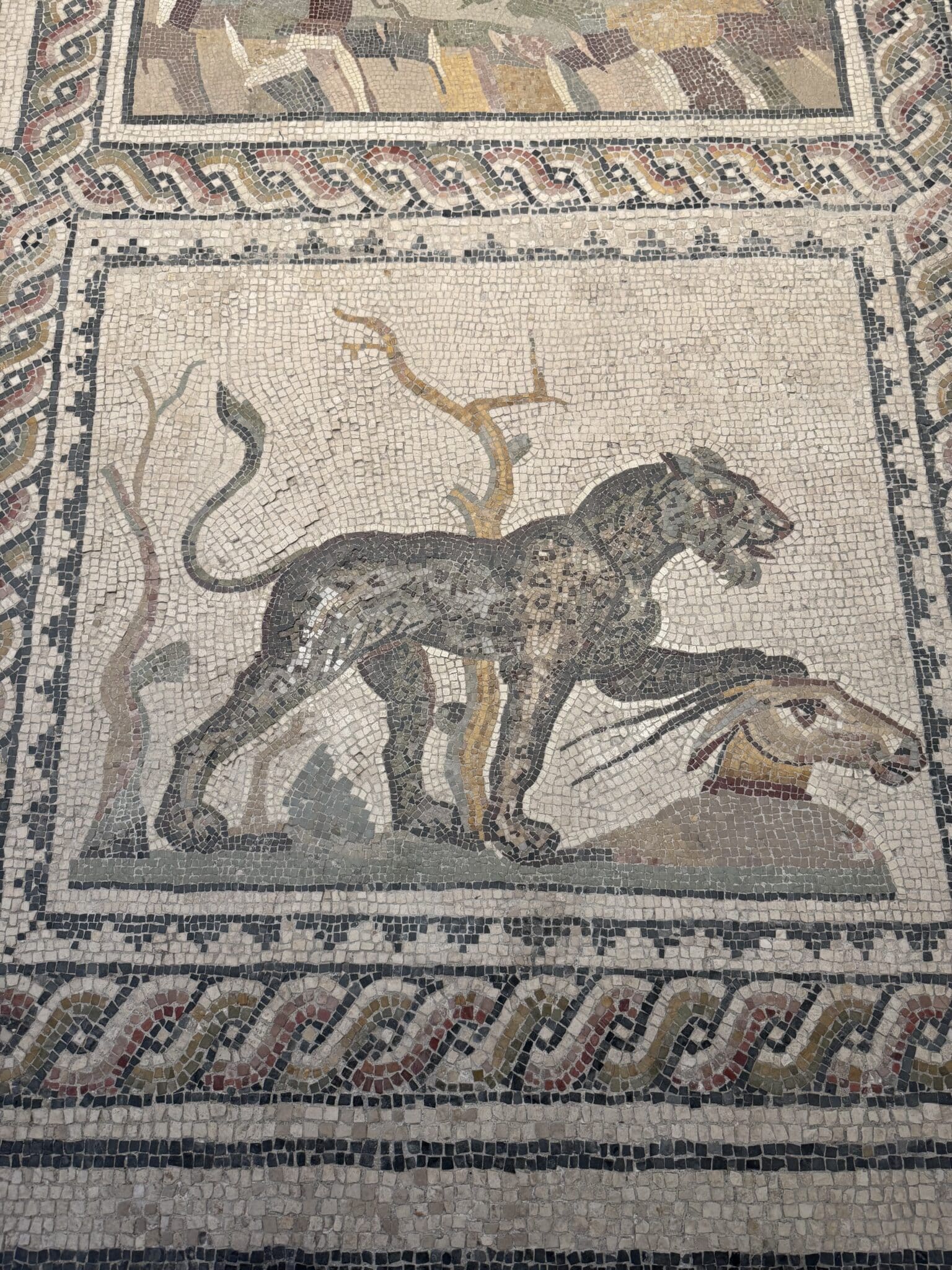
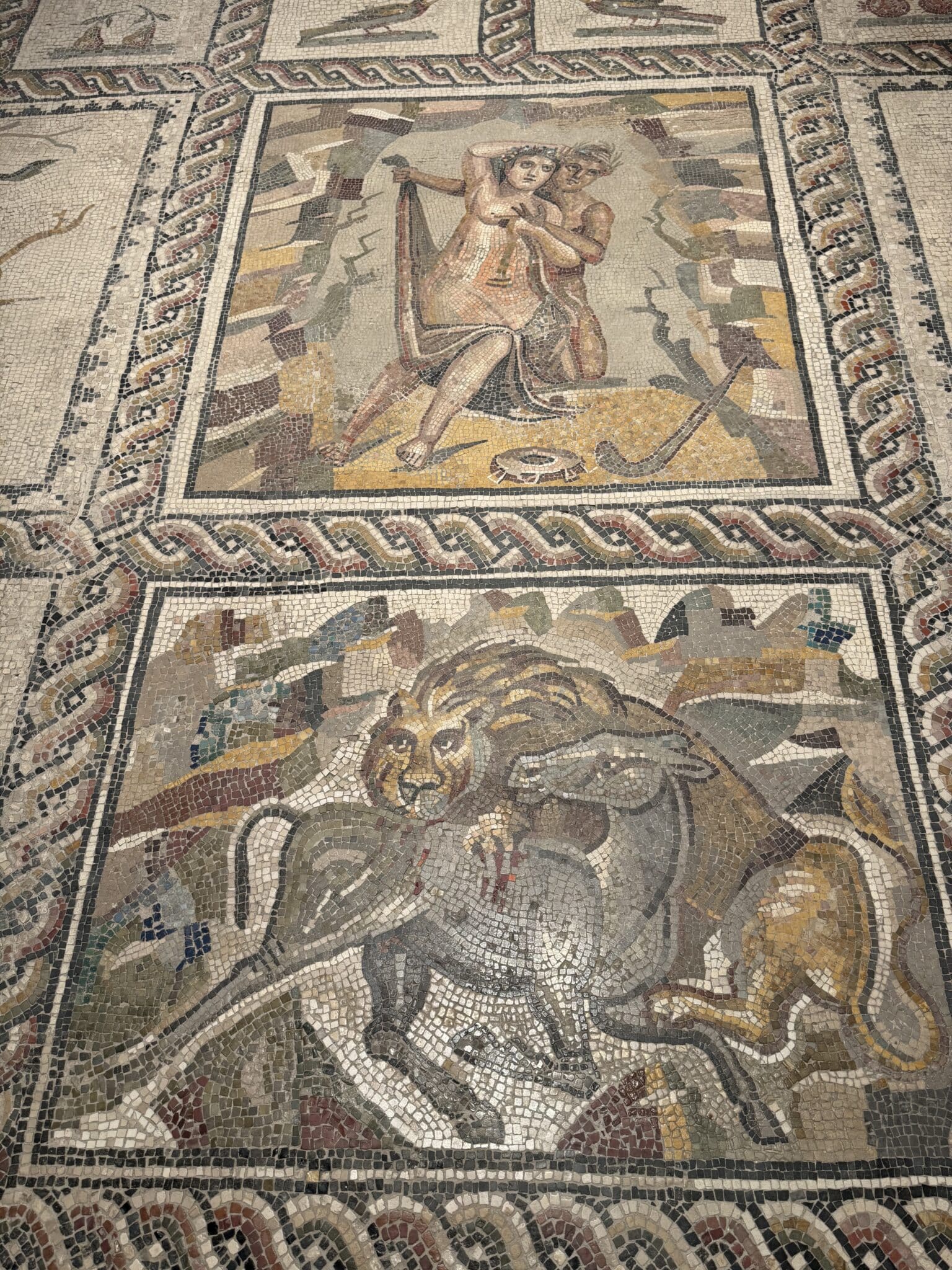
After lunch we went right back to the archeological museum to see some more of its treasures. Traveling around the Mediterranean, we discovered the beauty of ancient mosaics. When we asked about mosaics here, one of the security guards led us enthusiastically around the expansive collection.
Mosaic leopard.This mosaic seems to picture two attacks, one human and one animal..
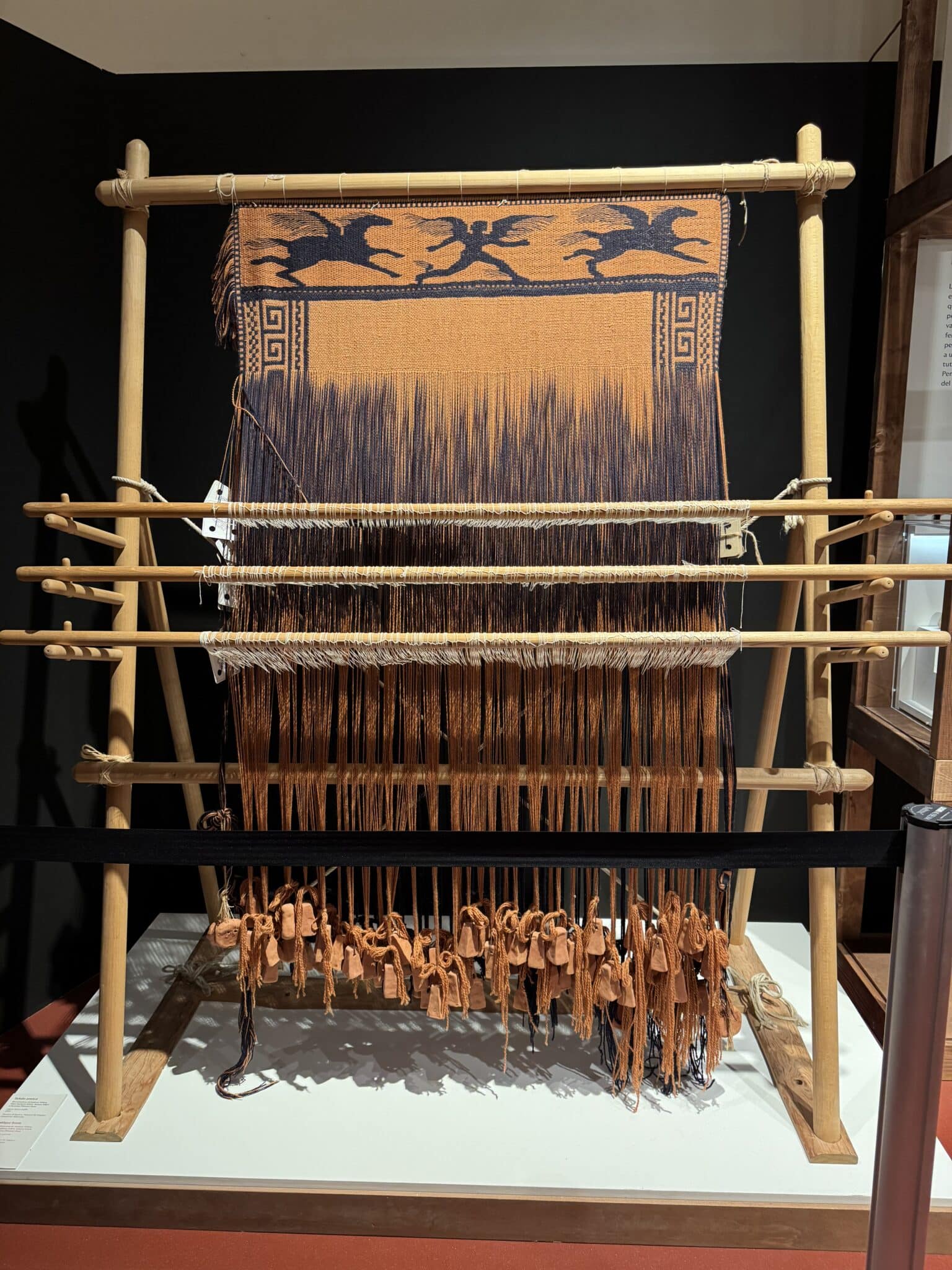
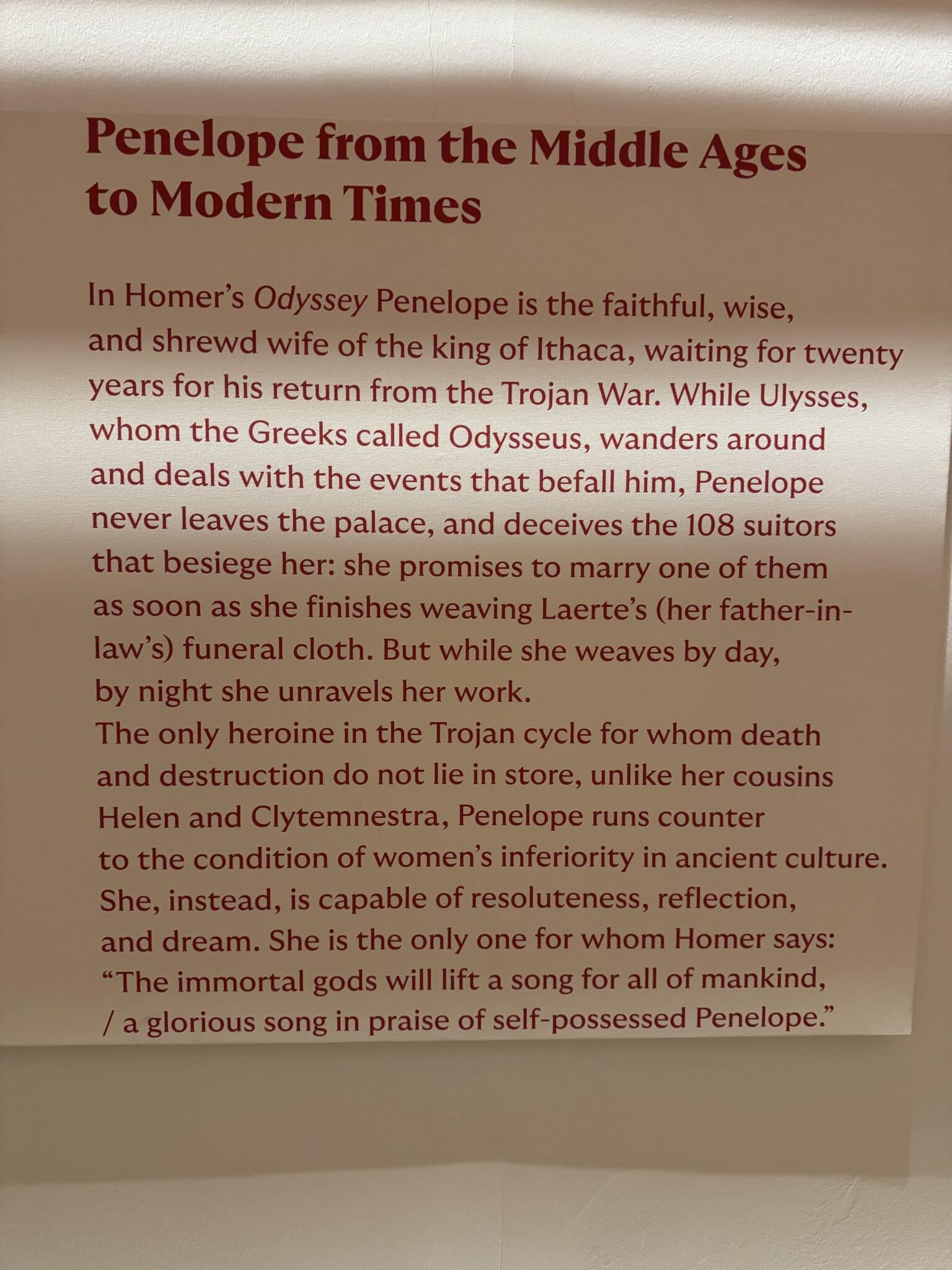
Just as we were about to leave, we notice an exhibit dedicated to Penelope and the craft or art of weaving. The loom and her weaving is central to the legend of Penelope as she waits for her husband Odysseus to return from the Trojan war.
Penelope’s loom.
Penelope, according to the text here, was stubborn, single-minded and cunning.
The legend of Penelope.
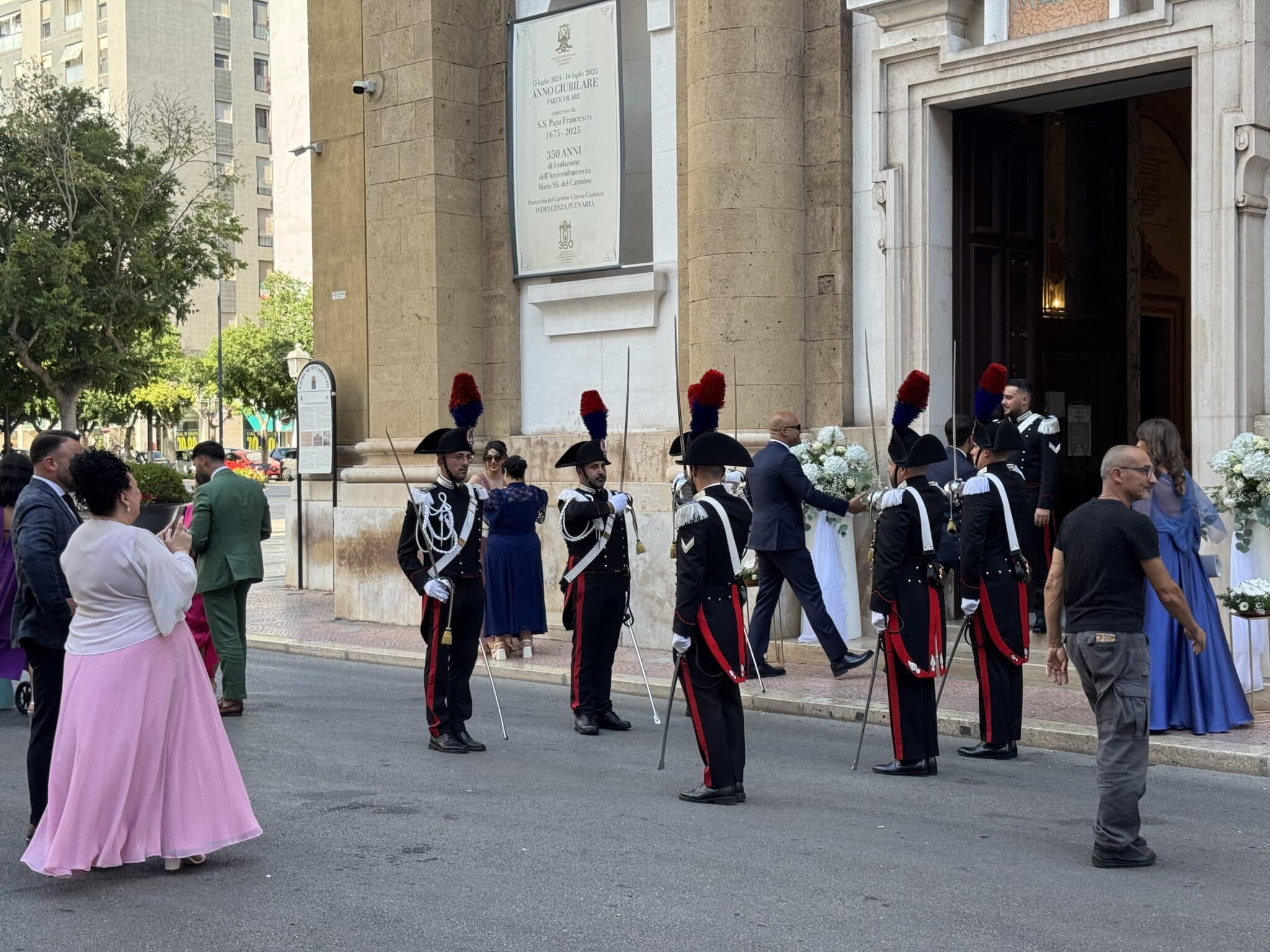
When we finally tore ourselves away from the archeological museum, we wandered near the central part of Taranto and almost joined a wedding party.
A wedding in Taranto?
Back at our hotel, we heard the sounds of the Medimex International Music Festival & Music Conference wafting over the Ionian shoreline. We had tried to get tickets, but it was sold out. And so we satisfied ourselves with listening in.
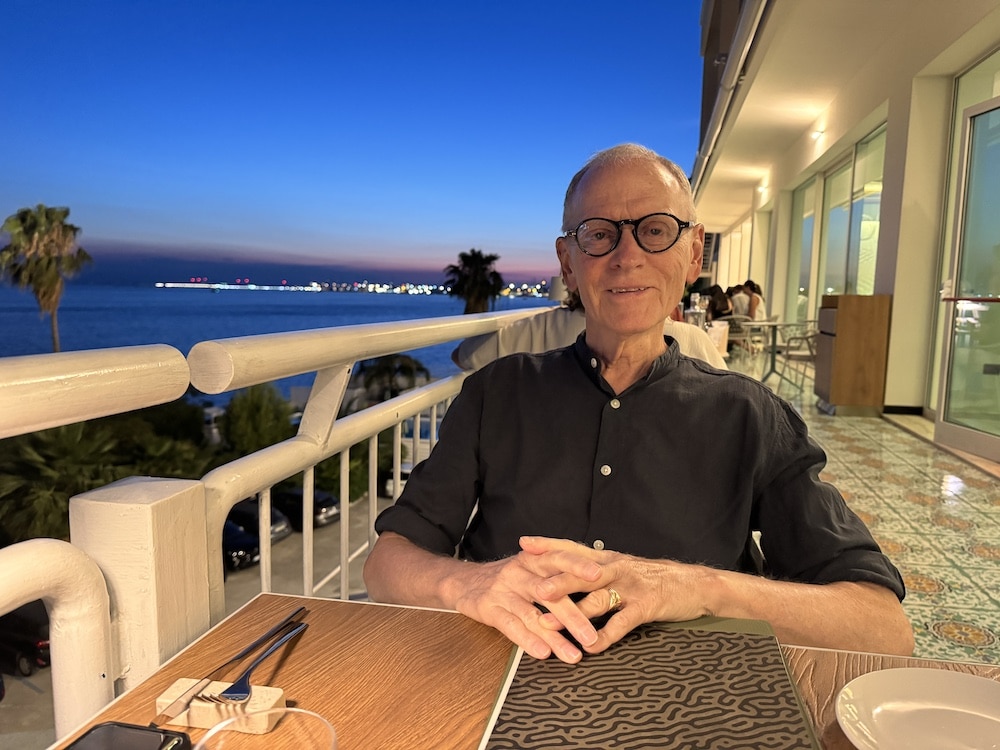
We ate dinner on the terrace of the Delfino’s excellent restaurant,
Nick Taylor on the terrace of the Delfino Hotel. Photo by ConsumerMojo.com
with the concert music in the background, and had one of the best meals of our trip.
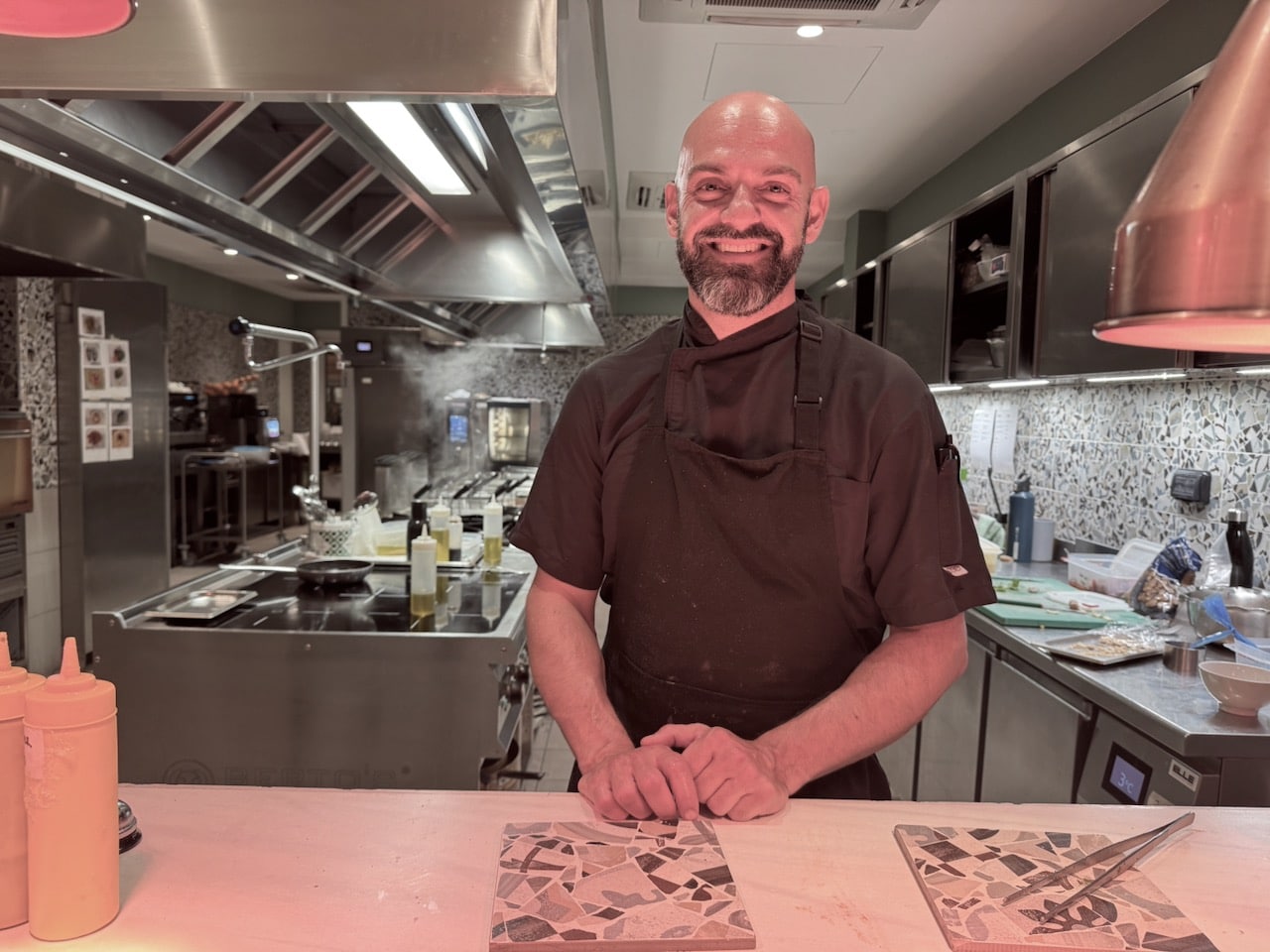
Roberto Chyurlia chef at Delfino Hotel, Taranto. Photo by ConsumerMojo.com
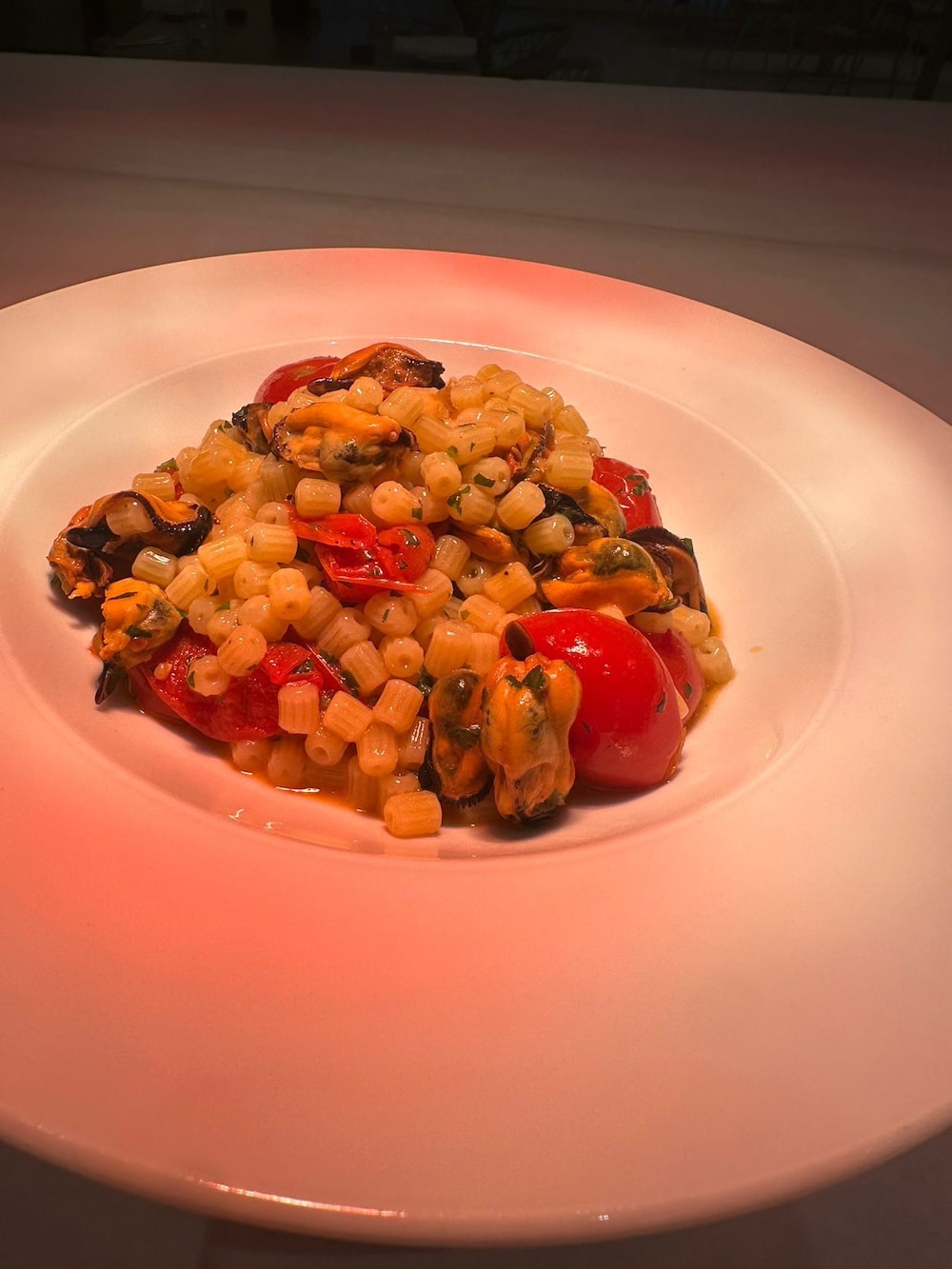
The chef Roberto Chyurlia expertly turns out beautifully prepared pasta and fish, and we noticed at nearby tables that people were enjoying entrecote and beef tenderloin. But for us grilled fish, and the very simple, but special Cozze e Tubetti with roasted cherry tomatoes was the centerpiece.
Sure it’s off the proverbial beaten track, but Taranto is definitely a town we would visit again.
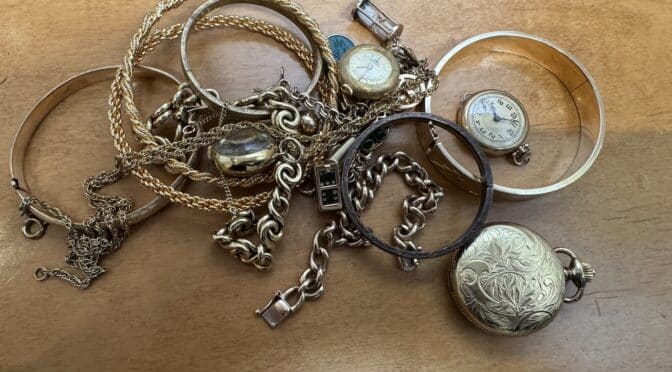
Gold prices rose to a record high of $4,300 per troy ounce on October 17. Sure there was a sell-off in gold and prices may fluctuate. But if you are considering selling gold jewelry that you don’t wear or may have inherited, we have tips from an expert.
York Diamond District jeweler Stephen Herdemian sells and collects antique jewelry. As a collector, he understands that it’s hard to give up some things. Steve tells ConsumerMojo that scraps in our jewelry boxes, broken bits of chain and things we don’t wear can bring us cash.
We made the video some time ago. But what Steve told us then is still valuable. It’s worth it to watch the video. But his big tips include:
Learn about what you have:
It’s always a good idea to know something about what you’re selling. Here are a few explanations and questions to ask. The list is provided by the Jeweler’s Vigilance Committee, an industry watchdog:
Precious Metal
Platinum
Items containing 950 parts per thousand (95%) may be marked as platinum.
Items that are 85% or 95% platinum must be marked with the platinum content. Examples: 900Pt, 850Pt.
Items containing less than 85% platinum must detail the platinum group metal. Example: 750Pt200Irid. Total parts must equal 950 (95%). Note: Platinum group metals are: Platinum, Palladium, Rhodium, Iridium, Ruthenium and Osmium.Gold
10 karat gold is the minimum fineness of gold that may be sold in the U.S. Jewelry under 10kt fineness may not be sold as gold.
Jewelry is made of many different types of gold: solid gold, gold plate, gold filled, gold overlay, gold electroplate, gold flashed/washed or rolled gold plated.Silver
Silver/Sterling Silver means that 925 parts per thousand (or 92.5%) of the item is made of pure silver.
Silver plate describes a product made of base metal and layered (or plated) with silver.
Silver coins contain 900 parts per thousand (or 90%) pure silver.
Diamonds
The Four C’s are the criteria used to value a diamond. Carat weight, color, clarity and cut (cut refers to the quality of cut, not the shape).
Ask if the diamond(s) have been treated in any way (i.e. fracture-filled, laser drilled) and whether or not the treatment is permanent.
Colored Gemstones
Is the gemstone natural, lab created or an imitation?
Has this gemstone been treated? If so, how?
If treated, is the treatment permanent and has the treatment affected the gemstone’s value?
What is the country of origin of the gemstone?
Pearls
Are the pearl(s) natural or cultured?
Has the pearl been dyed to enhance or change its color?
If the pearl is dyed, is the treatment permanent? Did this affect the value?
Thousands, young, old and in-between flooded the Times Square area in Midtown Manhattan for the No Kings protest. “Donald Trump has got to go,” and “Trump must go now,” they chanted as they stood in Duffy Square waiting for the march down Seventh Avenue to begin. When they got moving, they were shoulder to shoulder slow walking their way south. One woman who gave her first name as Deborah said,” “Probably this is the most important thing I’ve ever done. It’s a turning point.”
No Kings protestors were young and old. Photo by ConsumerMojo.com
They carried signs that displayed their concern. “We have a constitution,” one woman’s poster said, and the reverse read, “Imagine All the People.” Others carried signs that spoke to the attack by the Trump administration on healthcare. “Save Medicare,” many said.
Another held a poster that read, “First they came for the media and then we don’t know what happened after that.”
The NYPD said that about 100,000 people protested throughout the city and organizers estimated that there were 2,500 protests across America.
We have this video that captures the spirit of what we saw, and we’ll continue to post videos and photos.
It could have been Bob Dylan’s big break. But the future Nobel laureate was caught in a cancelling controversy that six decades later sounds painfully familiar. It happened in the spring of 1963, four years before Jimmy Kimmel was born, when a major American television network feared the mere threat of retribution from a group of wealthy influencers said to hail from the lunatic fringe of American politics. And who espoused ideas that seemed far behind —and today, way ahead — of the times.
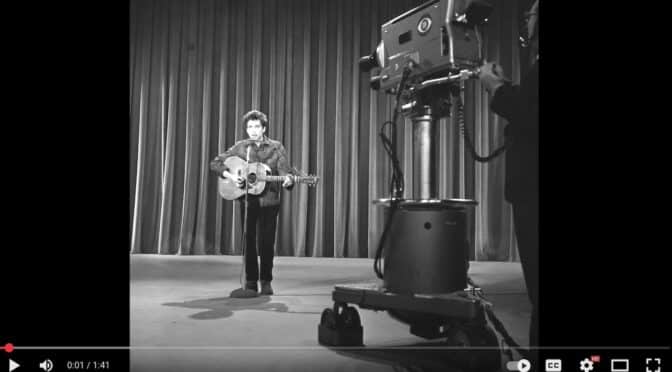
The then all-but utterly unknown 21-year-old Dylan was scheduled to sing a track from his upcoming album on The Ed Sullivan Show, the variety program that measured the audience for its Sunday night broadcasts in the tens of millions. Not bad for a folkie whose only previous album was a complete unheard bust. His new one, The Freewheelin’ Bob Dylan contained songs that were long-range career rocket fuel. But instead of performing since-enshrined masterworks like “Blowin’ in the Wind” or “A Hard Rain’s A-Gonna Fall,” Dylan chose a destined-to-be forgotten ditty titled “Talkin’ John Birch Paranoid Blues” that set CBS-TV network censors’ hair on fire.
As told in “How Many Roads: Bob Dylan and His Changing Times, 1961-1964,” a traveling exhibit on loan from the Bob Dylan Center archives in Tulsa and on view at NYU’s Gallatin Galleries at 1 Washington Place in Greenwich Village through October 15, Dylan showed up at dress rehearsal the day before the May 12, 1963 broadcast and warbled the satiric protest song mocking the John Birch Society.
Though just a decade past the Red Scare of the early 1950s, the rabidly anti-communist Birch Society espoused a conspiracy theory so all encompassing and that targeted public figures so unlikely it seemed pure lunacy to many.
Revered former President and World War II superhero Dwight D. Eisenhower, the Civil Rights Movement —easily the most galvanizing social issue of the day—and even Fluoride, a nature-produced mineral added to drinking water to prevent children from getting cavities, were all part of an international communist conspiracy to destroy America. According, that is, to the John Birch Society. It was founded in 1958 by the candy man himself, Robert Welsh, the enormously wealthy white business man who owed his fortune to selling Sugar Babies, Pom-Poms and Junior Mints to children of all ages. To Welsh and his well-heeled supporters— among them, according to Mathew Dallek, author of Birchers: How the John Birch Society Radicalized the American Right, was Fred Koch, father of the right wing billionaire Koch brothers— communists were as plentiful in America as kids with cavities.
Well I was feelin’ sad and kinda blue/I didn’t know what I was gonna do/Them communists was comin’ around/They was in the air and on the ground . . . So I run down most hurriedly/And joined the Birch Society. . .
The following verse of Dylan’s original lyrics, as published by the Greenwich Village folk music sheet Broadside in February 1962 — and on display at the Gallatin Gallery—might well be censored by some social media platforms today:
We all agree with Hitler’s views/Tho he killed 6 million Jews/It don’t matter if he was a fascist/At least he wasn’t no communist.
Likewise, anti-anti-fascist alerts might be triggered by a later verse, name checking as it did George Lincoln Rockwell, founder of the American Nazi Party:
Now Eisenhower, he’s a Russian spy/Lincoln and Jefferson and that Roosevelt guy/To my knowledge there’s just one man/That’s really an American/That’s George Lincoln Rockwell/I know for a fact he hates Commies/’Cause he picketed the movie Exodus. . .
As it happened, CBS-TV’s program practices censors needed no algorithm-produced prompt to demand that producers cut “Talkin’ John Birch Paranoid Blues” from the next night’s broadcast. “Despite getting initial approval to perform the song,” a text display at the “How Many Roads” exhibit explains, “Dylan was instructed to choose a different song due to CBS censors fearing legal repercussions from the John Birch Society. He refused and walked off the show.”
Ed Sullivan himself strongly objected to the network’s decision. “We fought for the song,” he told the New York Post’s long time TV critic and “On The Air” columnist Bob Williams. Referring, to the widely reported “lunatic behavior” of the Birchers, Sullivan said, “We pointed out that President Kennedy and his family are kidded constantly by comedians. But the John Birch Society—I said I couldn’t understand why they were given such protection.”
“In his song,” Sullivan continued, “Dylan talks about the fears of the John Birchers, looking for Reds everywhere, including the refrigerator,” not to mention the toilet bowl.
I finally started thinking straight/When I run out of things to investigate/I couldn’t imagine anything else/So now I’m investigating myself. . .
The Sullivan show went on without Dylan but whatever cachet was lost, it was regained and then some nine months later when 70 million viewers tuned in to see a previously unknown on these shores quartet from Liverpool, England, remembered today as the Beatles.
Dylan himself endured the cancellation of his performance and went on to do quite nicely career-wise. He did so despite the fact that his label, Columbia Records, itself a sister subsidiary of the Columbia Broadcasting System and possibly paranoid about the power wielded by the Birchers to smear as well as to sue, ordered that “Talkin’ John Birch Paranoid Blues” be removed from all future pressings of The Freewheelin’ Bob Dylan, set to be released on May 27, 1963, two weeks after the Sullivan broadcast.
Sixty-two years later, Dylan, now 84 and drawing new generations of fans in the wake of the hit 2024 biopic A Complete Unknown, continues to perform. And as it happens, the U.S. government is today in the hands of the Birchers’ direct descendants, heirs apparent who routinely smear all who disagree as communist lunatics.
As for Dylan’s censored song, “Talkin’ John Birch Paranoid Blues,” excised on all but a few, now exceedingly rare copies of Freewheelin’ and consigned to bootleg discs and deep tracks from the oeuvre released over the years by Columbia, it can be heard today with a click of the cursor. [Live at Carnegie Hall concert October 1963:
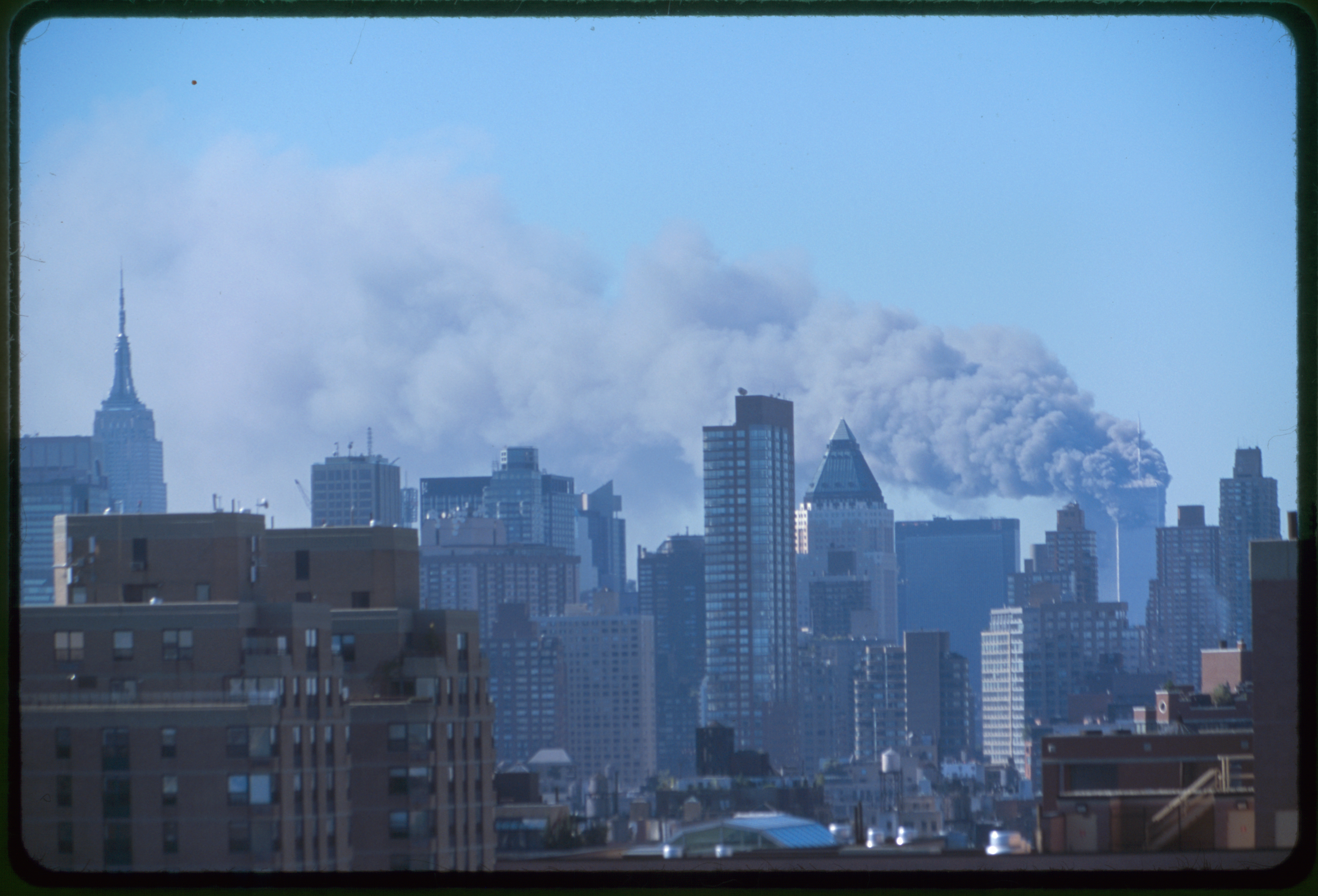
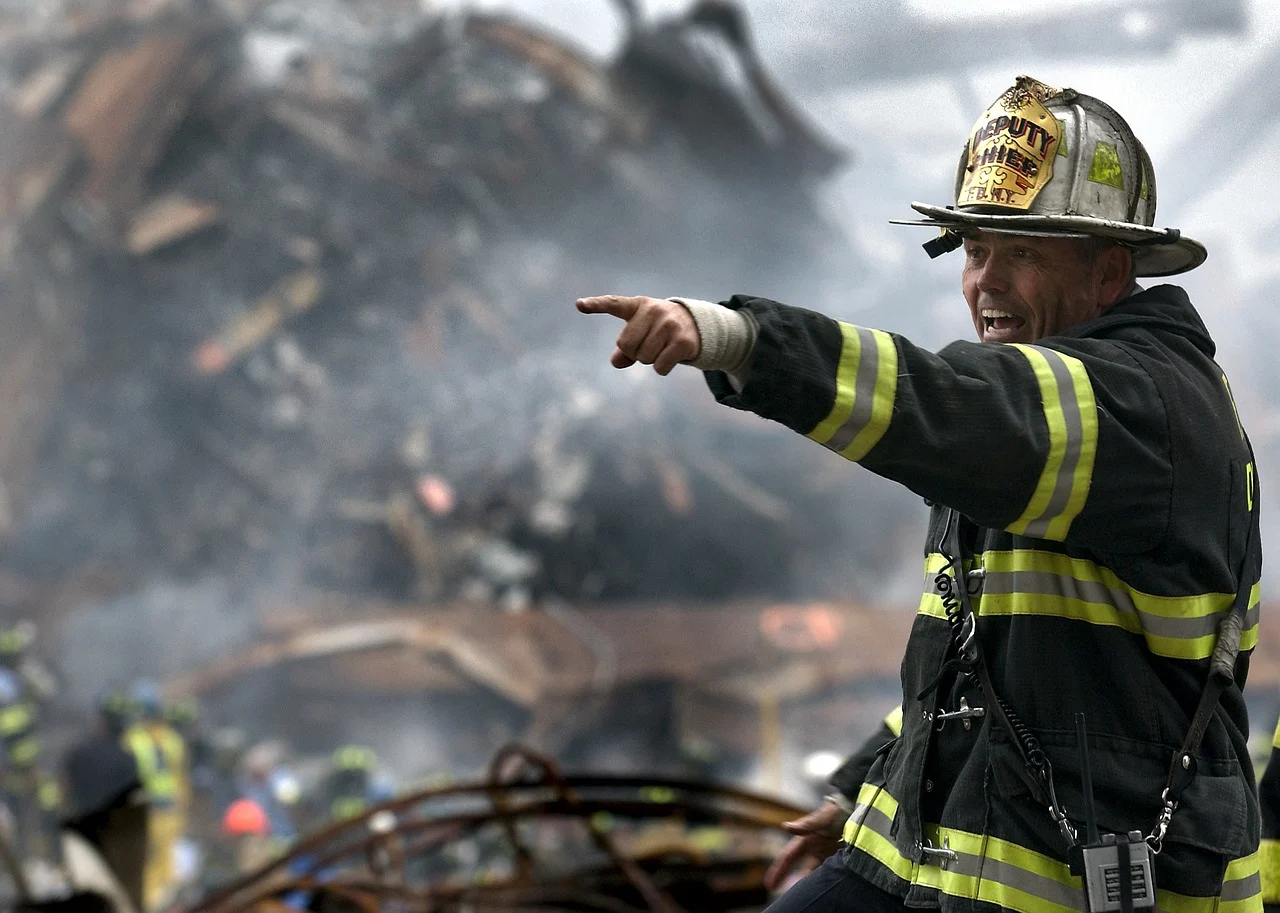
The sky isn’t quite as blue this morning as it was that day and even if it were raining, it wouldn’t matter. For those of us who were there, felt the terror and the anger, for those who lost loved ones, for those who were hurt and for those affected, 9/11 burns in our memories. We cannot forget. Nearly 3,000 people died in the towers that day, but since then nearly 50,000 have developed 9/11 related cancers and other illnesses traced to the toxins in the air.
9/11 lives deep inside me in a way that I never imagined. Twenty-three years ago all I thought about was getting to the scene, to the story. I first felt something was wrong when a plane flew so low overhead that my house in Greenwich Village shook. WNYC suddenly went silent on my radio. Within seconds, my husband came running up the stairs and yelled, “People are on the street crying. A plane flew into the World Trade Center and it’s on fire.” That low flying airplane had used Sixth Avenue like a runway to slam into the North Tower.
We didn’t hesitate to head toward the disaster. I am a reporter and that’s what I have always done. My husband Nick, a writer, pitches in to help when he can and this time he carried my backpack. I wanted to get there fast and as close as I could, I didn’t think about the obvious dangers, or the hidden danger in the air that day. Few who rushed to the scene to help, to report, to find loved ones, did. We could see the stuff in the air.
Things sparkling like crystals glittered in the distance. Thick black smoke swirled out of the towers. Paper litter flapped against the bright blue sky long before the buildings collapsed into themselves. What was in the air that day and the days after continues to make 9/11 a killer. It continues to threaten me and the estimated 400 thousand who responded, lived, worked, went to school, and even walked nearby.
Six years ago I learned that I had two small cancerous tumors in my right lung. I also had a lot of what radiologists call ground glass in my left lung. Biopsies revealed I suffered from adenocarcinoma, or non-smokers cancer. Doctors said the cancer was caused my exposure to the air on 9/11 and the days and months that I covered stories close to Ground Zero. A pulmonologist, the late Mark Rosen, referred me to thoracic surgeon Andrew Kaufman at Mount Sinai Medical Center. He removed the tumors and continues to monitor my lungs. That means every three to six months, I travel nervously to Mount Sinai to have a CAT scan. Then I sit and wait more anxious than ever to see if there is a new growth in my lungs. 9/11 taught me that you never know.
In 2019, the cancer diagnosis threw me back into the world of first responders and others who found themselves struggling with the long-tail effects of the terrorist attack. 9/11, the day, the memories, the people who died, what it meant to New York and our country were all indelible. But I didn’t live in the world of the first responders still struggling to get recognition from Congress.
Photo courtesy Pixabay. Creative Commons License.
I learned quickly that they needed money to help them live because some were too sick to work, and others couldn’t pay medical bills. Families of victims also needed help.
The answer was for the federal government to fully fund the Victim Compensation Fund (VCF). This program didn’t just hand out money. It required medical proof that you were ill and proof that you were in specific locations in lower Manhattan, a part of Brooklyn, or the Pentagon in Washington. A panel reviewed applications. Nothing was guaranteed. Senator Kirsten Gillibrand (D) and then Representative Carolyn Maloney (D) led the charge to get Congress to authorize the money. But others including many Republicans refused to get behind the push.
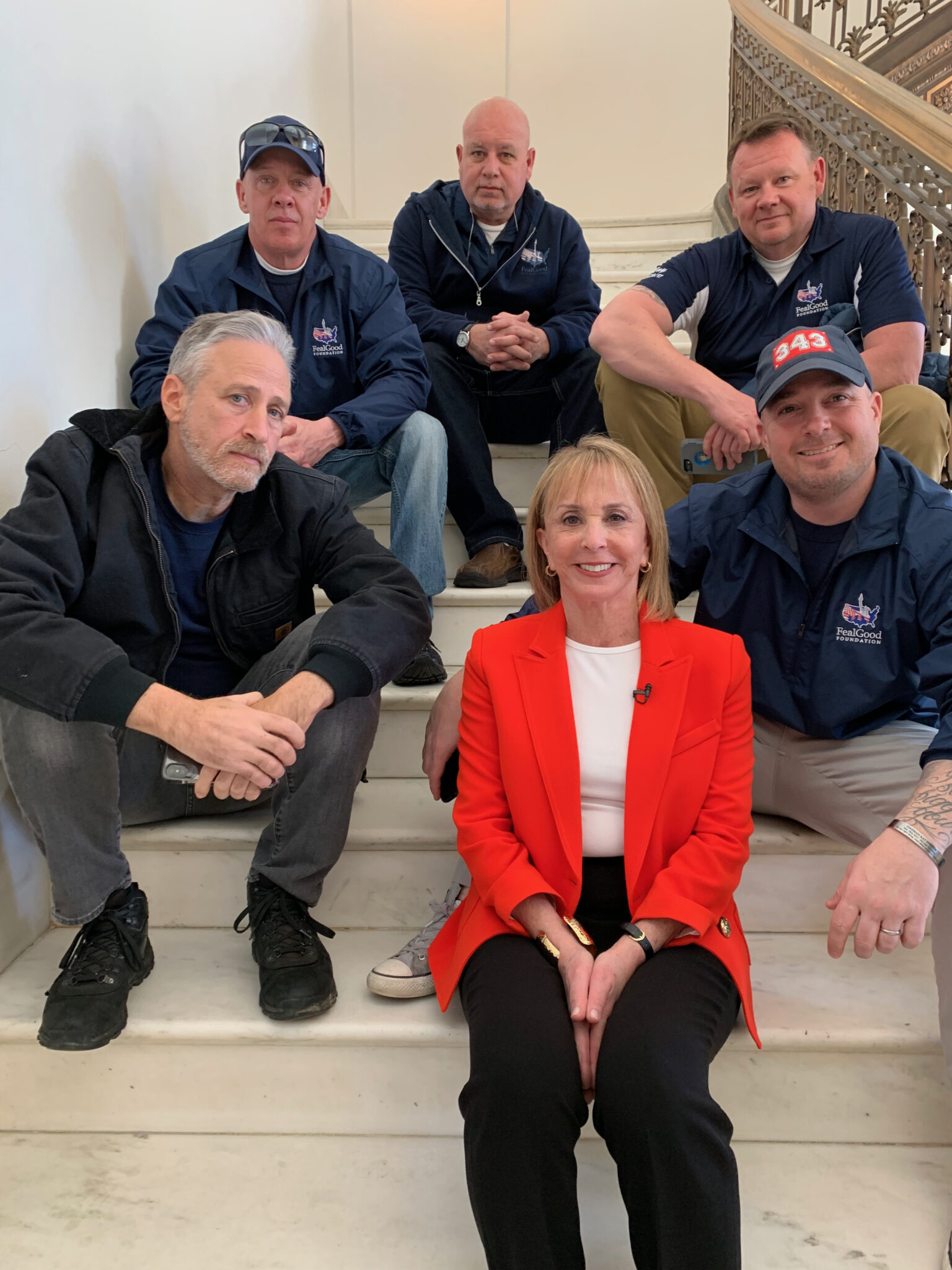
Senator Kirsten Gillibrand, Congresswoman Carolyn Maloney, Jon Stewart and 9/11 first responders. Photo by ConsumerMojo.com
I began to produce a documentary with a young filmmaker who wanted to make me the center of the story, and that didn’t work out. But we traveled to Washington and walked through the Capitol with a group organized by first responder John Feal. He and comedian Jon Stewart had a laser focus on getting money for first responders.
Jon Stewart, Barbara Nevins Taylor, John Feal and 9/11 first responders at the U.S. Capitol
Stewart told me that he was committed to the first responders because of his admiration for what they did on 9/11. “It was chaos. Everybody thought the world was ending. And they brought a sense of stability and comfort, security and a feeling of like, ‘Oh, they’re on the case. We’re going to be all right.’ And then to have that response met with apathy (by Congress) when they were in trouble, blew my mind. It was galling.”
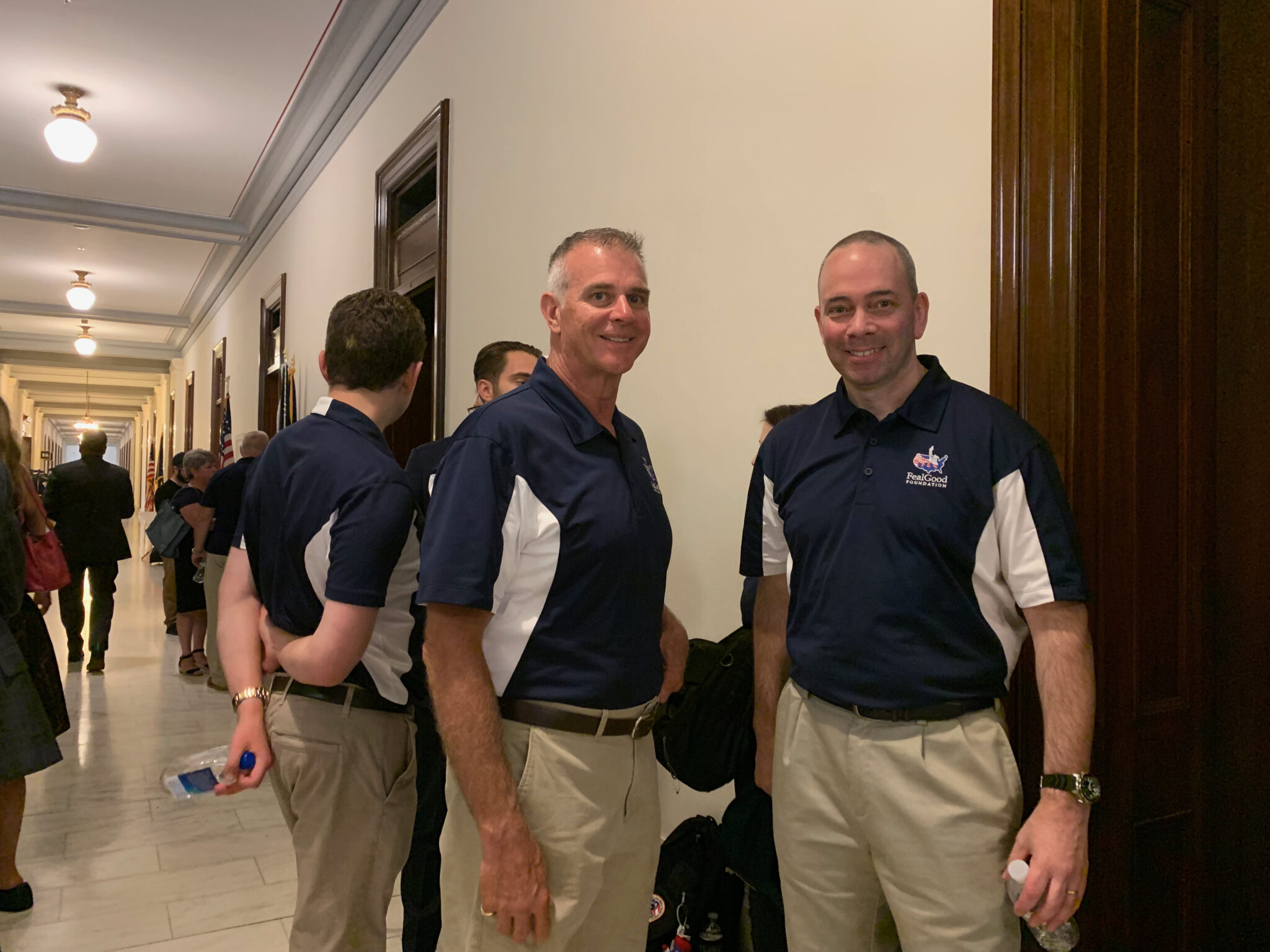
And it was stunning to walk with them into offices and listen as they had to explain 9/11 and its consequences to young staffers. Sometimes they met with a representative or senator. But the staffers mostly were the first line. Rafael Orasco, a former NYPD detective, said, “You’re talking to people who are relatively young and new. And I’m sure that this particular issue for them is really a little overwhelming.” He said the number of responders who came in wheel chairs, or carrying oxygen tanks might upset some. “It can be a little bit much to just take in and comprehend,” he said kindly.
9-11 first responders lobbying in the U.S. Capitol
But the lobbying paid off. In July 2019 Congress passed legislation named after first responders who died. They called it, The Never Forget the Heroes: James Zadroga, Ray Pfeiffer and Luis Alvarez Permanent Authorization of the September 11 Victim Compensation Fund. The deadline for people to apply for benefits was extended until October 1, 2090.
That will help the young children who were in the area in strollers, or in school and others who may not realize they still carry a piece of 9/11 in them. I was encouraged to apply to the fund and did receive money. I’m grateful for that.
Others are too. But really? What’s compensation for fatal illness or the looming threat of it. There is also a big part of this puzzle missing when we talk about 9/11 and money. Why aren’t we demanding that the government of Saudi Arabia pay victims, their families and others harmed by the terrorist attack. Fifteen of the terrorists were from Saudi Arabia. Oh yes. We don’t know what role the Saudi government played because our government has not fully released FBI documents that might tell us more. Families of those lost on 9/11 have sued Saudi Arabia and are trying to get documents and transcripts of FBI interviews with Saudi officials.
There is also another problem. First responders and others now worry that the money to help them will run out before 2090. Advocates claim Congress needs to add another $3 billion to shore up the program. At the same time, there is a call from Allison Turkel, the special master of the Victim Compensation Fund, reminding people who might be eligible and unaware of the program to apply. “We are actively working to close this awareness gap and have extended our outreach significantly,” she wrote in a message on this anniversary.
Almost a week after we posted the story about being unable to get the COVID vaccine in New York, Governor Kathy Hochul changed the rules. She declared a state of emergency, “due to recent federal actions related to vaccine access. She signed an executive order allowing pharmacists in New York State to administer the vaccine to those who want it.
This was a big deal because right after the vaccine was approved by the FDA, CVS and Walgreens said they would not offer the vaccine in 16 states including NY. That’s because heath policy in these states require that a Centers for Disease Control panel approve the vaccine before pharmacists can give it.
But the CDS is in chaos. President Trump fired the CDC director, and other top health officials resigned because they said they worried about Health and Human Services Secretary Robert F. Kennedy Jr.’s (RFK) anti-vaccine policies.
So although the FDA approved the vaccine, for certain groups including people over 65 and those with pre-existing health conditions, those who qualified for the vaccine couldn’t get it. But the FDA’s conditional approval also blocked out children and others who might want or need the vaccine. They now need a doctor’s prescription.
To try remedy the problem created in Washington, D.C., Western states, California, Oregon, Washington State and Hawaii formed an alliance to formulate their own health care policies. Governors and health care leaders cited attacks on science by RFK Jr. for the need to go it alone. Massachusetts and New Mexico are also setting their own health care policies.
While RFK Jr. told senators at a capitol hill hearing last week that anyone who wants the vaccine can get it. That turns out not to be true. Getting the vaccine is pretty much dependent on where you live and what your state has decided to do.
I got the vaccine in New York City, and I’m relieved to have some protection from the COVID virus.
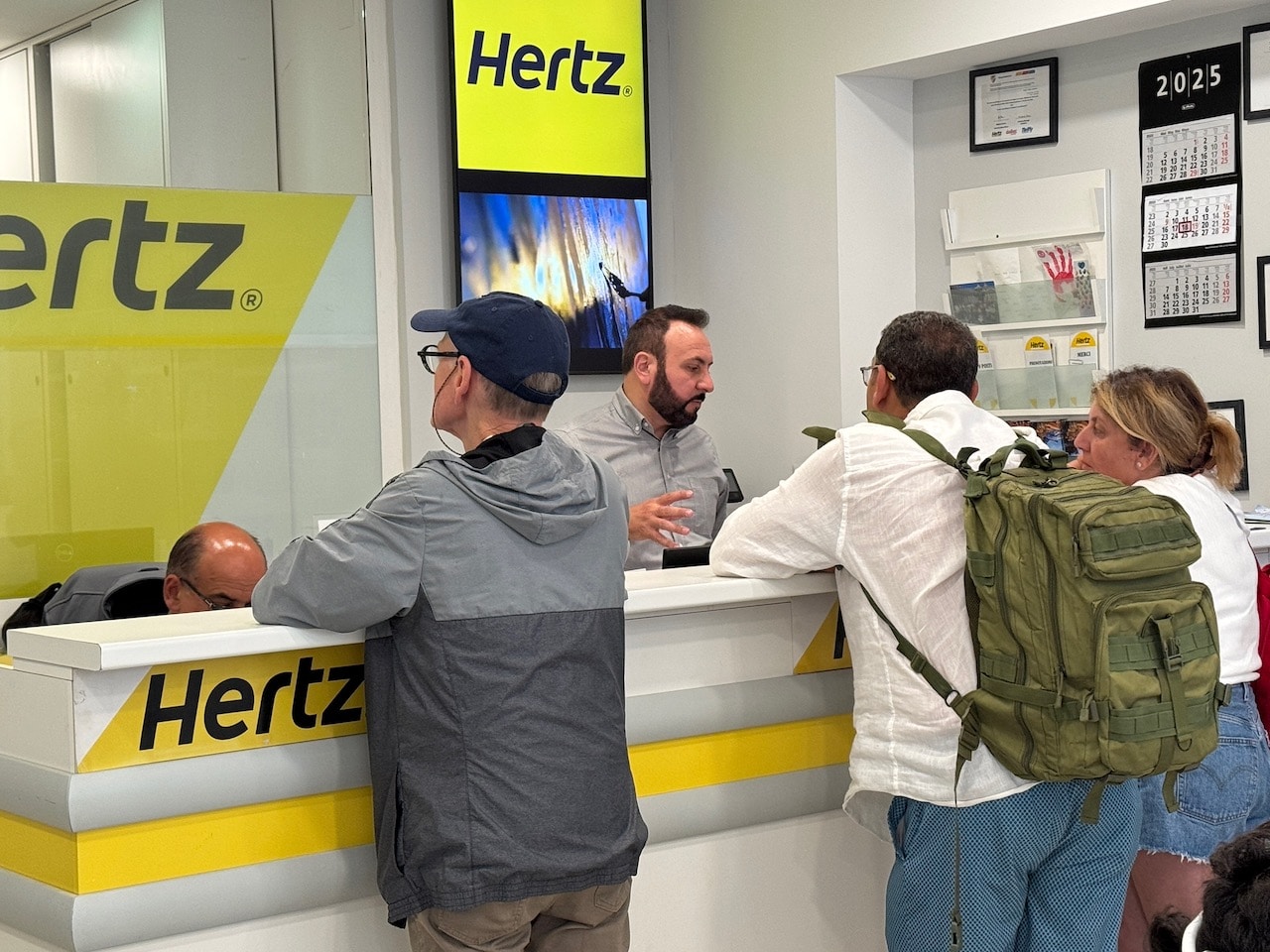
We arrived at the Hertz rental car office in Sorrento soggy from drizzle and eager for our trip to Matera in Basilicata. But we groaned when the agent offered us an SUV. Roads in many towns in Italy are narrow and we dreaded the idea of a big vehicle. “We’re small. Isn’t there anything else?” Nick asked.
Renting a car at Hertz in Sorrento. Photo by ConsumerMojo.com
The agent asked us to wait, went down a flight of stairs and came back up with a set of keys. “Good news. We have brand new Lancia,” he said. And that was that.
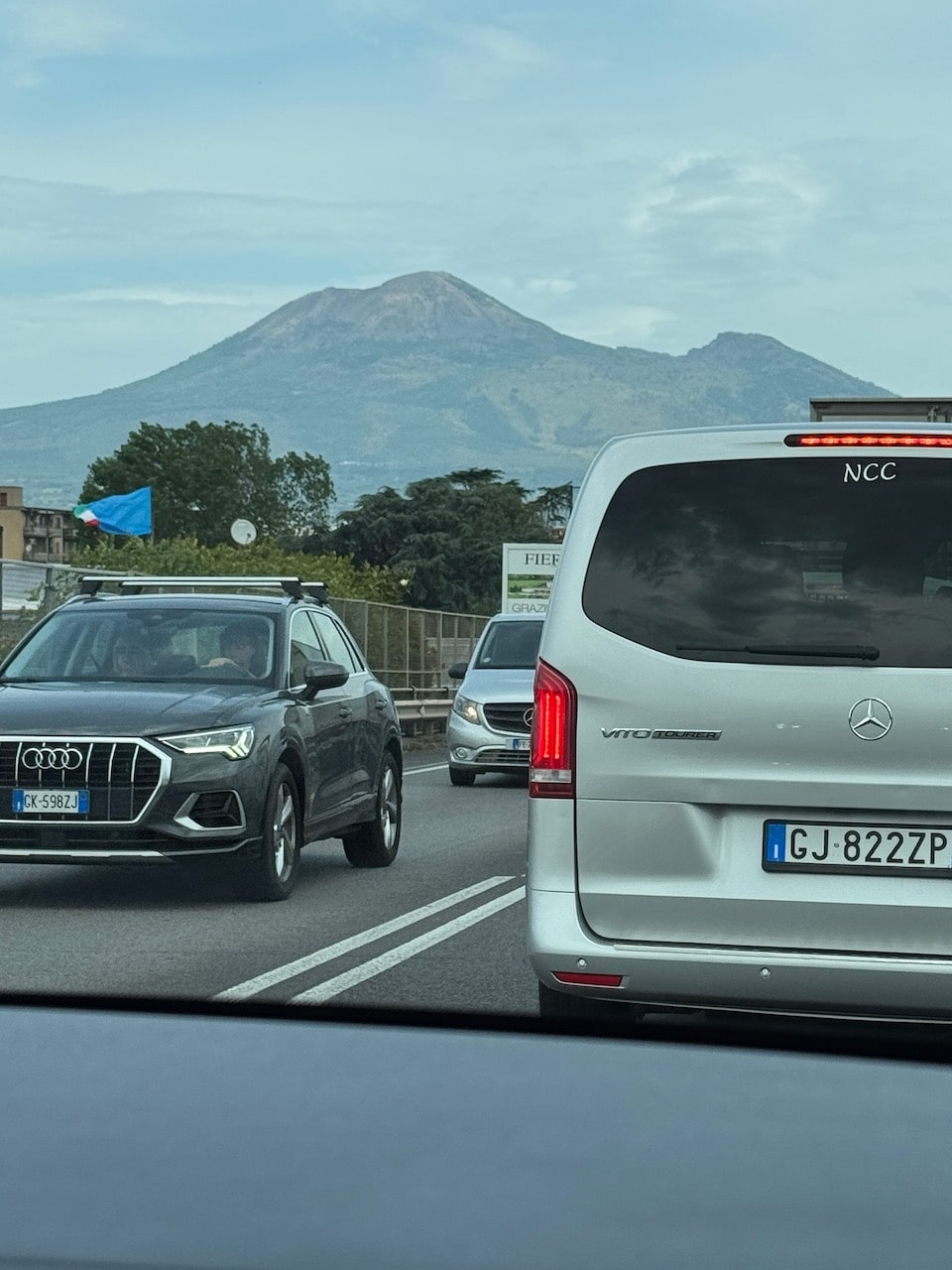
We set off, with Nick at the wheel, and found ourselves in the infamous traffic jam along the Sorrento coast. Our route took us back toward Pompeii and the traffic was particularly bad when we got to Castellemare di Stabia. That’s Mount Vesuvius up ahead. The mountain was quiet but many of the drivers seemed ready to erupt.
Stuck in Traffic coming out of Sorrento in Castellamare di Stabia. Photo by ConsumerMojo.com
Matera was a little over three hours away and when we turned east toward Salerno the traffic lightened up. It was drizzling, and from the highway, we could see the old town of Salerno on the hillside. It looked appealing and like someplace we’d like to stop. But not in the rain.
Town of Salerno. Photo by Kelly, Courtesy Pexels.
Not far out from there, the steady drizzle became a noisy downpour and then turned into a drum of hail on the Lancia’s roof. Nick kept a steady hand on the wheel and the Lancia held the road nicely.
At a town called Potenza, we pulled into an Autogrill that offered restrooms and food. But once we hit the road again something happened and Nick followed a sign to Matera that took us on a winding adventure of backroads and farms and rich wheat fields. It wasn’t clear that we could get back on the highway if we turned around, and the GPS was urging forward motion. We don’t have photos. But the weather from the west followed us and the sky let the rain rip. The narrow farm roads quickly filled with sloshing water, and the edges of the road and the fields became a muddy mess. There was nowhere to pull over and no one to ask until we reached a crossroads with workmen sheltering from the rain. They said that we were headed in the right direction. So we continued. Finally, we reached the highway again, and it stopped raining. A sign pointing to Potenza, where we got off the highway, told us we’d come 80 kilometers. So, onward.
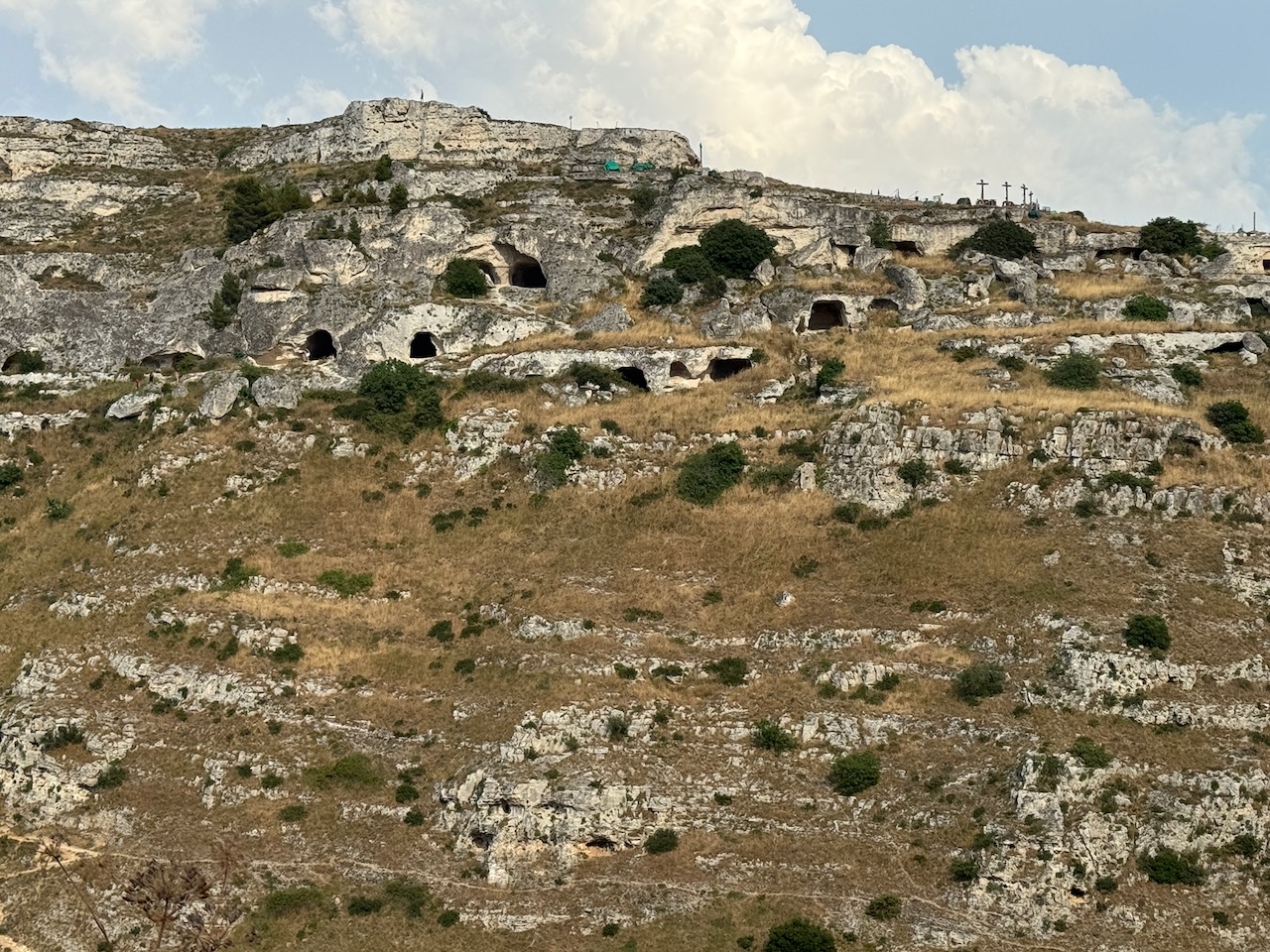
Finally, we made the turn off to Matera and drove into the main part of the new town created in the 1950s. It’s true we were a little shell-shocked from the ride, but as we circled around and looped down into old Matera we both exclaimed, “Oh my God. Look. Look!” Descriptions, even photos, fail to prepare you for the stark and shocking beauty of it. First there is a ravine and a cliffside of caves.
First spotting of caves in Matera. Photo by ConsumerMojo.com
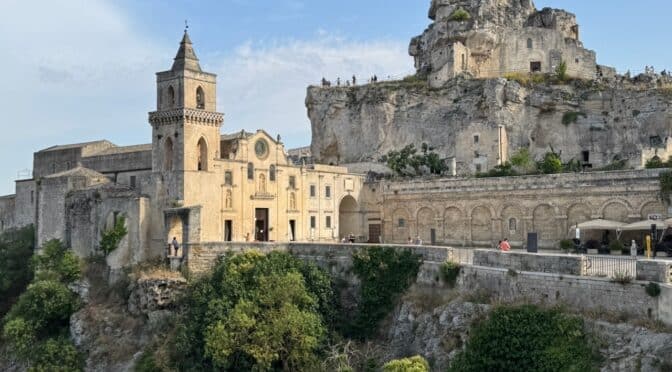
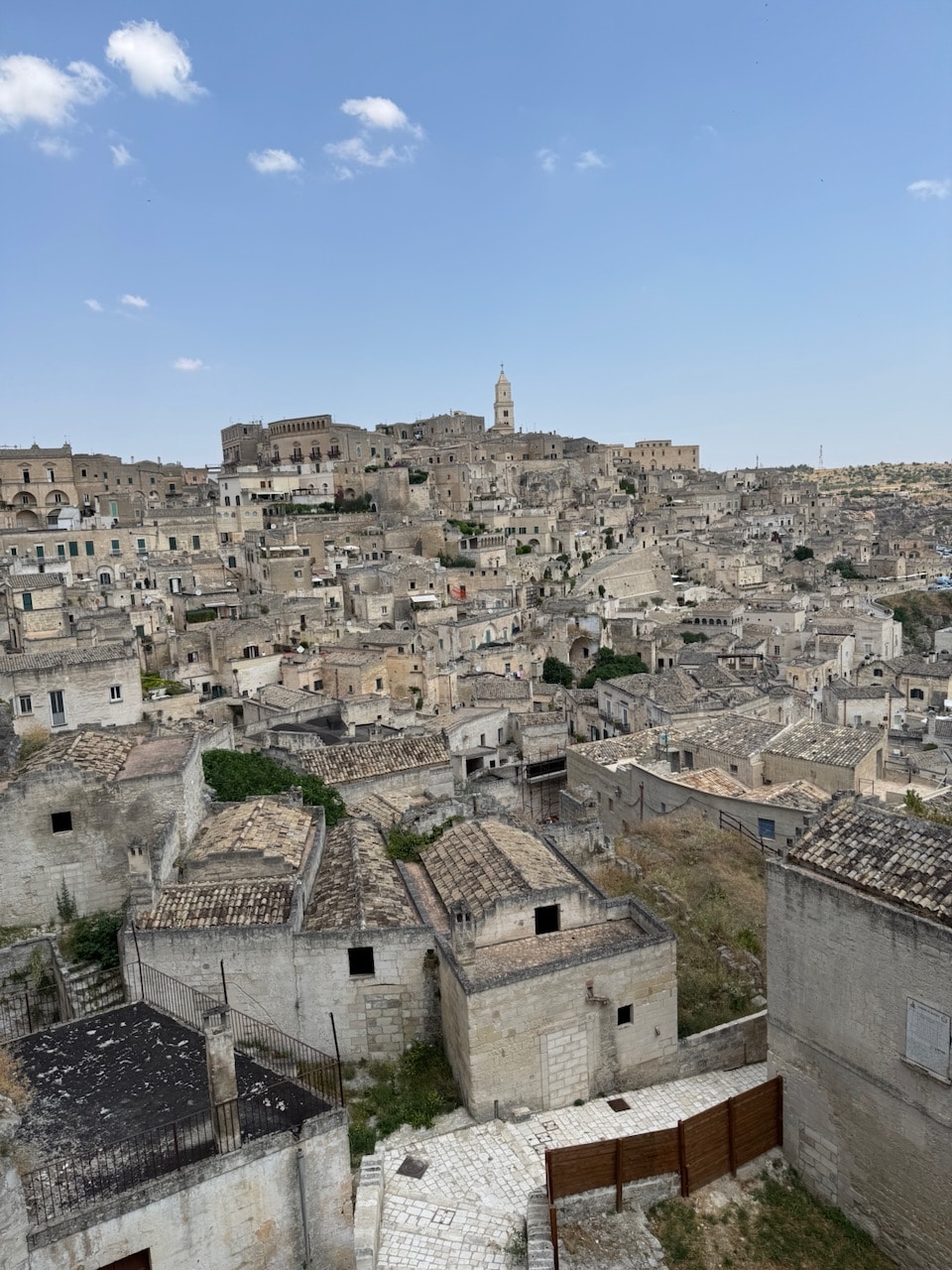
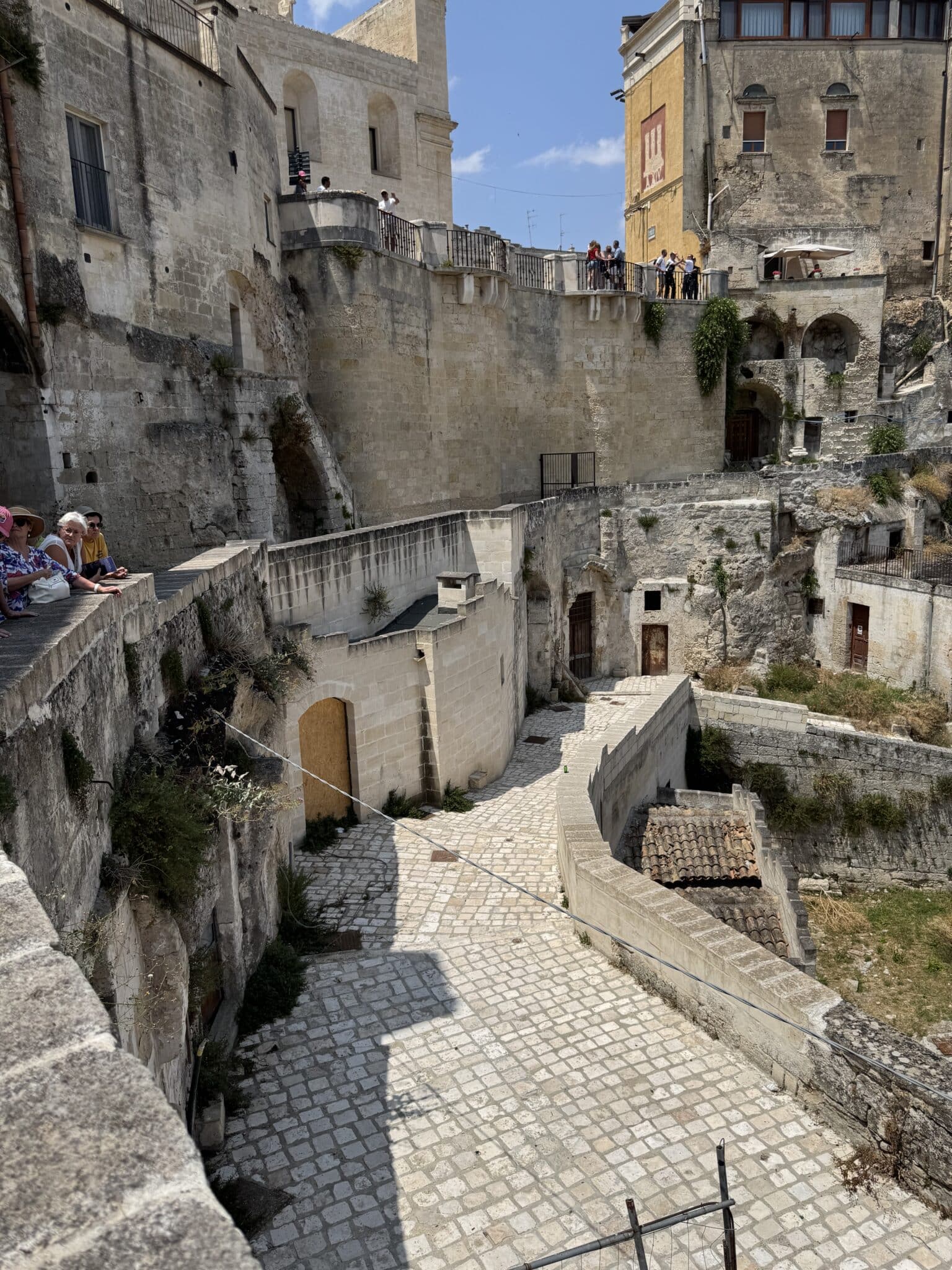
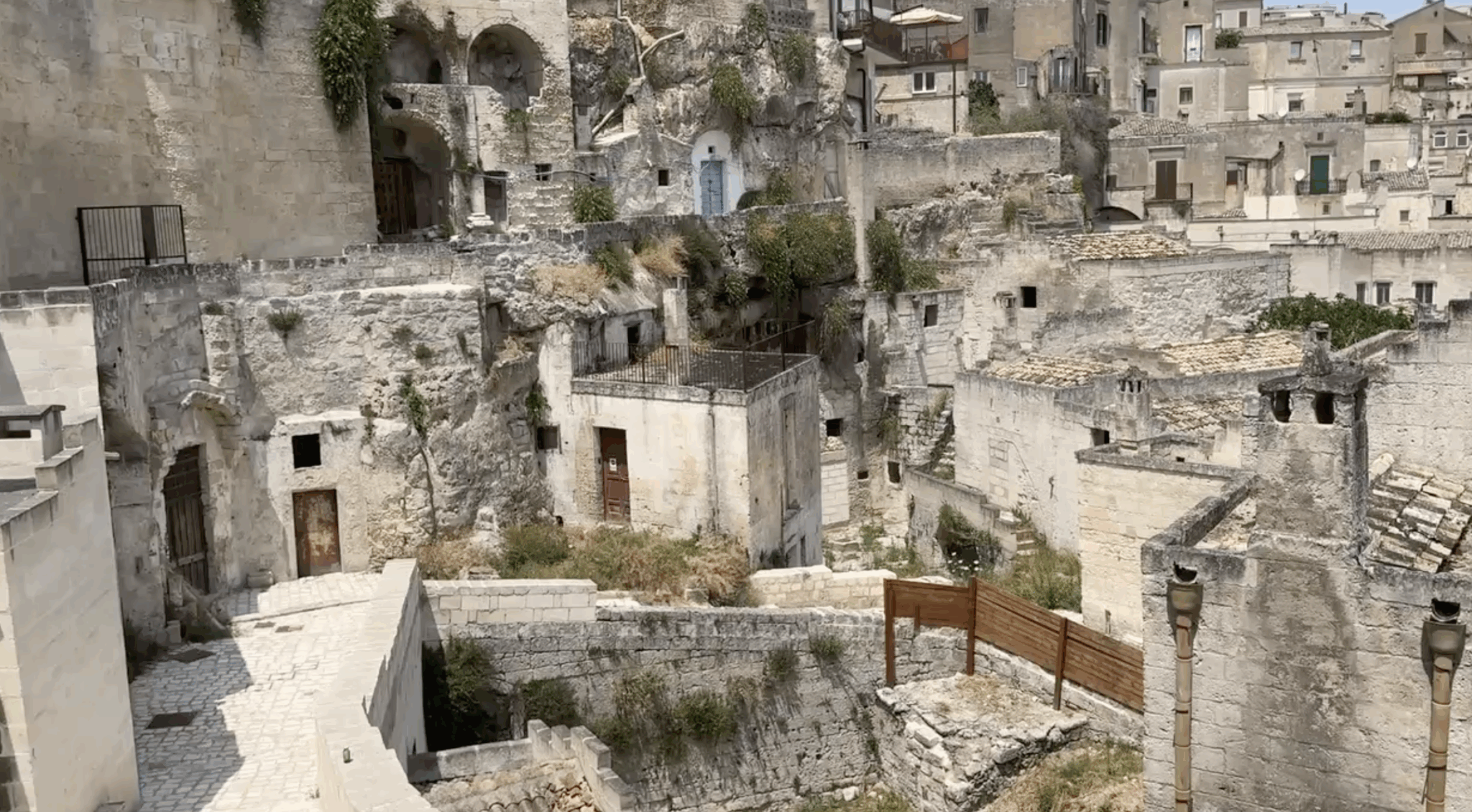
And then there was what we learned is called the Sassi, a town of limestone caves, structures built from caves, small buildings stacked on top of caves and churches rising from the rock.
High Shot of Matera. Photo by ConsumerMojo.com
Matera’s history dates back 10,000 years or more to the Palaeolithic era and the Troglodytes — the word originally meant cave-dweller. It is one of the world’s oldest continuous settlements in the world and artifacts of Greek, Roman, and Norman life have been discovered here. Until the late 1950s, people lived in the more than 1,000 limestone caves without power, running water or basic sanitation. Typhoid, malaria, cholera and other diseases were rampant. Infant mortality was estimated at 40 percent. The extreme poverty and difficult living conditions were mostly ignored until 1945 and the publication of “Christ Stopped at Eboli,” by Carlo Levi. A doctor, artist and writer, Levi was among the political prisoners exiled to small towns in the south by Benito Mussolini. His memoir chronicled his experiences and the suffering of local people. His first impression of Matera was shocking. “Of children I saw an infinite number. They appeared from everywhere, in the dust and heat, amid the flies, stark naked or clothed in rags ; I have never in all my life seen such a picture of poverty,” he wrote.
After Mussolini was ousted, killed by partisans, and the Allies won and ended World War II, Italy slowly started to rebuild. Matera was on the agenda. In 1950 Italian Prime Minister Alcide De Gasperi visited Matera and called it “a national disgrace.” Matera then became known as “the shame of Italy.” With money from the US-backed Marshall Plan, star architects created a new housing development. Over a 17-year period more than 15,000 people were forcibly moved out of the Sassi.
The city of caves became a ghost town until the 1980s, when people rediscovered the beauty of the city. They renovated caves, rebuilt structures, and opened airbnbs, hotels and restaurants. In 1993, Matera became a UNESCO World Heritage site.
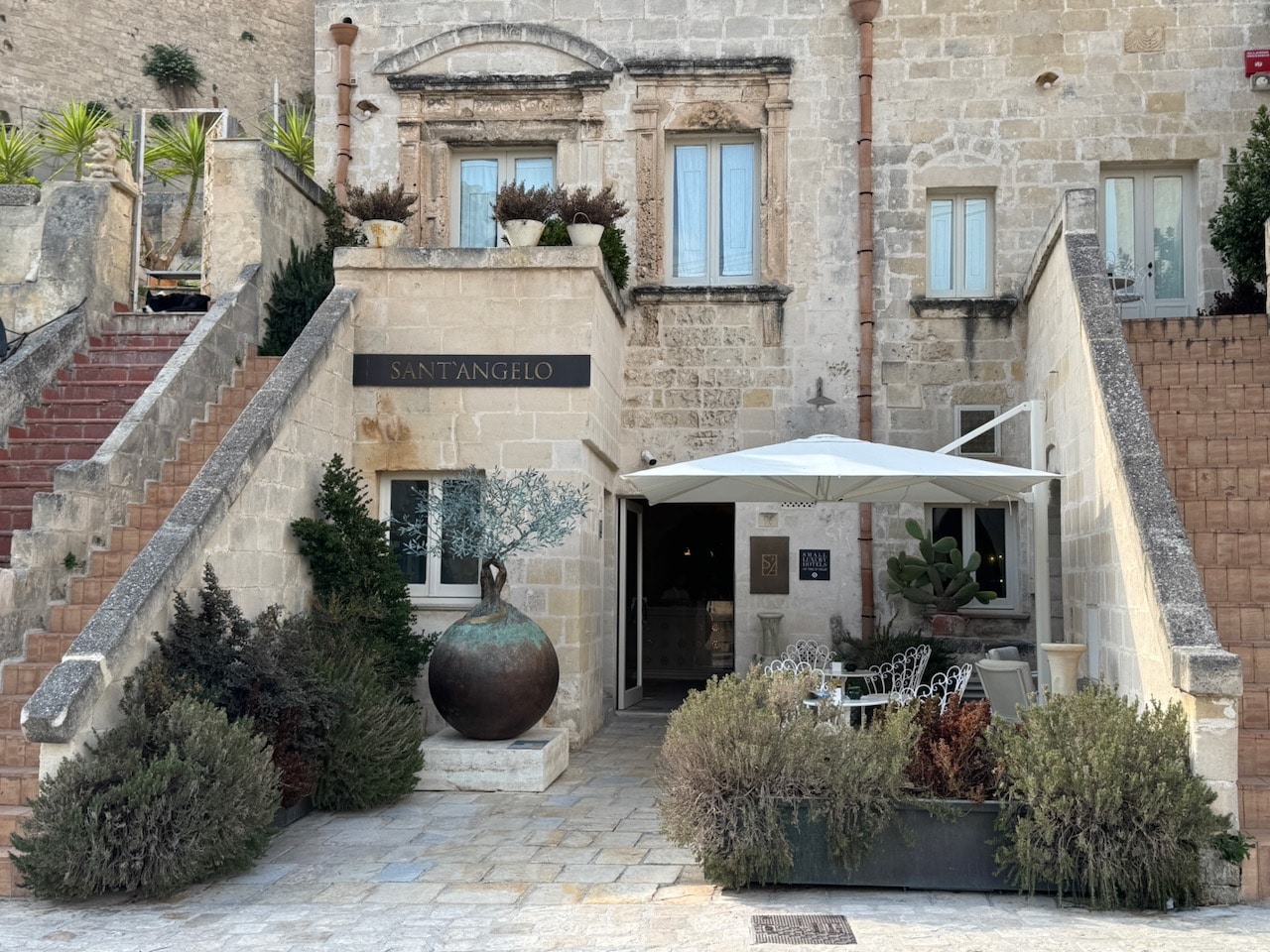
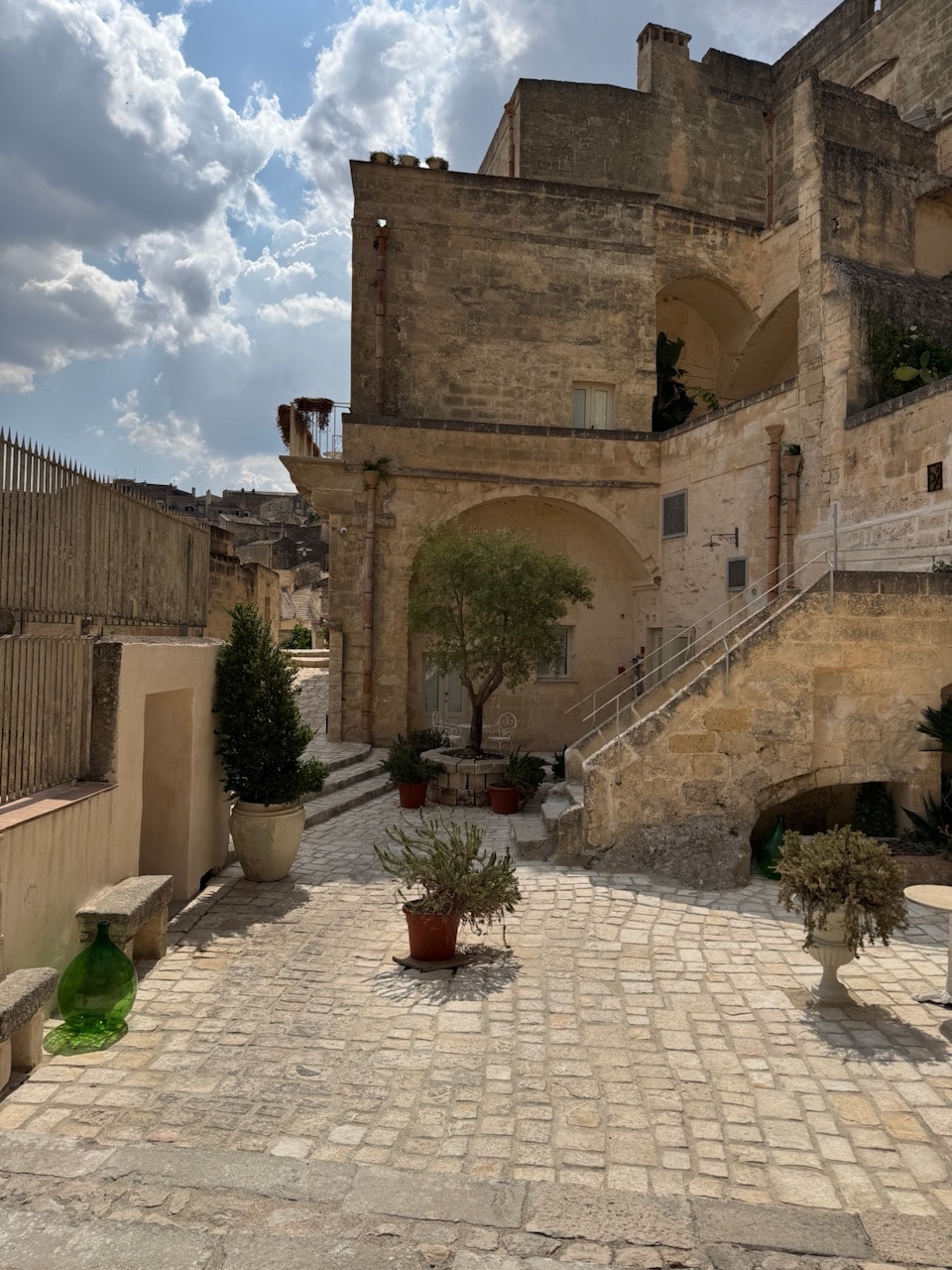
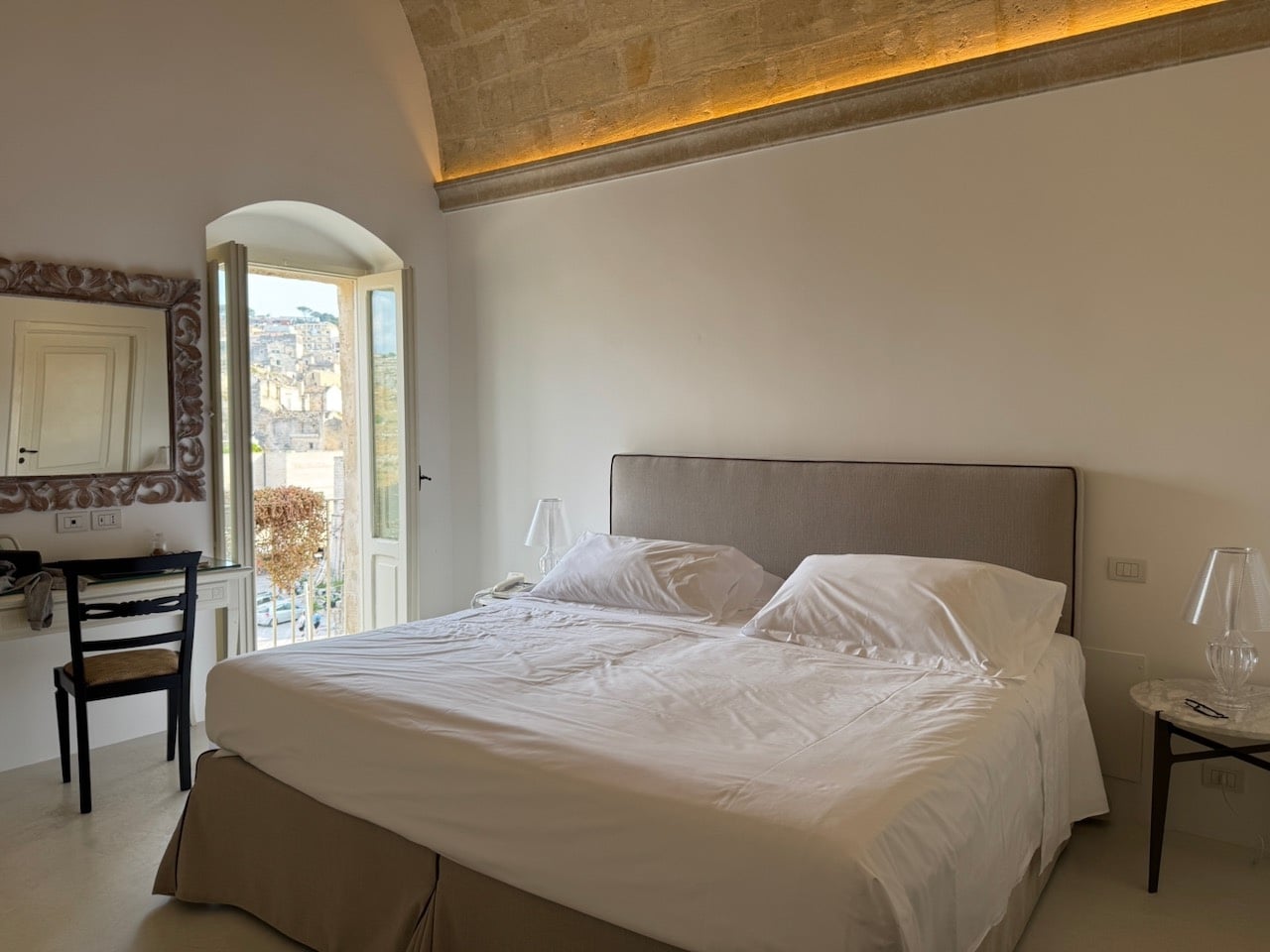
Our hotel in the Sassi, the Sant’Angelo Luxury Resort, is a collection of buildings carved out of caves and added on to. The hotel prides itself on having restored historic structures using local materials.
Exterior of Hotel Sant’Angelo in Matera. Photo of ConsumerMojo.com
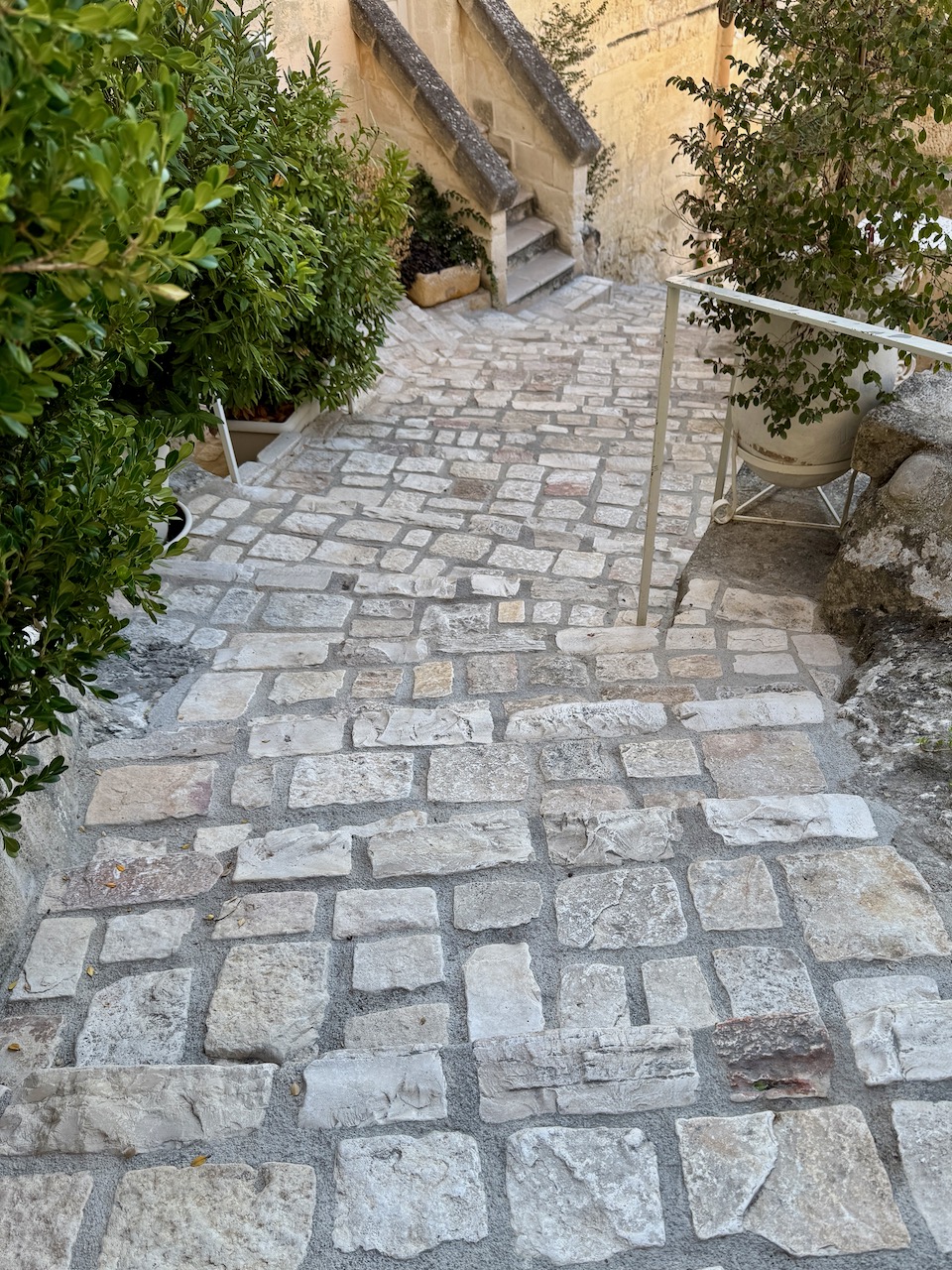
The rooms are tucked into the hillside and to reach most of them, and the dining room, you walk up and up and up.
Limestone stairs at Sant’Angelo hotel. Photo by ConsumerMojo.comSant’Angelo Luxury Resort, up the stairs into the rooms. Photo by ConsumerMojo.com
Climbing up and going down kept us feeling grateful that, for the moment, we are fit enough to handle it.
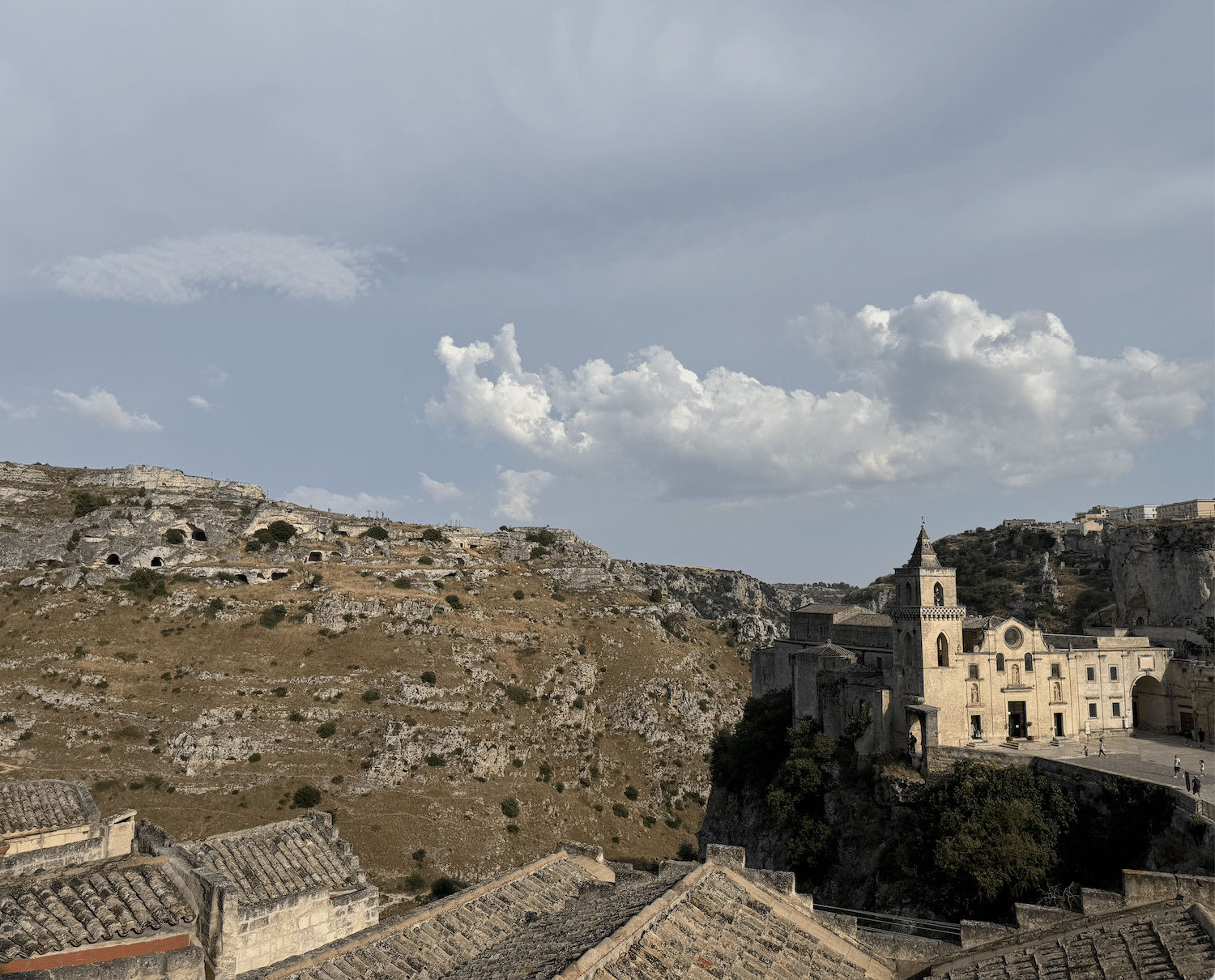
From the terrace of our lovely room we had a clear view.
We could see how the caves blend into the mountain and how the city of caves curves around a deep ravine.
Cliffside caves and church in Matera. Photo by Consumer Mojo.com
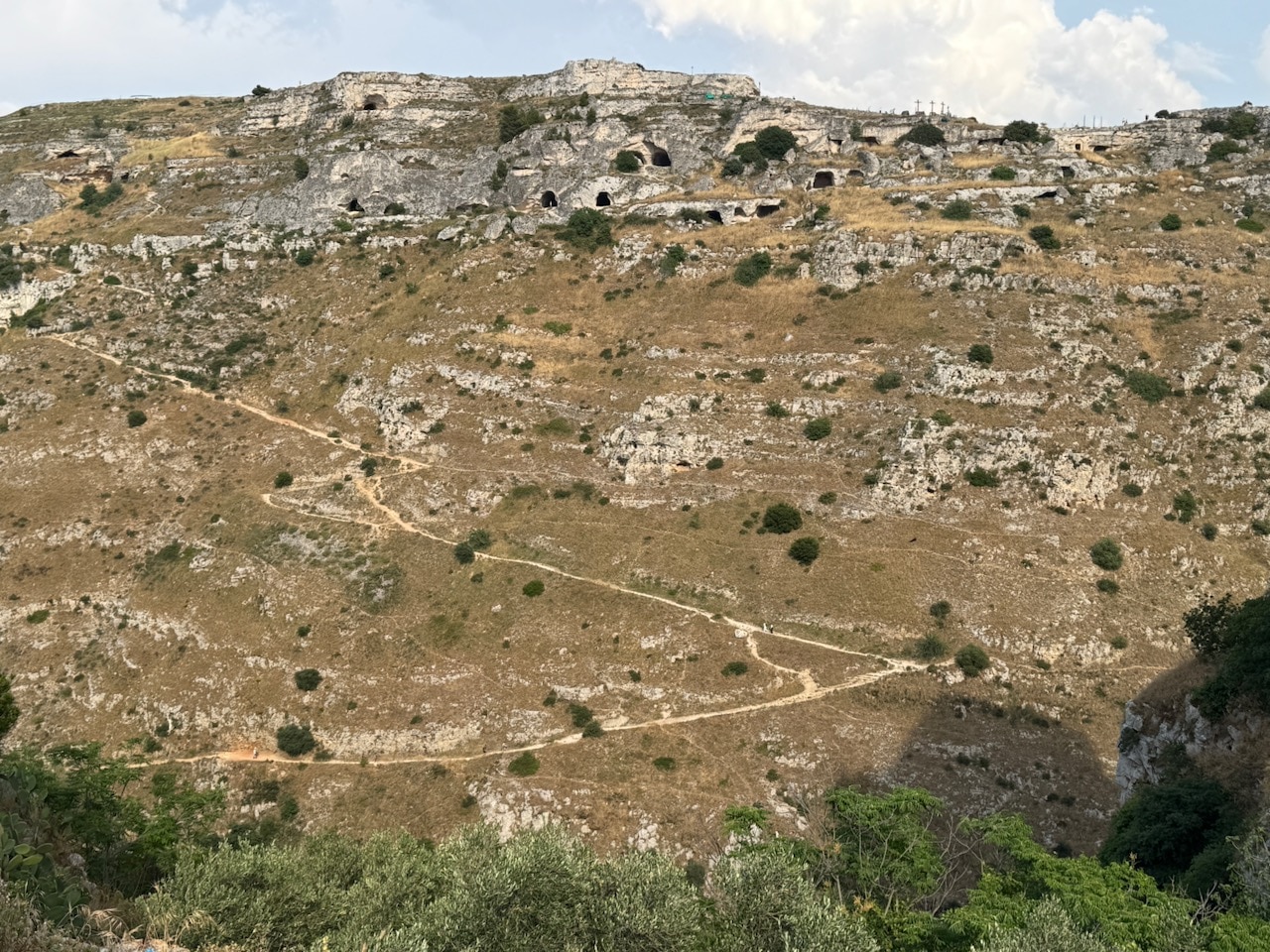
If you look closely at the photo below, you might see crosses on top of the mountain. A production company had erected them for a Christian themed film. We learned that producers often choose Matera as a location because the limestone is similar to Jerusalem stone and the city has the same ancient feel.
Road leading up to the caves across the way. Crosses on top of the mountain. Photo by ConsumerMojo.com
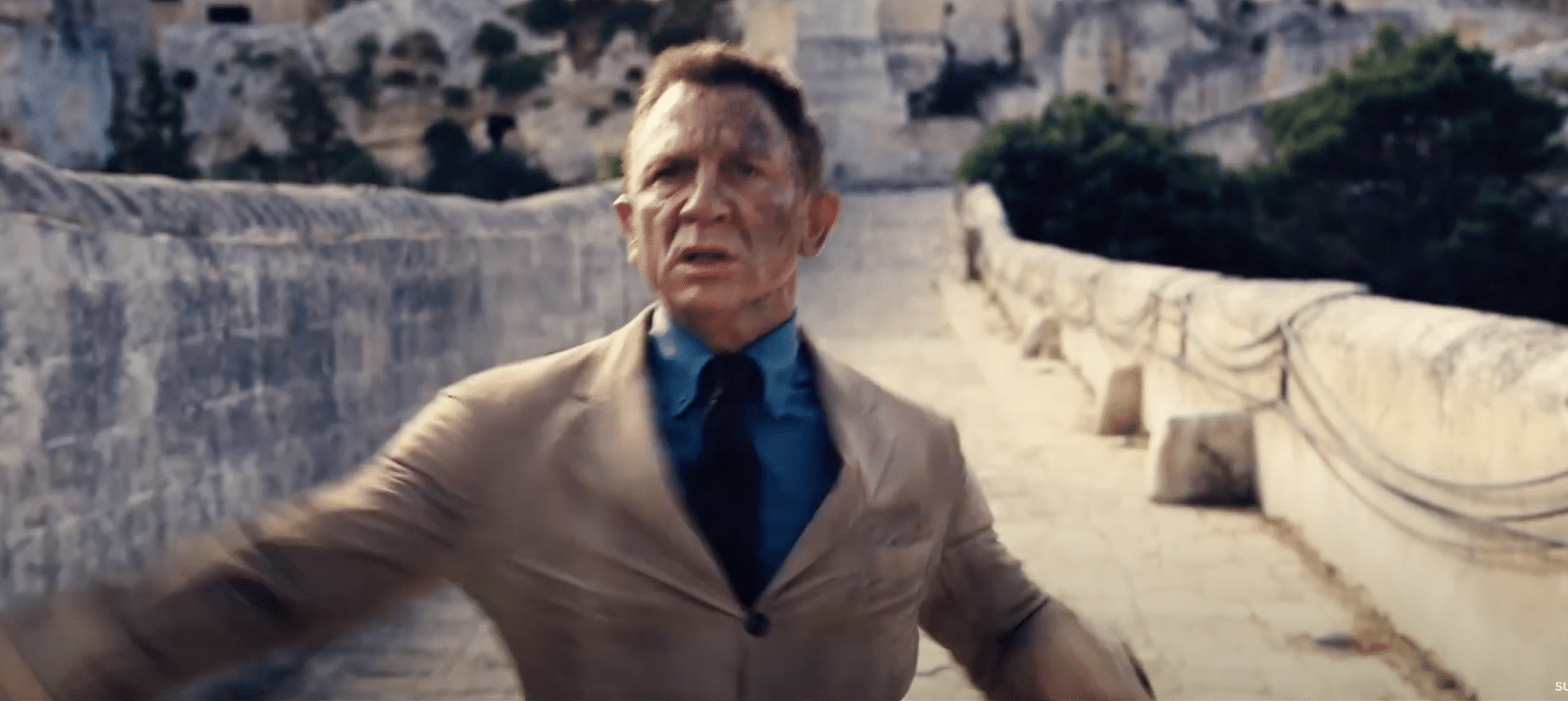
It’s an attractive location for other types of films, too. You may have caught a glimpse of Matera in the Daniel Craig James Bond film “No Time to Die.”
Daniel Craig in No Time to Die. Courtesy Universal.
We learned that the women at the hotel reception desk, like us, are fans of the Italian police procedural “Imma Tattarani,” which is set in Matera. Even though we watch the show, we had no sense of the dramatic beauty of the city, or its history. We planned to fix that on a tour the next day.
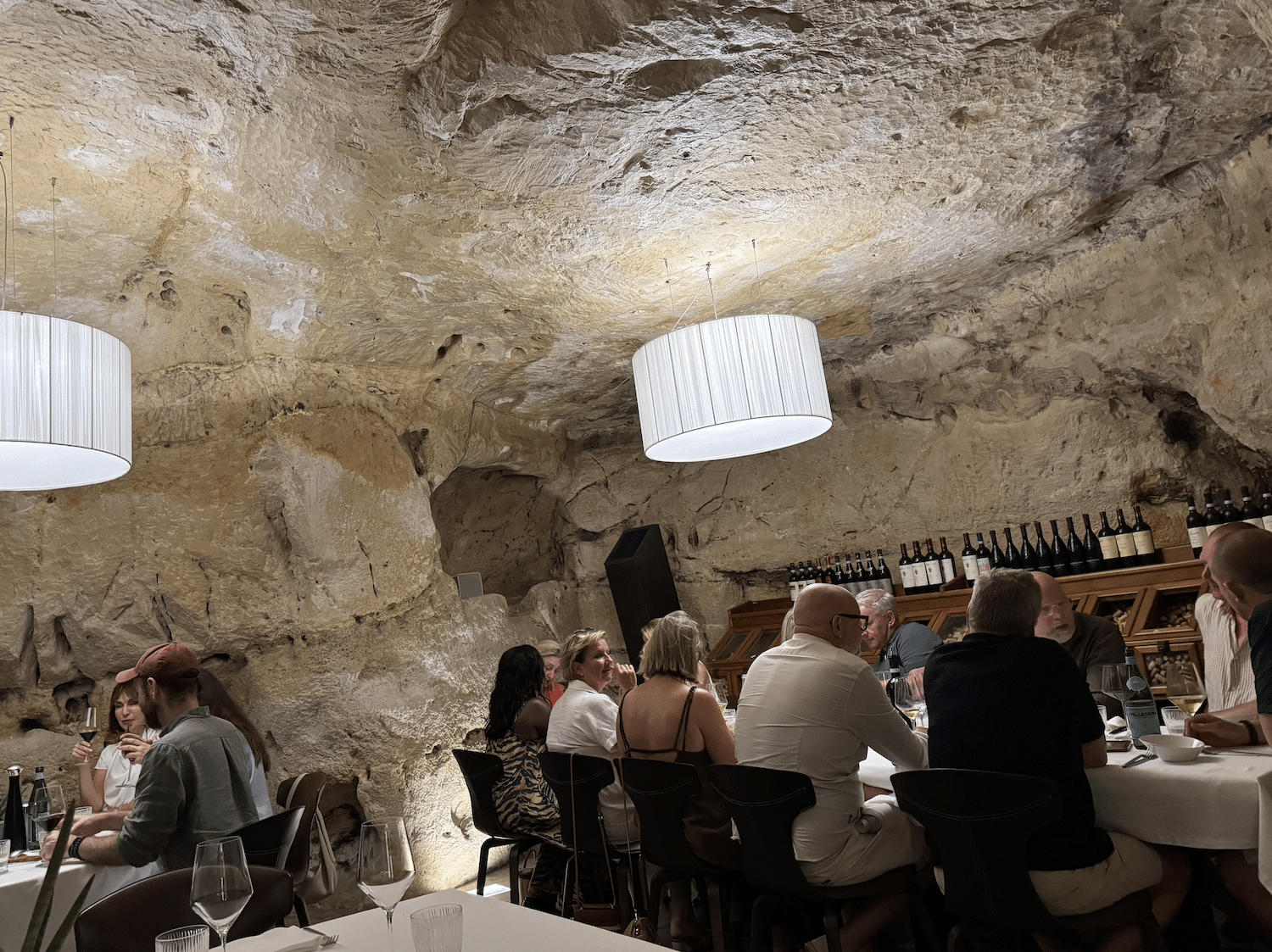
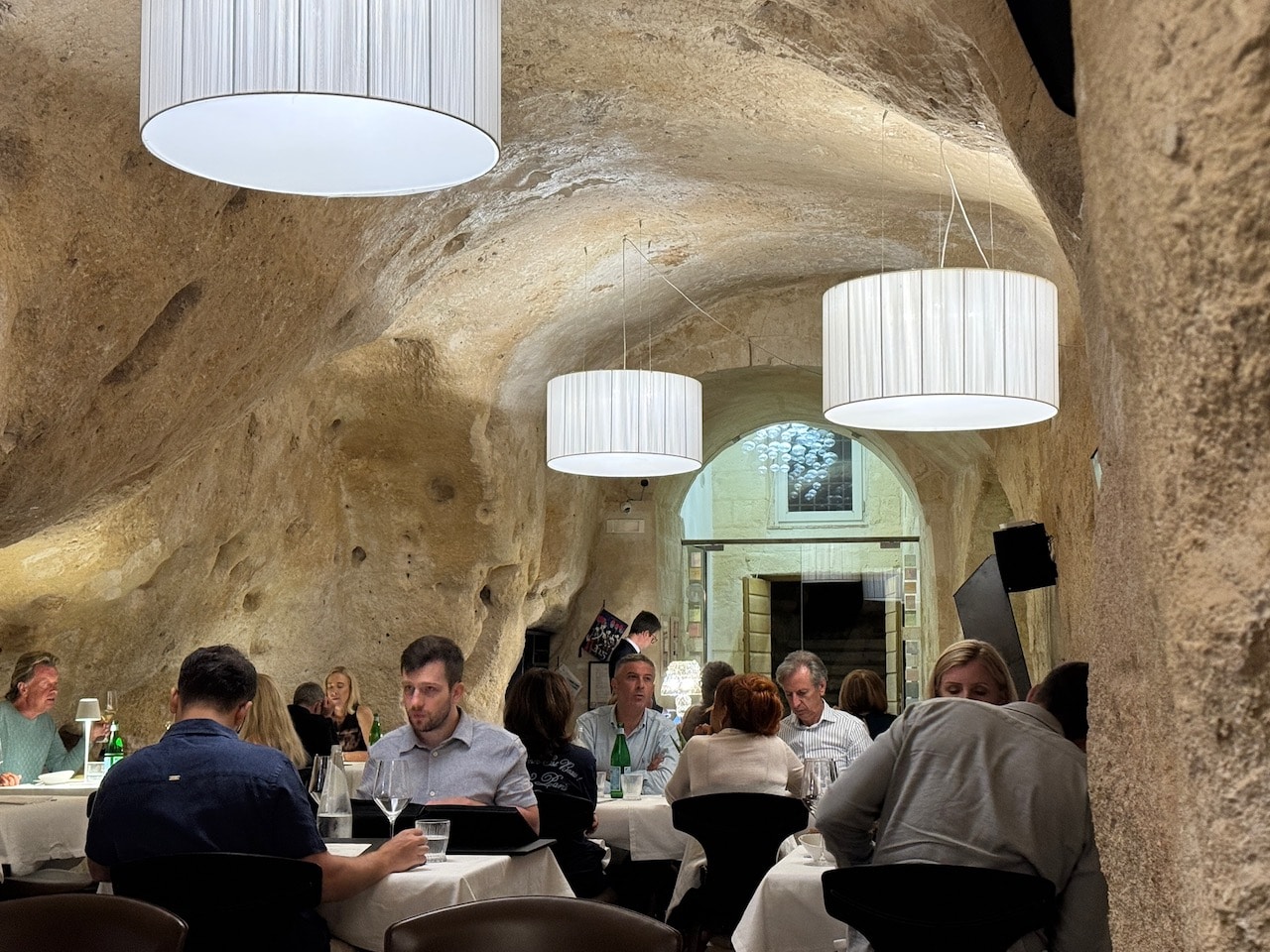
Once we got settled, we took a short nap to recover from our harrowing drive from Sorrento. We felt ready for dinner and a drink. Luckily we didn’t have to walk far from our hotel to Ristorante Baccanti, where we had a reservation. Baccanti is set in a series of caves that feel oddly spacious and even elegant.
Large group eating in Baccanti’s cave. Photo by ConsumerMojo.com
We were surprised that although there were large groups chatting away and enjoying dinner, the caves seem to provide a natural sound buffer and were quieter than most New York restaurants.
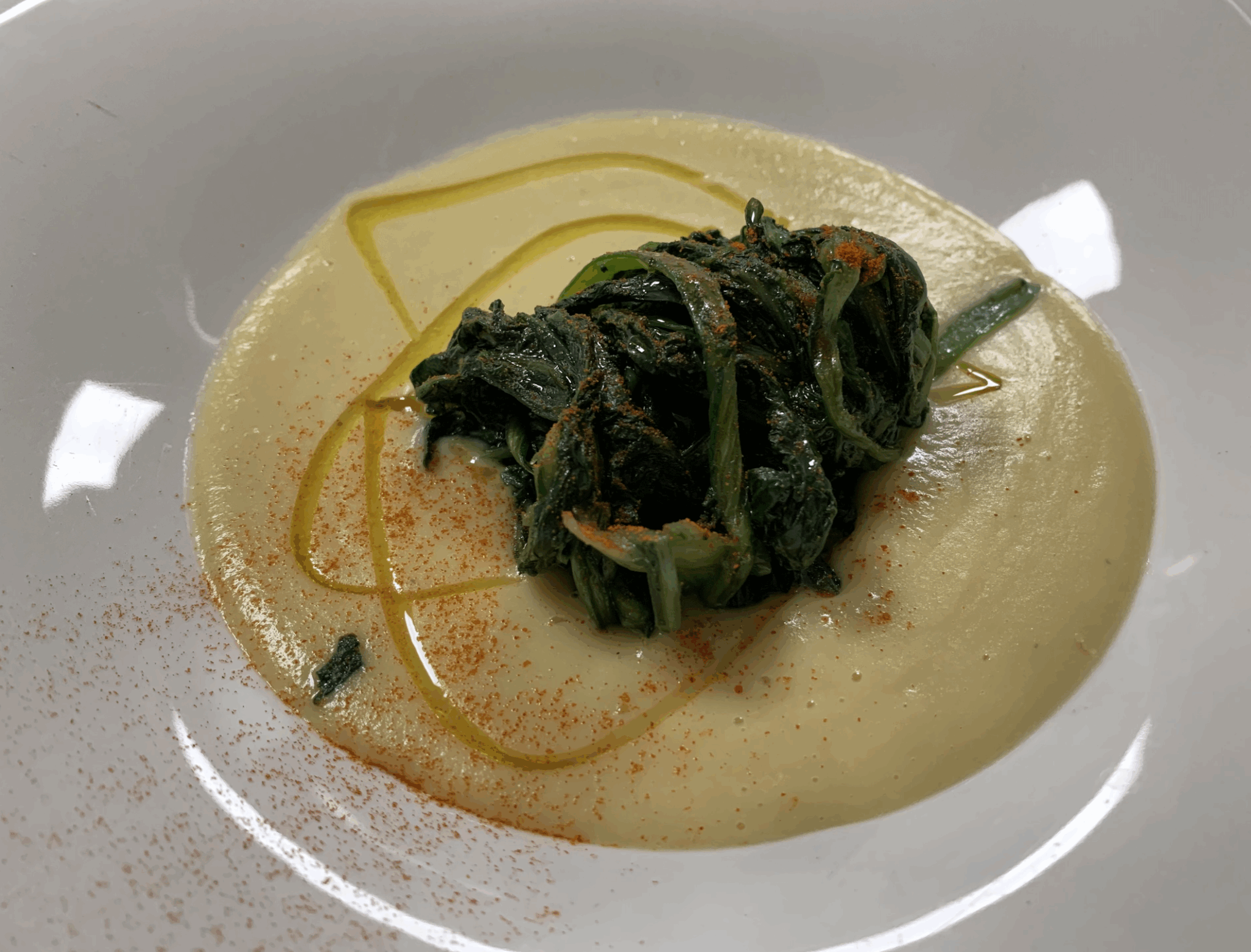
Michelin had recommended the restaurant for its food and ambience and we were happy that we chose it. We were introduced to the regional favorite starter of pureed fava beans and found the taste lighter and fresher than hummus–definitely a dish we wanted to try at home.
Pureed chicory from Baccanti Restaurant in Matera.
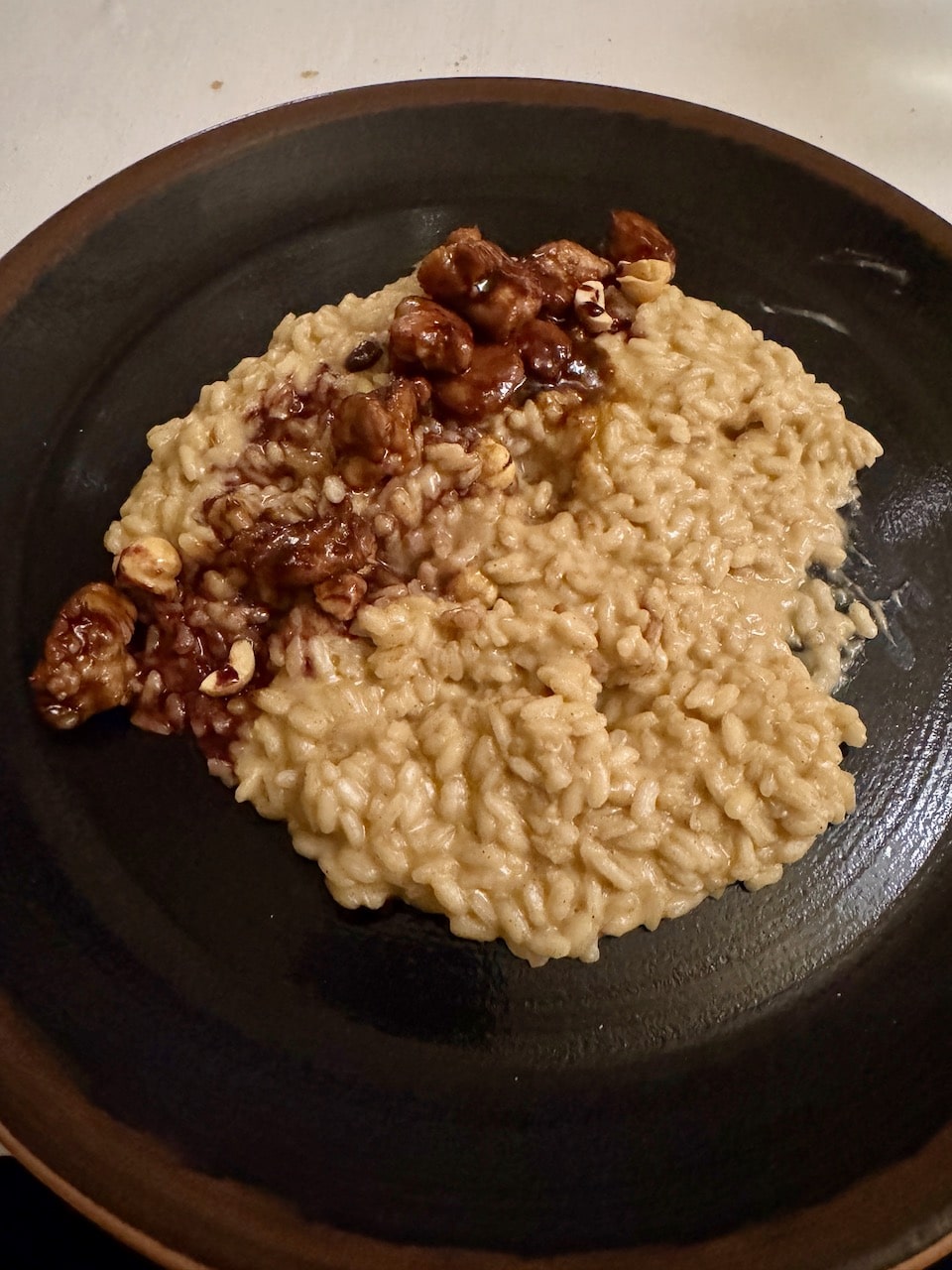
But the standout for us was risotto with lamb sweetbreads.
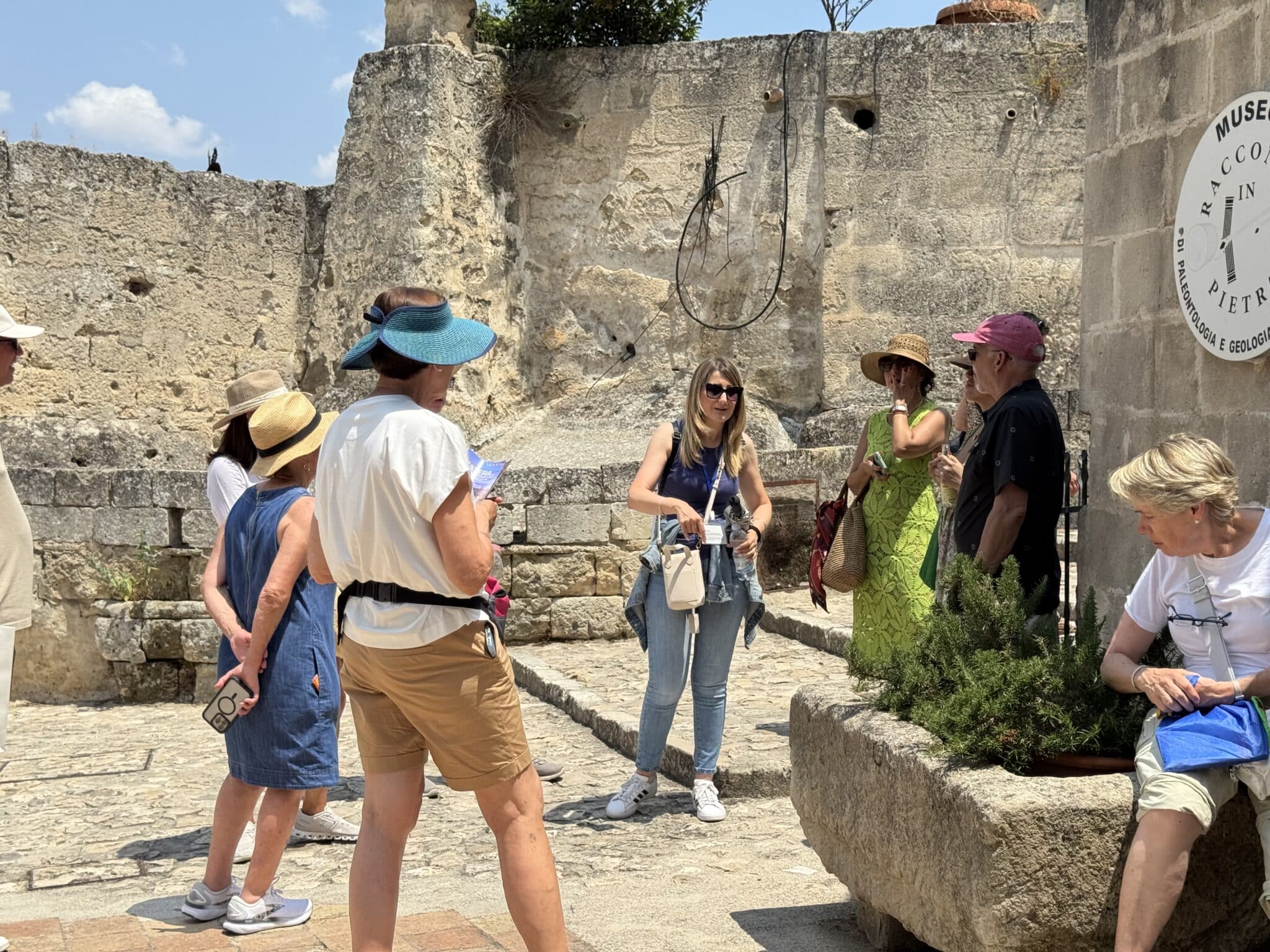
The next morning, the Sant’ Angelo’s front desk arranged a tour with the company Altieri Viaggi. We met our guide Terry in the upper part of the city and instantly realized how important the tour would be to understanding Matera. The small group included people from Switzerland, Miami, Puerto Rico, Spain, and Roseanne and Tony from New Jersey who had family roots in southern Italy and Sicily.
Our Matera tour group. Photo by ConsumerMojo.com.
We started out above the Sassi, the area of the caves. Terry lived nearby and told us her grandfather had lived in the Sassi until the late 1950’s and had not been eager to move.
Tour guide and tourists walking in the city of Matera, Italy. Photo by ConsumerMojo.com
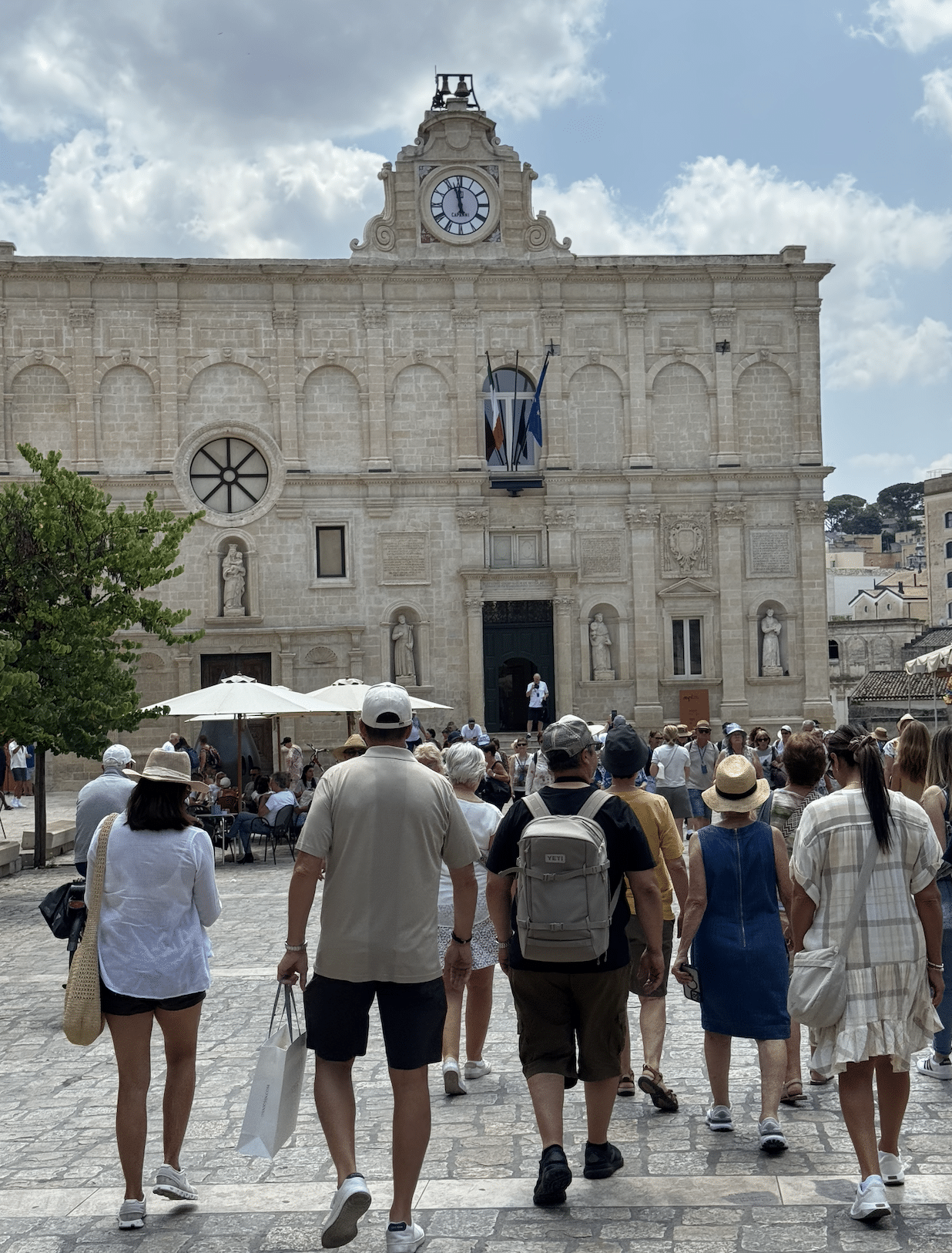
Terry gave us a crash course in the history of the Sassi. She explained that we were meeting in and would walk through the part of the city called the Civita, where the wealthy people historically lived.
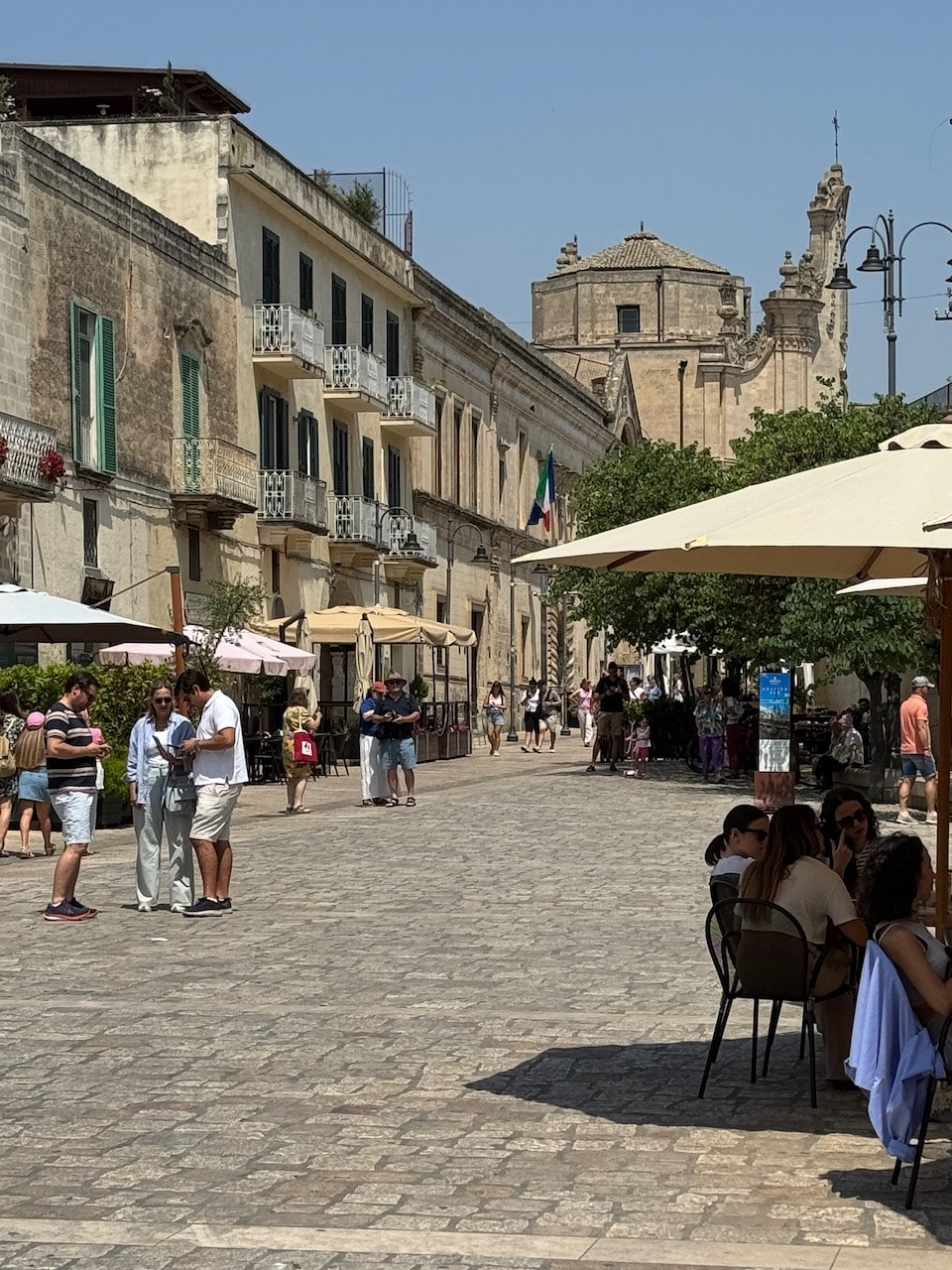
Upper plaza in central Matera. Photo by ConsumerMojo.com
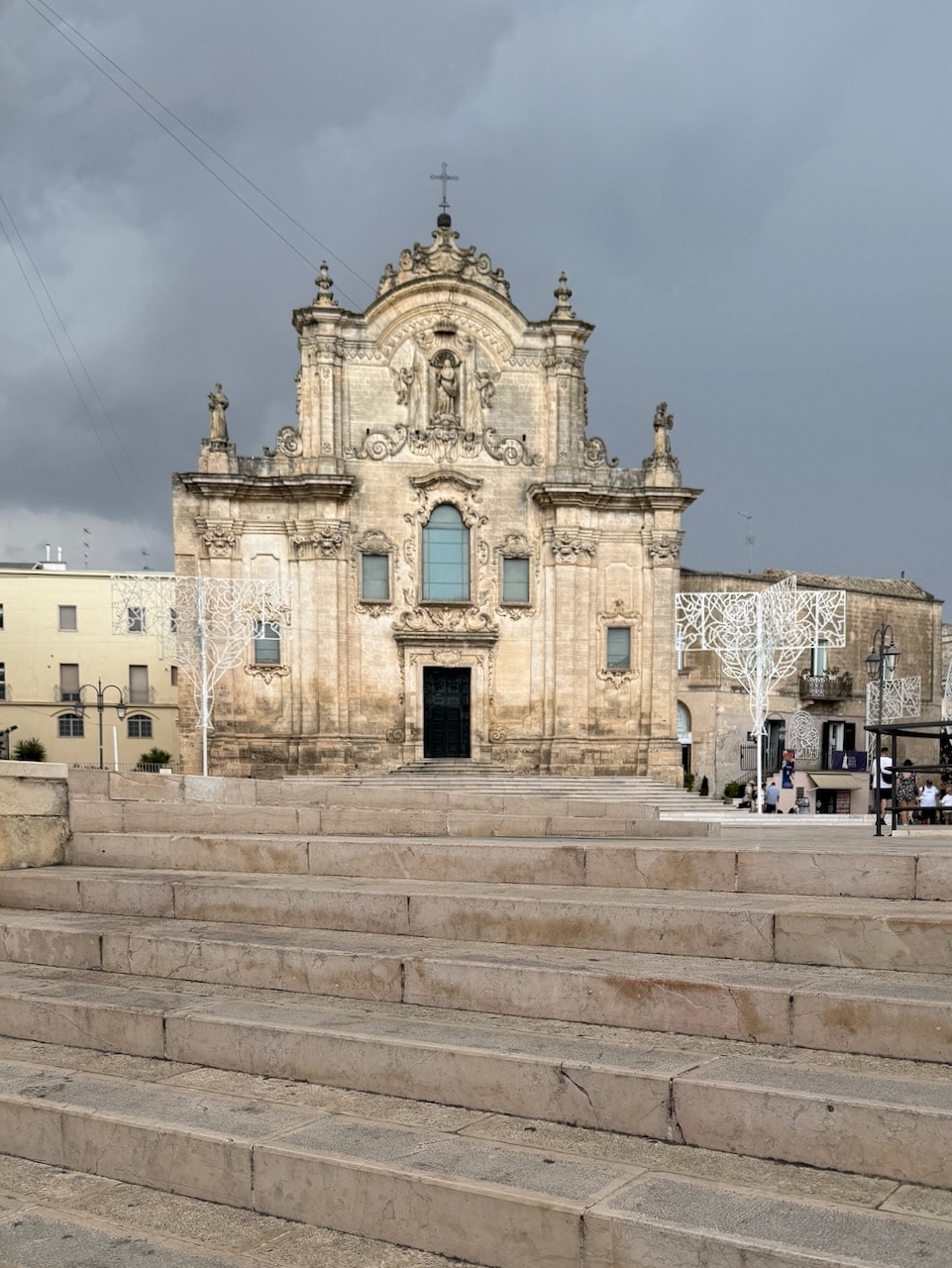
In the 17th century Matera became the capital of the Basilicata region. The elaborate Baroque architecture you see in the upper city is the legacy of that era.
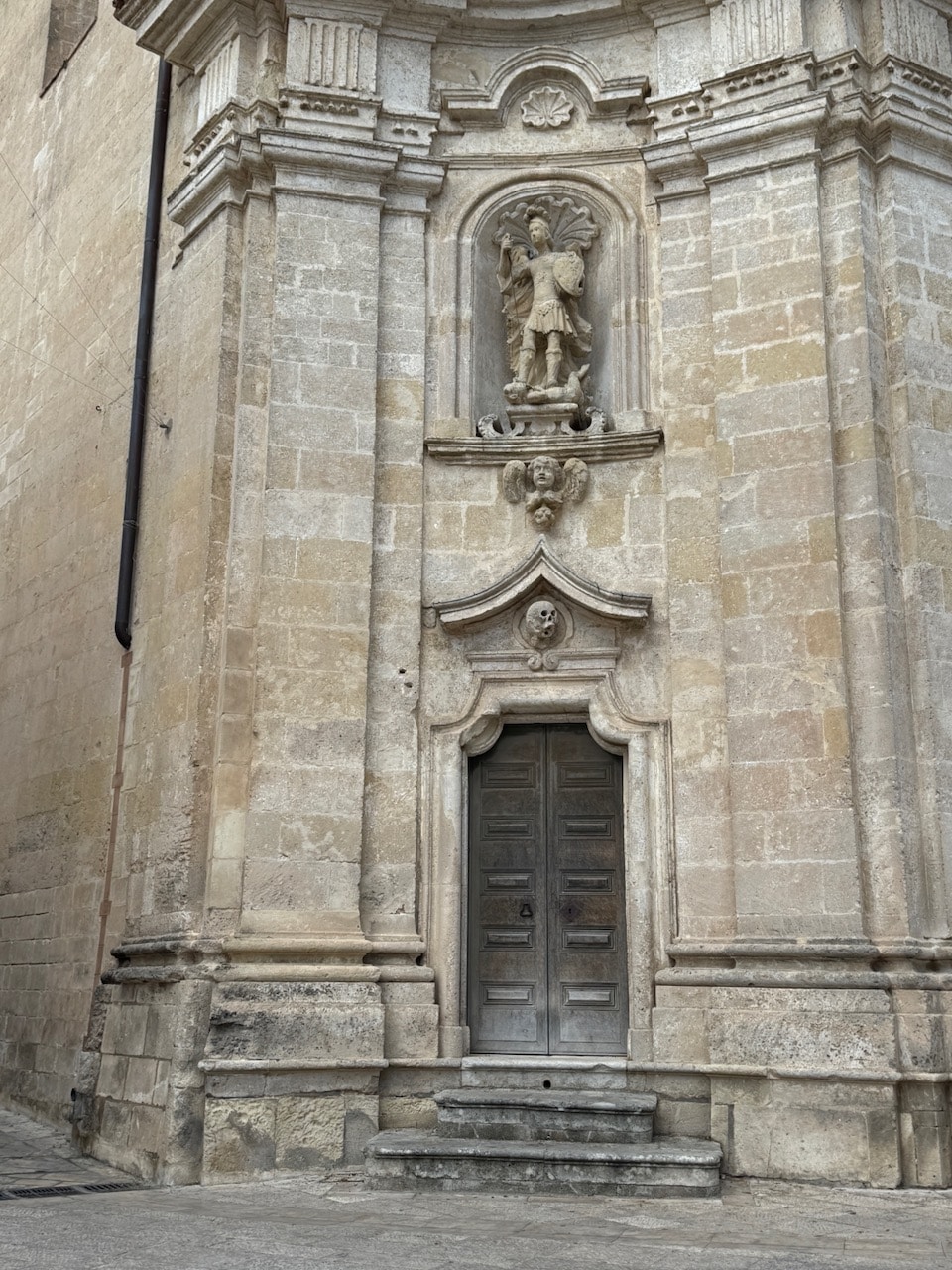
Detail of church in Matera. Photo by ConsumerMojo.comChurch of San Francesco d’Assisi in Matera, Italy. Photo by ConsumerMojo.com
We headed past the 17th century and went down to explore the levels of the Sassi.
There was a clear delineation in class and attitude about the people who lived in the Sassi.
The City of Stone and its caves are intermingled. Photo by ConsumerMojo.com
The people below, Terry said, were regarded as inferior and the people who lived up higher in the Civita would say, “No. I was not living in Sassi.” The rich people, she said, “. . . built on top, or in front of the caves.”
Many levels of the Sassi. Photo by ConsumerMojo.com
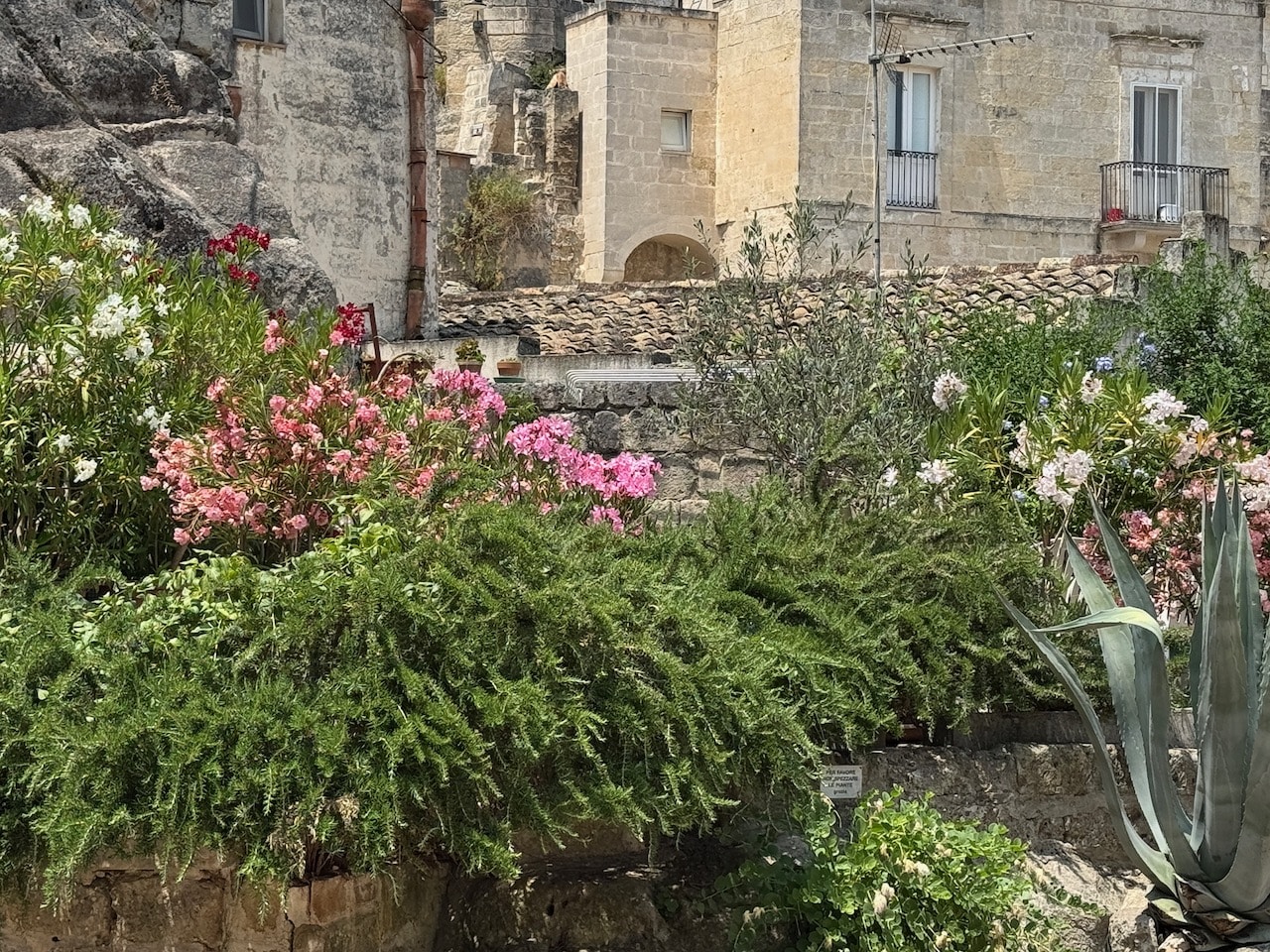
In the searing sun on a June day, the collection of white limestone structures, built into the hillside, vividly displayed the seemingly haphazard stacking she was talking about. We wound our way through the maze of the Sassi, where a beautifully planted garden stood out against the stone. It reminded us that development of restaurants, hotels and people who bought property here brought Matera back to life and helped it earn the designation of European Culture Capital in 2019. Terry said, “From the ‘shame of Italy’ to the European Culture Capital. We got the last laugh.”
The city has worked hard to please tourists, who keep the economy humming, and they try to tell their story in an appealing way.
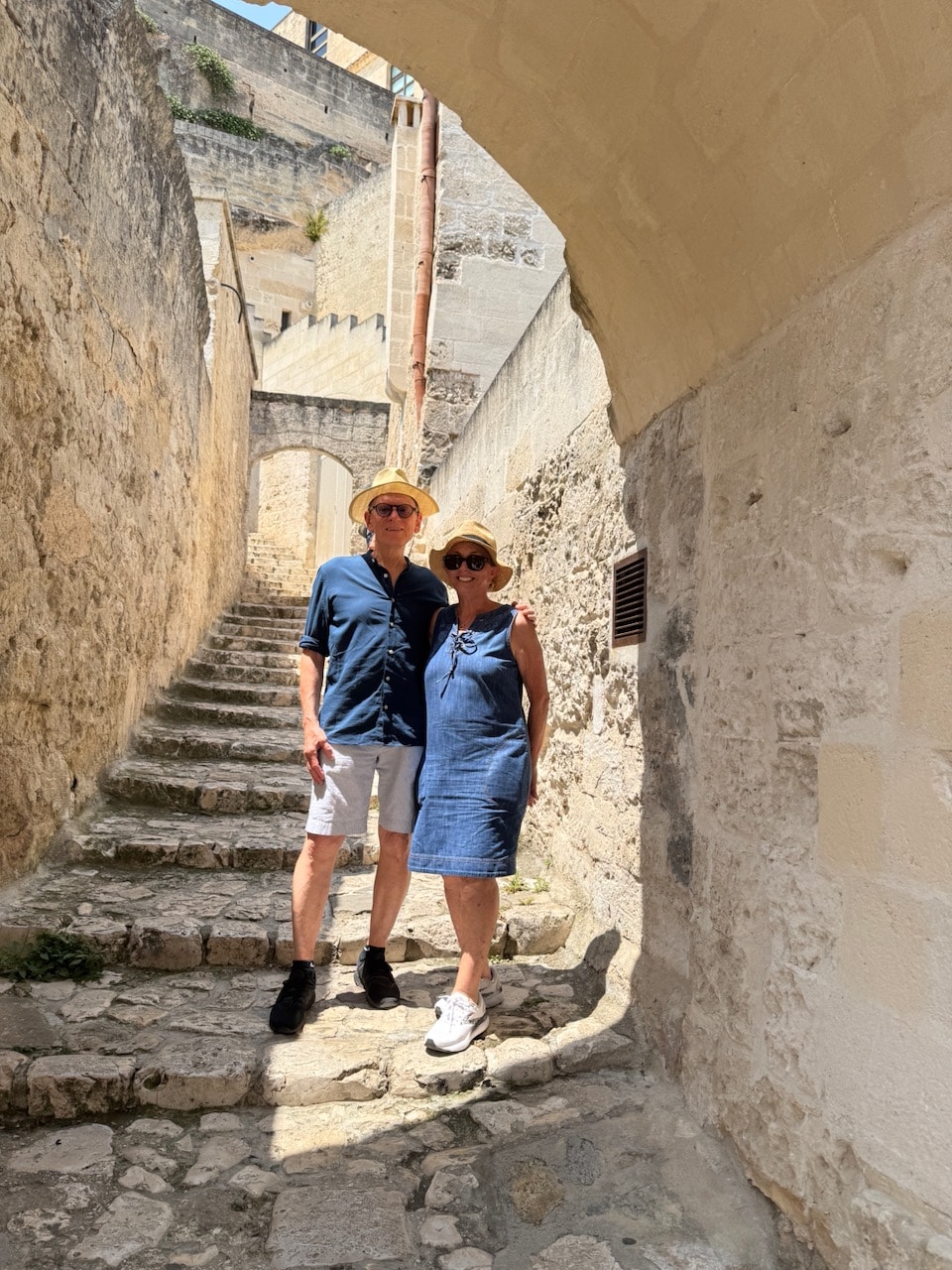
Nick Taylor and Barbara Nevins Taylor on the steps in Matera. Photo by ConsumerMojo.com
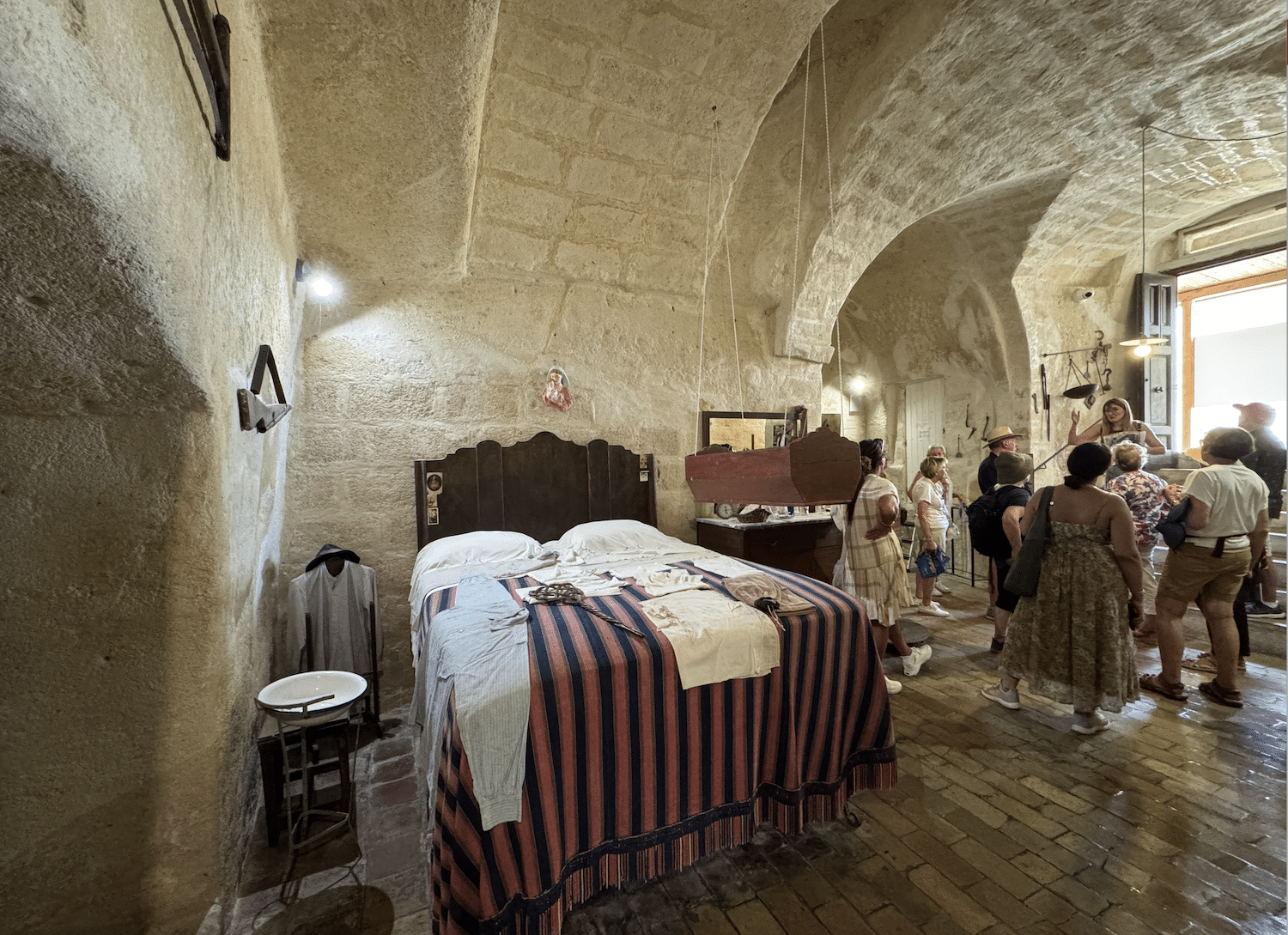
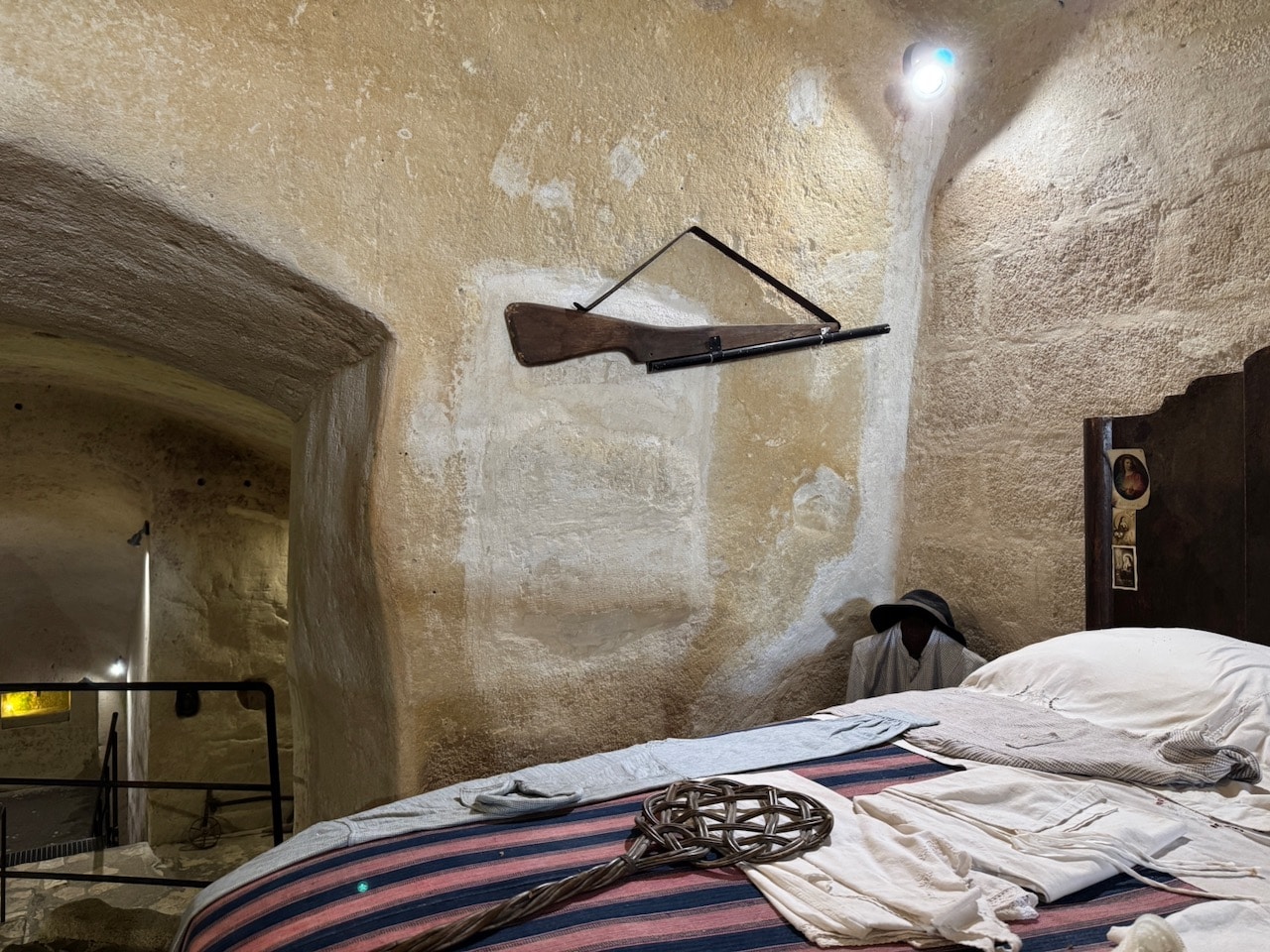
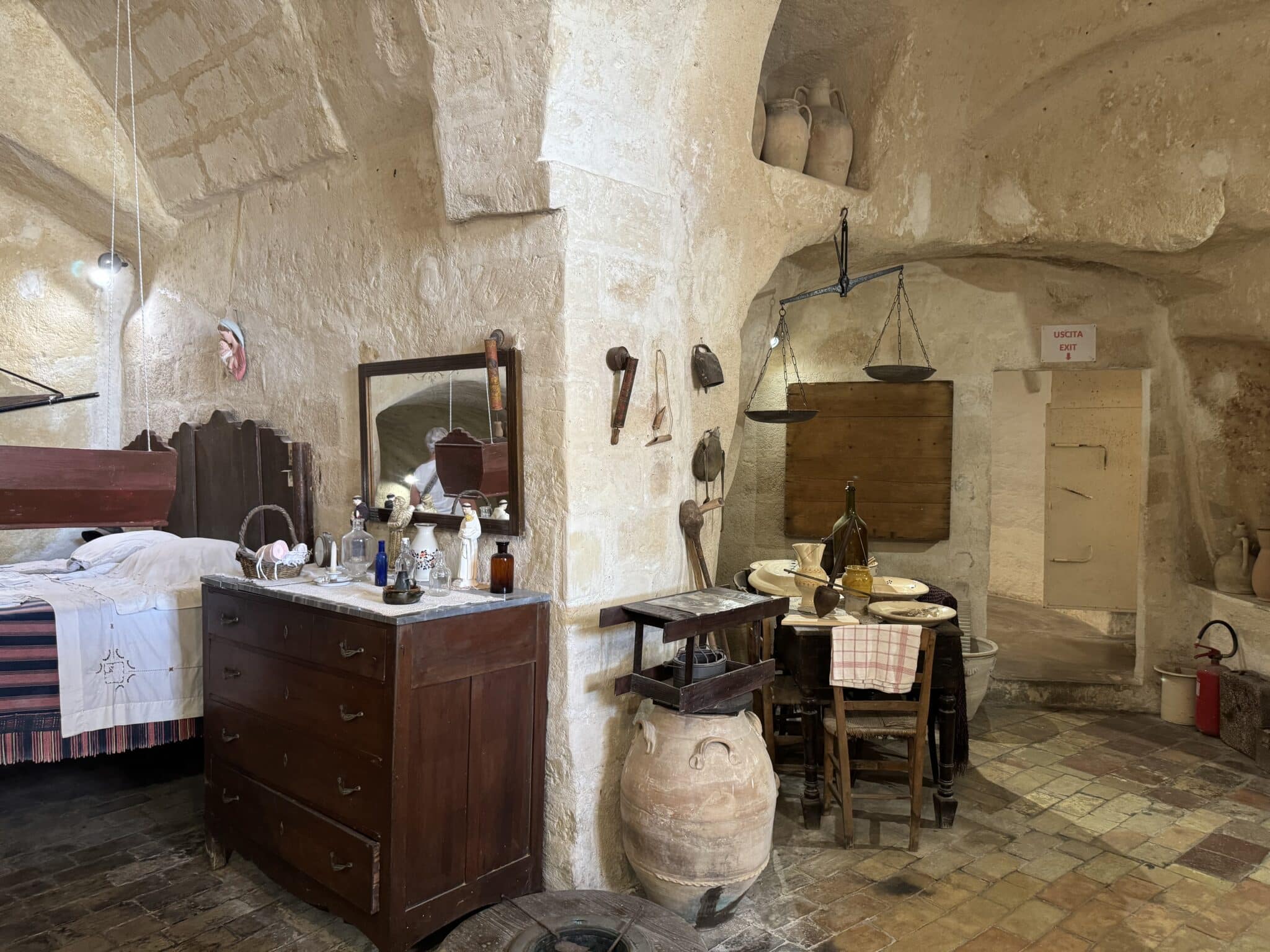
Several of the cave houses have been fitted out to display the way a typical Sassi family lived before they were moved out to modern housing.
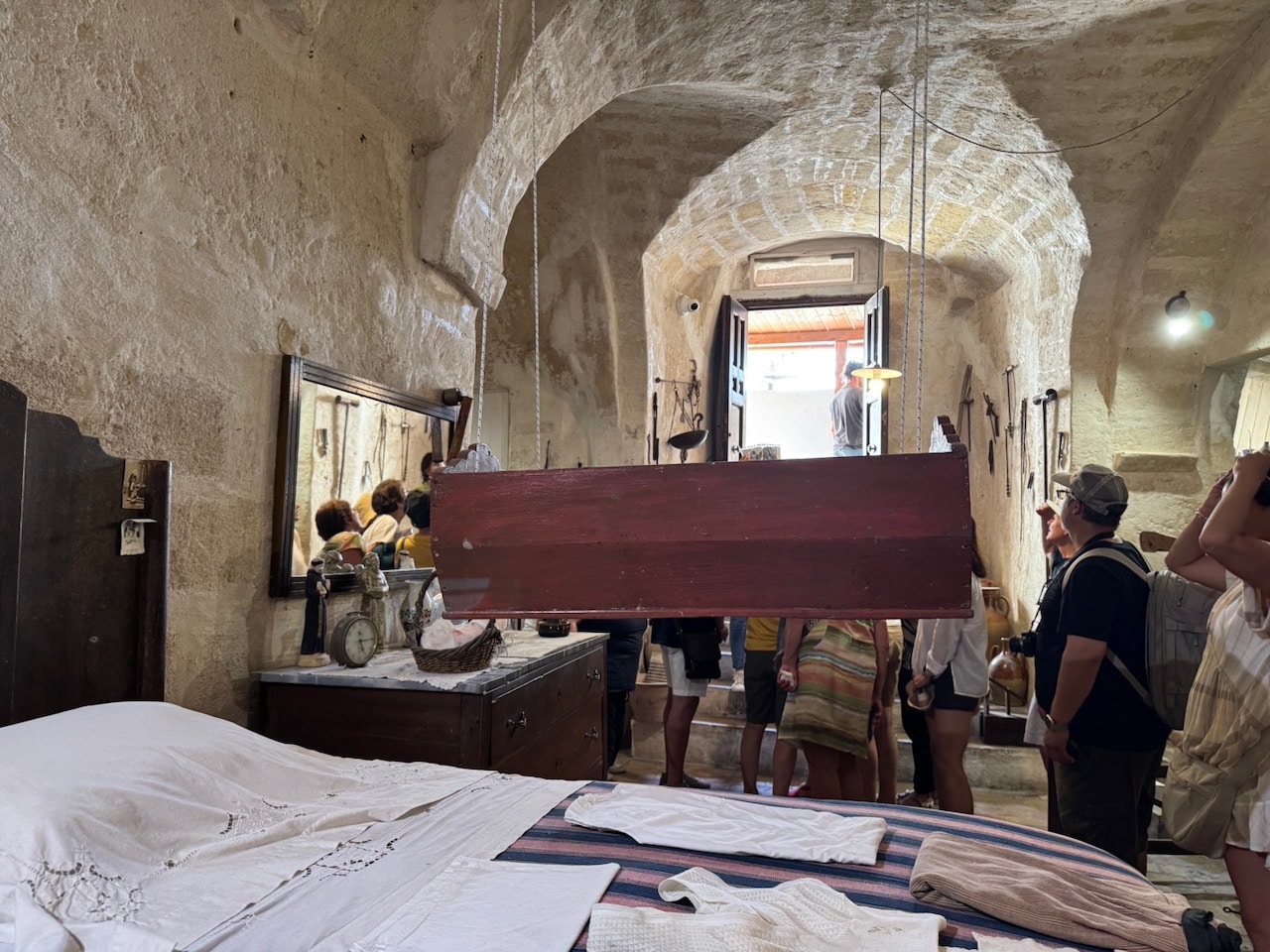
Bed in the Sassi house with clothes and cradle. Photo by ConsumerMojo.com
Terry explained that the big bed, at the center of the cave, was where everyone in the family slept. The cradle above the bed was intentionally high.
The elevation kept the rats from getting to the baby, or the child. And a rifle hung on the wall close by.
Shot gun in the Matera cave house. Photo by ConsumerMojo.com
Through the arch, deeper into the cave, the family kept their livestock, donkeys, and chickens, if they had any. Many of those who lived in the Sassi farmed in the valley or in fields beyond the town walls.
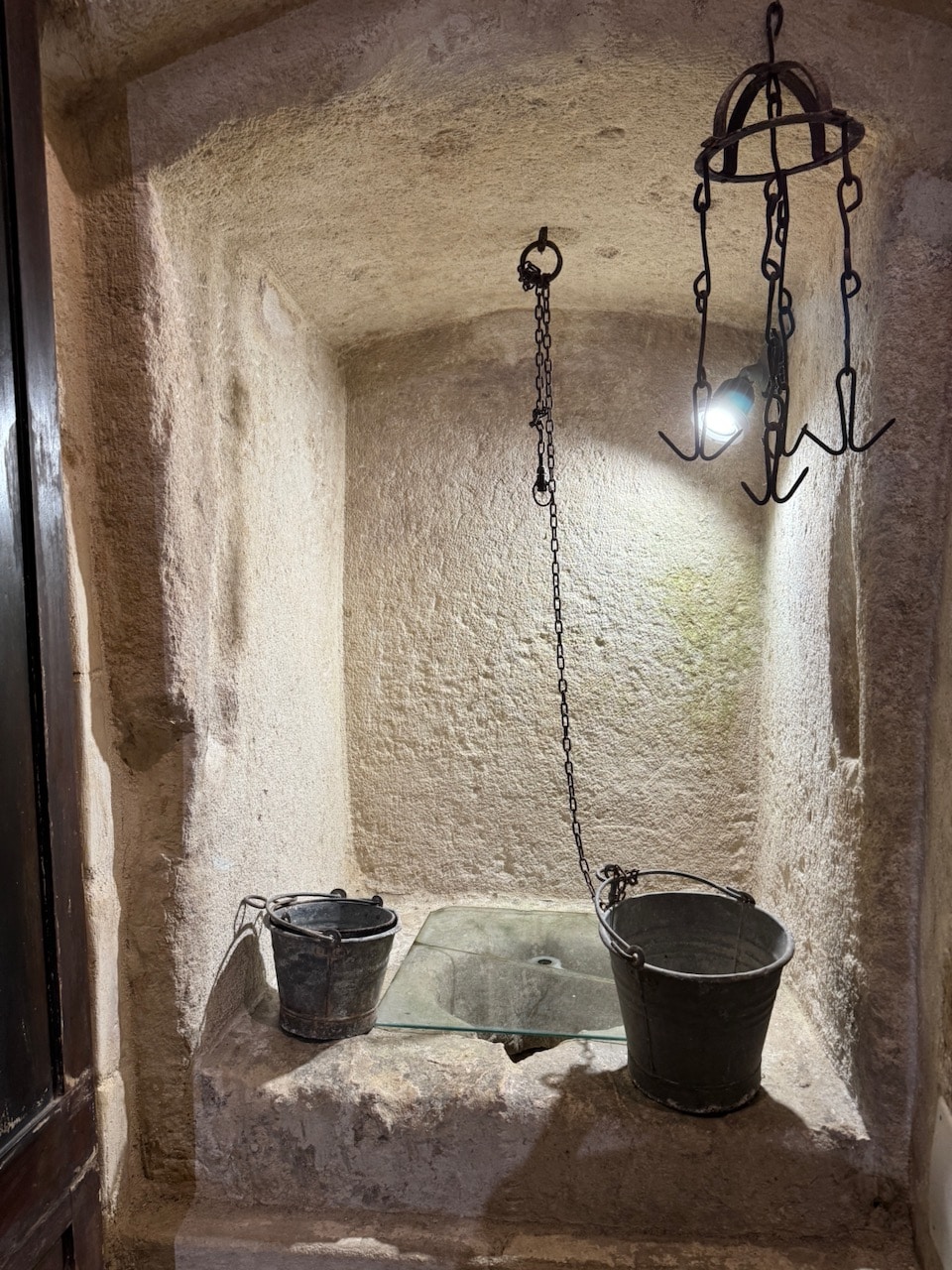
And what passed for plumbing was tucked into an alcove close to the foot of the bed.
Buckets and a pulley system worked as a toilet in Matera. Photo by ConsumerMojo.com.
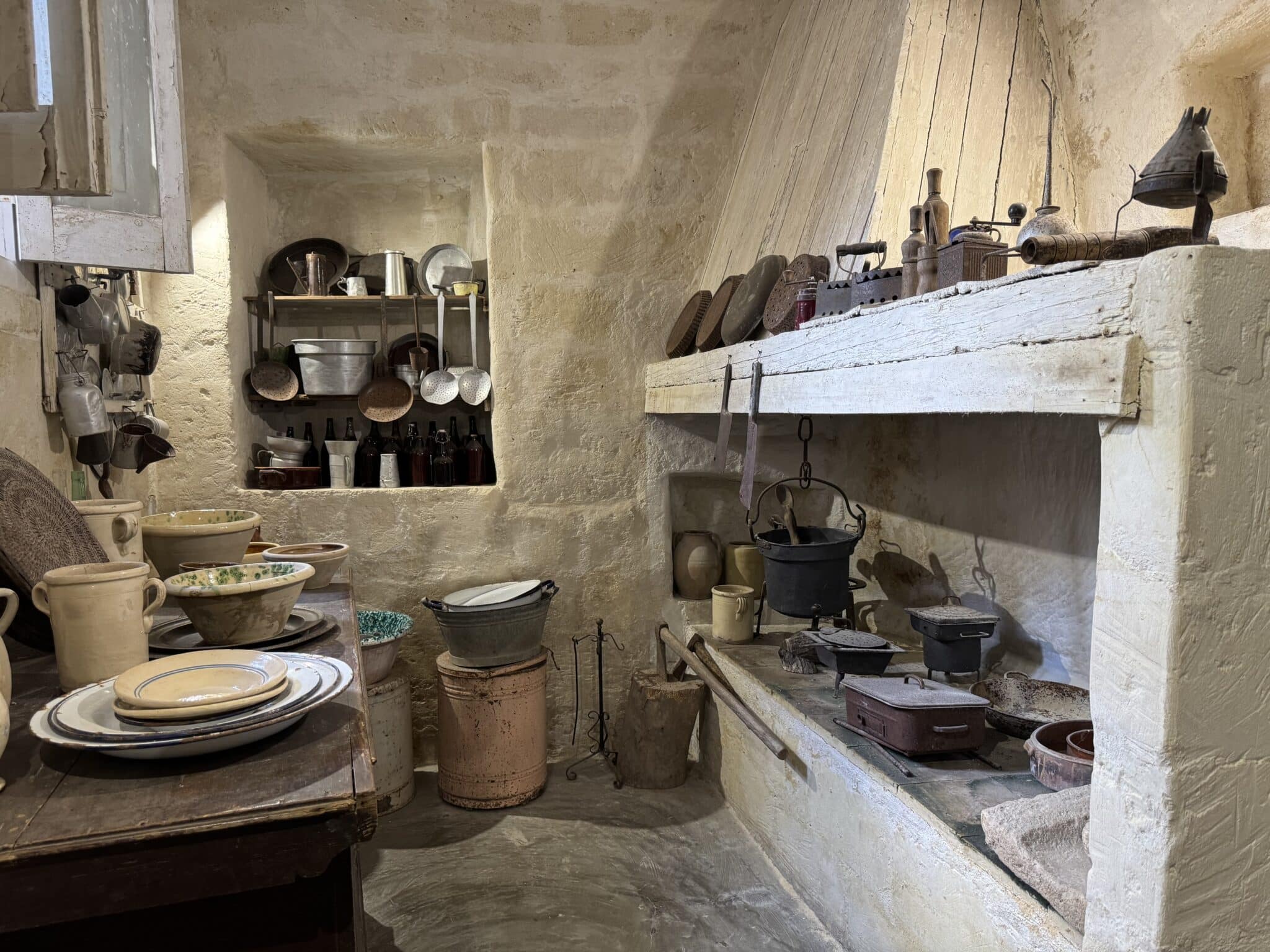
The kitchen was a separate area and you’ll notice that there are pots and pans, but no oven. Materans used communal ovens and had a system for collecting rain water and spring water for washing and bathing.
A kitchen carved out of a Matera cave. Photo by ConsumerMojo.com.Dining area in a cave house. Photo by ConsumerMojo.com
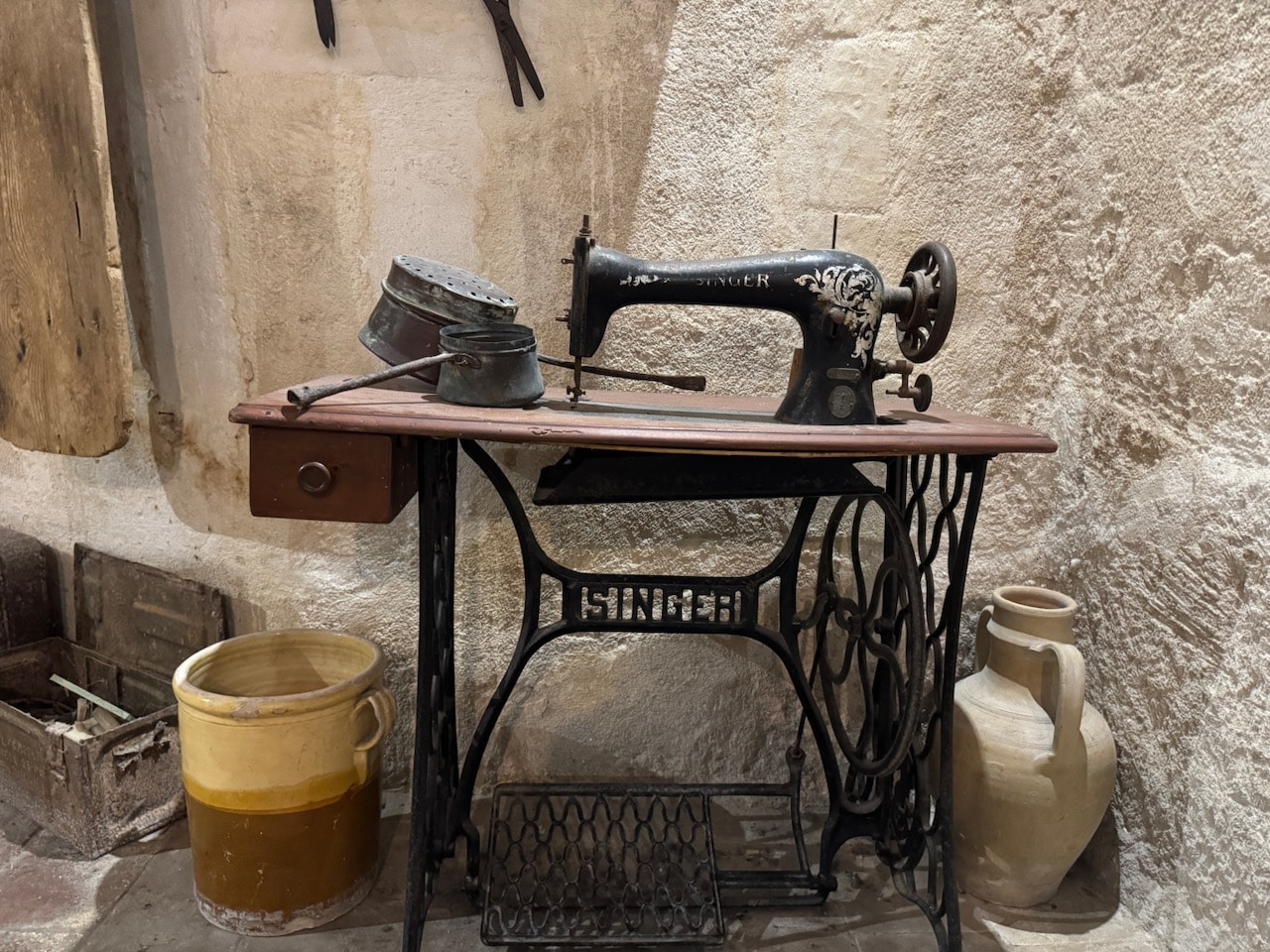
In the cave we visited, a place to sew was set up with a machine like Barbara’s grandmother used in New York.
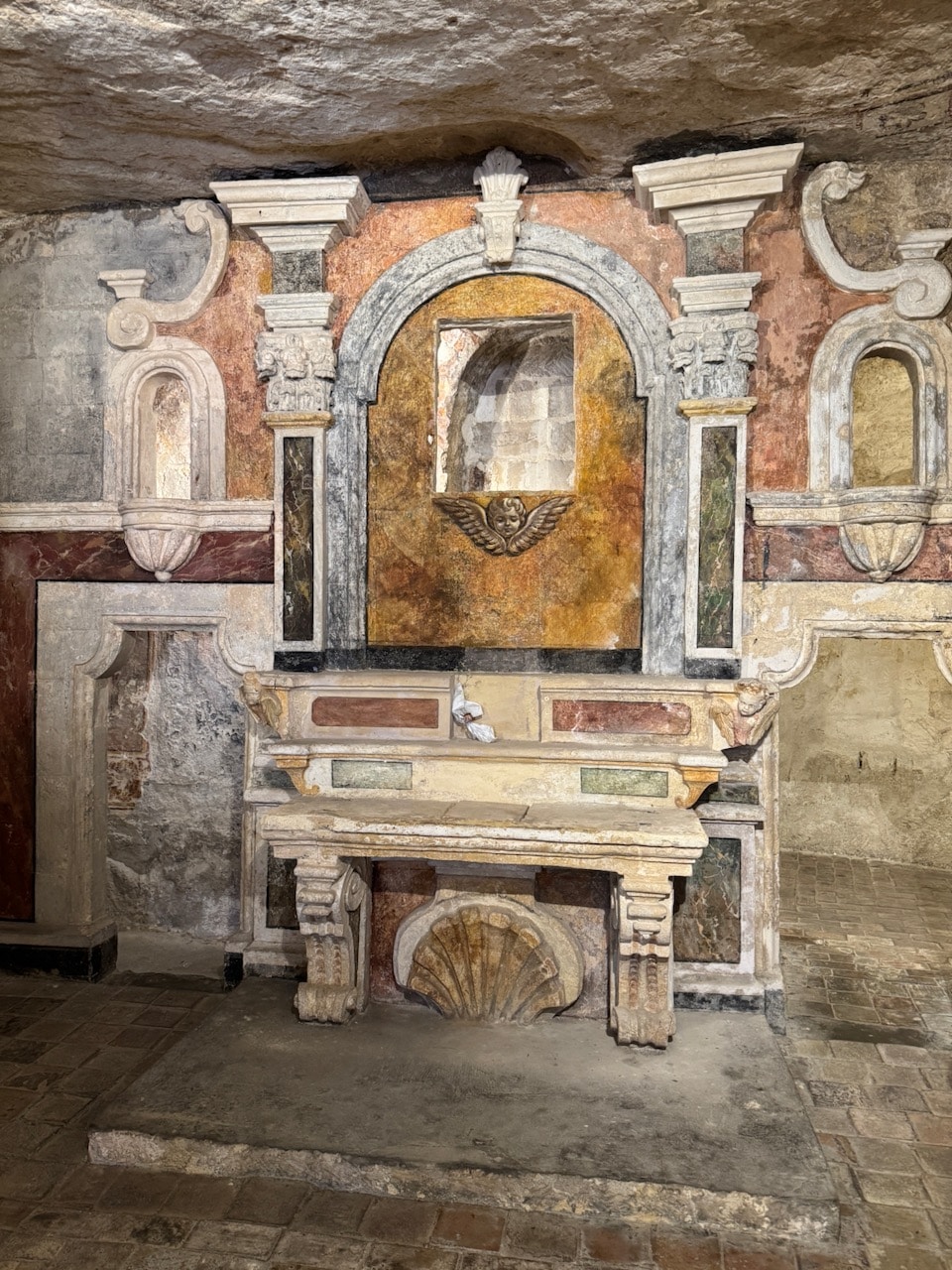
This is Italy, and just as there are churches that rise high from a mountain, there are churches below ground.
Altar in the cave. Photo by ConsumerMojo.com
Cave churches are thought to have been created between the 8th and14th centuries by Benedictine and Byzantine monks.
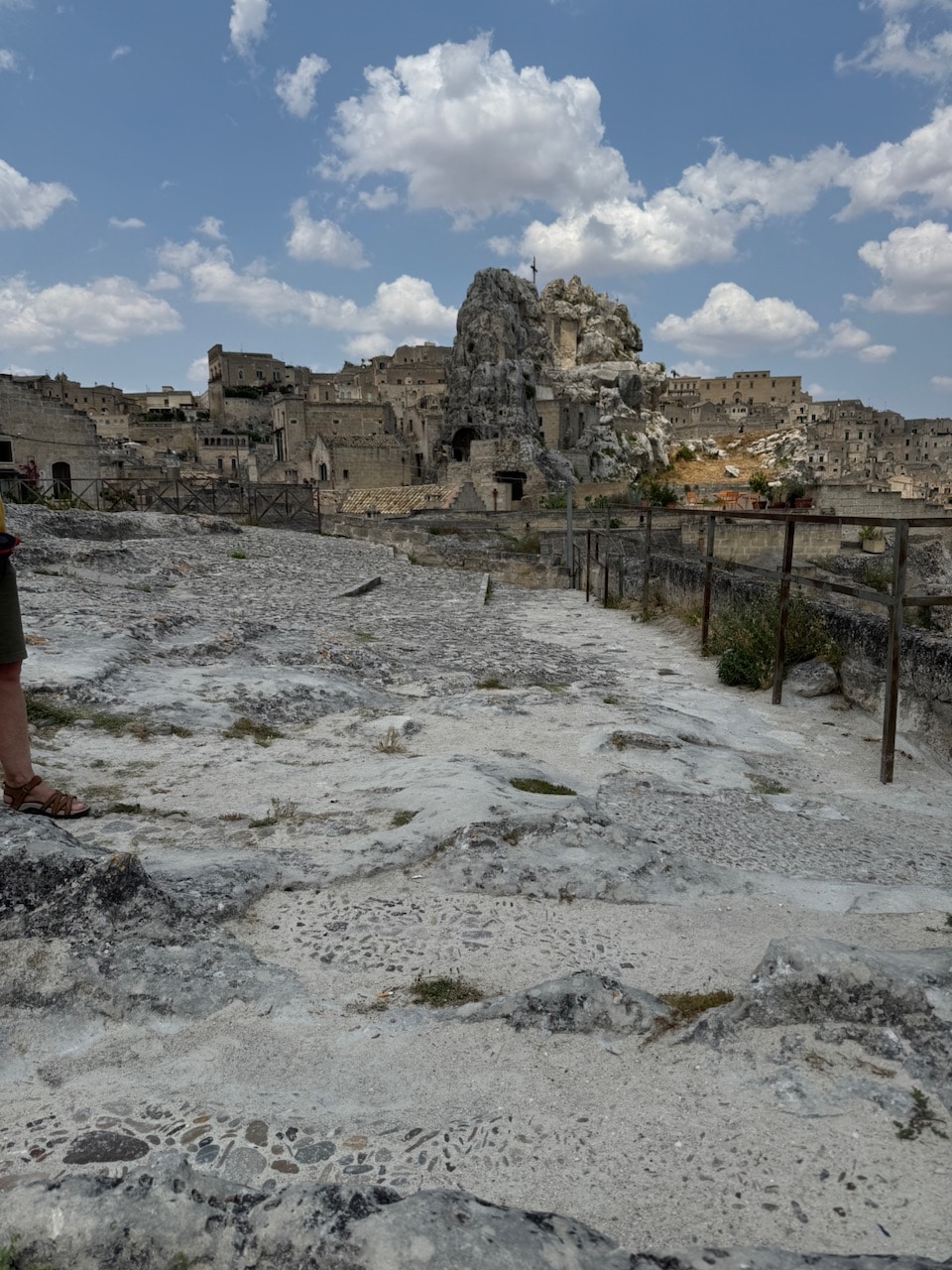
Back out in the sunshine, Terry led us to what she called “the cemetery.” Archeologists digging here realized that these imprints were actually graves and stopped the dig. The church in the background is Santa Maria de Idris, carved out of rock, and one of Matera’s most famous.
The ancient graves in the Matera stone ended Terry’s informative tour, and we headed back to the Sant’ Angelo to escape the heat and rest for another lovely dinner at Baccanti. Pasta was on our menu!
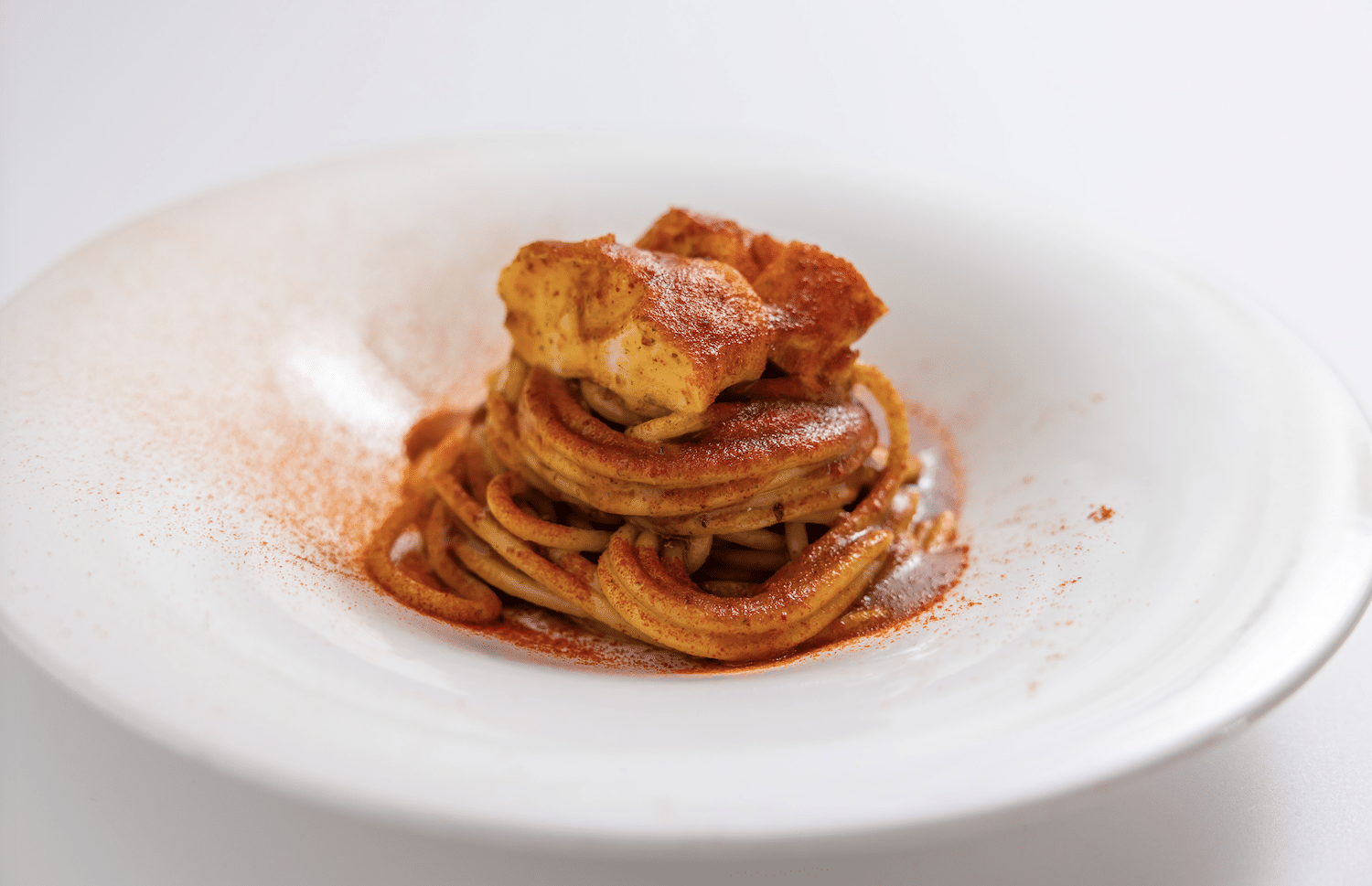
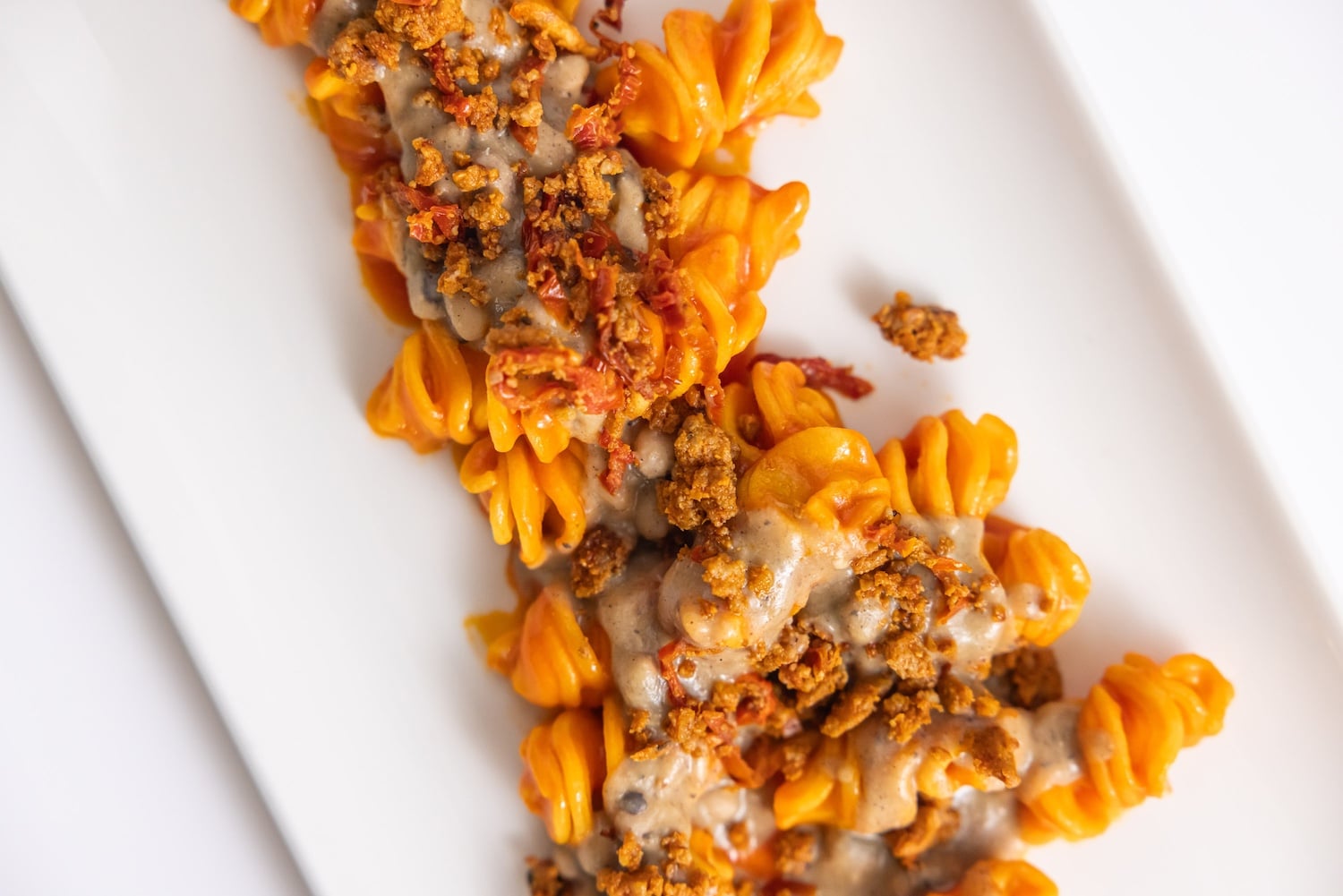
Spaghettone Gentile with garlic and oil, Crusco, nduja and cod. Photo by BaccantiFusillone con peperoni arrosto, pesto di mandorle, olive taggiasche e capperi. Photo by Baccanti
In the morning, we and our luggage piled into a hotel van that took us away from the Sassi into the new part of Matera and the parking garage where we had left our rental car. We were off to Taranto, with a stop in Alberobello and some cone-roofed trulli houses on the way.
And you can watch and listen to Terry the tour guide talk about the class distinctions in Matera.
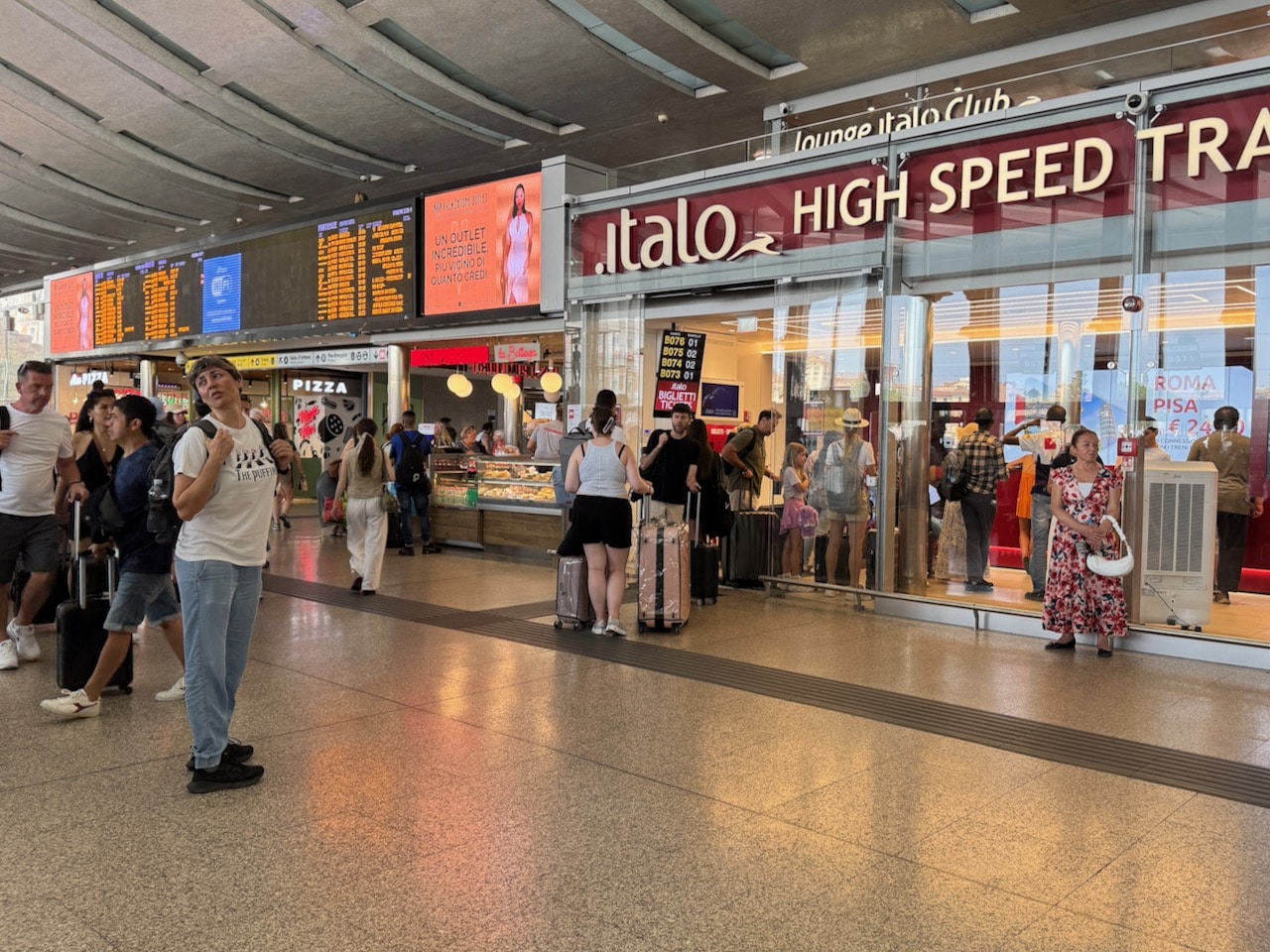
We hoped three days would work for a visit to Pompeii, Sorrento and the Amalfi Coast. It seemed ambitious, but doable if we used the Sorrento area as a base. So on a Sunday morning, we boarded a high speed train from Rome to Naples. Once we sorted out the difference, basically not much, between the state-owned rail line Trenitalia and privately owned Italo, we booked first class seats on Italo because the Sunday morning schedule worked for us.
Rome Central Station. Photo by ConsumerMojo.com
An hour and 10 minutes out of Rome, the train pulled in to Napoli Centrale. We’d arranged to have a driver pick us up there and take us to Vico Equense near Sorrento for the next part of our Italian adventure.
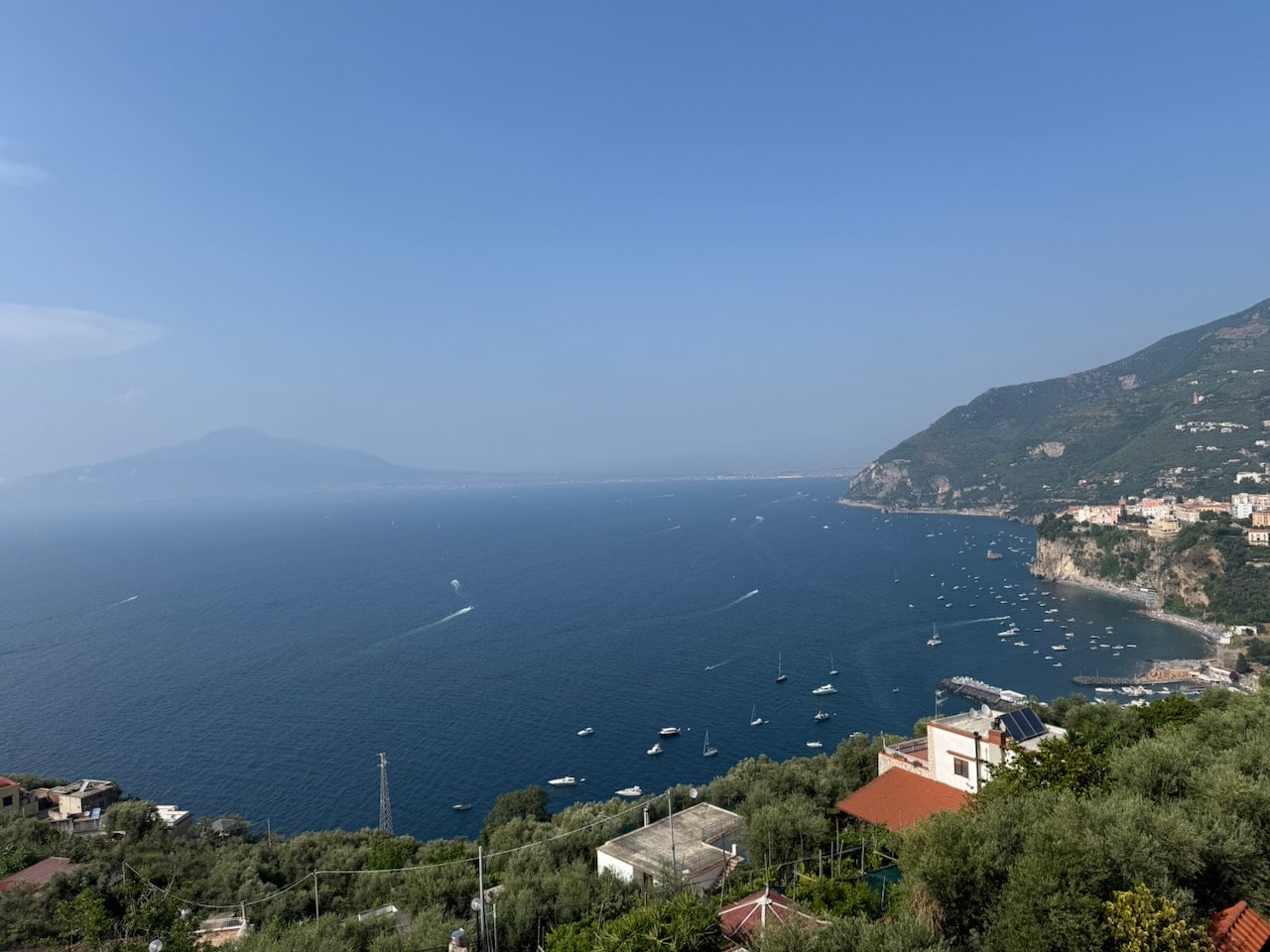
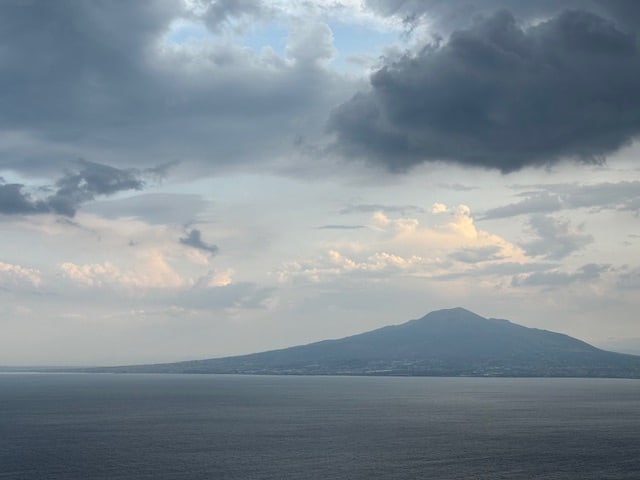
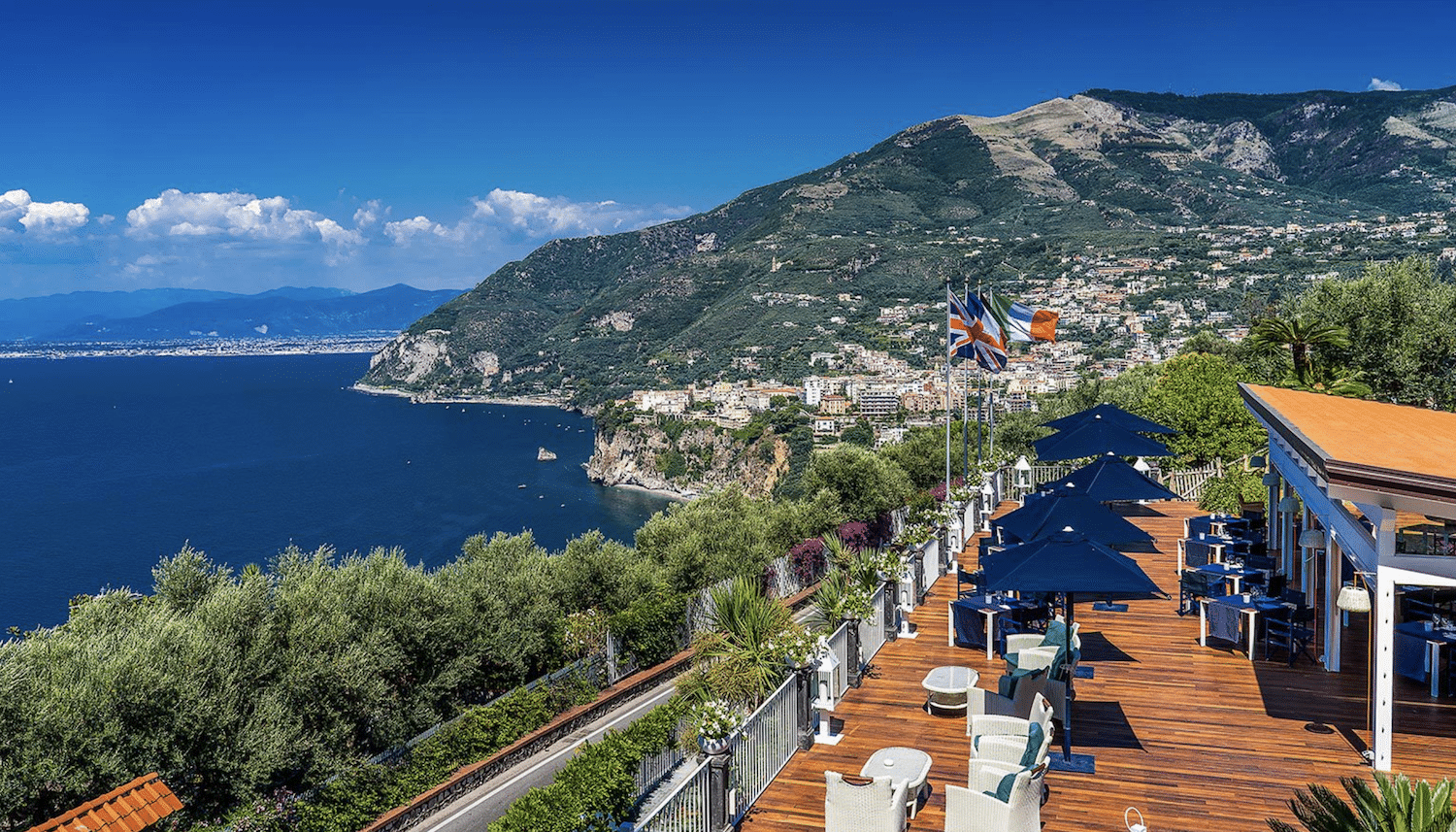
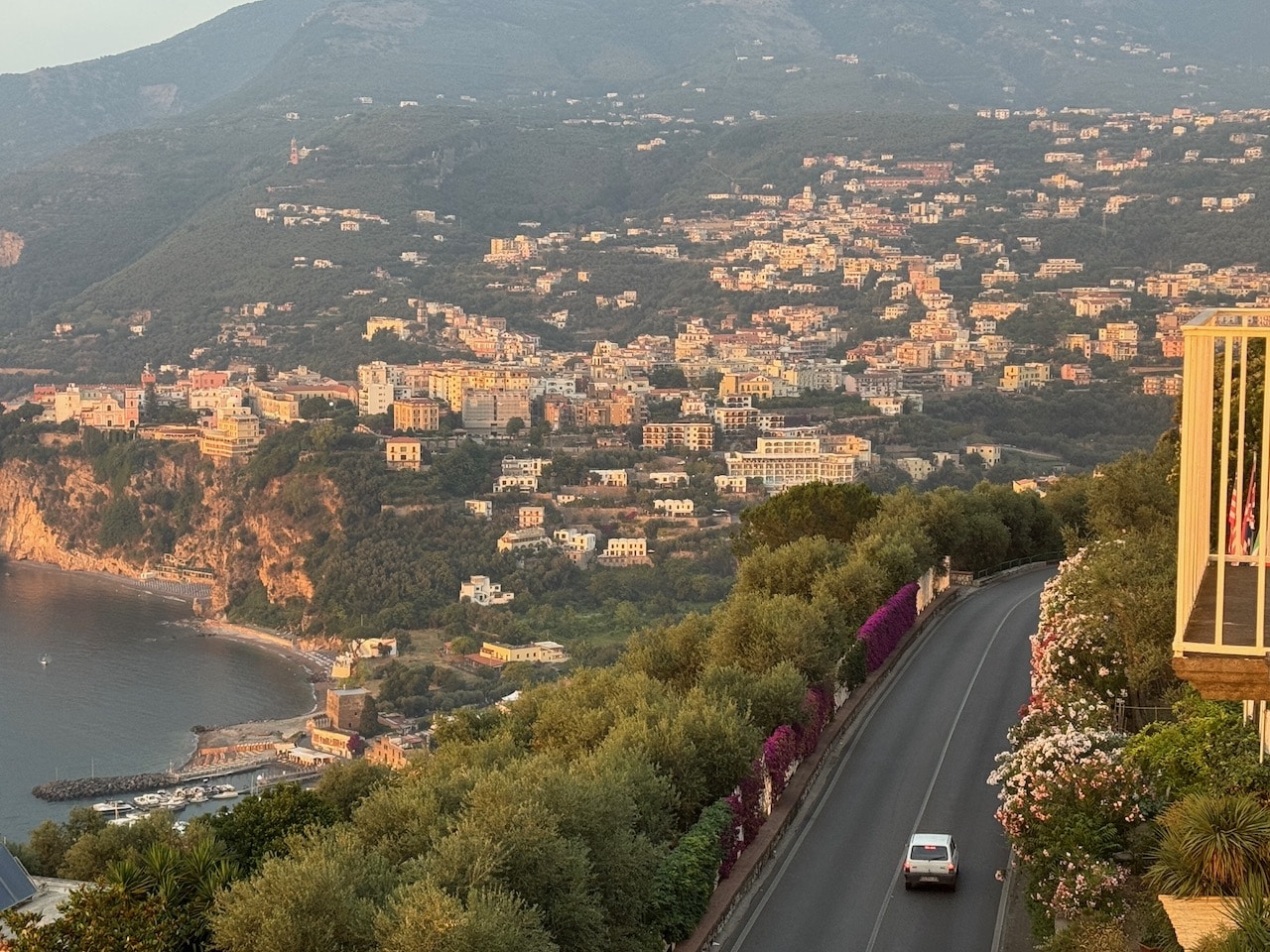
We chose the Hotel Torre Barbara as our base. We picked the hotel not just for the name but for the view we saw online. The reality when we arrived was more spectacular than the photos. Our room had a terrace that hovered over the main Sorrento Coast road and the beautiful Bay of Naples. A persistent mist shrouded Mt. Vesuvius at first, but it cleared as time went on.
View of Bay of Naples with Vesuvius from Vico Equense. Photo by ConsumerMojo.comMt. Vesuvius from across the Bay of Naples. Photo by ConsumerMojo.com.
Staffers at the small hotel made us feel like we were in a family place, although a thoroughly professionally one. Benedetta Torrico checked us in and right off the bat told Barbara the correct Italian way to pronounce her name was BAArbAArA, as if each A was an Ah! said when you’re enjoying something very much. She and the other staffers live in neighboring towns, loved the Sorrento Coast and were warm, knowledgable about the area and extremely helpful.
We decided to enjoy drinks and dinner on the hotel terrace.
Photo courtesy Torre Barbara.
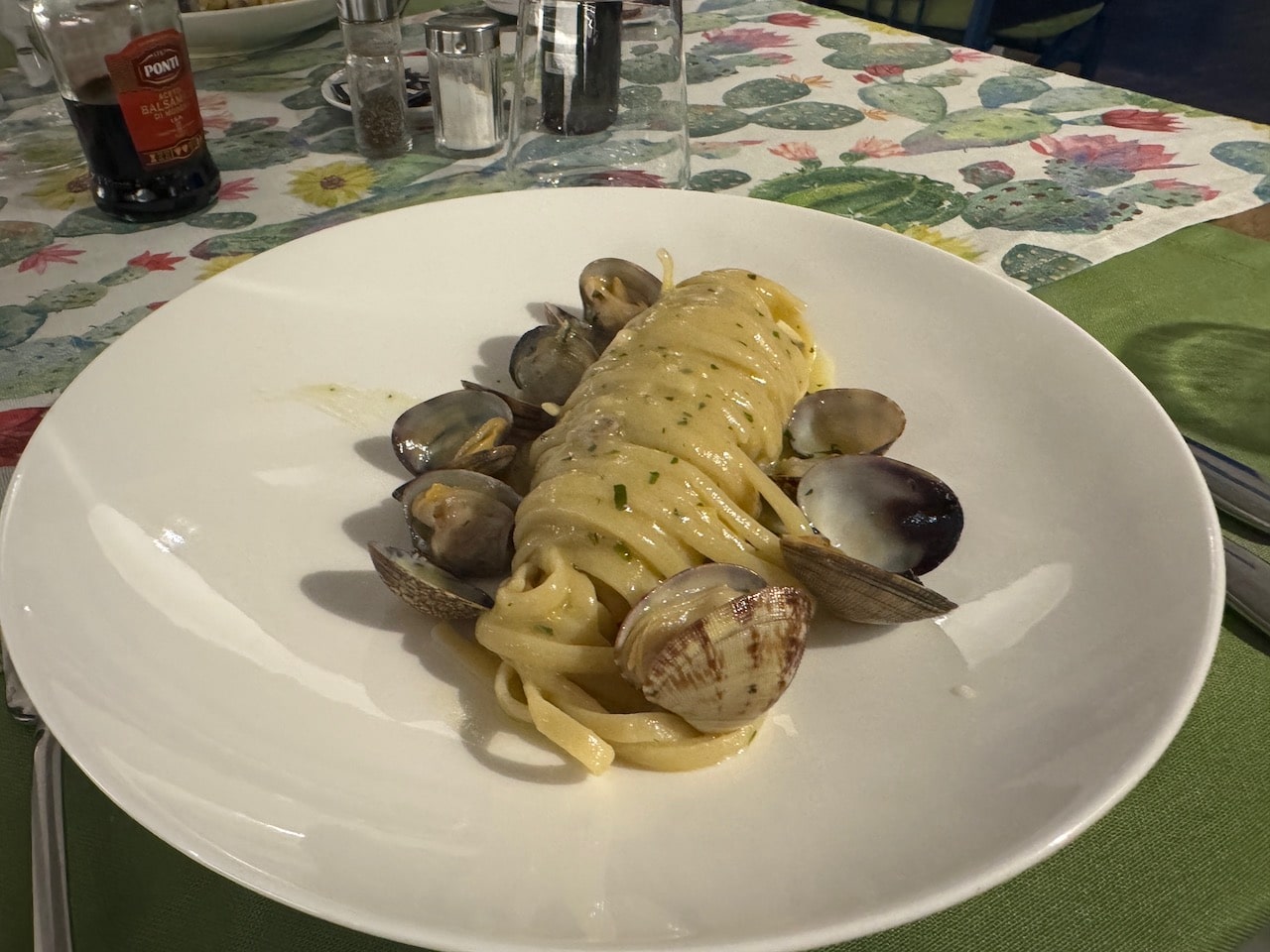
That first night Maria Ercolano, an enthusiastic server, became an instant friend. The linguine vongole tasted as good as it looked.
Linguine Vongole, Torre Barbara. Photo by ConsumerMojo.com
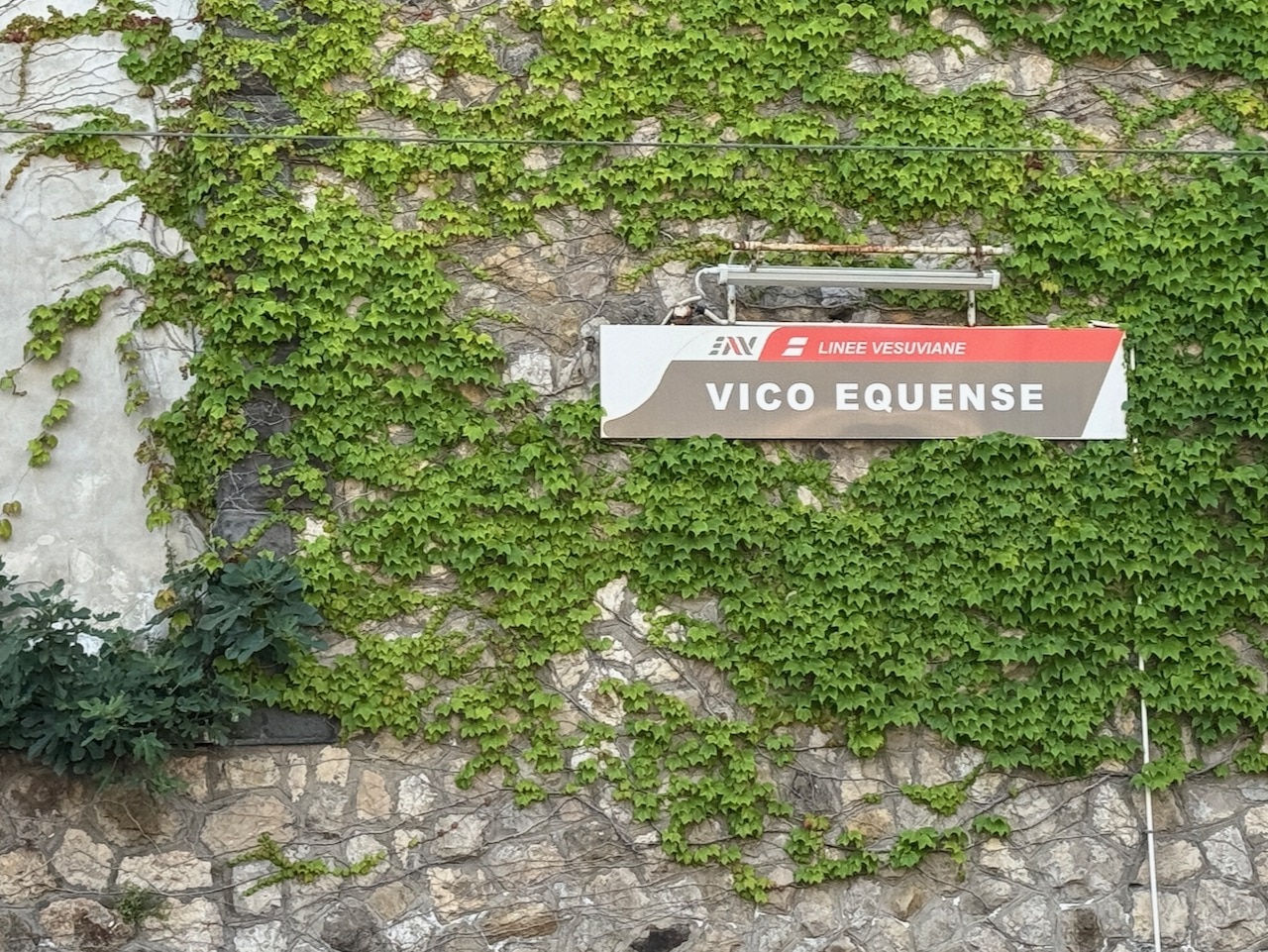
Early the next morning, we took a taxi into Vico Equense and caught a train for the 25 minute ride to Pompeii.
Vico Equense Train Station. Photo by ConsumerMojo.com
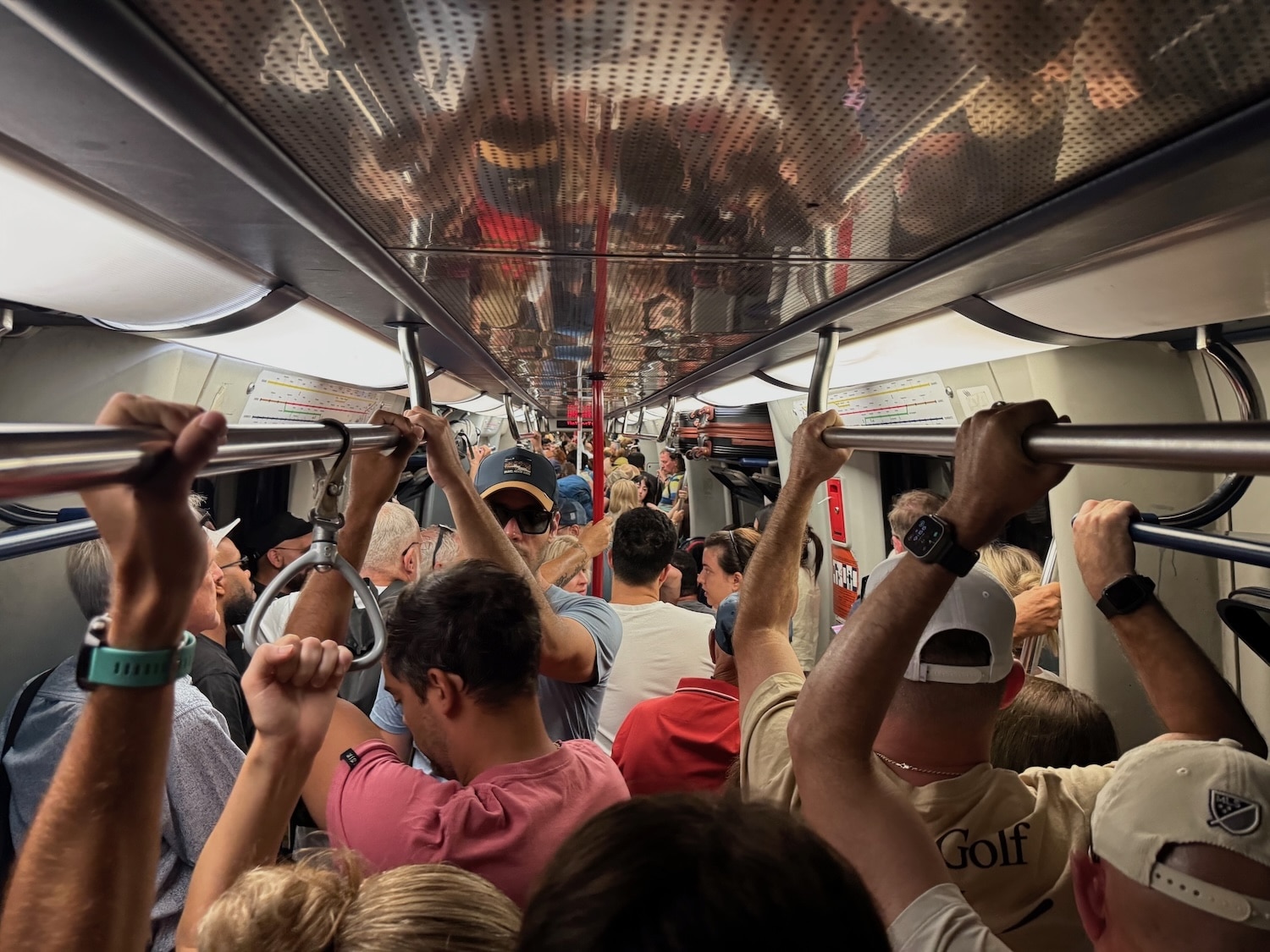
It turned out we weren’t the only people who wanted to stay on the southern coast and travel back up to Pompeii. The train was as packed as the A train in Manhattan.
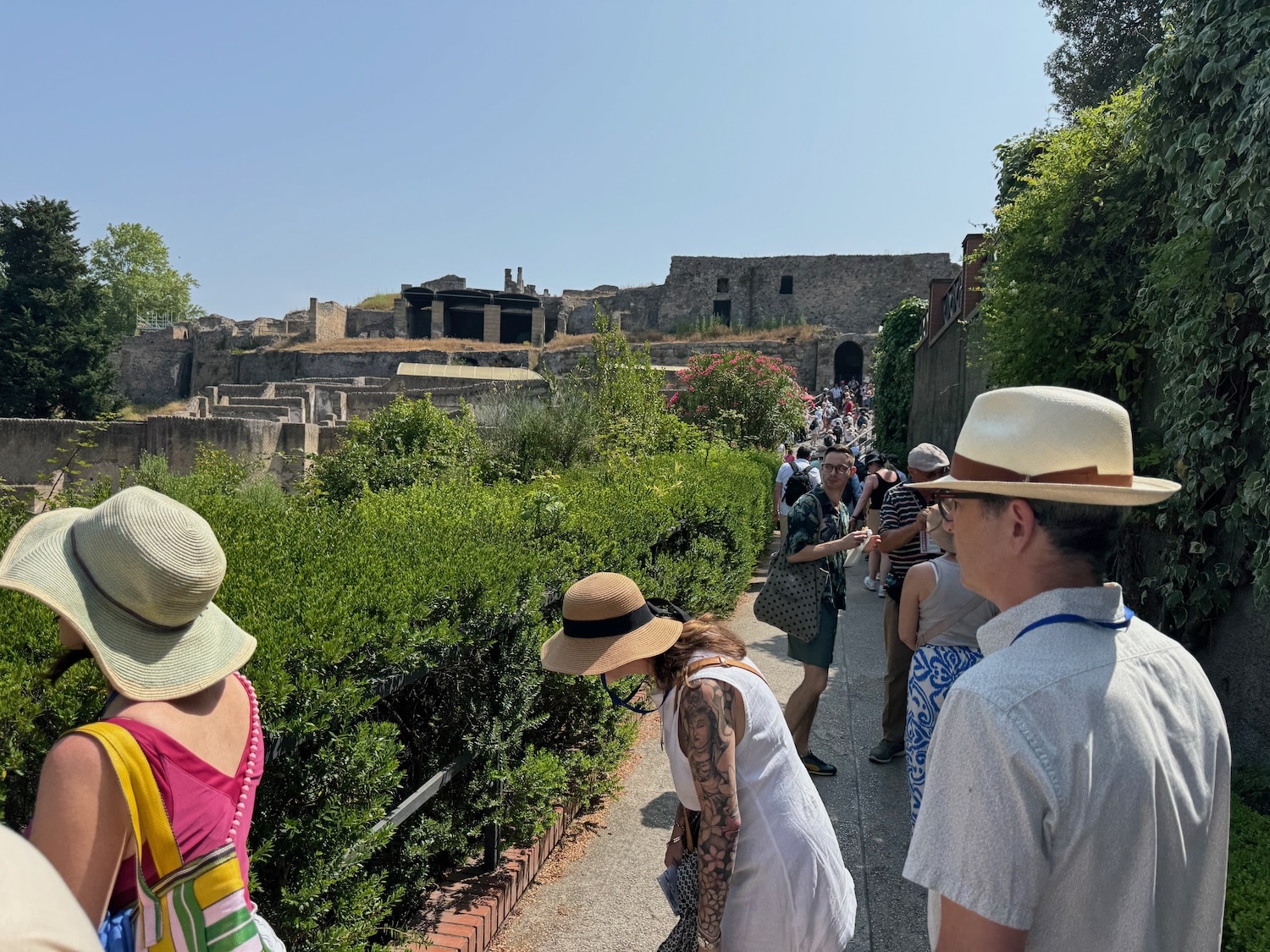
We weren’t the only people who wanted to see Pompeii. Photo by ConsumerMojo.com.
Pompeii was the main reason for this part of our trip. Before we left home in New York, we read Robert Harris’ gripping novel Pompeii that imagined the days and hours leading up to the eruption of Vesuvius and the city’s burial under ash and lava in 79 AD. With this fictionalized history under our caps, we signed up for a tour with Walks of Italy so that we could hear from an expert and get more of the real story. How did people live on the Bay of Naples nearly 2,000 years ago? We also hoped to see more of the Roman mosaics and frescoes we’d seen and admired on previous trips
We met our guide Vincenzo Di Mauro, who had degrees in archeology and anthropology, at the main gate just a short walk from the train station. He introduced himself to our small group of twelve or so people and spoke excellent English. We entered the main gate, Porta Marina, and began an short uphill climb.
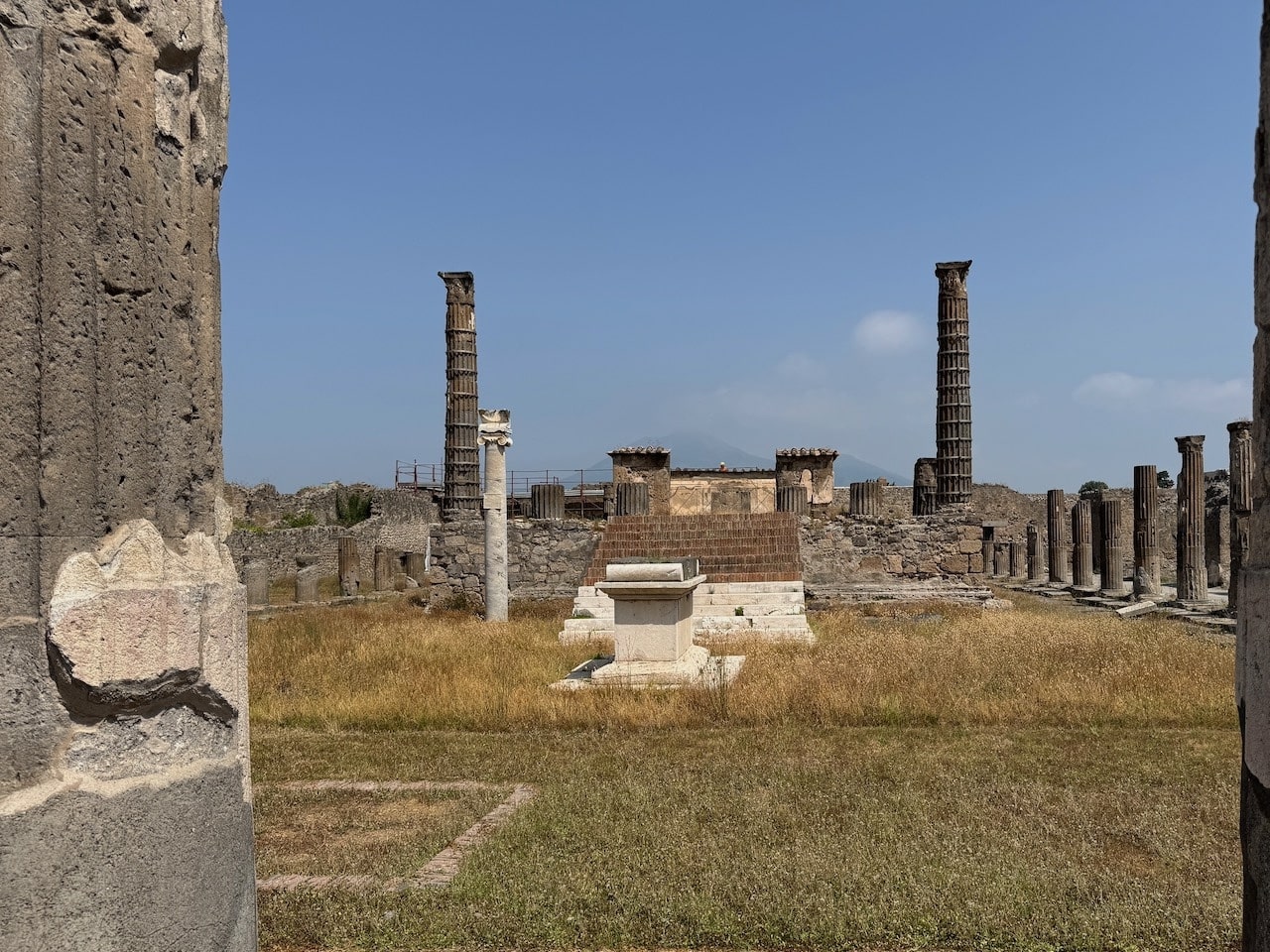
The Sanctuary or Temple of Apollo, built in 120 BC, was our first big stop.
Sanctuary of Apollo with Vesuvius in the background. Photo by ConsumerMojo.com
The sky looks bright, but it was hazy and if you look closely you can spot Vesuvius, five miles away, in the background. The sanctuary is part of the Forum, which was the center of life in Pompeii.
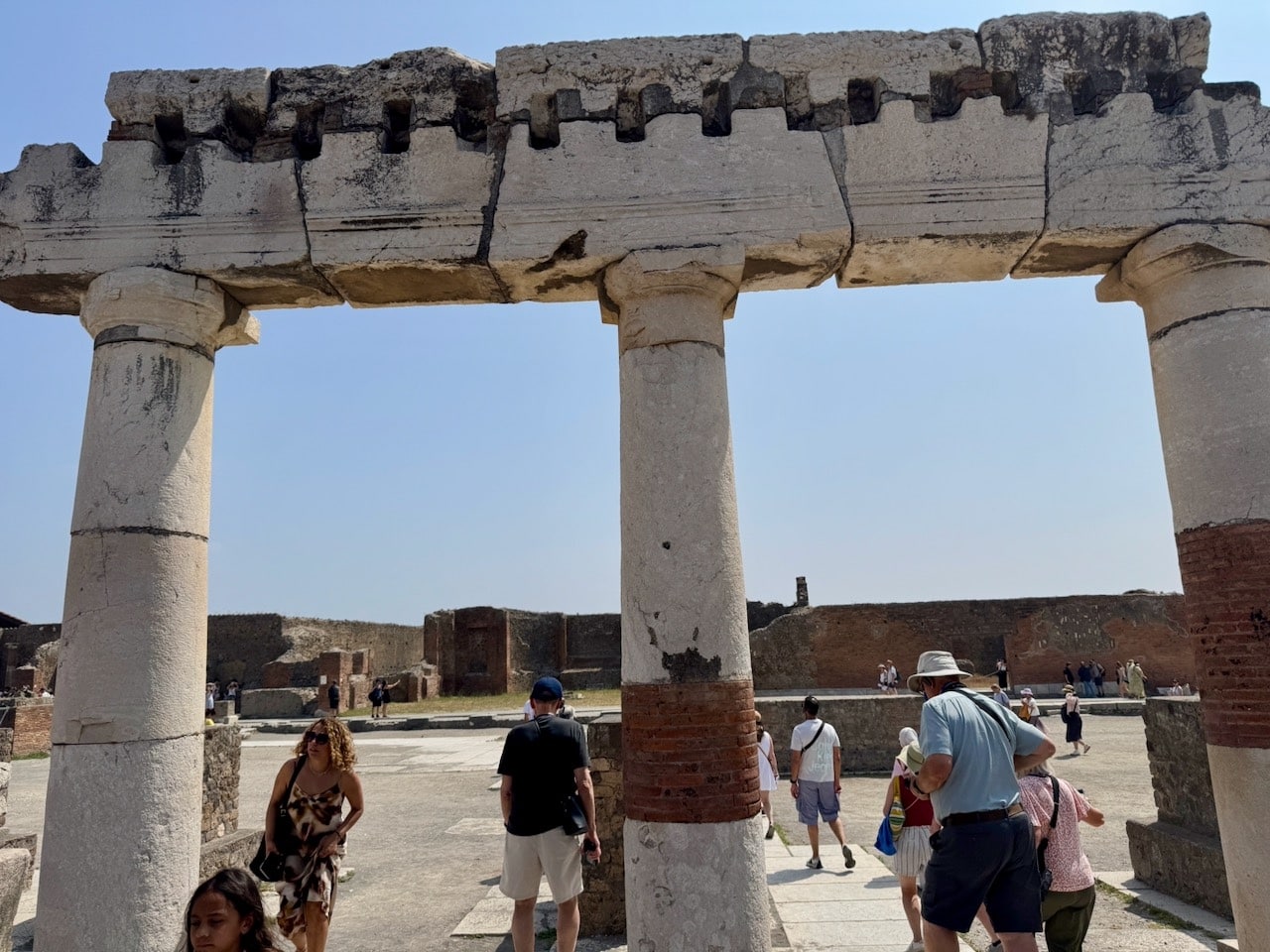
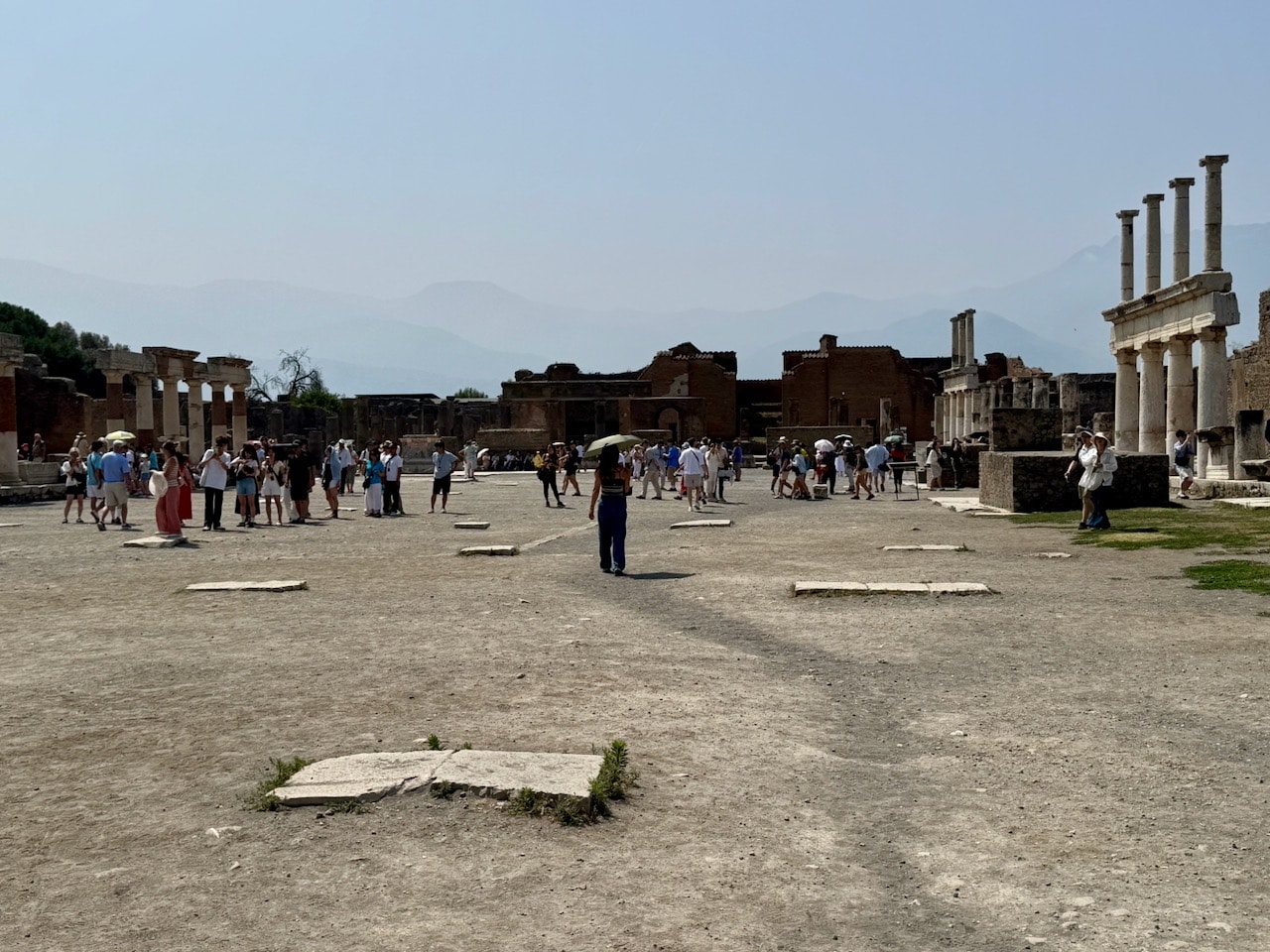
Forum at Pompeii. Photo
Today, tourists take the place of Pompeiians. But you do get an idea what it must have been like. The size of Pompeii surprised us.
Through our reading and the tour, we learned Pompeii was a thriving commercial seaport on the Bay of Naples, where rich Romans visited and came to vacation.
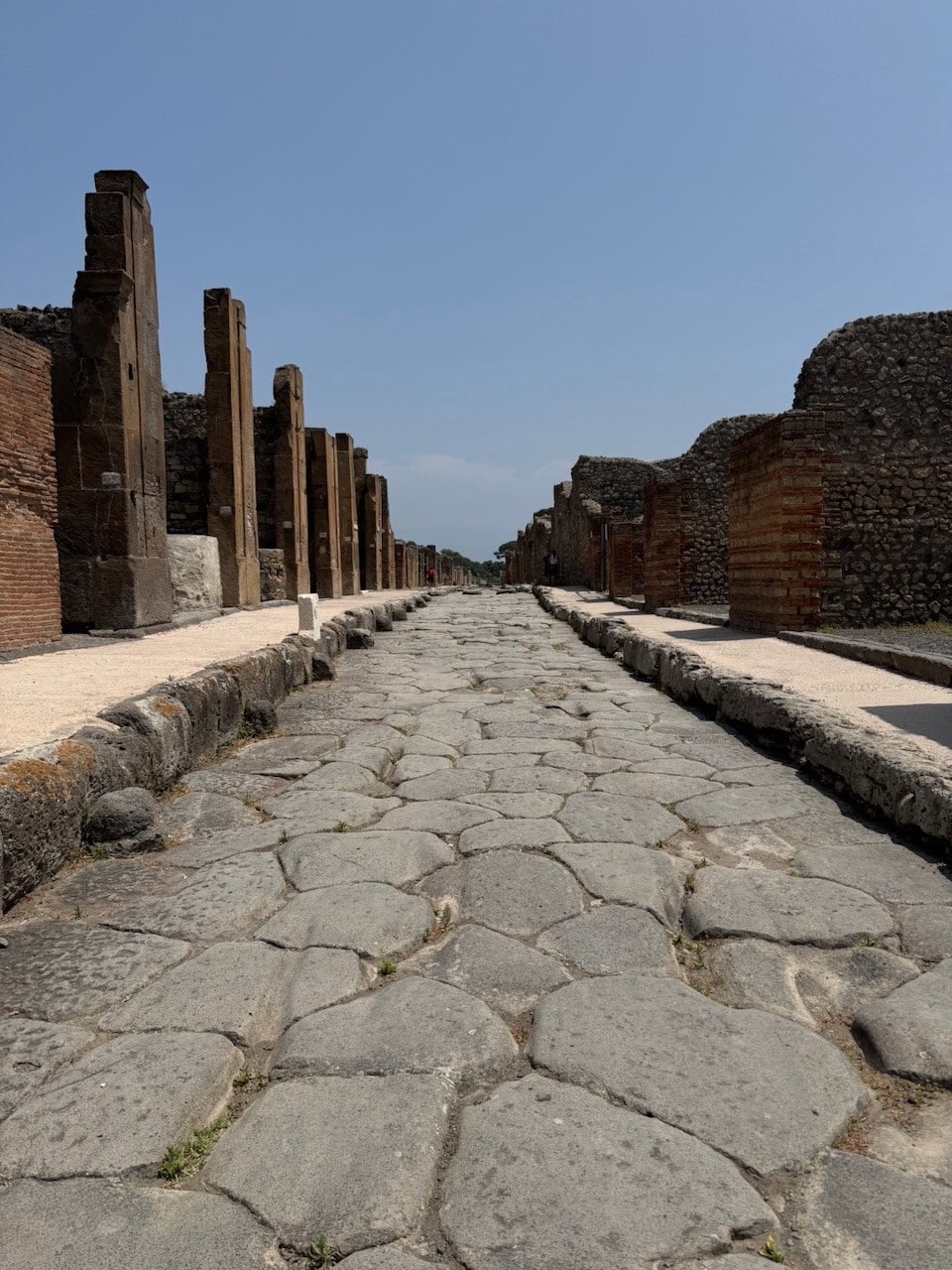
Long street in Pompeii. Photo by ConsumerMojo.com
Aristocrats and politicians vacationed in villas outside the city, but about 12,000 people lived within the walls of Pompeii when Vesuvius erupted over two days and buried it in ash, pumice, and lava. Thousands were killed.
The first exploration began in 1594 when traces of buildings and coins were found. More serious excavations began during the time of Charles III, the Bourbon king of Naples and continued. In the past, frescoes and precious objects were looted or sold off to wealthy patrons and museums. That apparently has stopped.
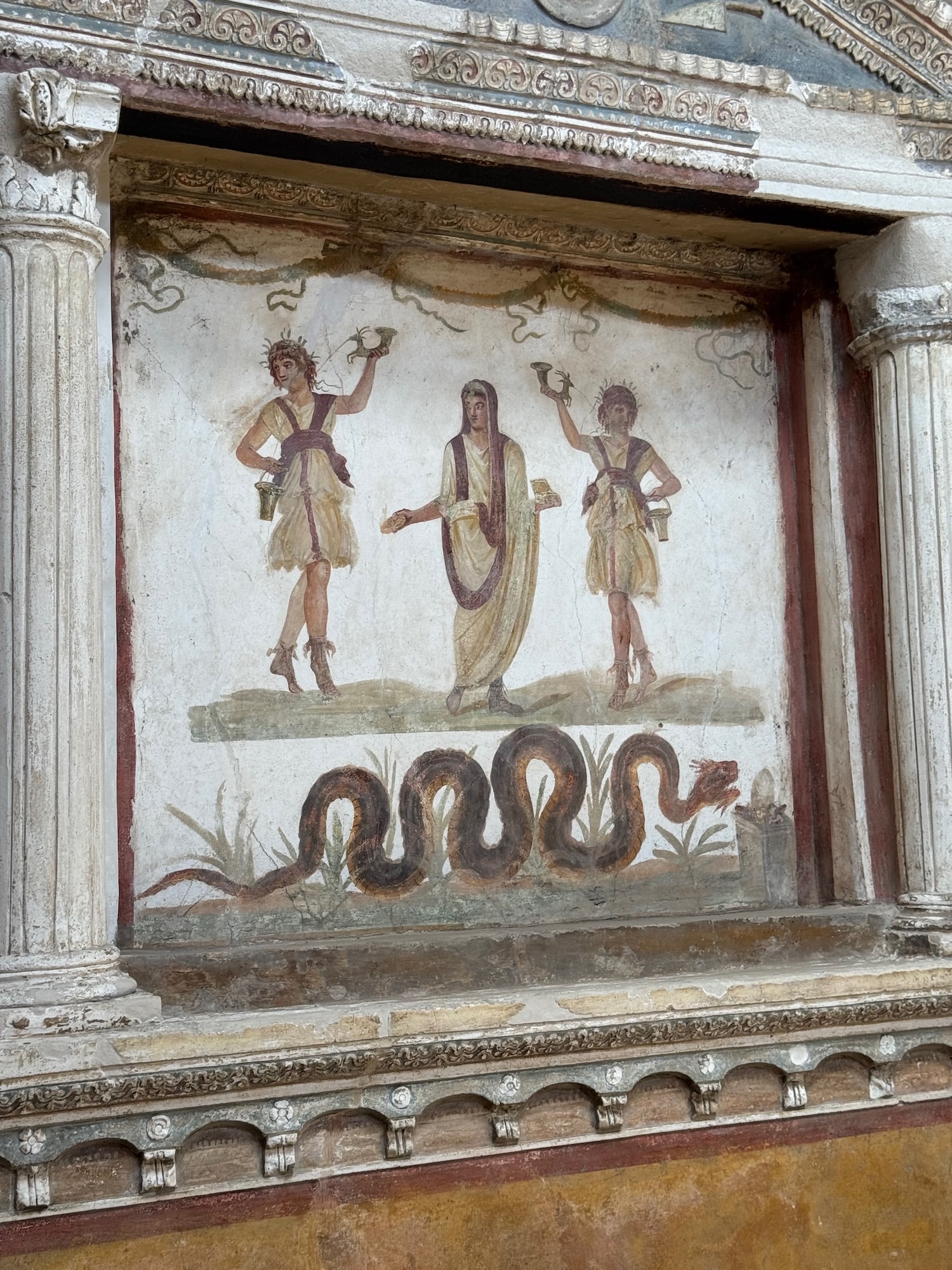
This fresco of the Dancing Lares and the Genius, for example, might have disappeared into a private collection if unearthed in a previous era. It was a household shrine and offers insight into the way people worshipped and what they believed in Pompeii and Imperial Rome.
The three figures represent household gods. The two dancing lares, or gods, hold drinking cups over the genius, another type of god. They symbolize prosperity and that’s reinforced by the snake at the bottom, who also represented a family’s prosperity.
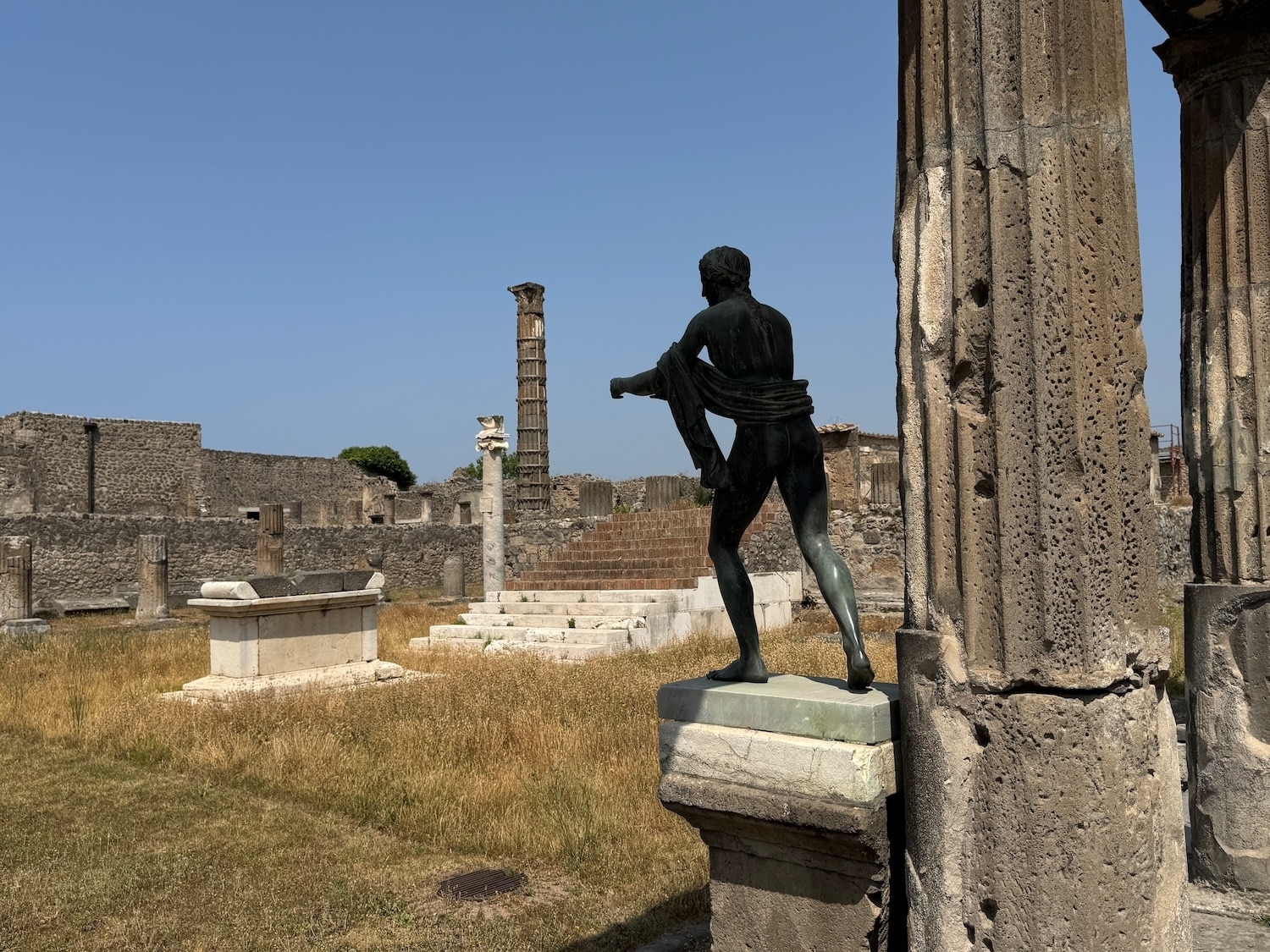
Restoration work has also put this large bronze statue Apollo Saettante, or Apollo the archer, in a prominent place. The rare surviving ancient bronze dates to 100 BC. Pieces of it were first discovered in 1817 and more was found the following year. Nineteenth century restorers put it back together, and in 2009 the National Archeological Museum in Naples sent it to Getty Museum restorers in Los Angeles for cleaning and restoration.
Apollo Saettante Apollo as Archer. Photo by ConsumerMojo.com
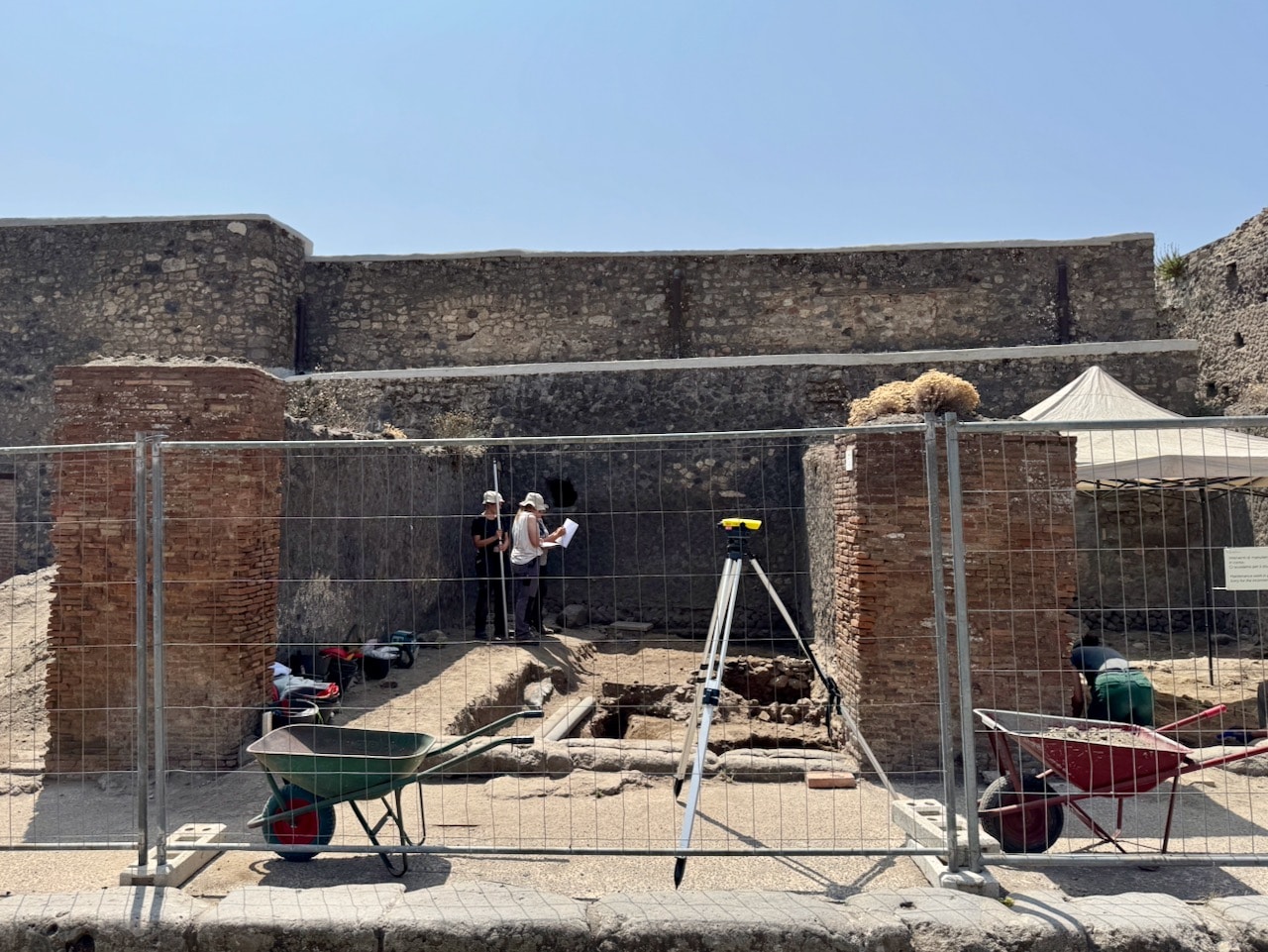
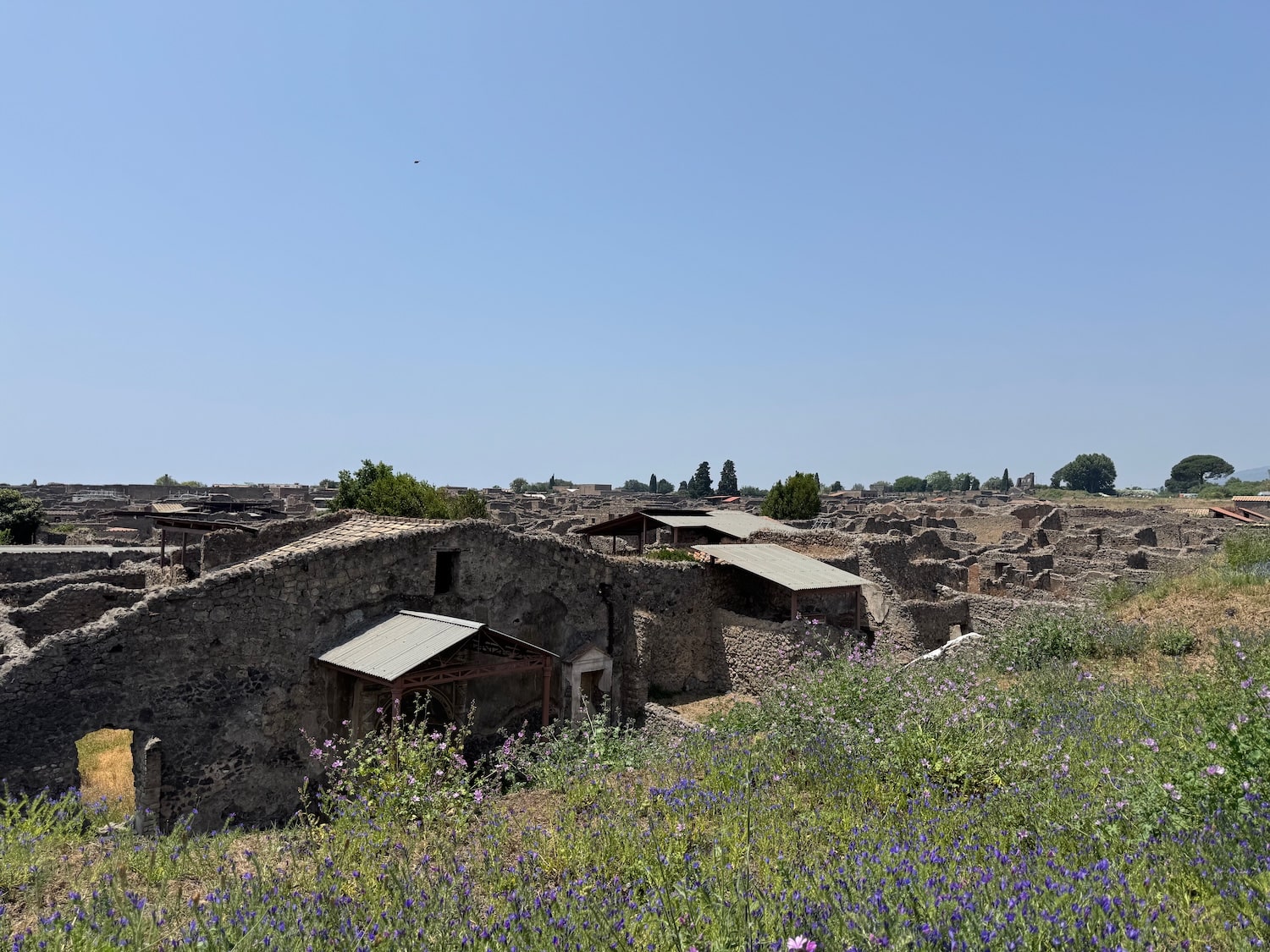
About two-thirds of Pompeii has been exposed by excavations — that’s almost 119 acres — and the work continues now supported by the Italian government and the European Union.
Archeologist practicing at a dig in Pompeii. Photo by ConsumerMojo.com
Our guide Vincenzo explained that the Archeological Park, part of the Italian Ministry of Culture, takes great pains to make sure that archeologists work with precision and care.
Unrestored section of Pompeii. Photo by ConsumerMojo.com
Pompeii is a treasure because the layers of ash and pumice preserved much of what it buried and there are still often surprises.
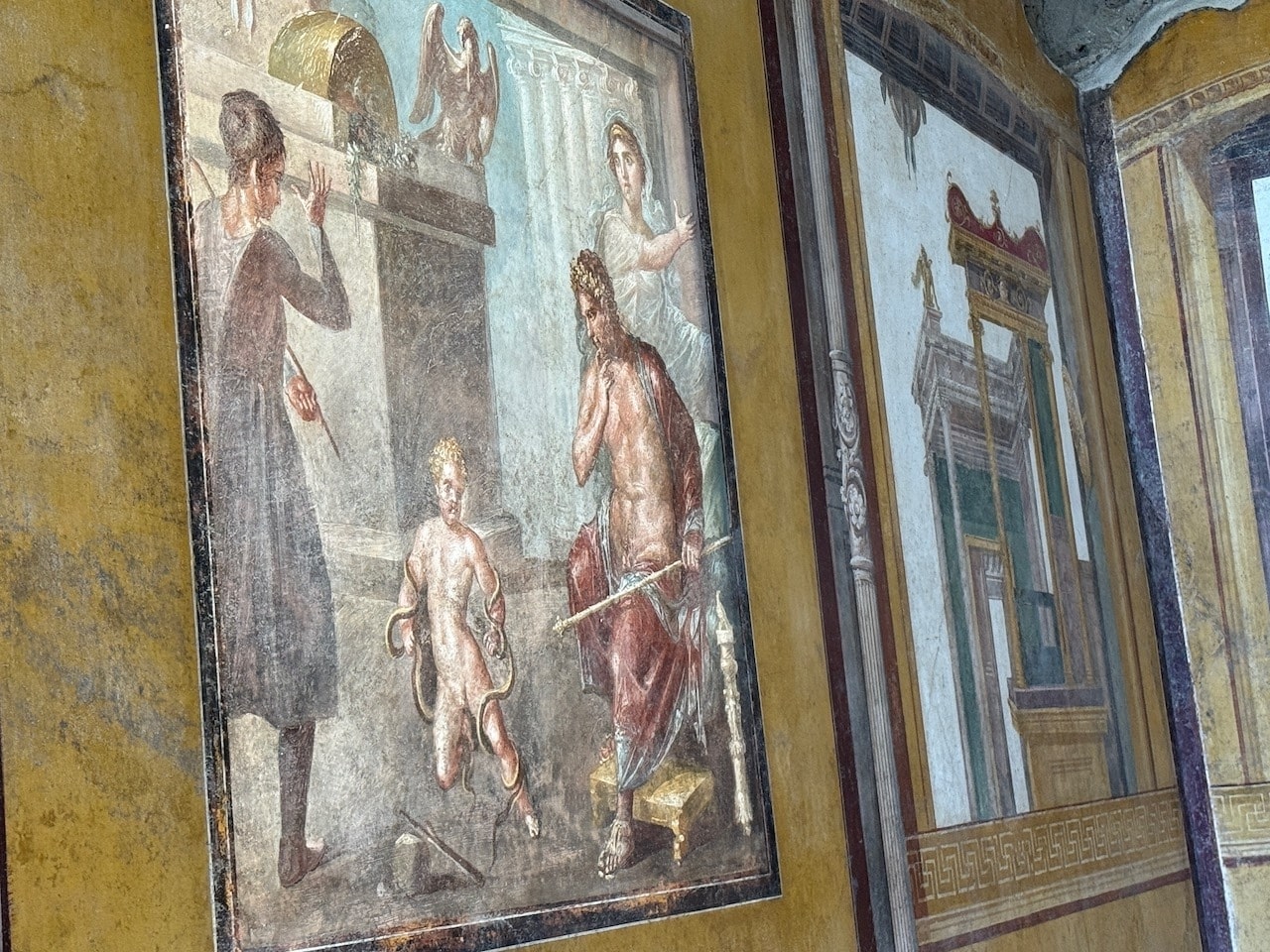
There was so much to see, and the three-hour tour gave us the highlights. We wandered in the Vettii House, the home of two brothers, freed slaves, who became wealthy wine merchants. Restorers worked for 20 years to try give historians and visitors a clear idea of the way it once looked.
Hercules as a child, fresco in Casa dei Vettii. Photo by ConsumerMojo.com
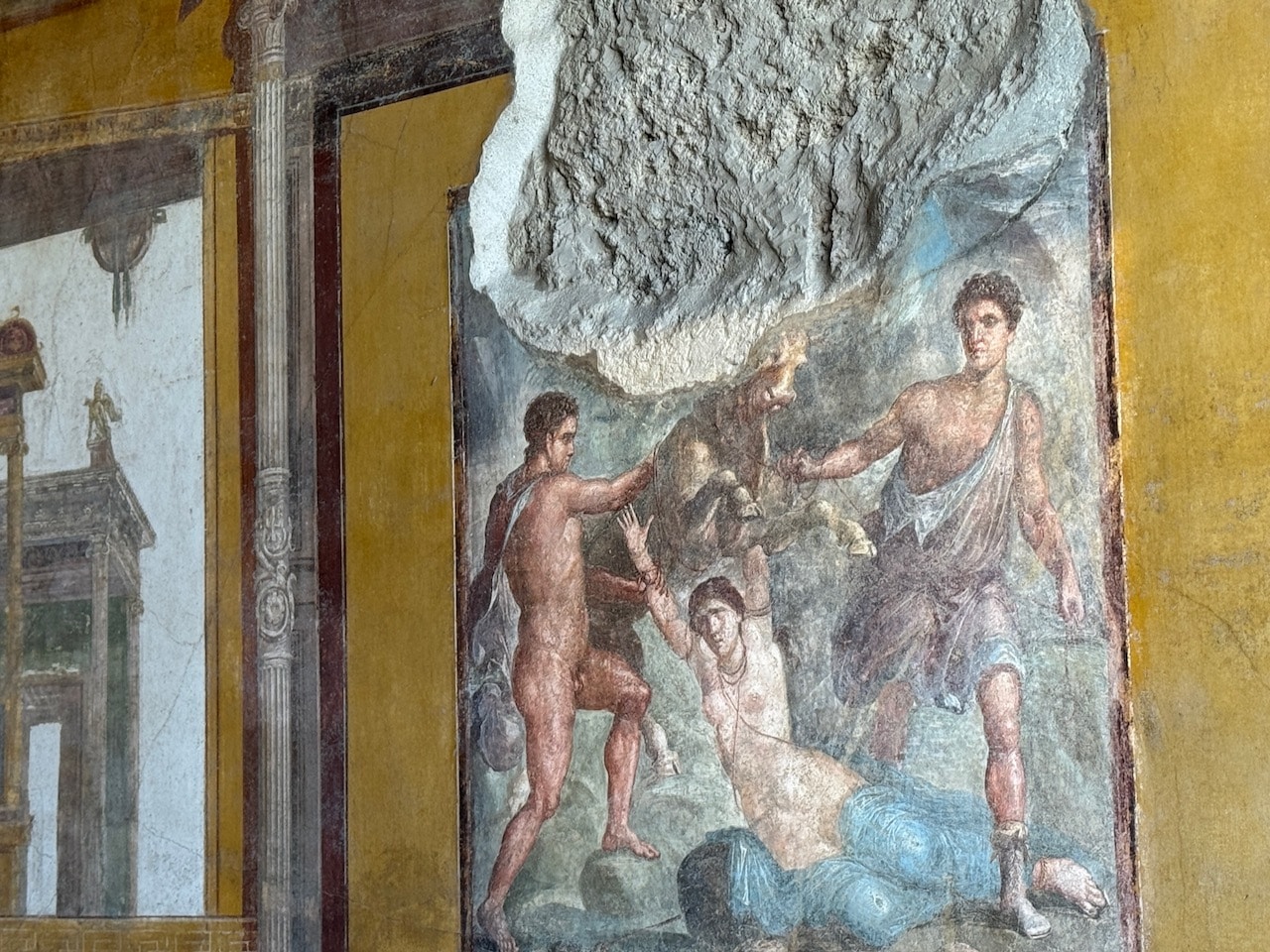
The home reopened in 2023 and the frescoes are really the show pieces. The walls of one room are covered in frescoes depicting Greek myths, including the punishment of Dirce. It graphically illustrates the revenge of twin brothers on a woman who wanted to kill their mother.
Punishment of Dirce in Casa di Vettii Pompeii. Photo by ConsumerMojo.com
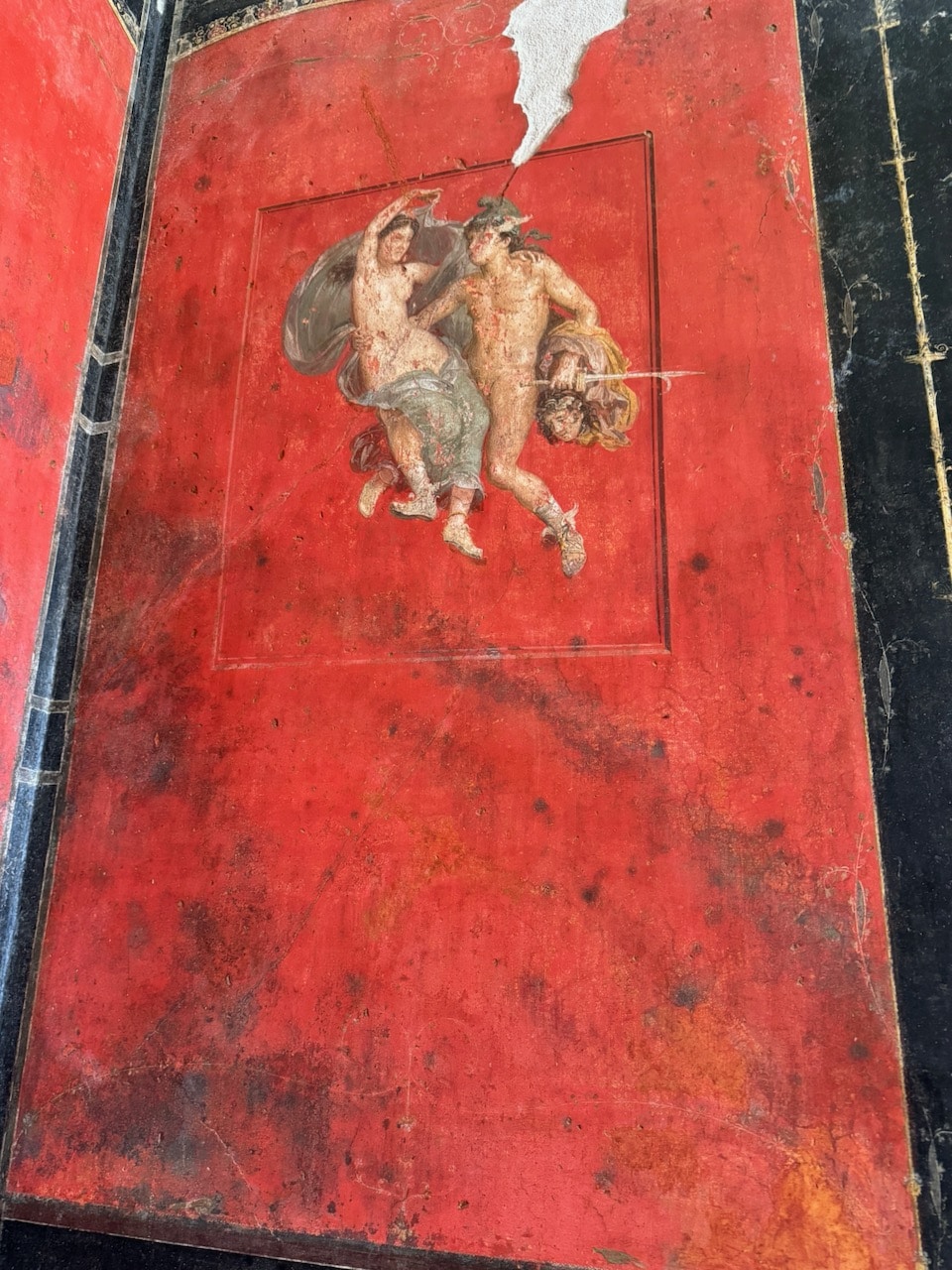
In another room, cupids lined the red walls.
Cupids on red painted walls. Photo by ConsumerMojo.com
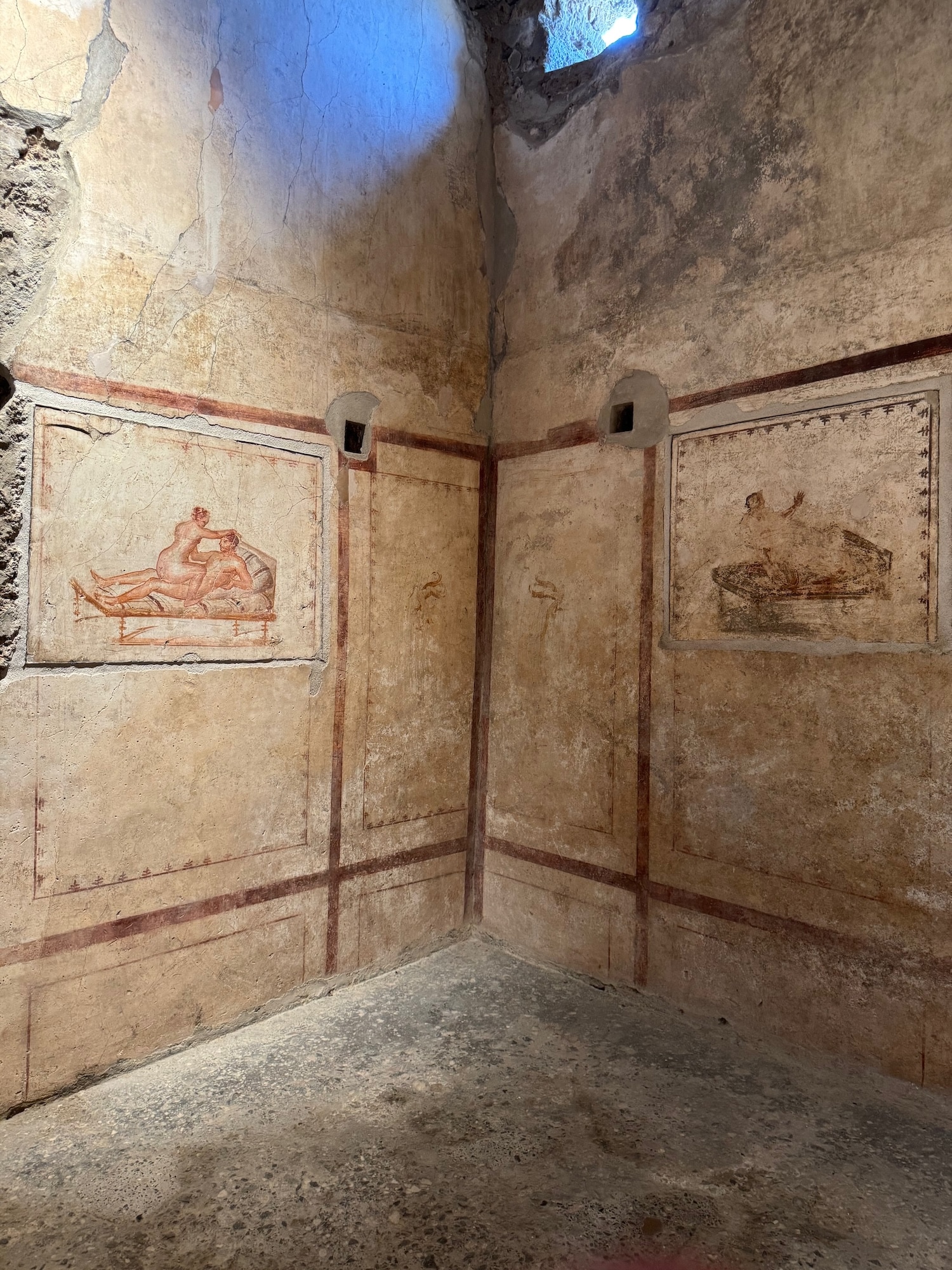
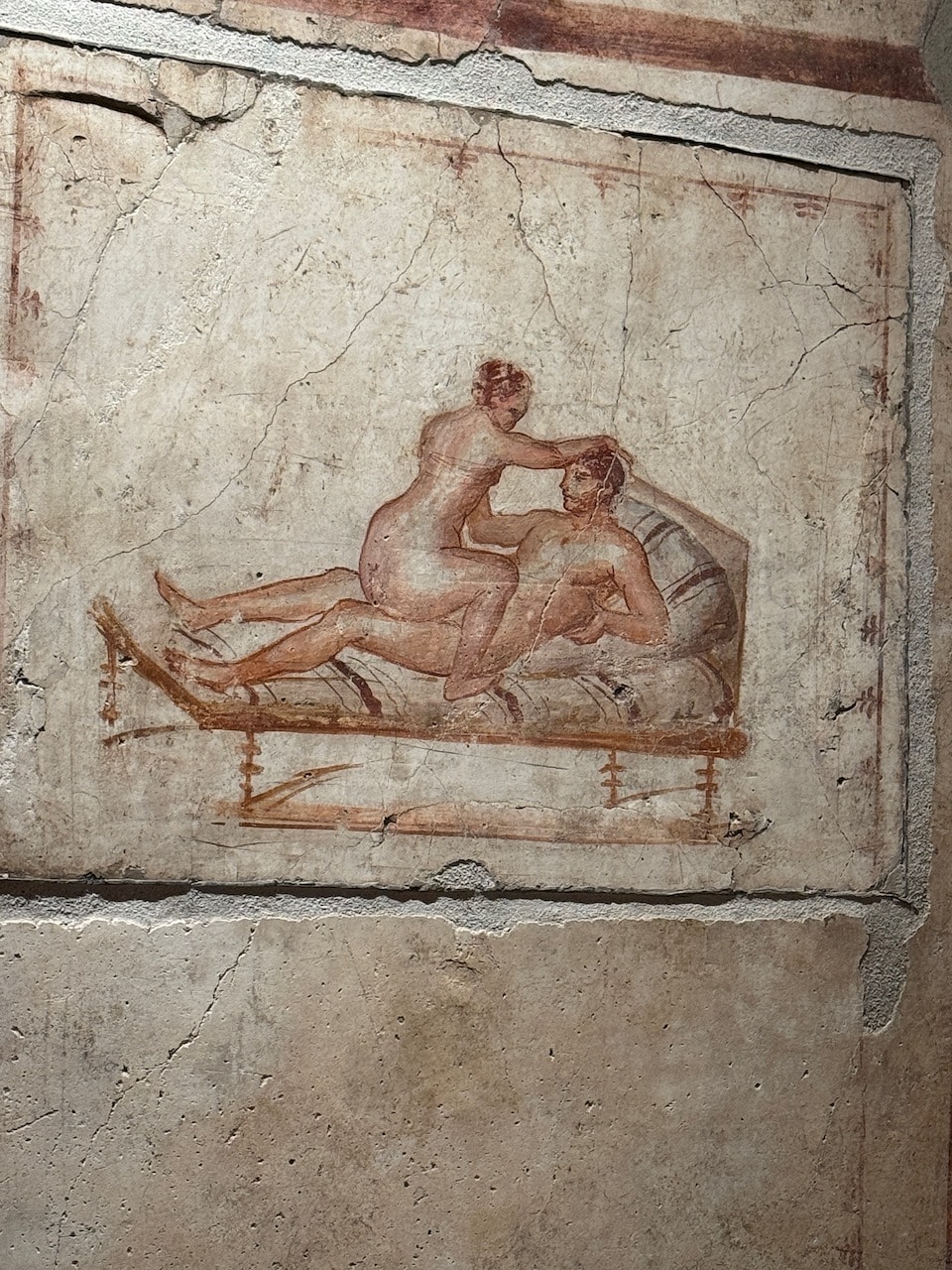
And in one small room we learned that a prostitute worked in the house.
The frescoes on the walls depict couples having sex.
In a vestibule archeologists found an inscription that read: “Eutychis Graeca a(ssibus) II moribus bellis.” The Greek woman Eutychis was described as having pleasant manners and charged two copper coins.
Fresco of couple having sex. Photo by ConsumerMojo.com
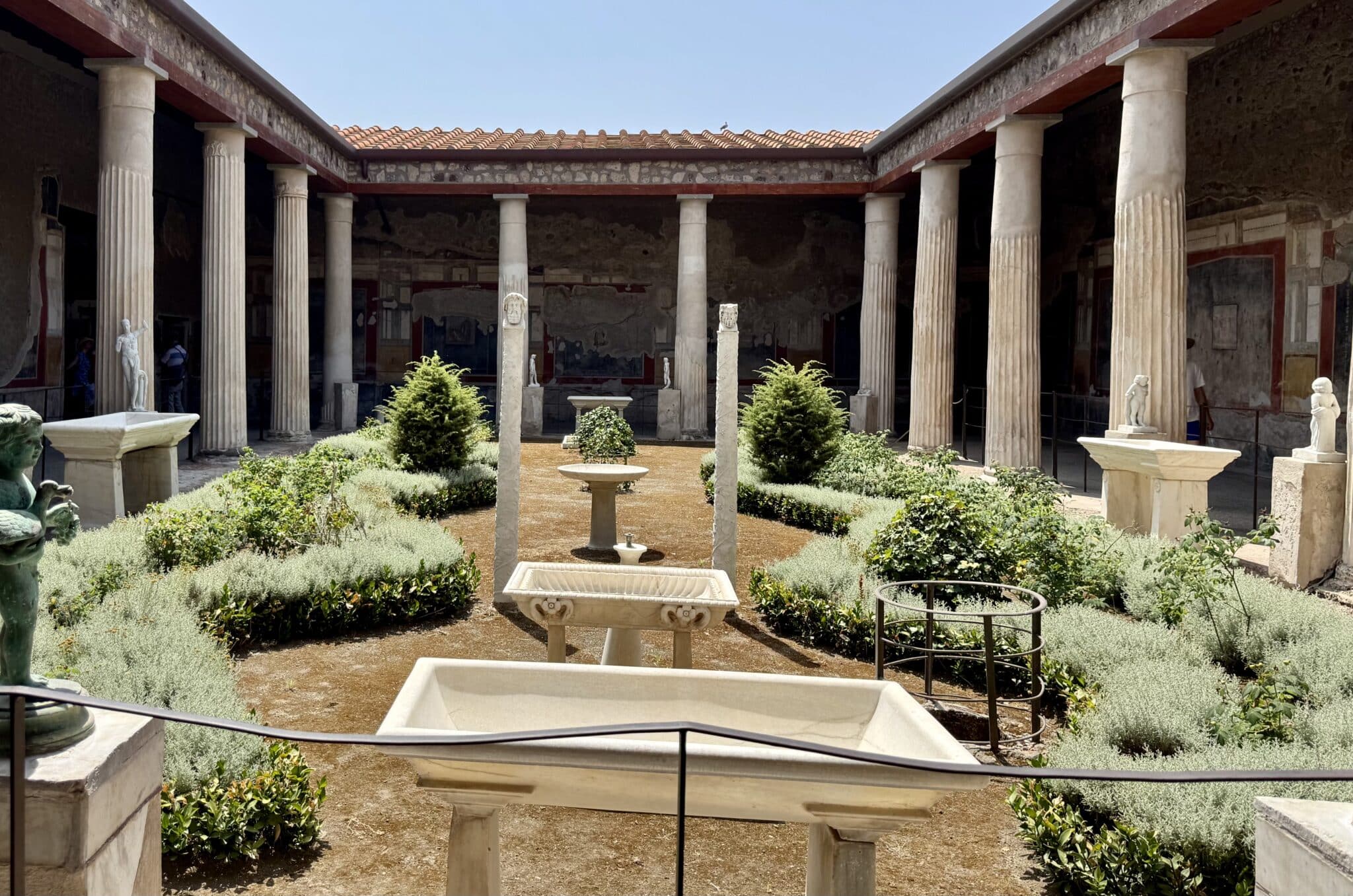
In addition to sex, the Pompeiians embraced the benefits of a good garden. This garden, surrounded by columns and filled with fountains, sat in the middle of the Vettii house. And that was apparently typical.
Garden in the house of Vettii. Photo by ConsumerMojo.com.
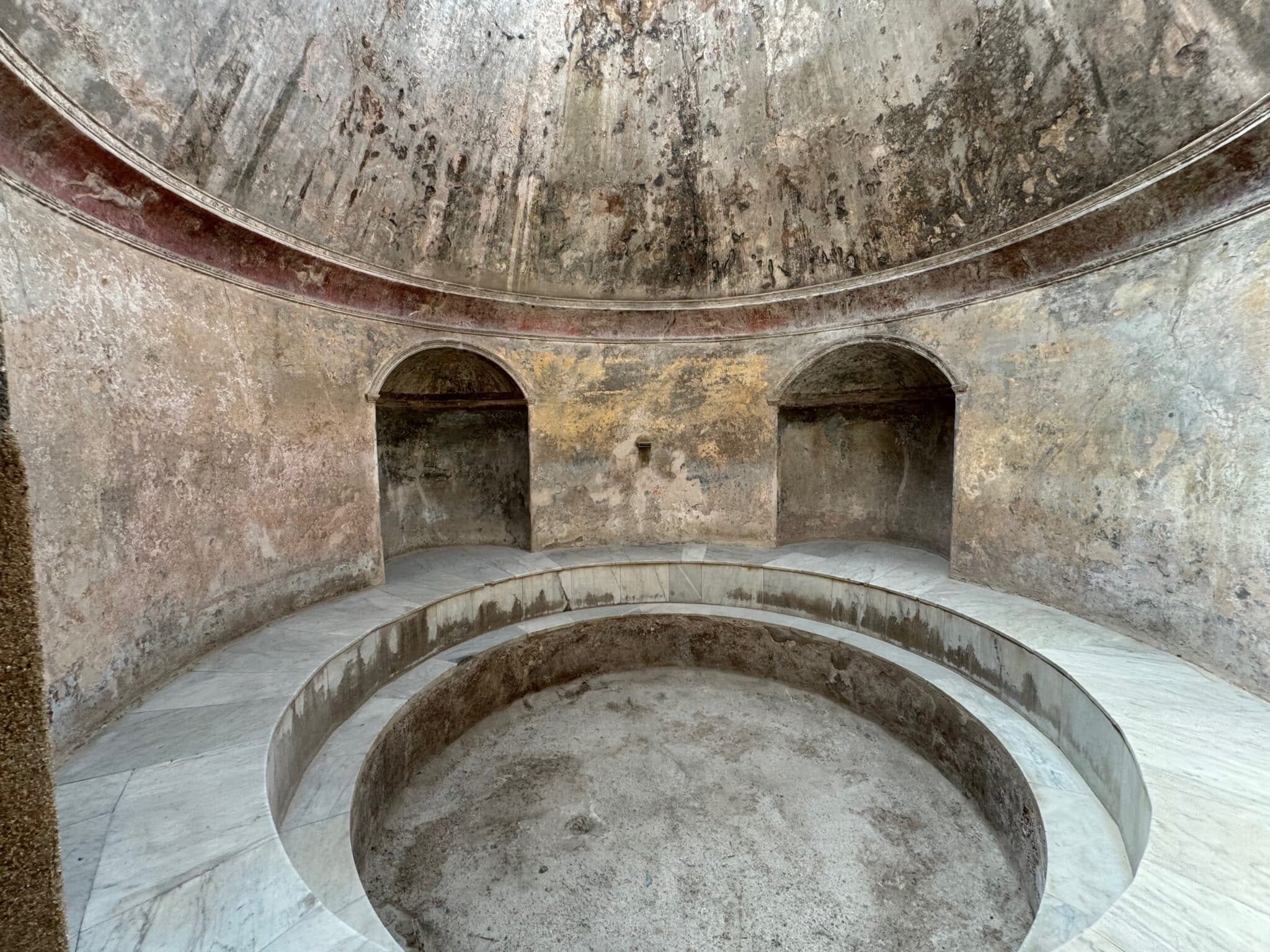
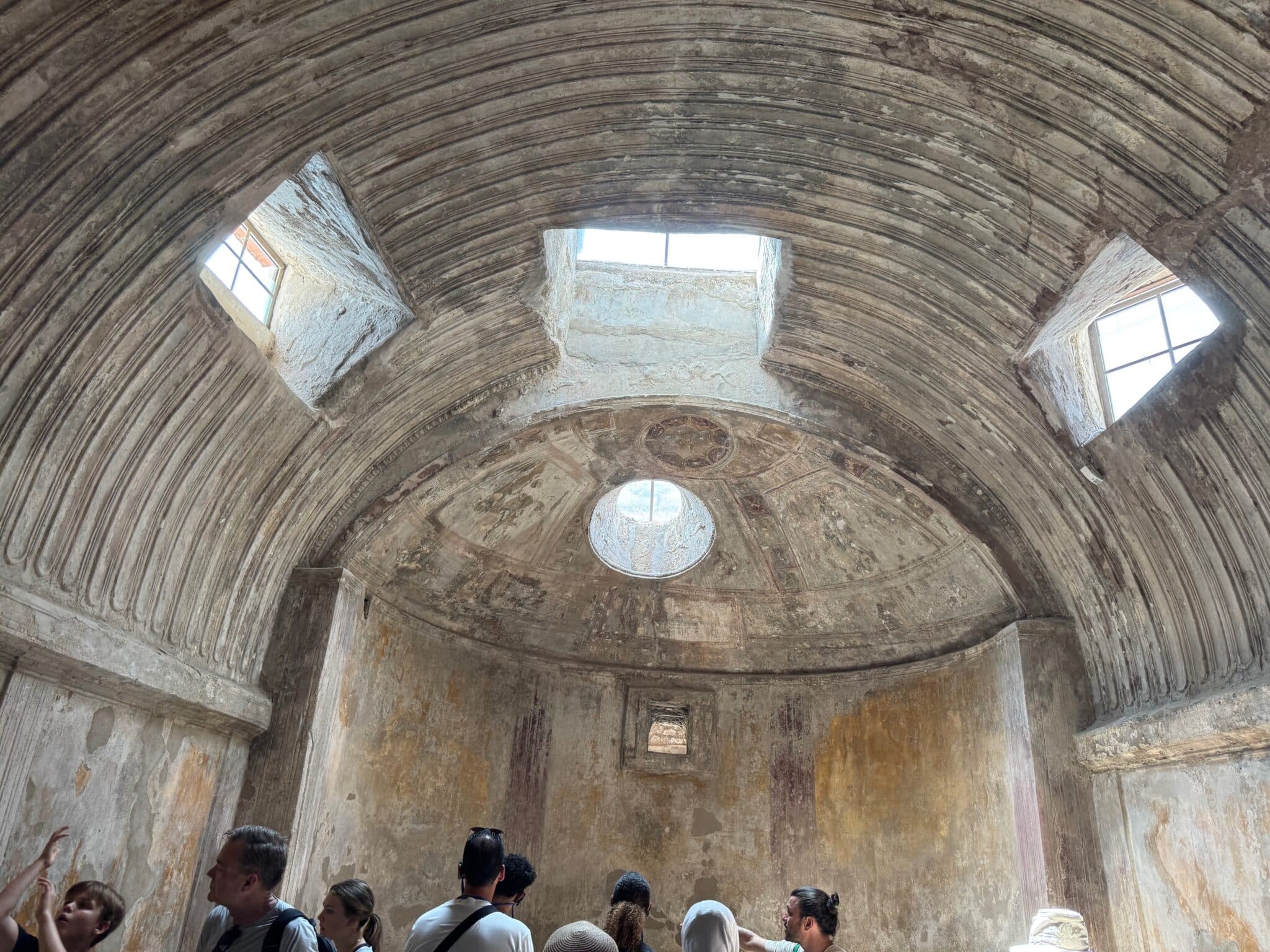
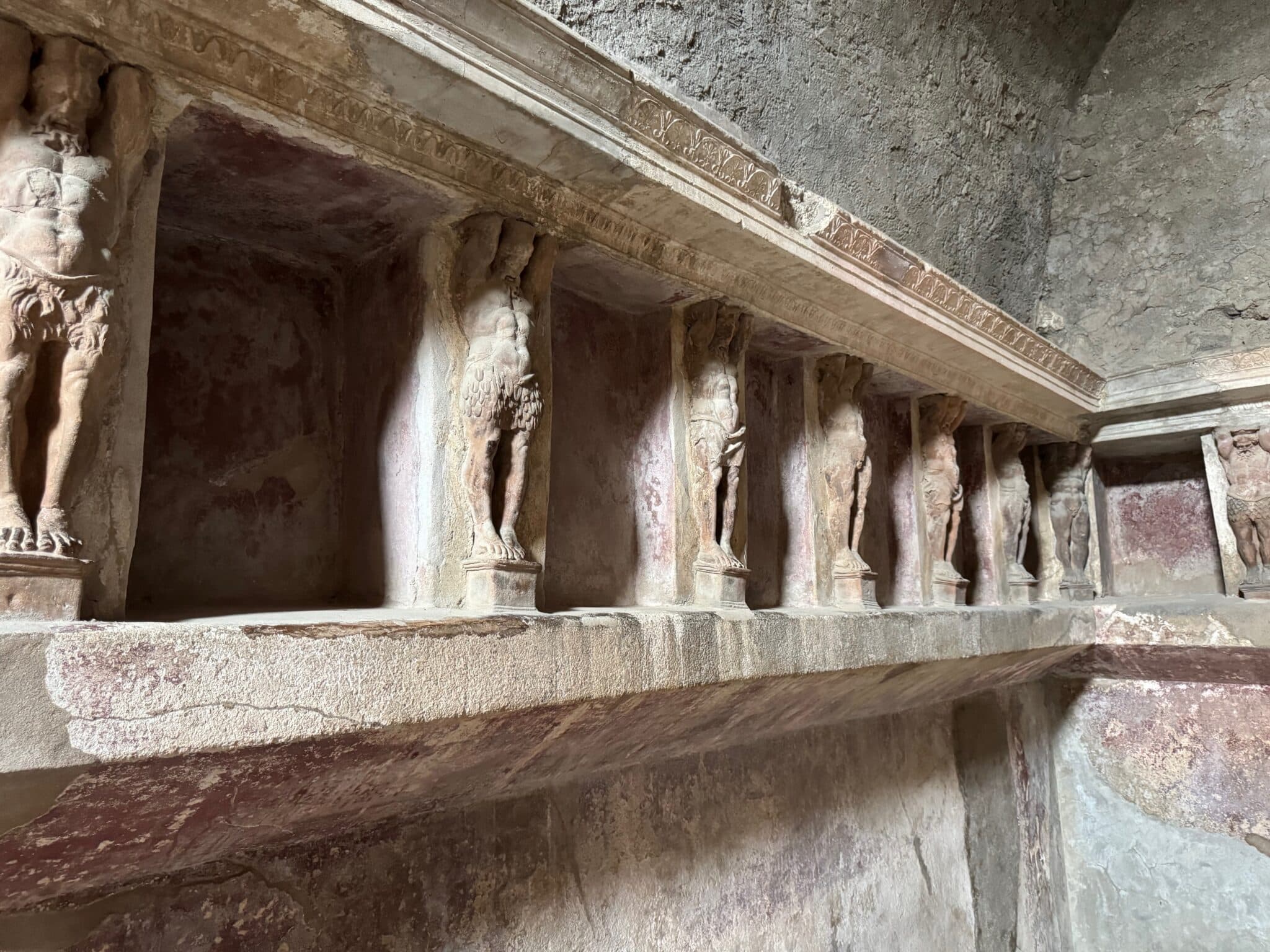
Some wealthy homes had private baths, but five public bathhouses have been found and restored to some extent. The Stabian Baths date to 125 BC and display the Pompeiians’ love of embellishment and beautiful decoration, but also the Roman engineering genius.
Bath House in Pompeii
Vincenzo explained that the windows provided light, while the channels in the arched ceiling helped keep moisture from dripping on the patrons,
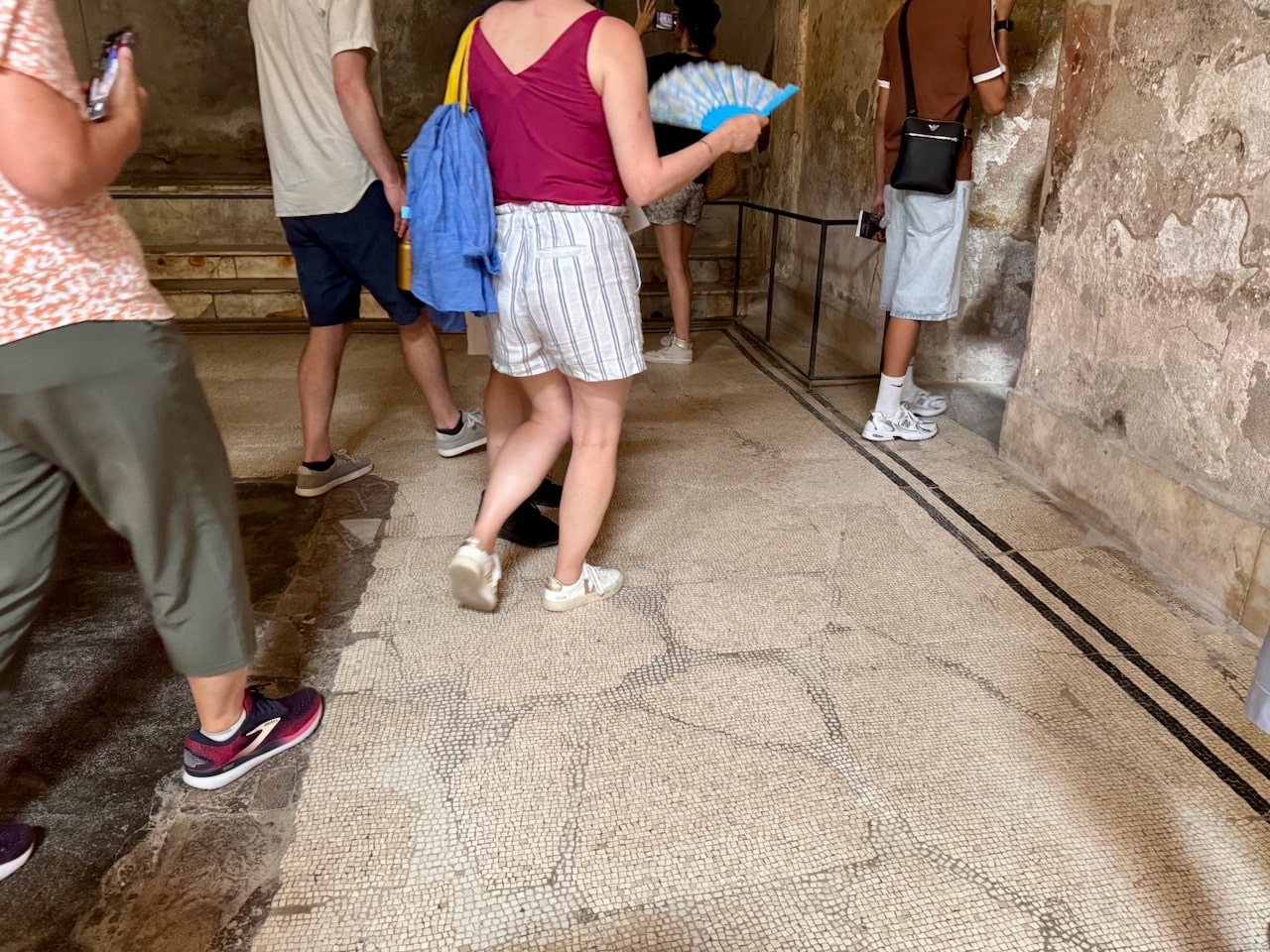
Men and women had separate areas that included changing rooms with lockers and areas for massage. Under the mosaic floors and along the walls engineers used a hypercaust heating system that sent hot air into the room.
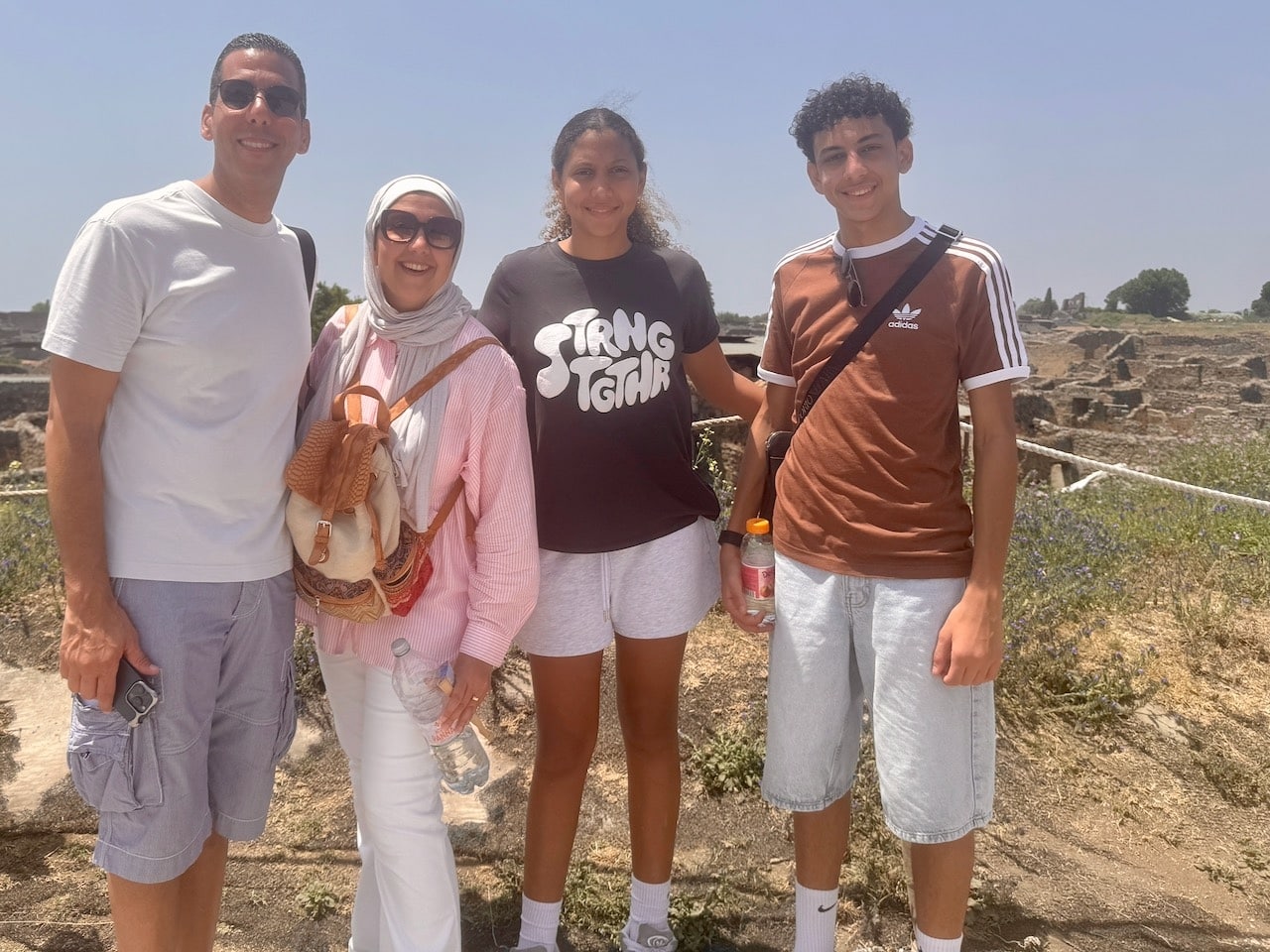
We were asked not to take photos of an excavation in progress during the last part of our tour. But we were mesmerized as we walked along a catwalk bridge and watched from above as workers, in sectioned off areas, gently whisked away pumice to unearth new discoveries. It made us want to return to see more. But now we were ready to leave. It was hot, 89 degrees, and we said goodbye to our guide, the group and the lovely Samara family from Egypt whom we liked especially.
We were dreaming about lunch facing the sea and once we got the train back south, we got off in Sorrento where a local recommended the Royal Hotel.
Royal Hotel in Sorrento. Photo by ConsumerMojo.com
It turned out to be an inspired suggestion. It was a little after 3 p.m. and that’s late for lunch in Italy. The terrace dining room was almost empty.
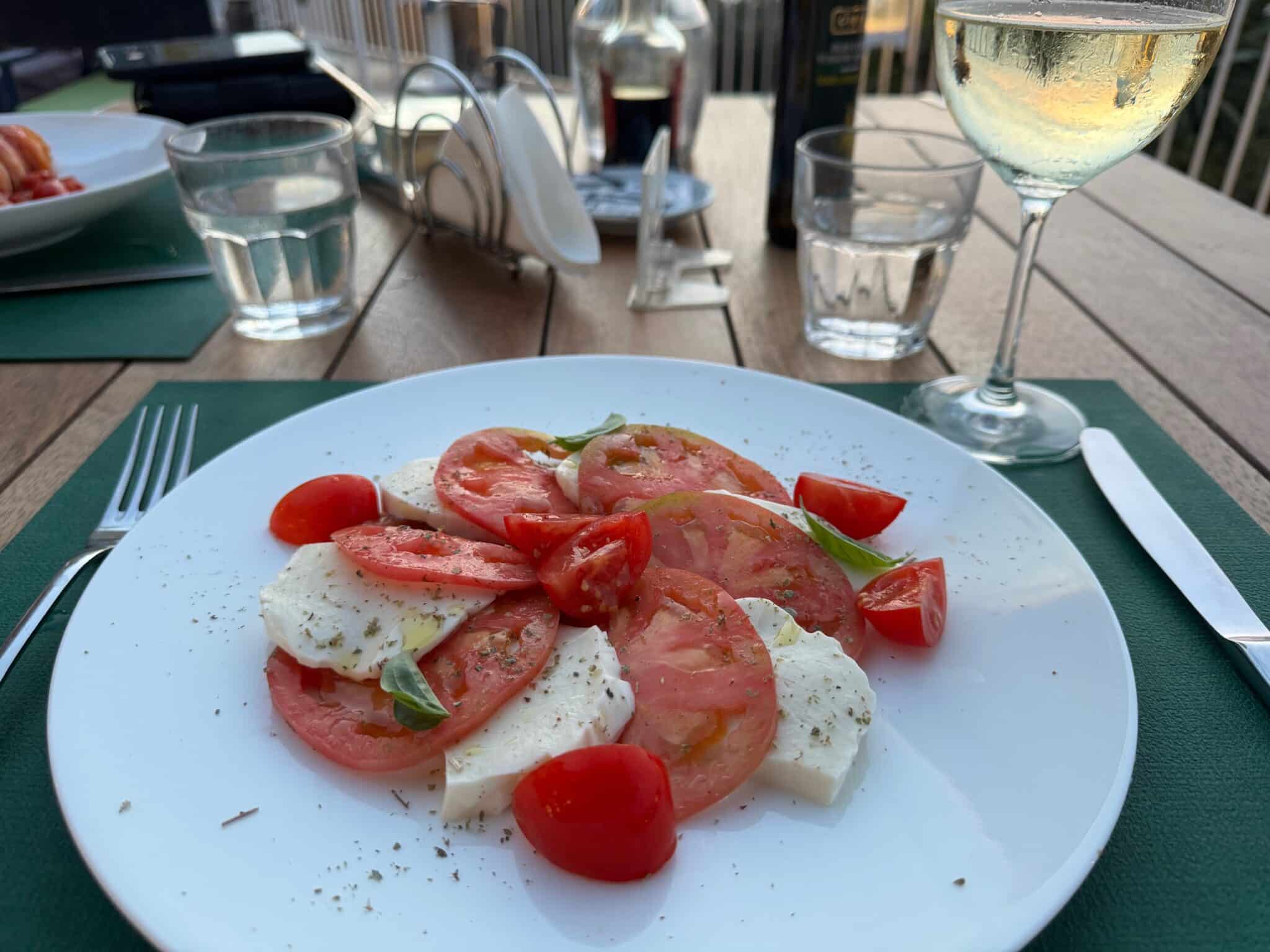
But they served they served us and Caprese salad on the Bay of Naples seemed just right.
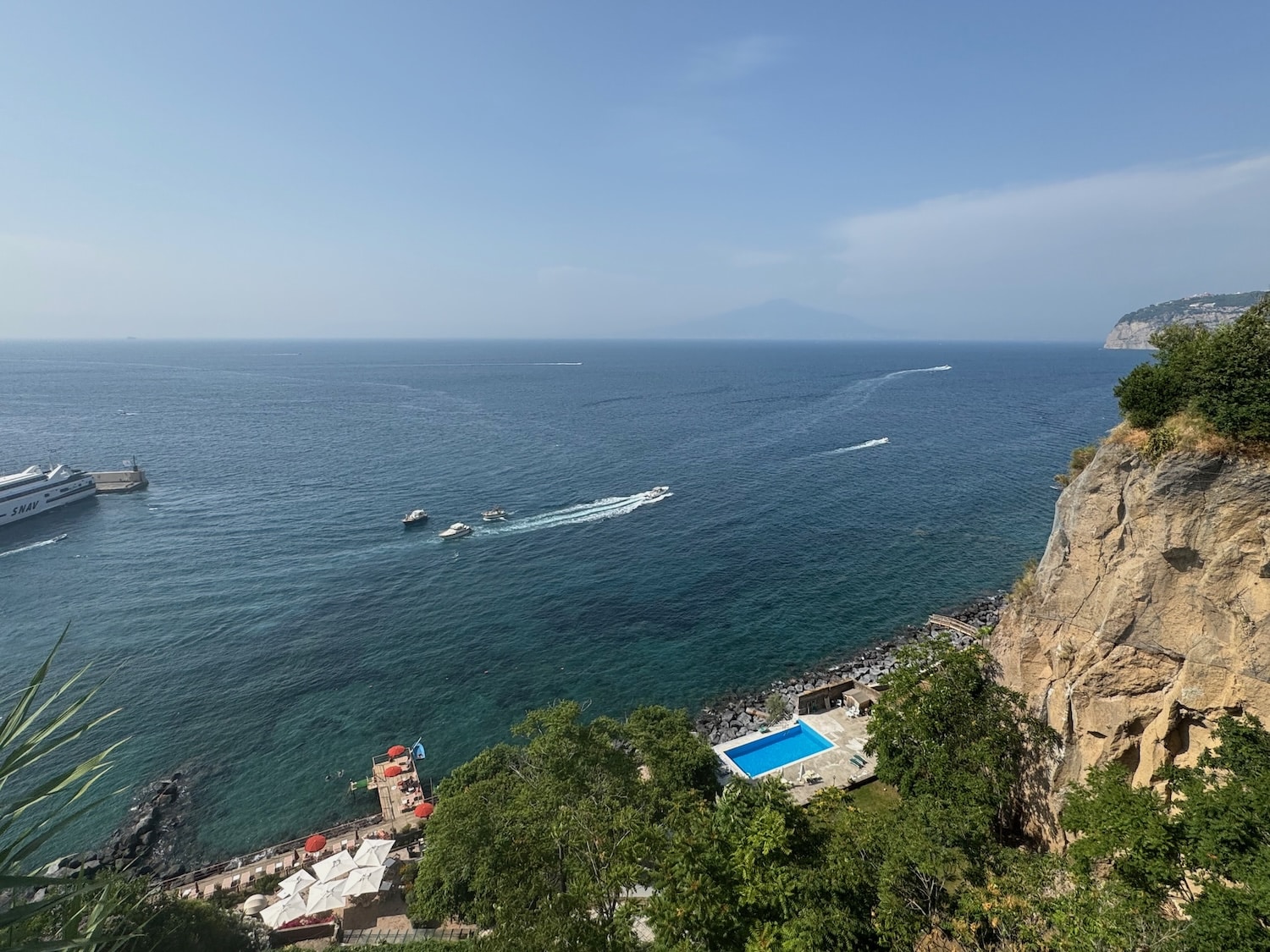
Our table had a beautiful view.
View of the Bay of Naples and the hotel’s beach below. Photo by ConsumerMojo.com
Back at Torre Barbara from our terrace we loved the way the late afternoon sun cast a golden glow on the town of Vico Equense.
View from room at Torre Barbara at dusk. Photo by ConsumerMojo.com
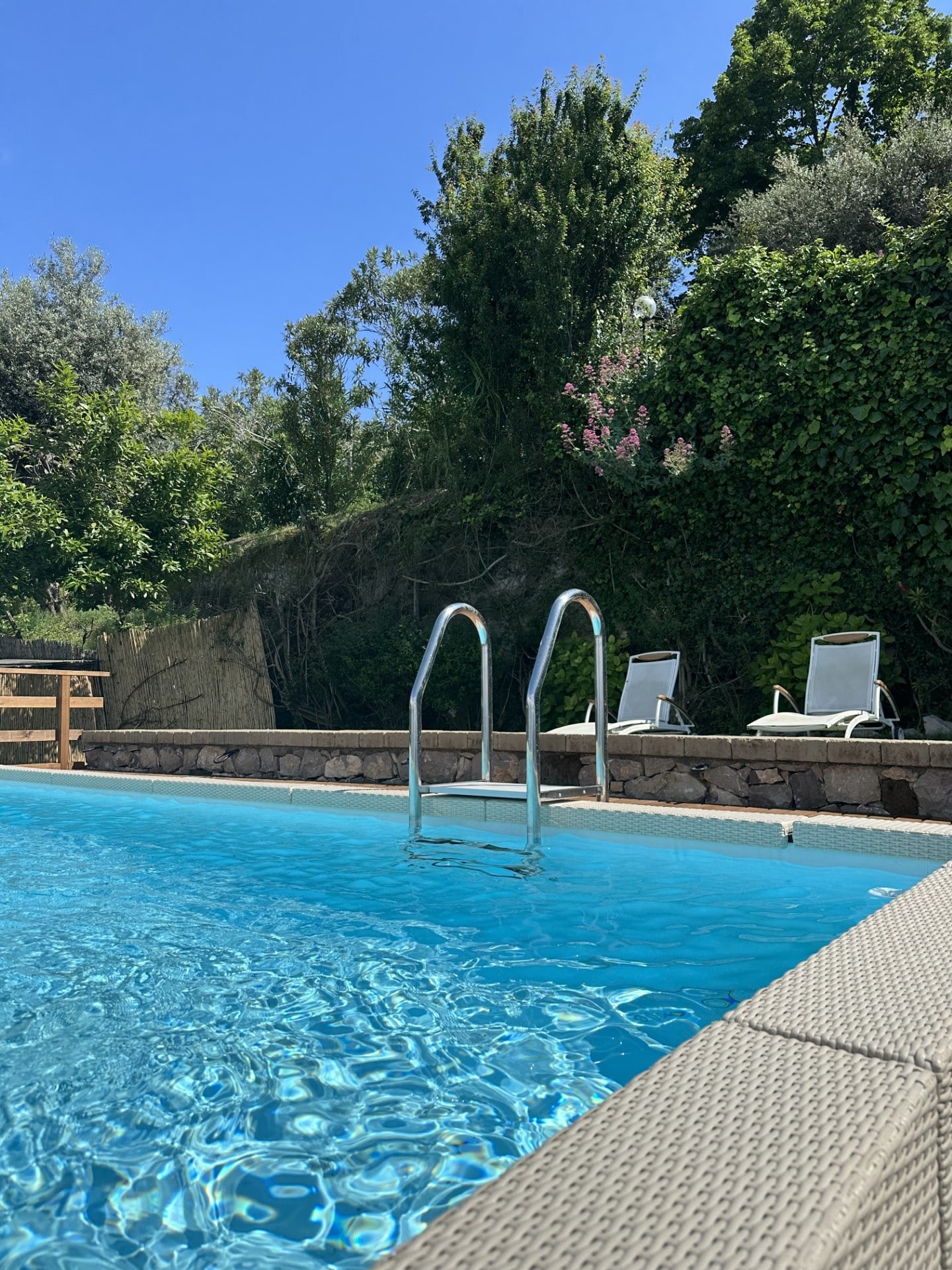
And there was just enough to time for a swim in the pool in the beautifully landscaped garden.
Photo courtesy Hotel Torre Barbara
But there was still something to arrange. Benedetta, at the reception desk, asked what we planned for the next day and when we explained that we were having a tough time getting a last minute boat trip to the Amalfi Coast, she jumped on it. Even though most offices were closed, she persisted. Amazingly, she found us a trip. While we were enjoying dinner, she came to tell us that we were set for boat trip the next day and a driver would pick us up at 7:30 a.m. and take us to the meeting point.
Meeting point in Piano di Sorrento. Photo by ConsumerMojo.com
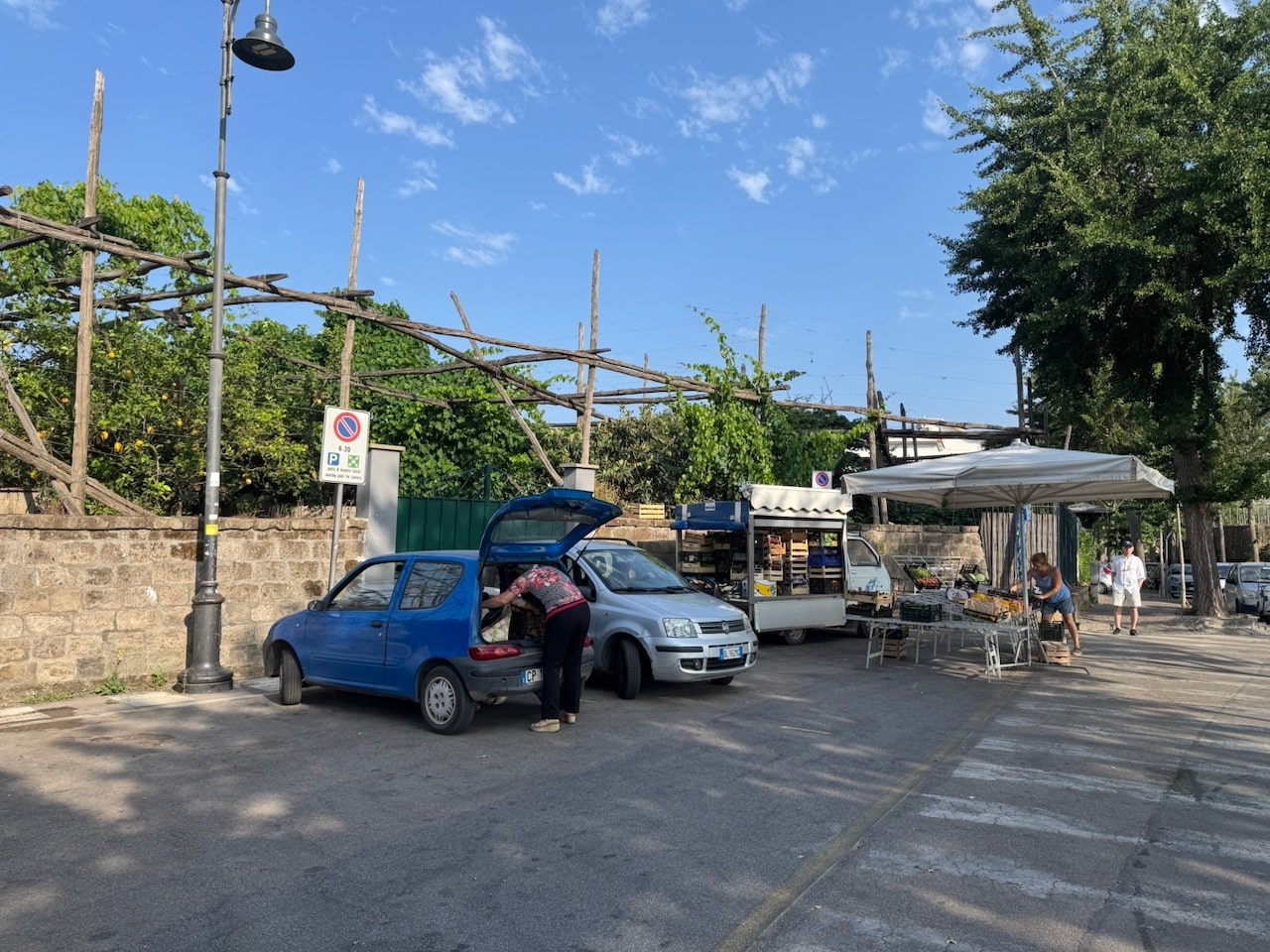
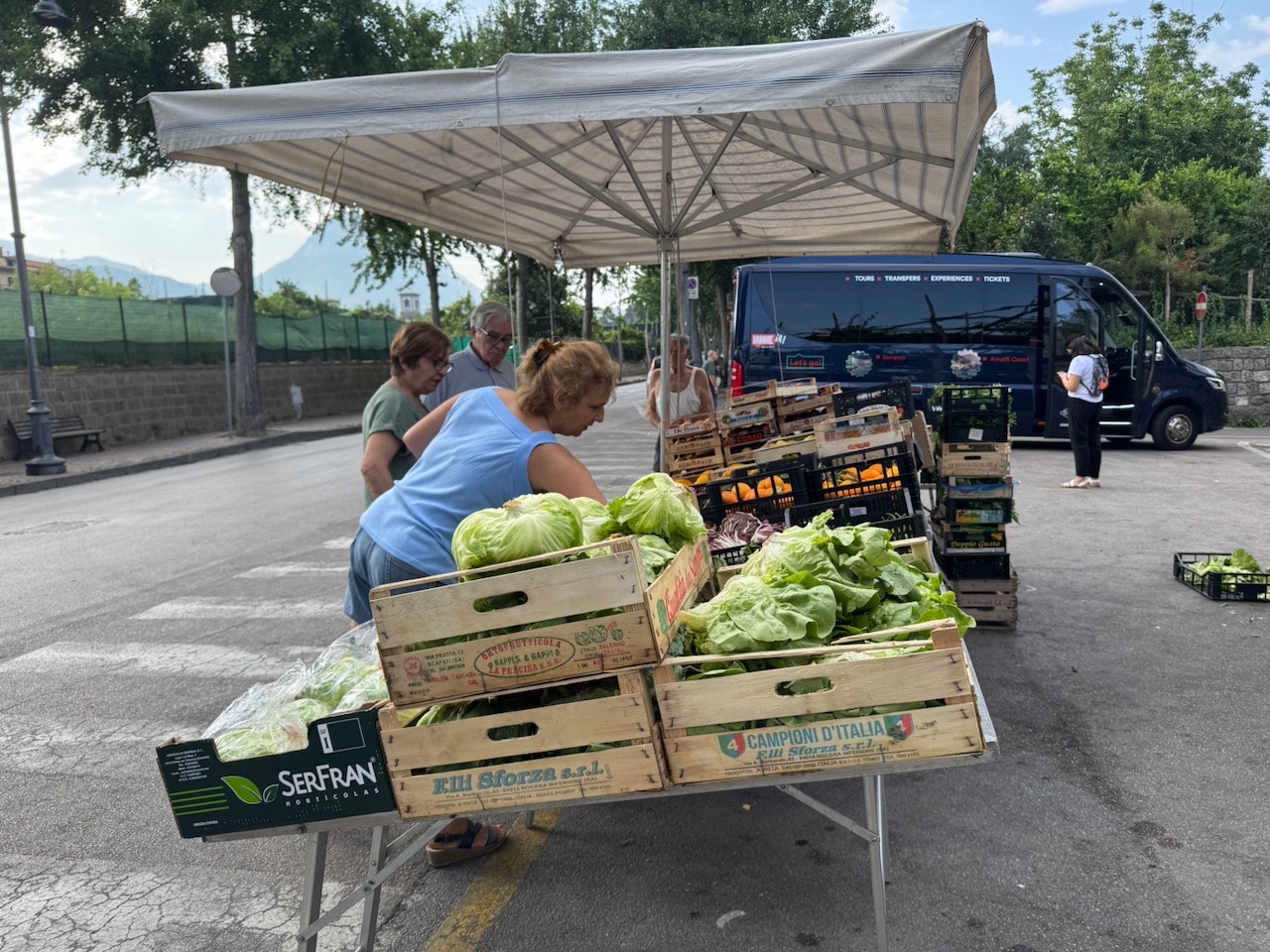
The driver dropped us in what felt like the middle of nowhere. It was a pull-off from a small road where we watched as a woman named Viola set up a fruit stand.
Viola and customers at fruit stand in Piano di Sorrento. Photo by ConsumerMojo.com
About 30 minutes later, a bus pulled up with others from Sorrento who would also take this tour. We all trouped down a narrow street to an elevator that took us down through the town wall and the mountain to the waterside.
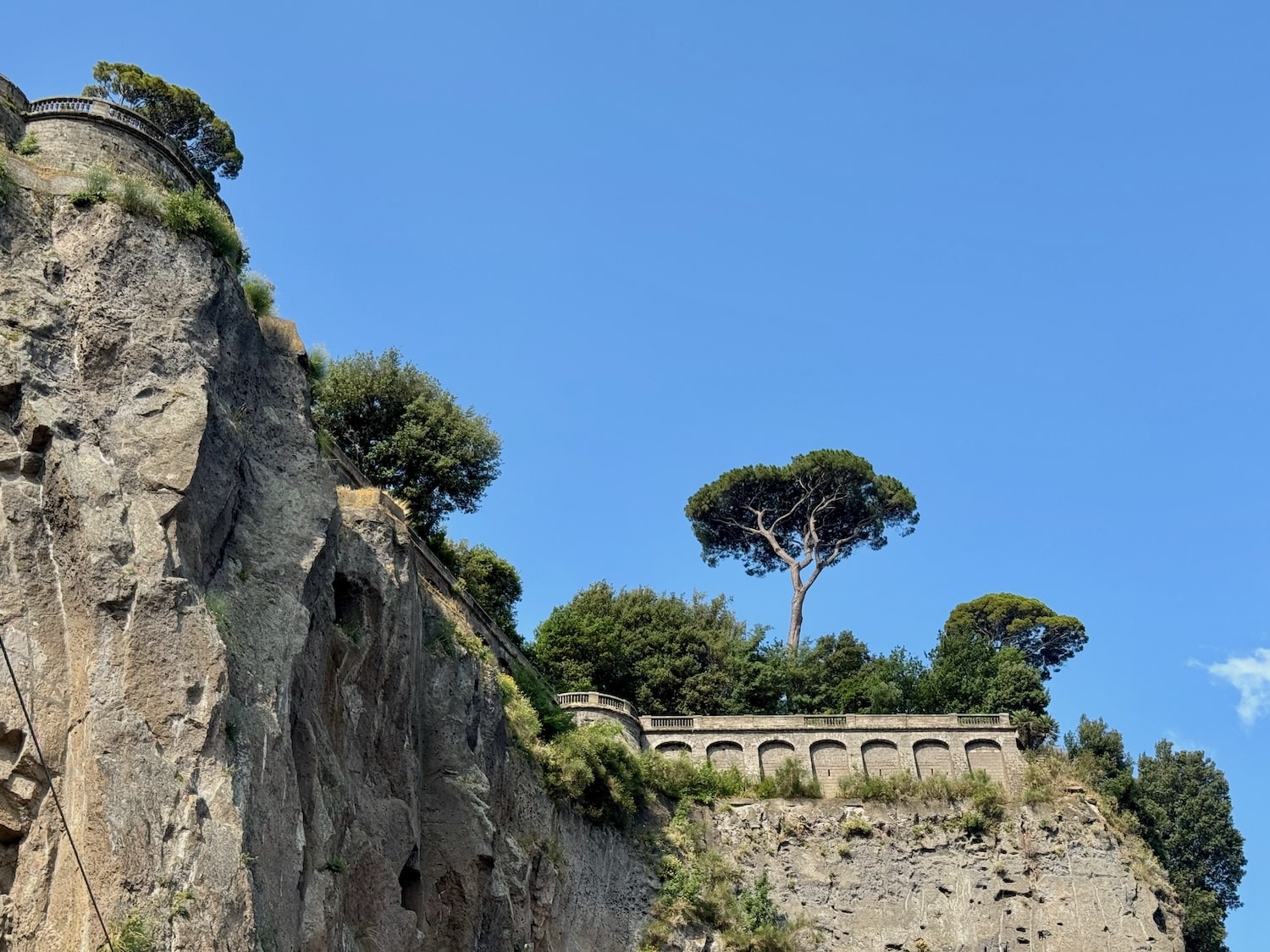
Cliff above Marina di Cassano. Photo by ConsumerMojo.com
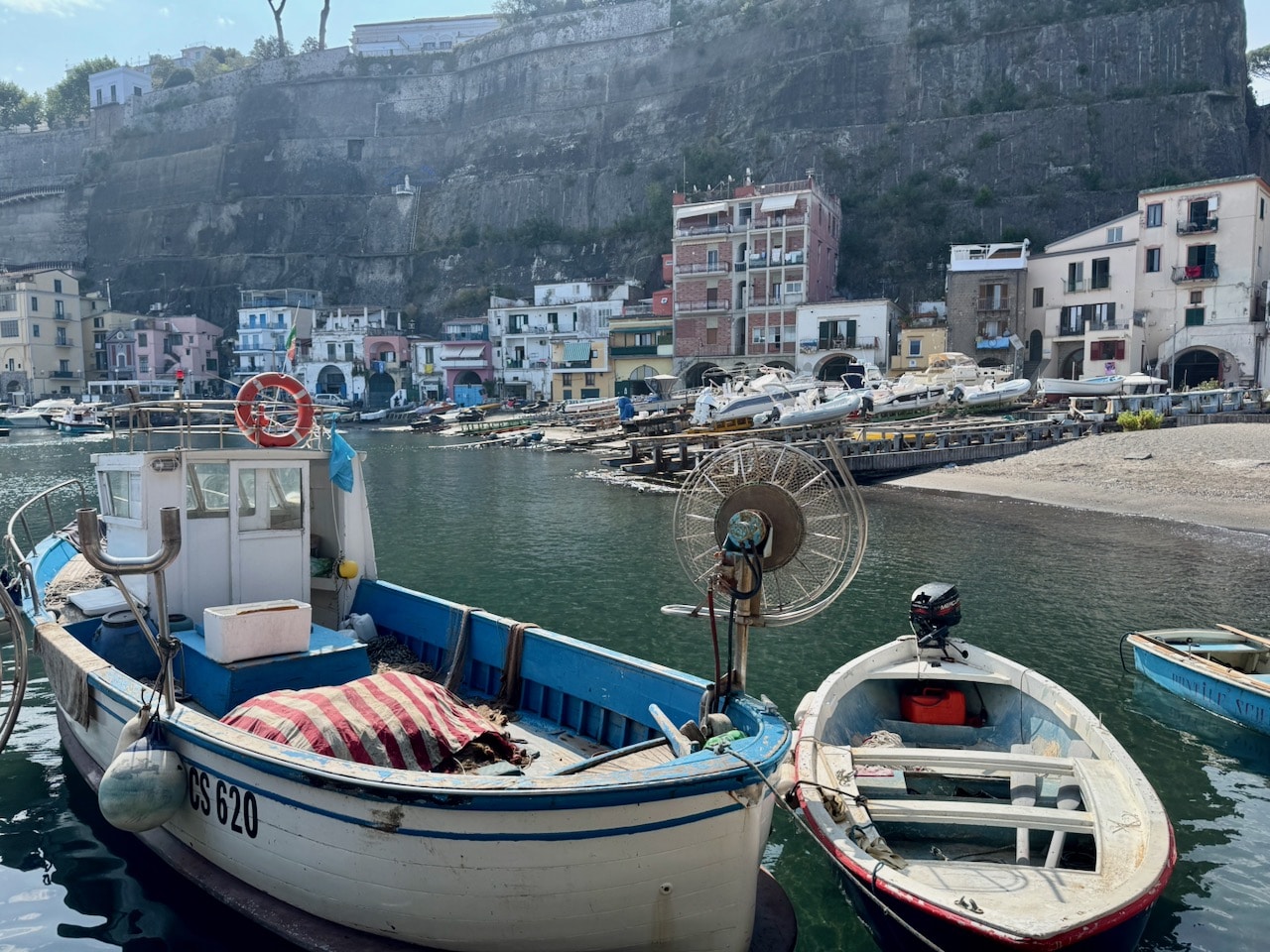
The harbor below was the Marina di Cassano, a little village hidden away.
Marina di Cassano, Piano Sorrento. Photo by ConsumerMojo.com
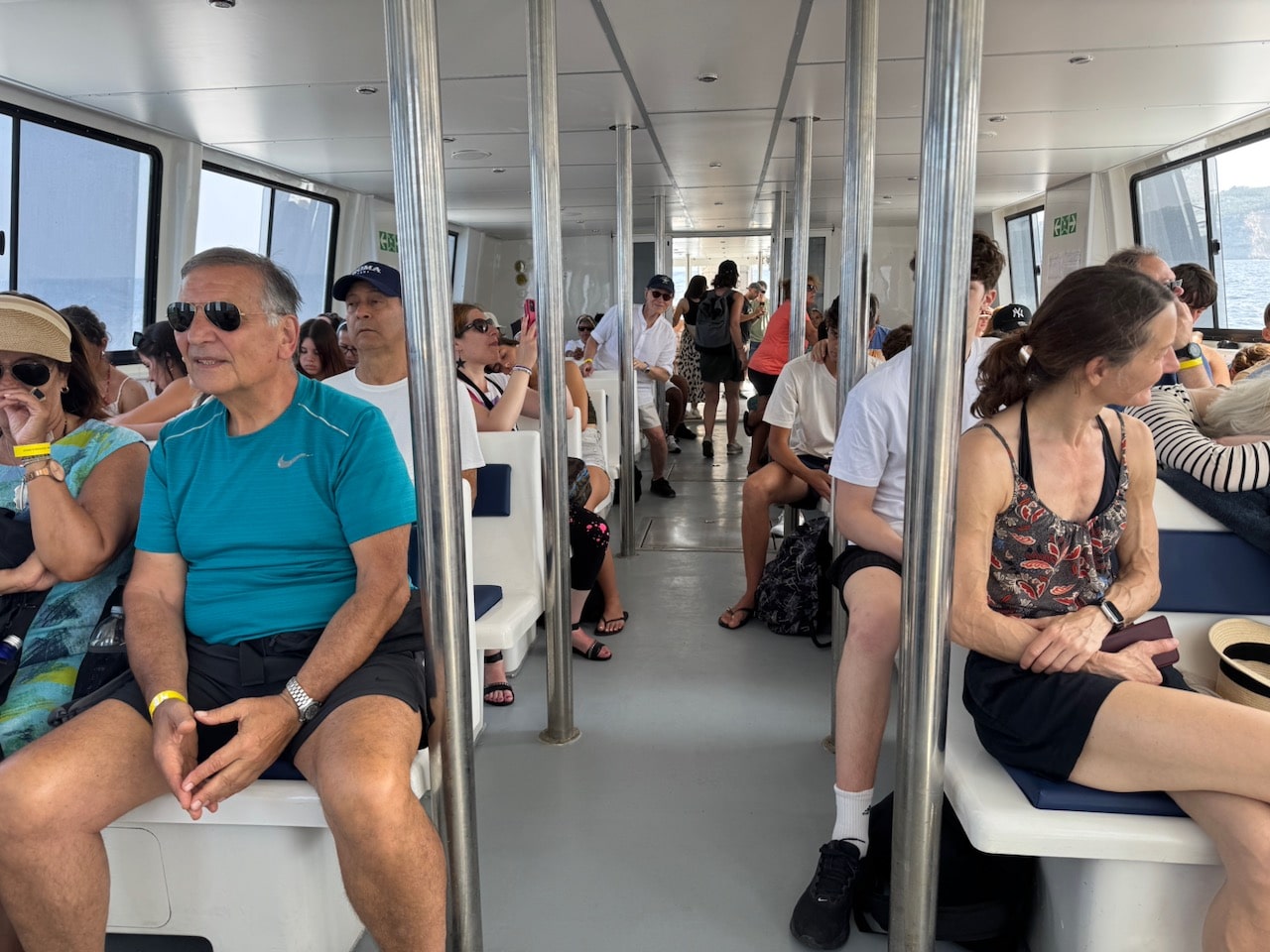
We boarded a boat that was more ferry than pleasure craft and probably held about 150 people. We opted for the shade inside rather than topside deck.
Look closely and you’ll see Nick Taylor peeking out into the aisle of the boat to the Amalfi Coast. Photo by ConsumerMojo.com
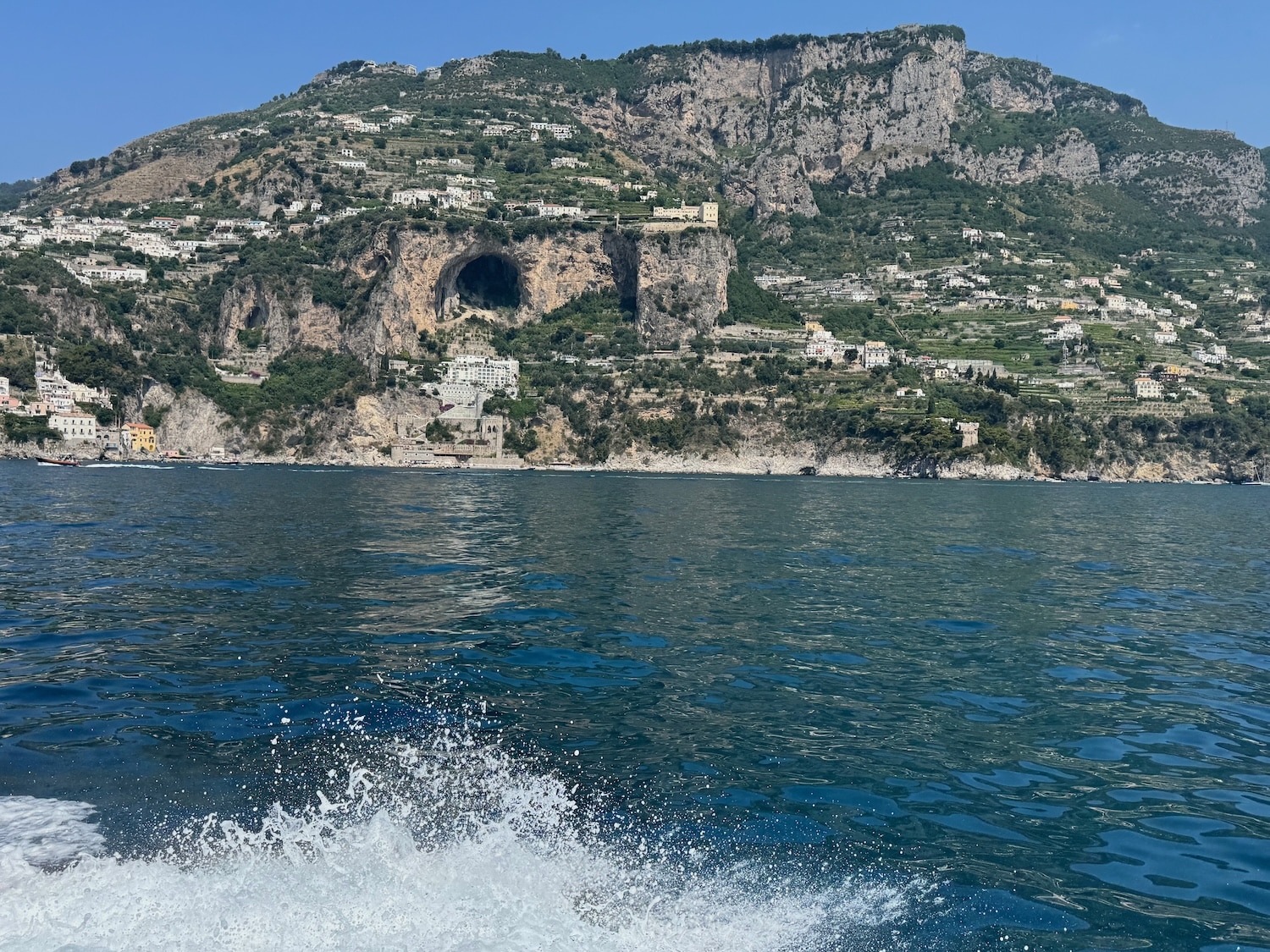
We felt we had a good view during the hour and 10 minute ride.
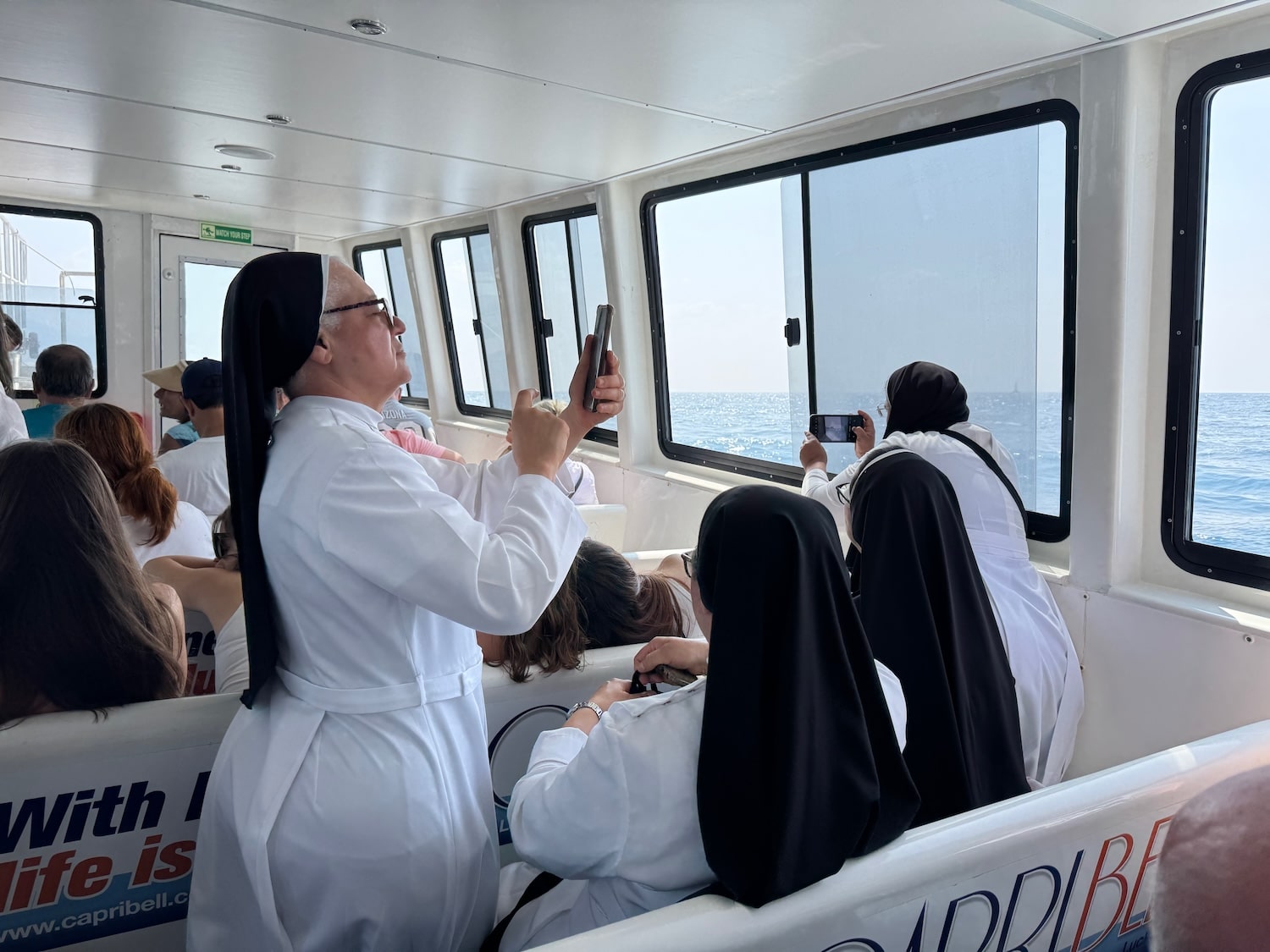
Cave on the way to Amalfi. Photo by ConsumerMojo.comNuns taking photos on the boat on the boat to the Amalfi Coast. Photo by ConsumerMojo.com
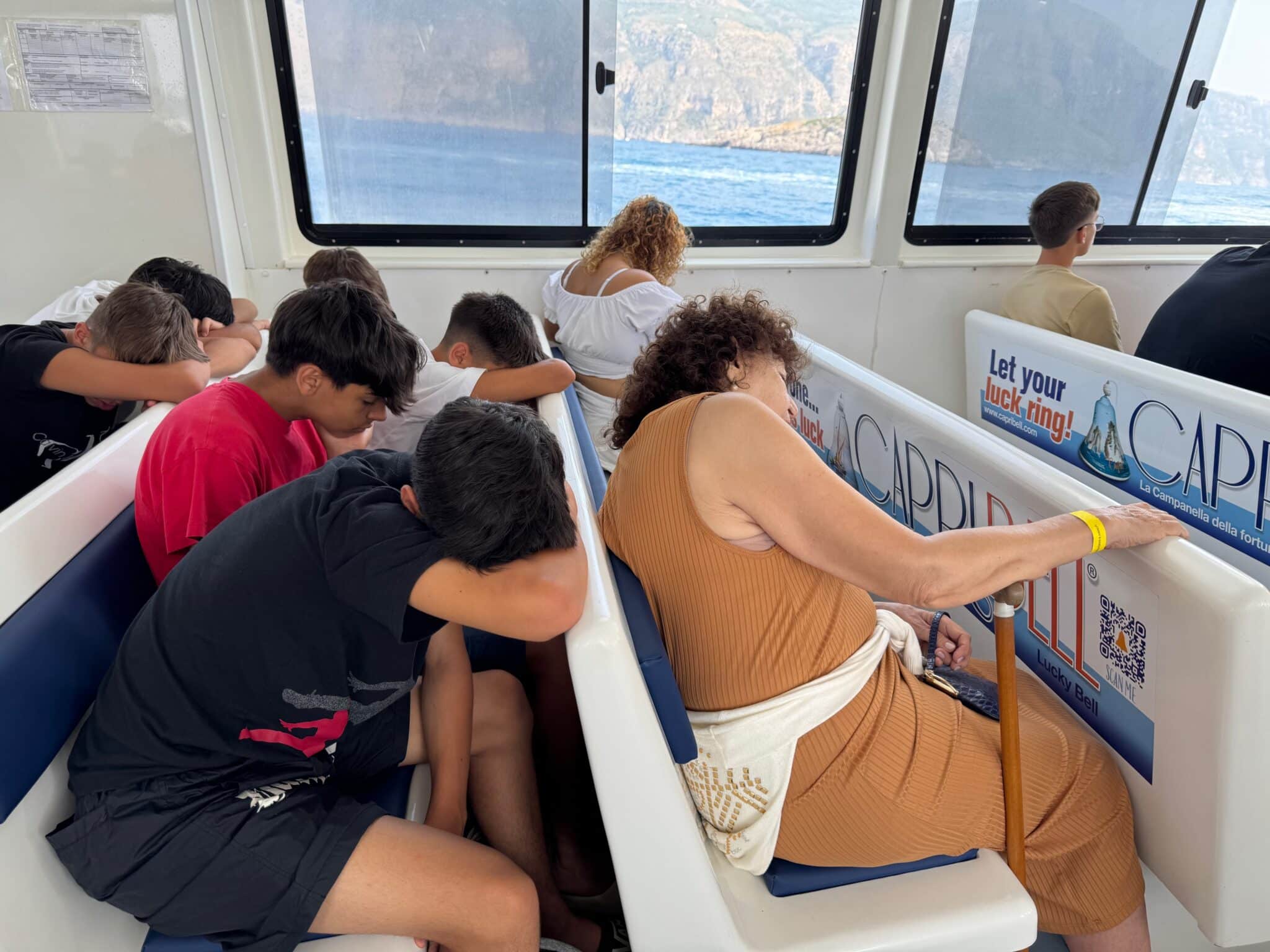
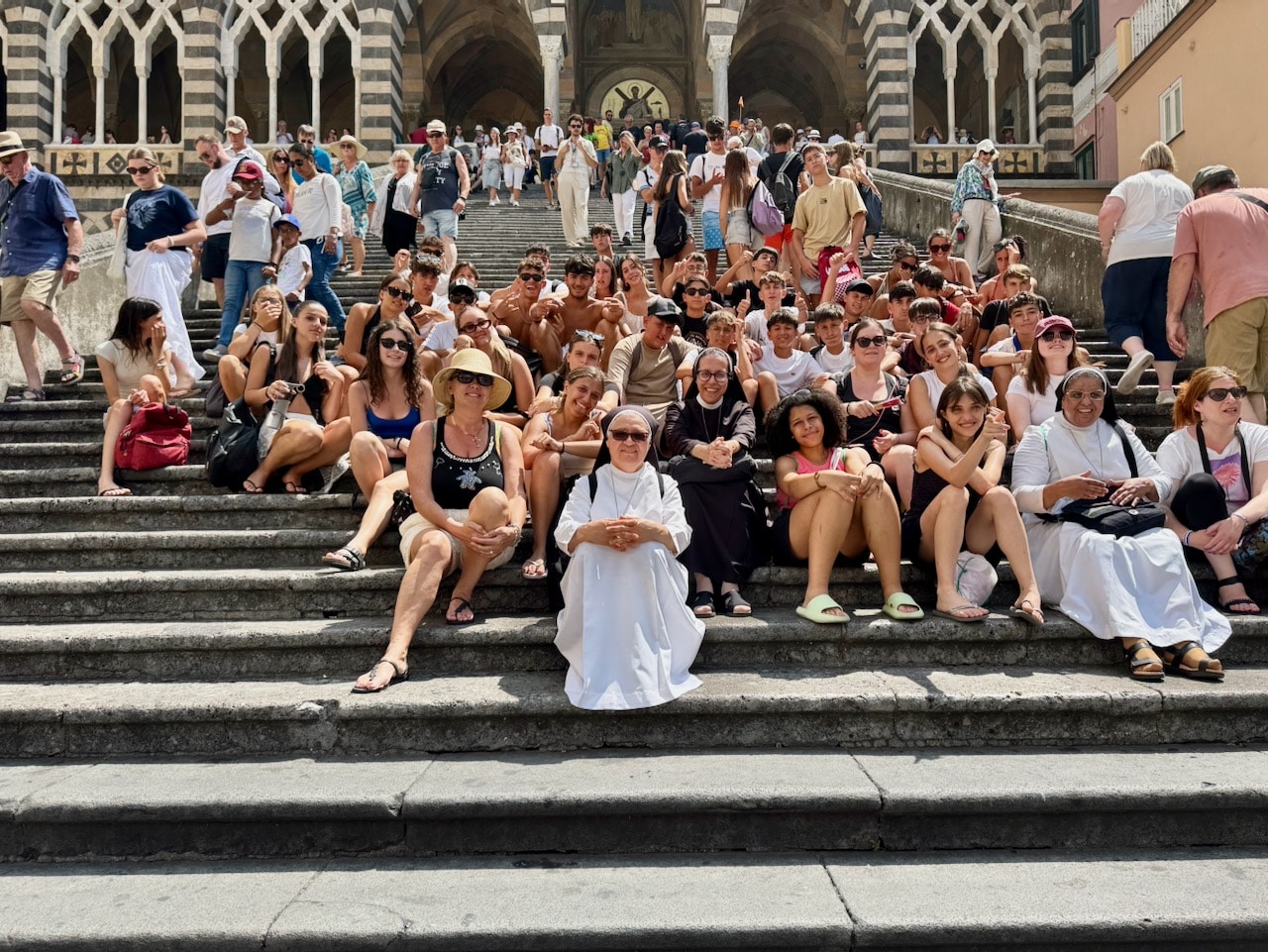
A group of nuns on the boat enjoyed the scenery while shepherding a bunch of high school students.
Sleeping students on the boat to Amalfi Coast. Photo by ConsumerMojo.com
While the students slept we, like the nuns, enjoyed everything we saw.
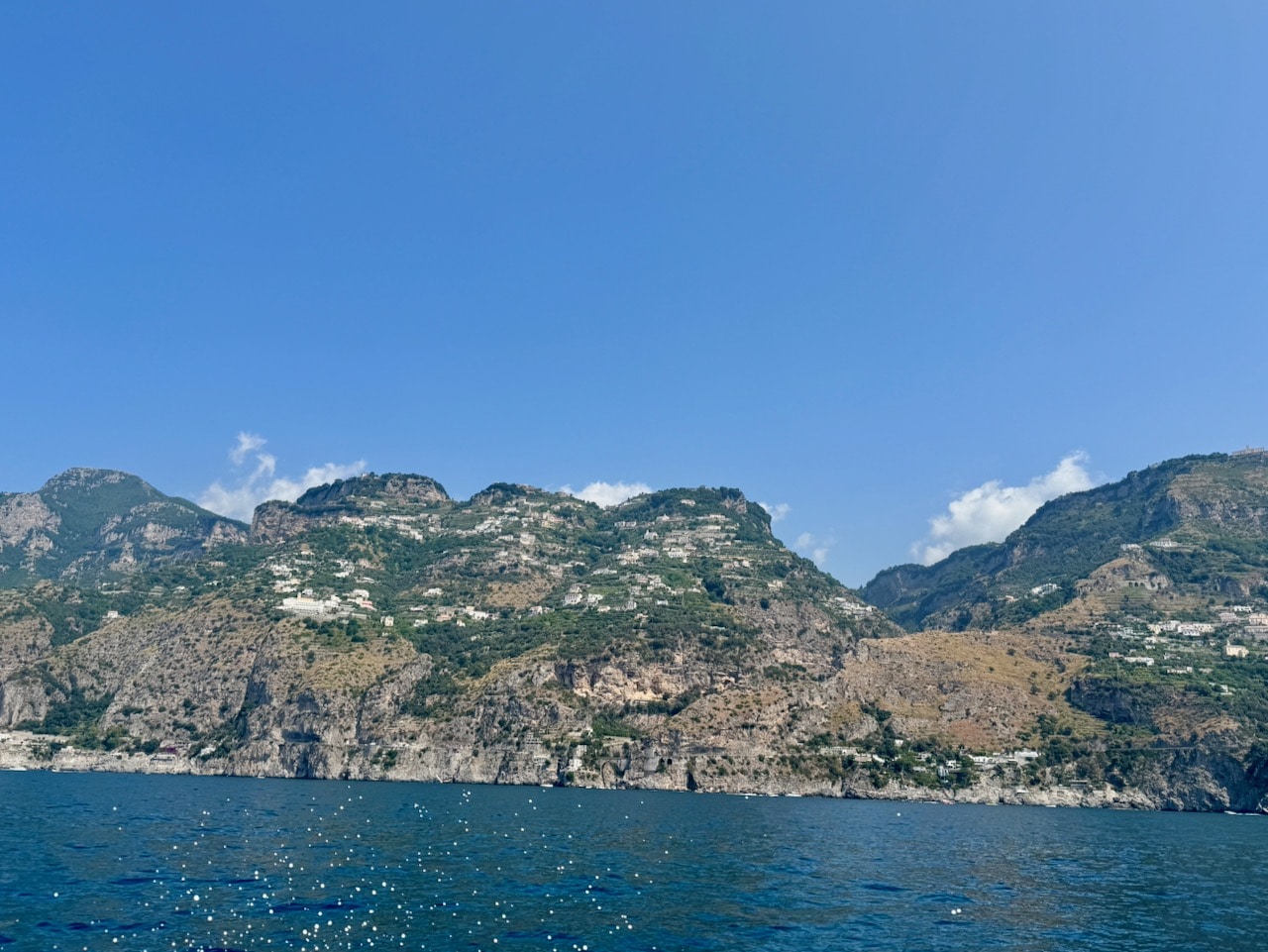
View from the window of the boat to the Amalfi Coast.Photo by ConsumerMojo.com.
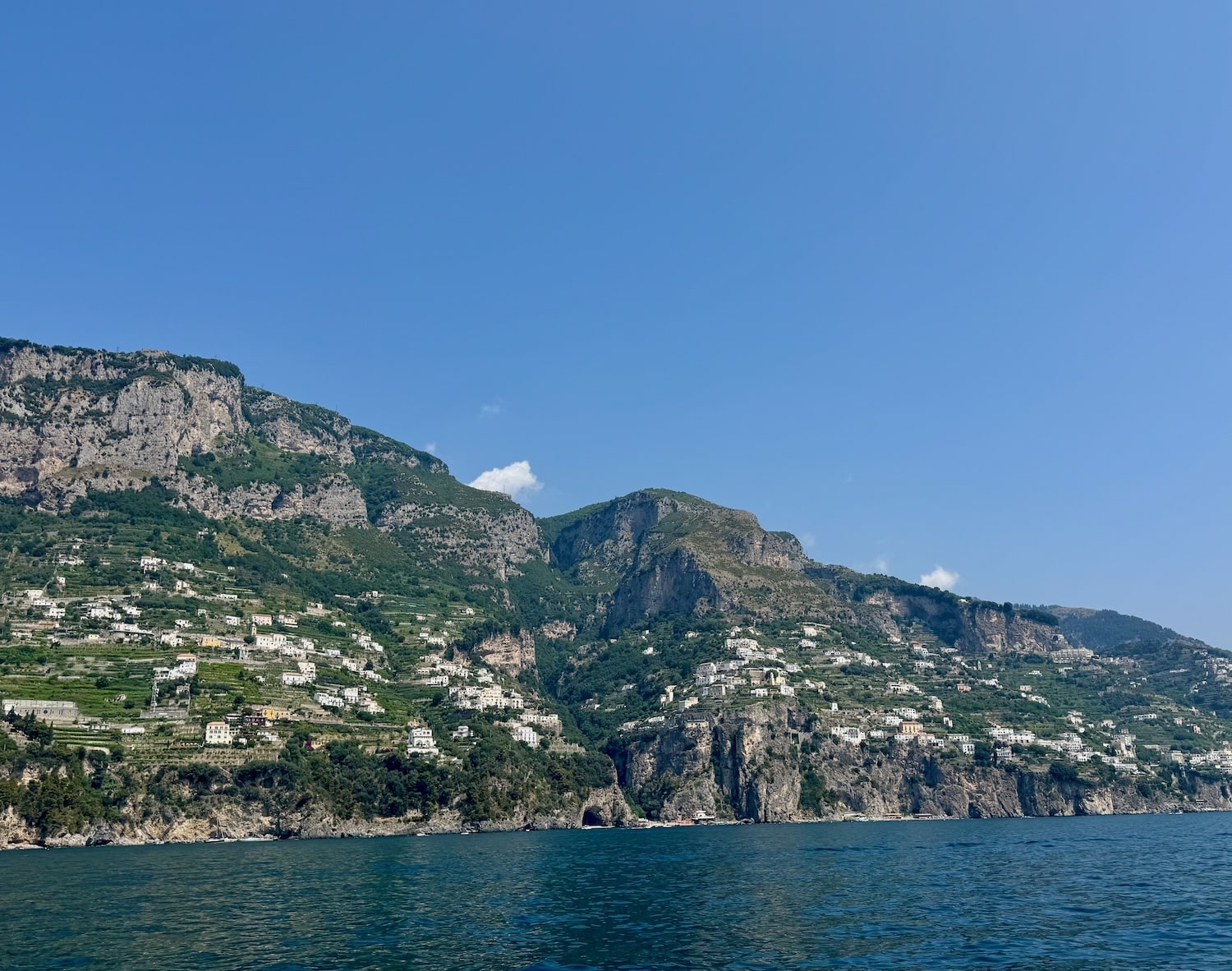
We saw scattered homes, and clusters of communities on the mountainsides on the way to Amalfi.
Homes are scattered over the mountainside on the Amalfi Coast. Photo by ConsumerMojo.com
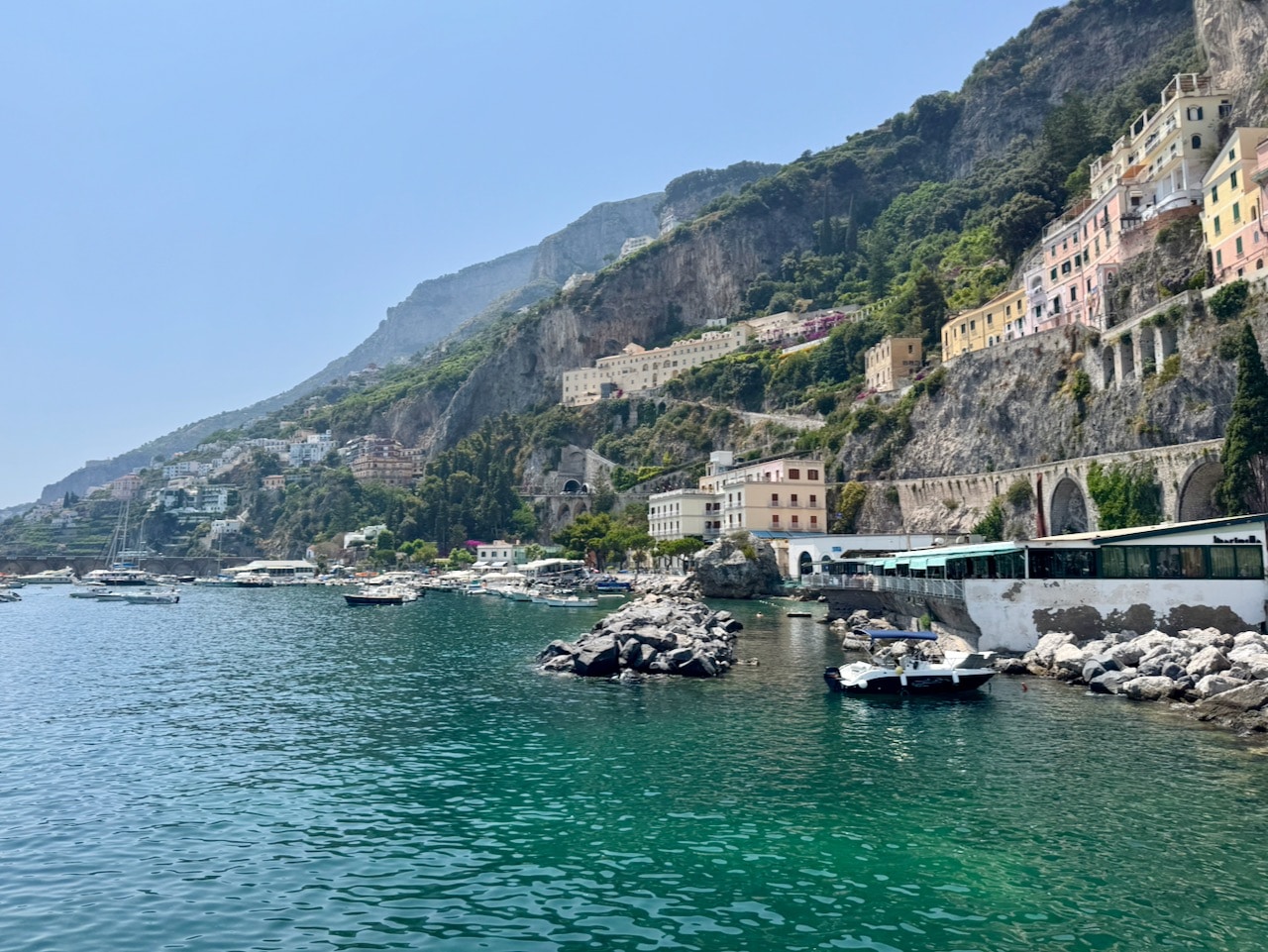
Amalfi was the first stop.
Port of Amalfi.Photo by ConsumerMojo.com
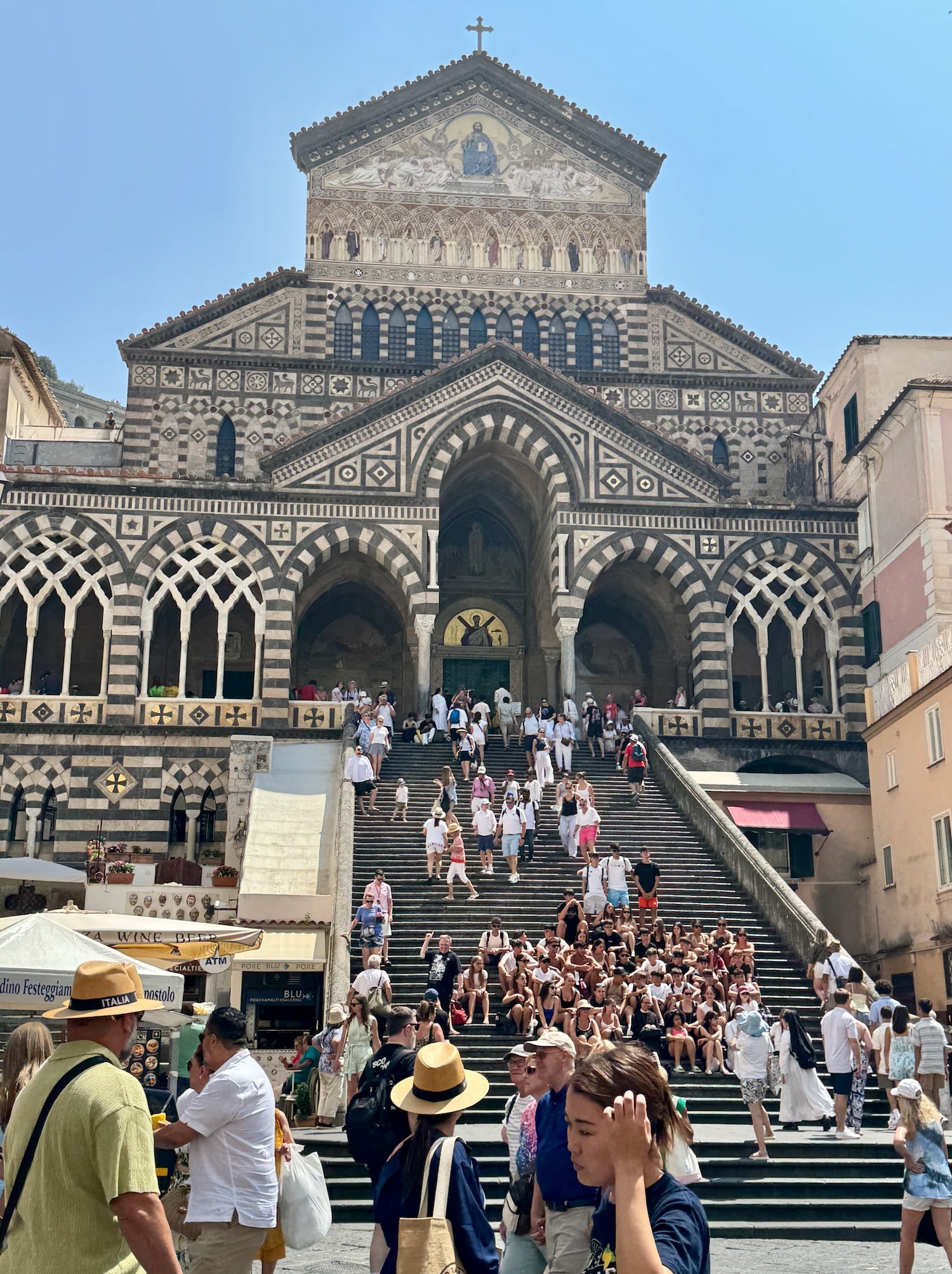
This was more of a boat ride than a tour and as we disembarked at Amalfi, we were told that the boat would pick us up in three hours. That felt like a long time, so we started out to explore a little. We wound our way up the hill to the main square, where we marveled at the arresting beauty of the medieval Duomo di Amalfi, begun in the 9th and 10th centuries renovated and restored over the centuries.
This is where the nuns from the boat brought the students.
The Duomo’s facade today reflects the Norman, Arab and Byzantine influence here. The church is dedicated to St.Andrew and contains his relics. We left the students to that, and continued the walk uphill from the church. Everything here was uphill.
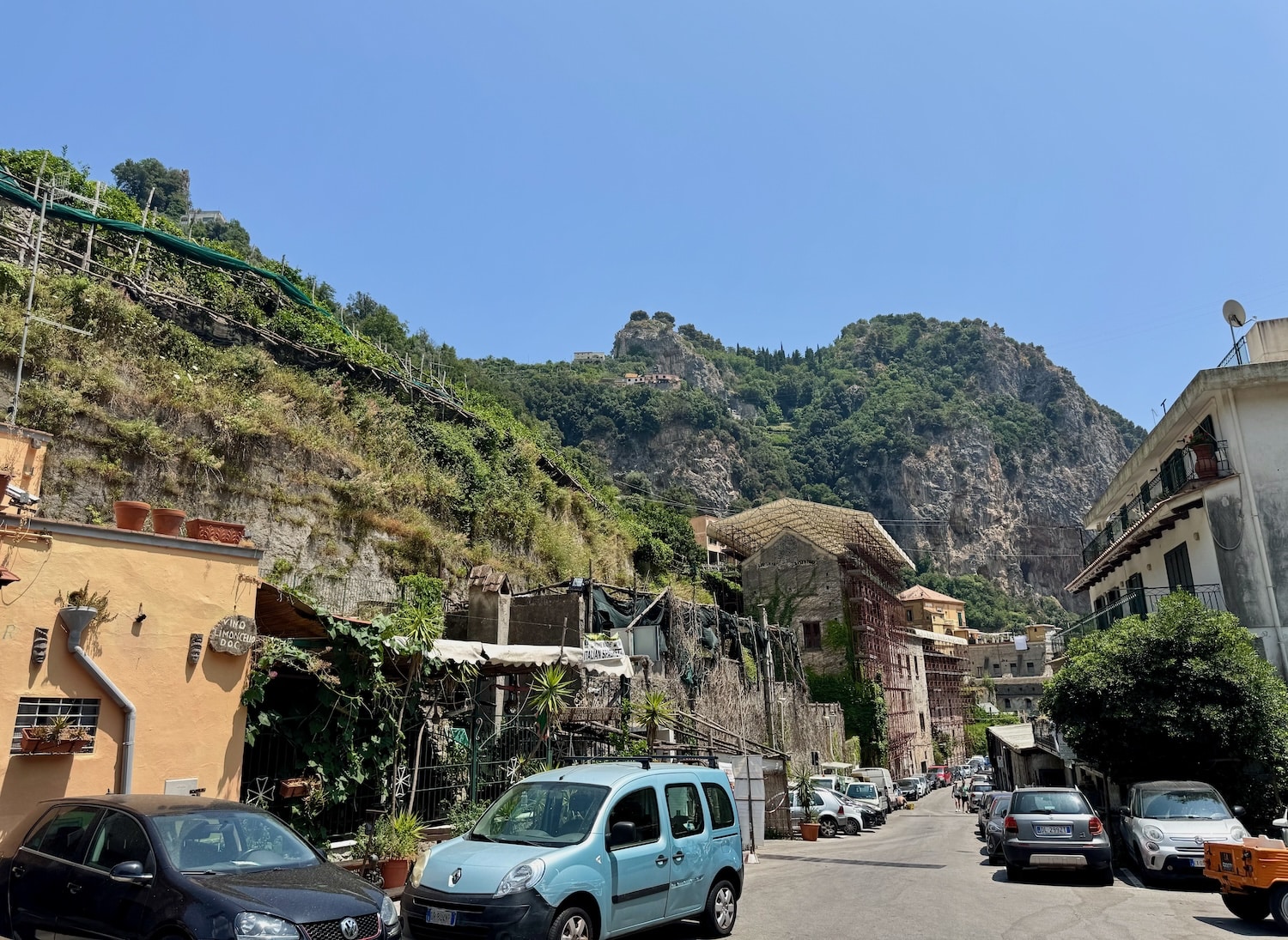
We wanted to get out of the narrow main street filled with shops and other tourists. We passed a man repairing a motorcycle and asked about a good restaurant for lunch. “Roccoco,” he said. “Where is it?” we asked. “Just keep walking,” he waved uphill. “About 10 minutes.” We followed his instructions and went through a tunnel and up the hill where the streets were calmer.
Looking down the hill outside of Amalfi. Photo by ConsumerMojo.com.
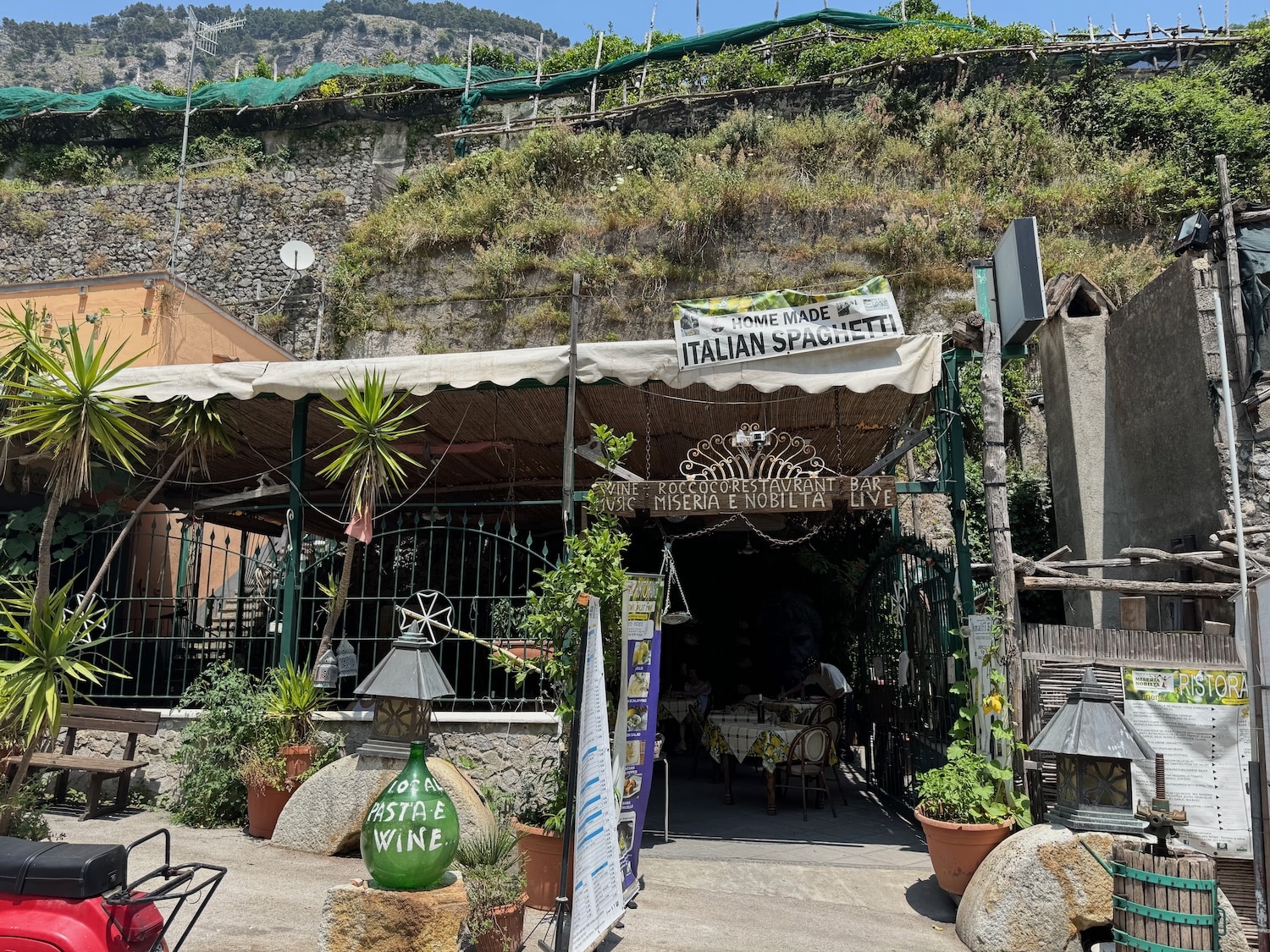
We finally found the placed tucked into the mountain underneath a lemon grove. Its official name is Miseria e Nobilita — misery and nobility — an odd contrast that sounds like a philosophical discussion. No surprise that locals just call it Roccoco, for the owner..
Roccoco Restaurant. Photo by ConsumerMojo.com
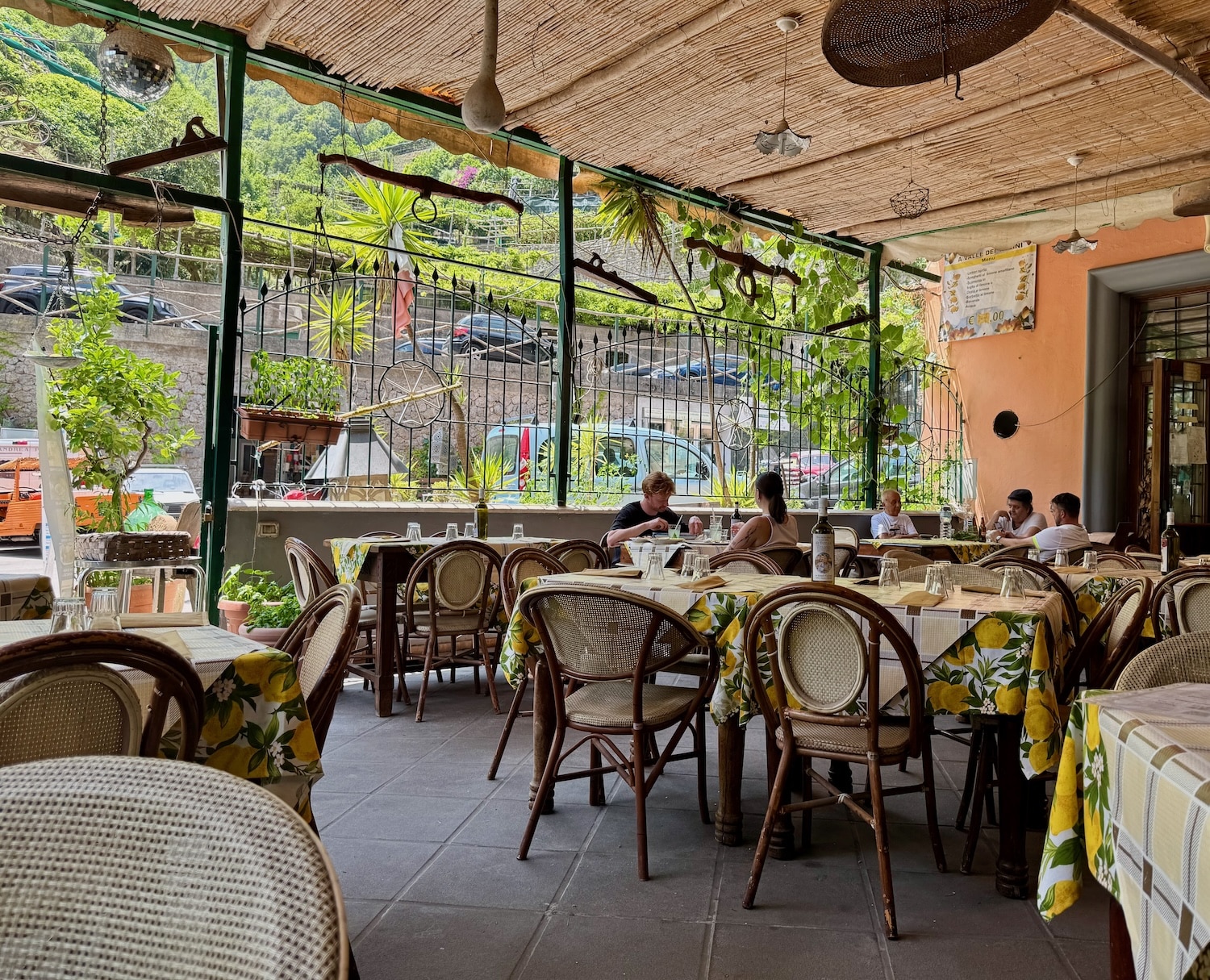
The owner Rocco was sitting in the back near the kitchen with his friends. He’s the one in the middle and he greeted us warmly after we told him the man in the motorcycle shop had recommend us.
Roccoco Restaurant with Rocco in the background. Photo by ConsumerMojo.com
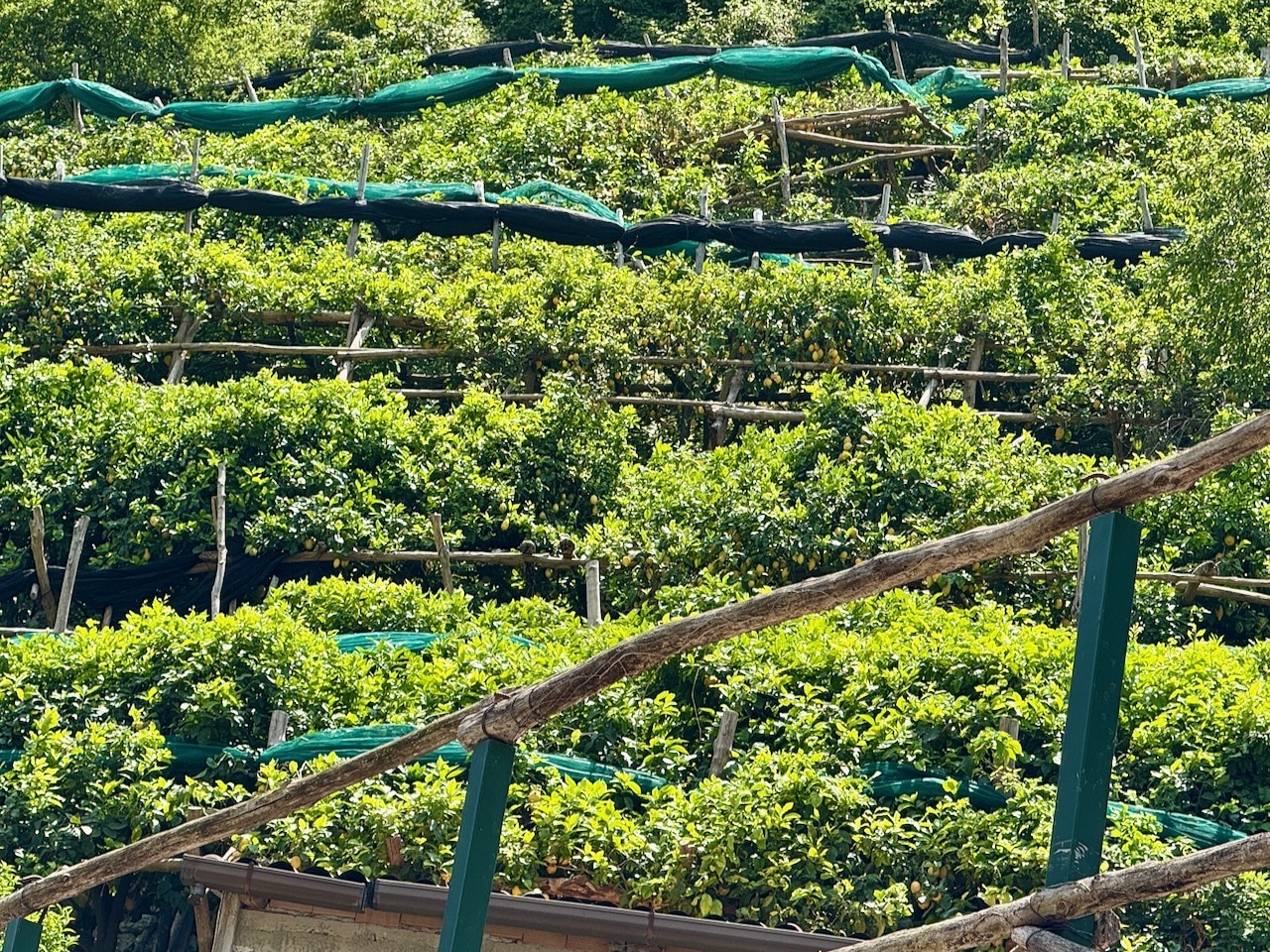
Right across the road from Rocco’s we spotted a lemon grove owned by the Acetto family. They and Amalfi lemons are famous. The lemons in the region are prized for their low acidity and have been grown on terraced slopes in southern Italy since the 2nd century AD. But in the 10th century, when the Arabs arrived, they spread the use of lemons on the sea to ward off scurvy among sailors. They may even have given the fruit the name lemon. Today’s Amalfi lemon, developed by farmers over the centuries, was crossed with bitter oranges and the current variety called Sfusato d’Amalfi.
Lemon grove in Amalfi. Photo by ConsumerMojo.com
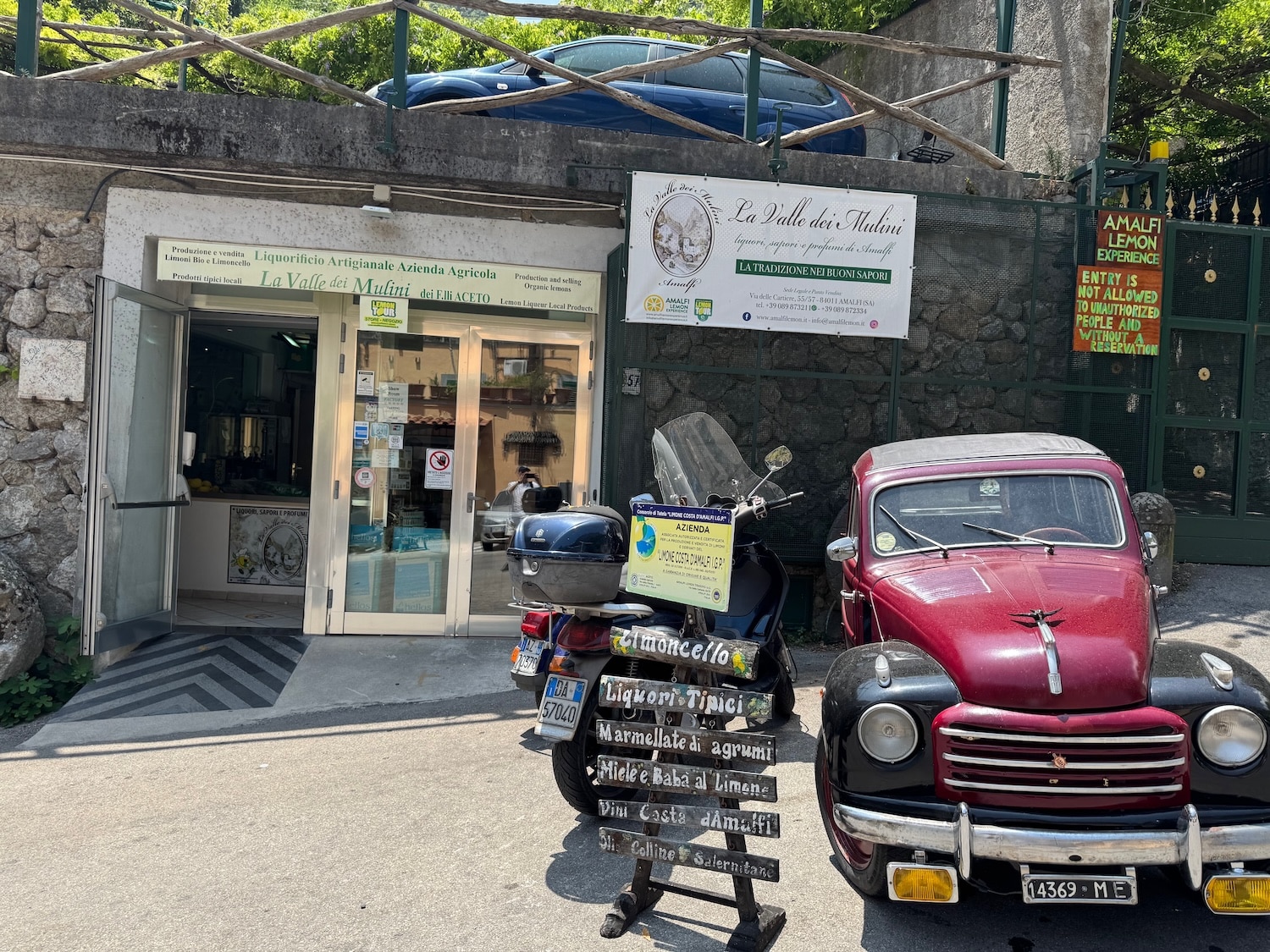
We saw a sign that said the grower offered tours and watched people climb the stairs into the grove.
The grove offers the Amalfi Lemon Experience. Photo by ConsumerMojo.com
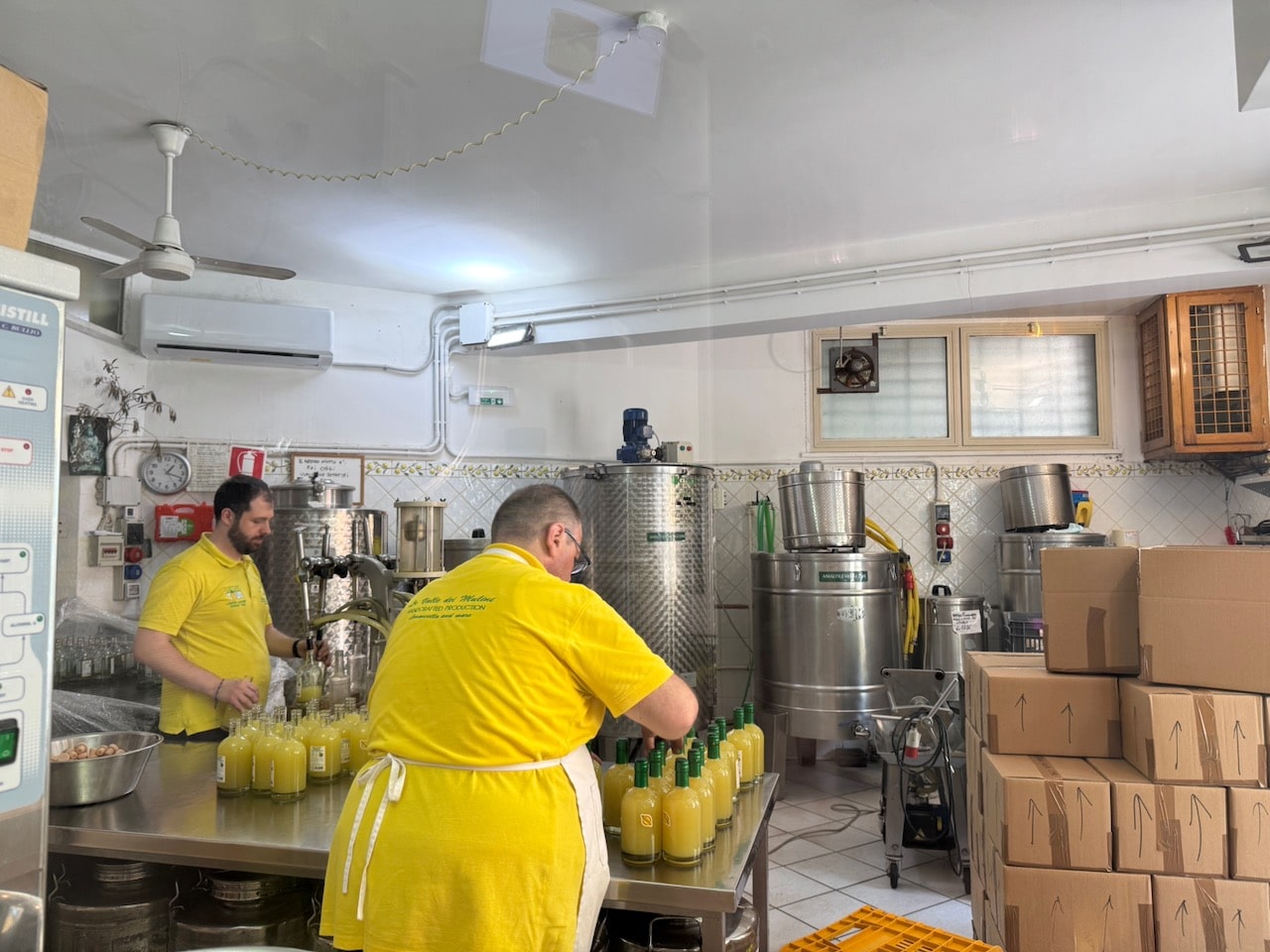
Our three hours were ticking away, but before we started back down the hill we stopped in the small shop and watched the men bottling limoncello. And of course Nick bought a bottle.
Inside the Limoncello factory. Photo by ConsumerMojo.com
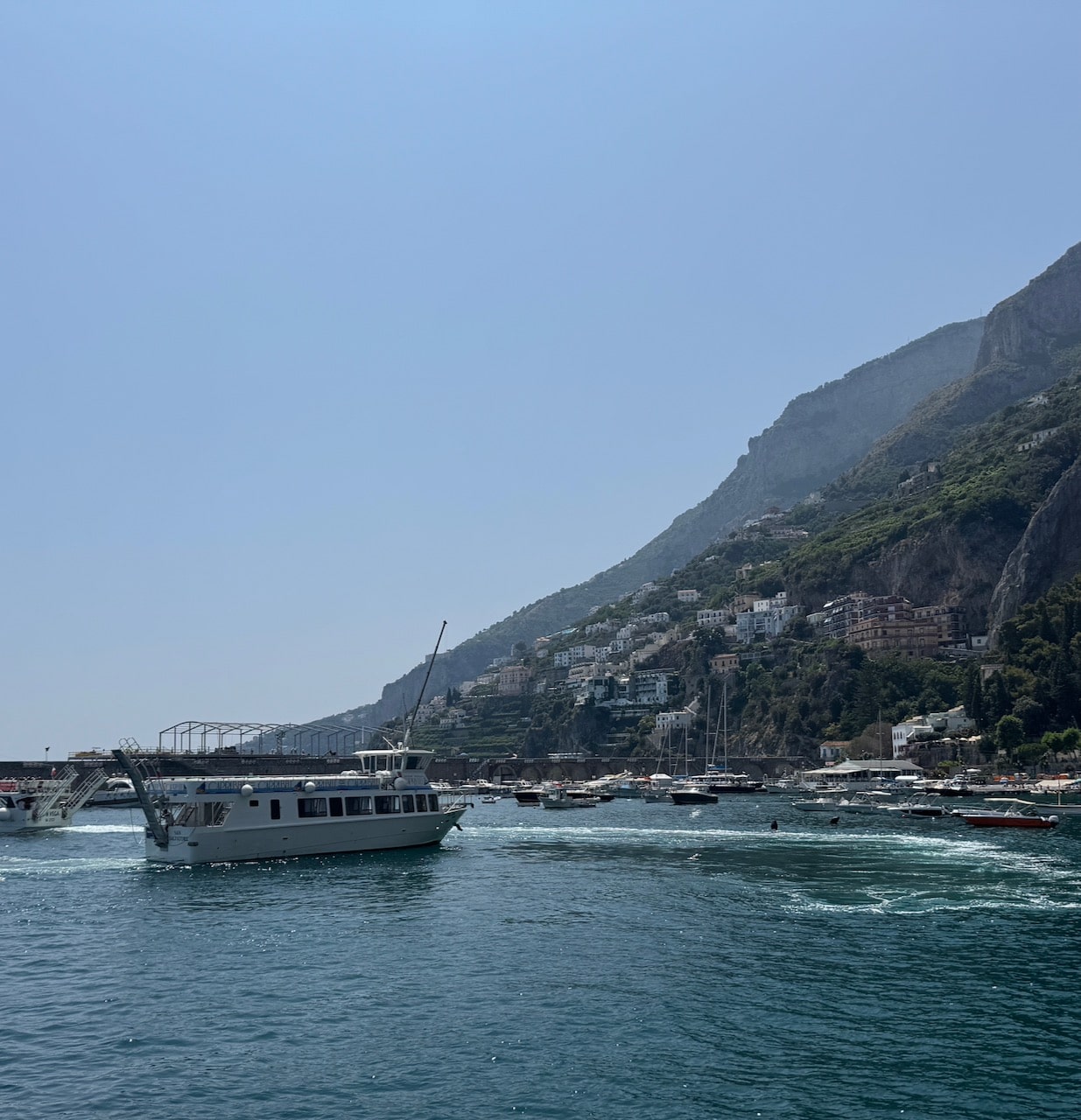
Back at the harbor our boat was waiting to take us to Positano.
Boat from Amalfi to Positano. Photo by ConsumerMojo.com
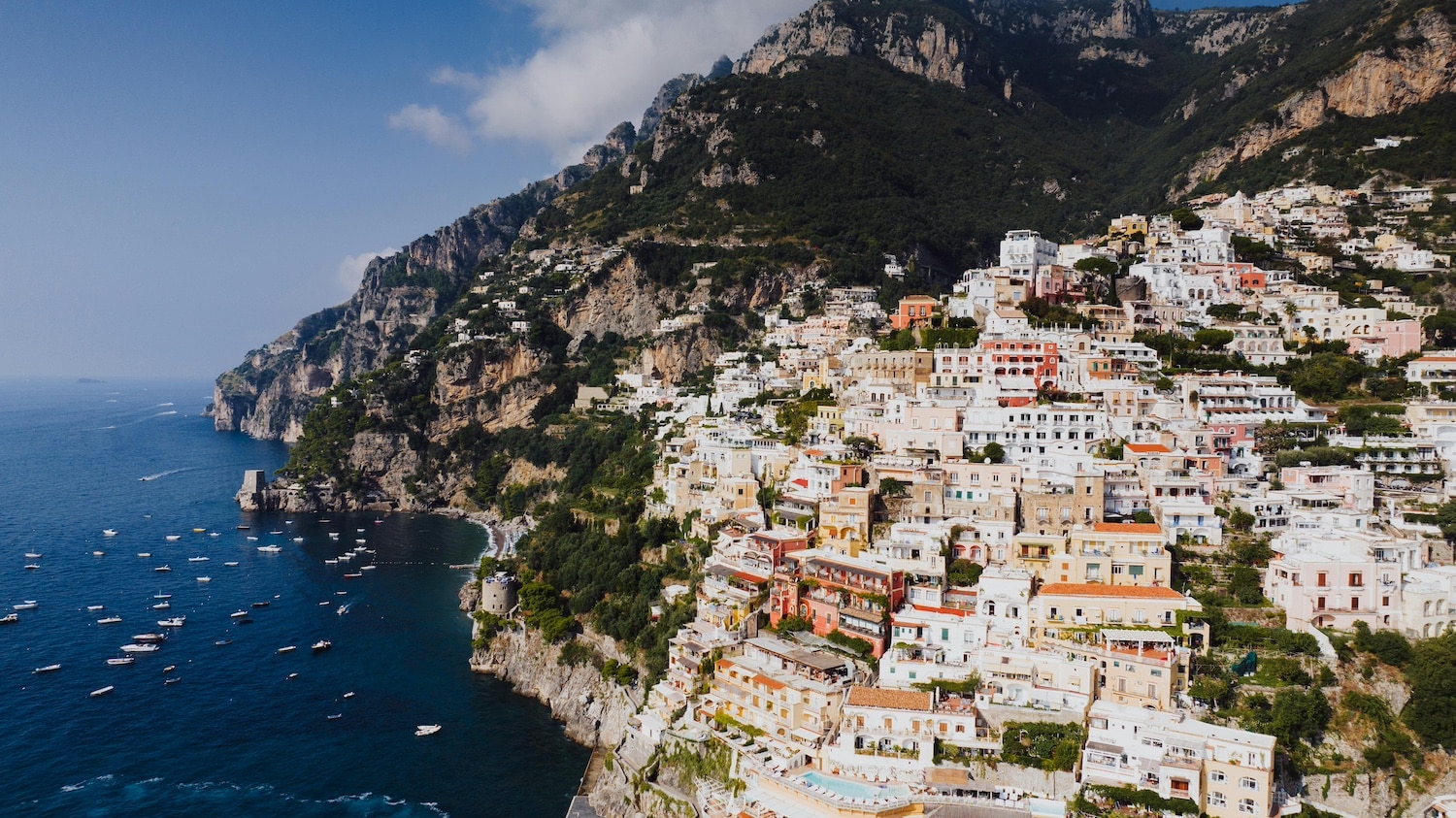
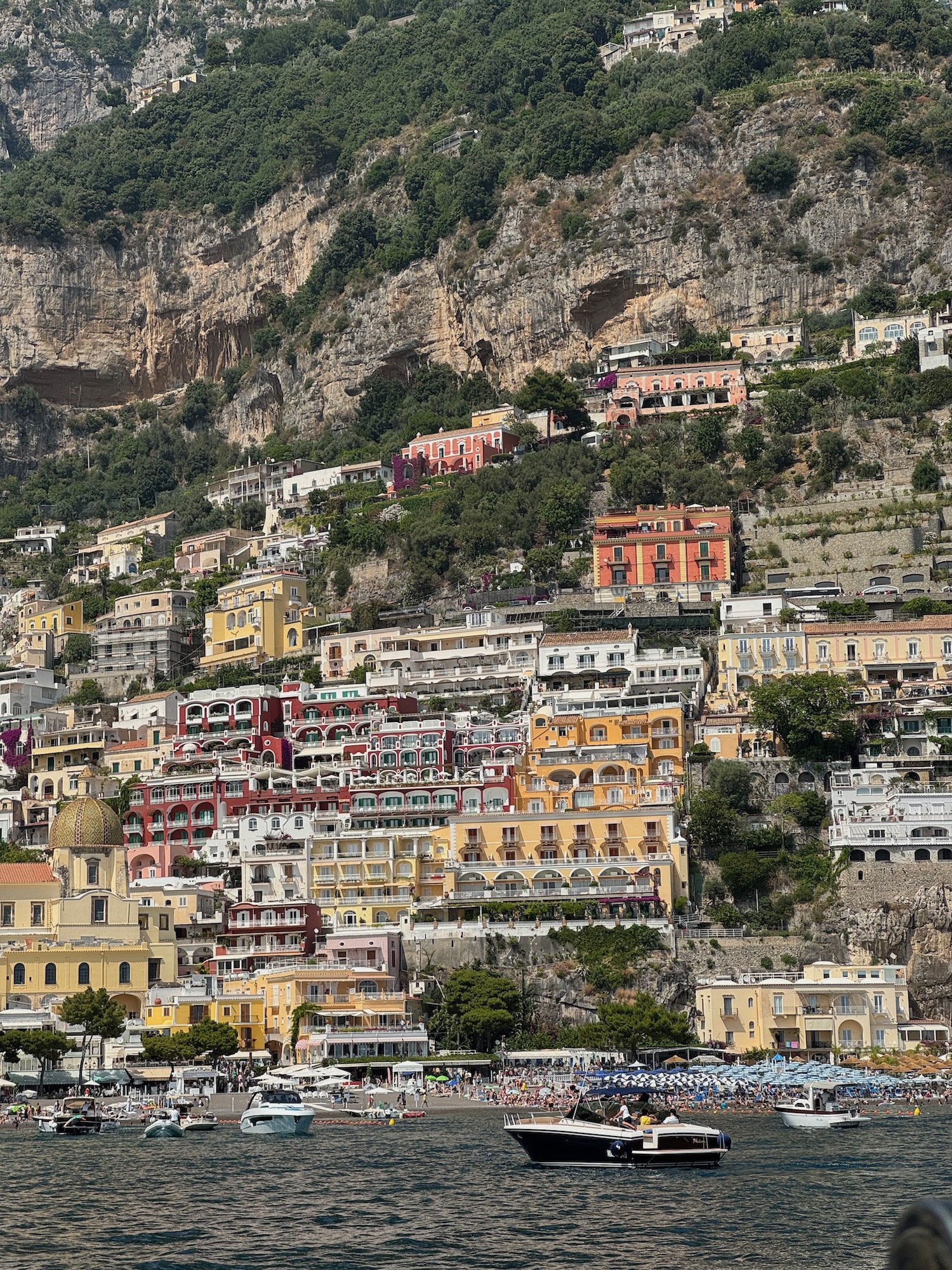
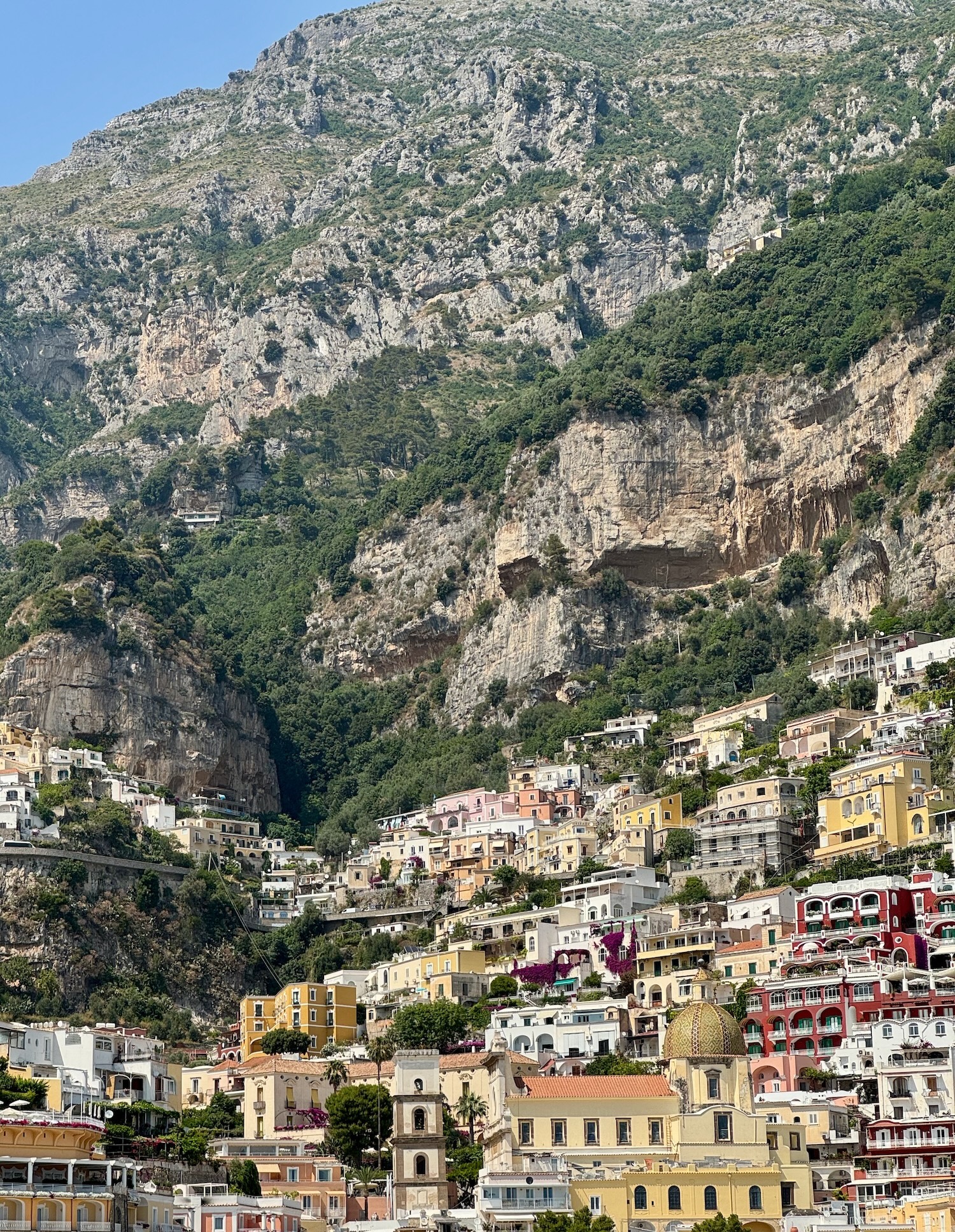
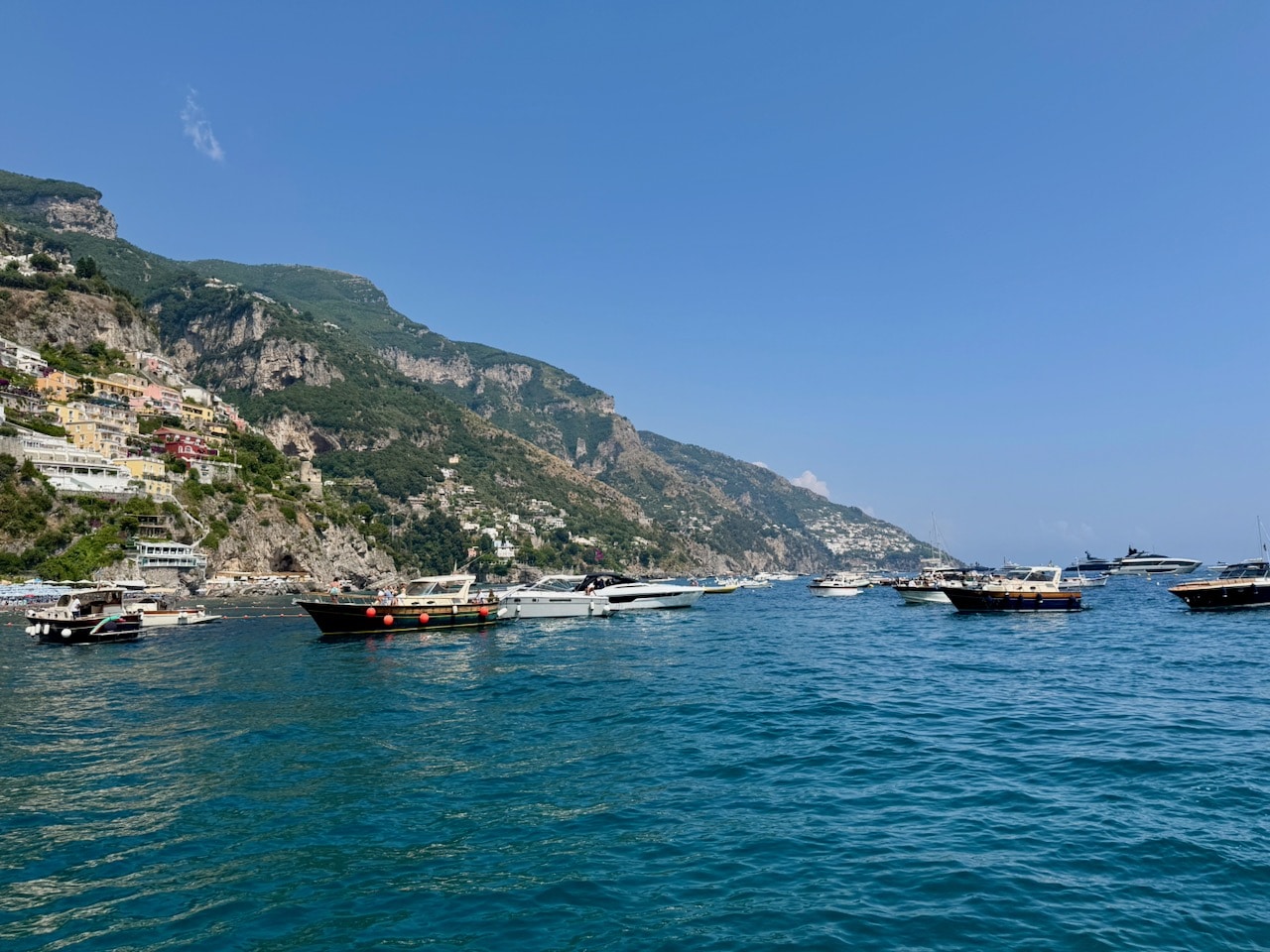
Again, the ride offered spectacular scenery and Positano appeared like a set of dollhouse buildings in the mountain.
Positano from the boat with small craft and beach. Photo by ConsumerMojo.com
As we got closer we saw how much this stretch of the Lattari Mountains dominated the town.
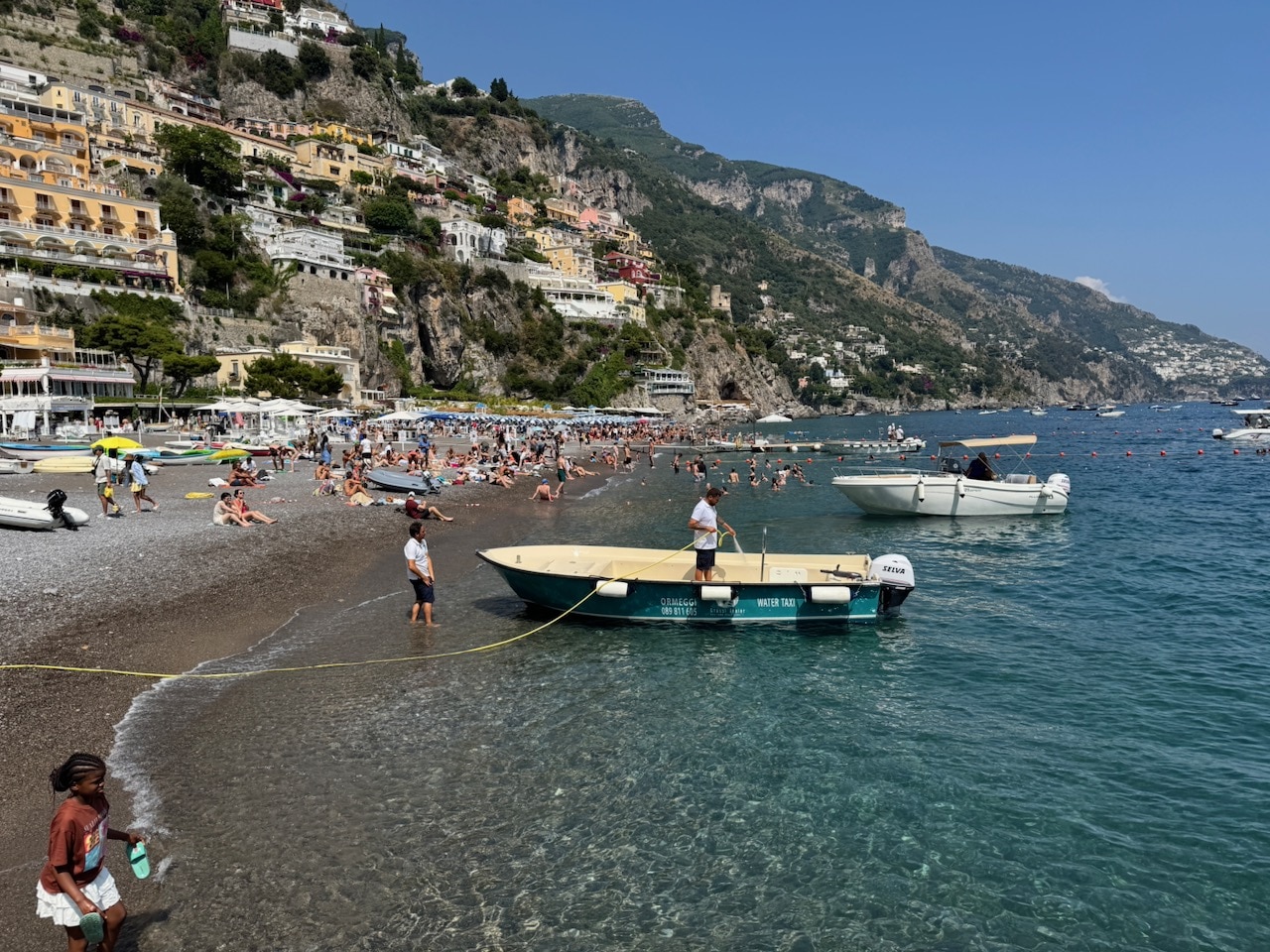
The small harbor was filled with small boats and beachgoers.
A man hosing down his boat in Positano harbor. Photo by ConsumerMojo.comMost of the small boats faced inward in Positano’s Harbor. A yacht anchored in the distance. Photo by ConsumerMojo.com
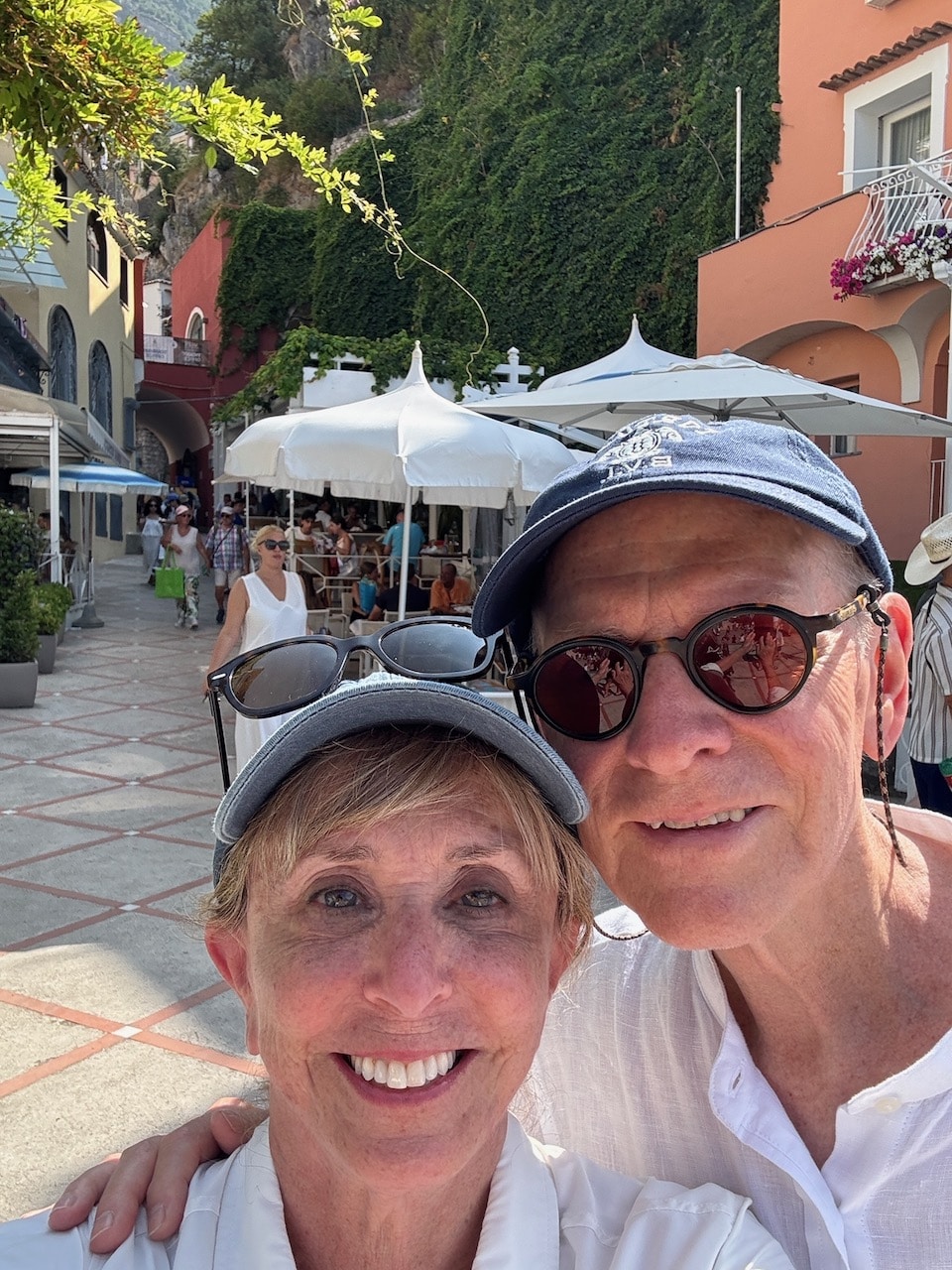
We had about an hour to see the part of Positano available to day tourists. And we started by doing what tourists do.
Barbara Nevins Taylor and Nick Taylor selfie in Positano.
Positano is very pretty, but like Amalfi, it seemed that if you want to get beyond the tourist hype, you’ll have to spend some time on land.
Positano town with dress stores.Photo by ConsumerMojo.com
To escape the the other tourists, we dipped into a coffee shop.
The pastries in the shop in Positano all looked tempting. Photo by ConsumerMojo.com
And what’s coffee in Italy without dessert?
Baba Au Rhum in Positano. Photo by ConsumerMojo.comChocolate pastry in Positano. Photo by ConsumerMojo.com
The trip back was as pleasant as the trip going and were happy that we managed to visit two very beautiful towns. Piano di Sorrento looked quite pretty when we returned and we didn’t think twice about leaving the tourist boat.
Piano di Sorrento in late afternoon. Photo by ConsumerMojo.com
Back at Hotel Torre Barbara, we took a swim in the pool with Vesuvius looking toward us from across the bay.
Torre Barbara swimming pool with Vesuvius in the background. Photo courtesy Torre Barbara
That evening the dramatic sunset reinforced the beauty of the Sorrento Coast.
Sunset from Terrace of Torre Barbara. Photo by ConsumerMojo.com
During another relaxed dinner on the Torre Barbara terrace with good food, we talked about our action-packed day and reviewed our plans to head to Matera in Basililcata the next morning.
It was an intense winter and spring of work, and a country and world filled with grim news. We procrastinated about making plans for a summer trip until late May and then we realized the clock was ticking. We sat down on a Sunday afternoon and started mapping out a trip to begin the second week of June.
We longed for a vacation that was different, something that would take us out of our phones and our worrying heads. The headline here is Rome, but that turned out to be a first stop on a trip through history, mosaics, art and culture and fantastic food that took us from Rome to Italy’s boot heel over three amazing weeks.
Taranto Harbor. Photo by ConsumerMojo.com
We booked our flights through American Express Travel and they set us up with a flight to Rome via Munich on Lufthansa, which had affordable business class seats. Lufthansa is a member of the Star Alliance, a group of 25 airlines that includes United Airlines and Swiss. Like other airline groups it offers mutual benefits including priority check-in and lounge privileges, which in an age of airline delays is helpful.
Beyond New York, Rome is Barbara’s favorite city because it is a walker’s paradise. You wander from piazzas to winding streets filled with small centuries-old details like the 17th century Fontana del Mascherone on the Via Giulia.
Water still runs from the mask. But wine is said to have run from the spout during festivals and feast days. Photo by ConsumerMojo.com
Or, you step into the Piazza Navona and fall in love all over again with the great Bernini sculptures, the Fountains of Four Rivers.
Fountain of Four Rivers, Piazza Navona, Rome, Photo by ConsumerMojo.com
Or, you turn a corner in a winding back street and find beauty in the way a homeowner has added to a centuries old building.
Doorway in Centro Storico, Rome. Photo by ConsumerMojo.com
Rome is where you go to buy a book, then cross the street and discover that you are at Largo Torre Argentina, where Julius Caesar was assassinated in the Curia of Pompey. It helped, of course, that both of us were reading the Robert Harris trilogy about Cicero and Imperial Rome. Our reading gave us a peculiar feeling of connecting and made the history come alive during our walks.
Largo Torre Argentina. Photo by ConsumerMojor.com
Rome, even overflowing with summer tourists, was filled with the possibility of new discoveries.
We stayed at the small and lovely Hotel Ponte Sisto, a former monastery on the Via dei Pettinari close to the Tiber River in Rome’s Centro Storico. Our small suite with a bedroom and sitting room opened onto a terrace.
Terrace in room at Hotel Ponte Sisto. Photo by ConsumerMojo.com
And there was a pretty garden where the hotel served breakfast and you could kick back and feel as though Rome was your own.
Hotel Ponte Sisto Garden, Photo by ConsumerMojo.com
The touristy streets nearby even felt familiar, much like our neighborhood at home, New York’s West Village. Barbara had dipped into her memory to book tables at restaurants we’d enjoyed on previous Roman holidays.
That first night, we returned to a favorite, Pierluigi, in the Piazza de’ Ricci about a ten minute walk from the hotel. It’s a seafood restaurant that’s been around since 1938. We approached to find a large crowd in the piazza enveloped in the sounds of a heavy beat maker. They were there for an art opening and it seemed like everyone was having a great time. We sat at an outside table and let the atmosphere wash over us.
The food here is wonderful and that’s why it attracts a crowd of locals, business people and tourists like us.
We started with tagliatella di calamari con gazpacho all’amatriciana.
Tagliatella di calamari con gazpacho all’amatriciana at Pierluigi. Photo by ConsumerMoj.com
And a wild octopus salad.
Wild octopus salad at Pierluigi. Photo by ConsumerMojo.com
We shared a pasta course of linguine, wild fennel and tuna n’djua.
Linguini with tuna n’djua at Pierluigi. Photo by ConsumerMojo.com
We went on to sea bass baked in salt, which a server expertly deboned away from our table. It was a good thing that we had a nice walk down the Via Guilia back to the hotel.
The next day, we stopped at the nearby Campo de’ Fiori to see the produce available in June.
Produce in Campo di Fiori. Photo by ConsumerMojo.com
Tourists are so ubiquitous here that vendors place no-touching signs and make the point that they don’t care if it’s for a selfie, or an Instagram story.
All the coverage of the election and installation of Pope Leo XIV made us want to visit the Sistine Chapel. Both of us had visited years ago in other lives and it seemed right to visit again.
Vatican and garden. Photo by ConsumerMojo.com
We booked with Tours Guys and were told to meet opposite the main entrance to the museum on the steps across the street.
The area was packed and we got there a little early. So we wandered around the corner and stepped into an air-conditioned grocery story. We were shocked to find prices for groceries were cheaper than in the U.S. Apparently no price gouging here.
That was especially true of Italian wines. But then….
Huffing with indignation at how ripped off we seem to be in the U.S., we headed to meet our tour guide. We had signed up for a three-hour tour of the Vatican Museum, the Sistine Chapel and St. Peter’s Basilica. The tour allowed us to skip the line with our small group and head inside.
Going inside the Vatican Museum. Photo by ConsumerMojo.com
The double helix Bramante Staircase, designed in 1932 to replace the 1505 original, is the first beautiful thing you see.
Bramante staircase inside the Vatican Museum. Photo by ConsumerMojo.com
The original was designed so that Pope Julius II could ride in his carriage to his private residence rather than walk.
Our guide Francesco Quirizi was extremely knowledgable. He’s holding a bunch of radio headsets that he gave out that allowed us to hear what he had to say.
The red flag helped our small group spot him in the crowd.
Francesco Quirizi, Tour Guys Tour Leader. Photo by ConsumerMojo.com
Francesco led us and gave us the backstory on key pieces in the collection.
Among the many beautiful works of art there are showstoppers including the Hercules Mastai. The gilded bronze statue dates to between the 1st and 3rd centuries AD, and was found buried beneath the courtyard of a palazzo near the Campo de’ Fiori in 1864.
Hercules Mastai, Vatican Museum. Photo by ConsumerMojo.comI
In the same room, the Round Hall, there is a giant red-purplish porphyry tub that the Vatican Museum believes may have been in a public square during the days of Imperial Rome. It sits in the middle of a spectacular set of 3rd century AD mosaics from Otricoli and Sacrafano, which were dug up and put back together in the museum in the 18th century.
Porphyry basin on mosaics in Vatican Museum. Photo by ConsumerMojo.com
This overwhelmingly beautiful collection got its start with Pope Julius II in 1506. Artists including Michelangelo encouraged him to acquire the Laocoön, which workers found buried in a vineyard. Pliny the elder described the sculpture in the second half of the 1st century AD when he saw it in the palace of the Emperor Titus.
Laocoön and the Winemakers in the Vatican Museum. Photo by ConsumerMojo.com
In case you are wondering: The statue is of the Trojan priest who warned his countryman not to trust the Greeks’ wooden horse. The story goes that Athena and Poseidon, who favored the Greeks, sent serpents to kill the priest and his sons.
Closeup Laocoon in the Vatican Museum. Photo by ConsumerMojo.com
Pope Julius added more statues to connect the idea of Imperial Rome with the papacy and created the Courtyard of Statues that included the Belvedere Apollo.
Belvedere Apollo, Photo by ConsumerMojo.com
Wikipedia suggests that Julius was a collector before he became Pope. He apparently acquired the Apollo, that dates to the 2nd century AD, while he was an abbott. It felt rare and special, even with the all the other tourists, to stand inches from it and appreciate the artistry and skill.
Steps away, you have the same powerful experience with the statue of Arno or the river god that dates from the time of the Emperor Hadrian.
Our guide explained that the popes who followed Julius added to the collection. And in 1771 Pope Clement XIV opened it to the public, making it the first museum that anyone could visit. Today there is so much to see and appreciate and it is definitely worth a trip.
We had signed up to see the Sistine Chapel, but felt the museum offered a bonus.
Ceiling in the Hall of Maps Vatican Museum. Photo by ConsumerMojo.com
We were not allowed take photos in the Sistine Chapel and there were other rules. Women had to cover their shoulders, everyone had to take off caps and hats, and our guide instructed us not to talk. Once inside you were elbow to elbow with other tourists who whispered, but definitely created a buzz about the spectacular works of art that surrounded us, especially the ceiling by Michelangelo depicting the stories in the book of Genesis.
To wind up the tour, we walked through St. Peter’s Square.
St. Peter’s Square. Photo by ConsumerMojo.com13 Statues set atop St. Peter’s Basilica.
That led us up the ramp into St. Peter’s Basilica and the awe-inspiring beauty that has to make even the most jaded tourist smile.
Inside St. Peter’s Basilica. Photo by ConsumerMojo.com
After a walk about inside, we said goodbye to our guide and our group, including the beautiful Gelfi family from Winneteka, Illinois via Brazil and Miami.
Gelfi Family. Photo by ConsumerMojo.c
That night, energized by all we had seen, we had dinner at Ditirambo, another more modest Roman favorite near the Campo de’ Fiori.
Ditirambo Rome. Photo by ConsumerMojo.com
Alex, the maitre d’ and sommelier, greeted us warmly. Zucchini flower cakes started us off.
We followed it with cacio e pepe ravioli with truffles and then swordfish.
The next day, we still had a taste for art and headed to the Palazzo Barberini, once the home of Maffeo Vincenzo Barberini, who became Pope Urban VIII. It is now the Museum Barberini,
The cab driver who took us there spontaneously explained the way the streets were named: “They are named from the days of the popes, You know, the rich people,” he said, referring to the eras when some of the richest men in Rome had streets named for them and then became popes, including Barberini.
We had tried to get tickets to the Caravaggio show, but had missed out. Instead, we had the galleries almost to ourselves and enjoyed the other masterpieces on display.
The Annunciation by Fillipo Lippi was a favorite.
The Annunciation by Fillipo Lippi in the Barbarini Museum. Photo by ConsumerMojo.com
And so was Raphael’s La Fornarina.
La Fornarina by Raphael in the Museum Barbarini Photo by ConsumerMojo.com
We spent our last afternoon in Rome shopping and Barbara reconnected with Leo Limentani, a storeowner on the Via De Giubbonnari. She had met him in Frandi, his leather goods store, before the pandemic.
Barbara Nevins Taylor and Leo Limentani outside his leather goods shop on the Via Giubbonarri.
She had been profoundly affected by his family’s story, which is commemorated by four small plaques in the sidewalk outside 30 Via Giubbonnari, the building where he grew up and has his store.
Memorials outside the Limentari building.
In 1944 Italian fascists needing to fill a quota of arrests and kills took his grandfather David Limentari off and killed him. Then someone informed the fascists that his father, uncle and another man were hiding in the building. They were taken to Auschwitz and only his father returned. Today Leo, a proud resilient Roman, shares the story so that we all remember.
Leo Limentani in his shop.
That night we had a passable meal in a restaurant we won’t name, and returned to the hotel rooftop for after-dinner Amari. Between sips we discovered a world of gardens among the buildings.
Roof top view from Hotel Ponte Sisto. Photo by ConsumerMojo.com
Rome! Always surprising and we wouldn’t be here long enough. The next day, we planned to head for the Sorrento coast and Pompeii.
President Trump and White House officials understandably bridle at any parallels drawn between this administration and Nazi Germany, whether it be something as serious as I.C.E’s SS-like arrest tactics or as trivial as Deputy Chief of Staff Stephen Miller’s perpetual death-camp-commandant scowl. Still, uneasy echoes of the past keep reverberating. It turns out even Mr. Trump’s Big Beautiful Birthday Parade has, yes, a Nazi antecedent: Adolf Hitler has been there, done that. Twice.
On April 20, 1936 the Führer decided to throw himself a very public forty-seventh-birthday bash that doubled as a coming-out party for a German army just beginning to emerge from the shell of its humiliating World War I defeat. The sweet perfume of renewed national pride hung heavy in the air. The streets were alive with the sound of storm troopers raising their voices in unison. “Today we own Germany,” they sang. “And tomorrow the whole world.”
Uh oh.
The New York Times’ Frederick T. Birchall was on hand and reported that 15,000 officers and soldiers; 1,500 vehicles; 1,000 horses; and 350 tanks coursed through center-city Berlin. “As rank after rank of armored cars, filled with rifleman; motorcycles, machine-gun companies, whippet tanks, howitzers, field guns and anti-aircraft batteries with searchlights and direction finders passed three abreast at the speed of ordinary taxicabs,” he wrote, “the newly acquired might of Germany took on a new aspect in the minds of the onlookers. What was seen today was a war machine built to fight, not parade.”
Germans lining the parade route cheered. An American who happened to be in Berlin on business drank in the spectacle more cautiously. “It makes you think,” he said, “but what I am thinking is, why put together a thing like this if it isn’t going to be used?”
Hitler, of course, was already thinking along those same lines. Nineteen months later, on November 5, 1937, he summoned his senior military commanders to a conference room inside the Reich chancellery. Seated around a large oak table were Foreign Minister Konstantin von Neurath, General Werner von Fritsch (Commander in Chief of the Army), Field Marshal Werner von Blomberg (Minister of War), Admiral Erich Raeder (Commander in Chief of the Navy), and Reichminister Hermann Goering (Commander in Chief of the Air Force). Rarely at a loss for words, Hitler prattled on for four hours. The gist of his message was that a resurgent Germany needed lebensraum, room to grow and prosper. For now, he had his eye on nearby Austria and Czechoslovakia, and if they had to be absorbed into the Reich by force, well, so be it. “Every generation needs its own war,” he told his commanders, “and I shall take care that this generation gets its war!”
Three months later, Hitler, who failed to advance beyond the lowly rank of corporal while serving in World War I, appointed himself supreme commander of the armed forces. Five weeks after that Germany invaded Austria. A small group of anti-Nazi conspirators in the upper levels of the military and government began plotting against Hitler. They managed to make direct contact with Britain’s chief diplomatic adviser, with Foreign Secretary Edward Wood, Lord Halifax, and with a Conservative backbencher in Parliament; one Winston Churchill, who advised “bring us Hitler’s head.”
The conspirators intended to storm the Chancellery and take Hitler into custody if he dared to push on into Czechoslovakia. However, that plan was made moot when Germany, Britain, France, and Italy conspired to sell out the Czechs by negotiating the infamous Munich Agreement in September 1938, which gave Hitler the industrial Sudetenland he so craved; 11,000 square miles of terrain taken without firing a single shot. British Prime Minister Neville Chamberlain crowed about how this “peace with honor” would guarantee the long-term stability of Europe.
In October Raymond Geist, a U.S. consul officer stationed in Berlin, sent a memo to Under Secretary of State George Messersmith in Washington, poking holes in Chamberlain’s rosy vision of the future by declaring “There is nothing to be optimistic about. The dictators have won.” He further noted “thousands of desperate people”, most of them Jews, were continually streaming into the consulate, literally begging at times for visas to escape Nazism. “It is a terrible situation and the plight of the Jews in the country is going to get worse.”
Geist had been posted in Berlin since 1929. A refined gentleman built like a defensive tackle, he earned a doctorate in philosophy at Harvard, spoke seven languages, and knew which palms to grease within the Nazi bureaucracy in order to secure a visa for somebody in a life-or-death pinch. An astute observer of German culture and politics, Geist took an unflinching, contrarian view of Hitler’s rise to power. Back in December 1935 he sent a prescient memo to one of his State Department superiors, arguing that it was simplistic to believe Adolf Hitler was imposing his iron will on a terrified, “liberty-loving” citizenry. To the contrary, the drift toward dictatorship was an expression of a warlike “national temperament” and “national aspirations”. This was two willing dance partners engaged in a perverted tango. Conventional wisdom had things backward, said Geist. “Germany is Hitlerism, rather than Hitler is Germany.” (Hmm. Some may detect another Trump administration parallel.)
A few weeks after Geist predicted life for Jews in Germany would “get worse”, it indeed did. Early November 1938 brought what became known as “Kristallnacht”, a two-day, anti-Semitic rampage that saw SS storm troopers, Hitler Youth, and assorted vigilantes destroy 267 synagogues and 7,500 Jewish businesses. Homes were burned, ninety people murdered and, per Hitler’s orders, more than 26,000 Jews carted off to concentration camps. In protest, President Franklin Roosevelt recalled U.S. Ambassador Hugh Wilson to Washington.
A frazzled Raymond Geist wrote another memo to Assistant Secretary of State George Messersmith, saying he went to work every day “with a heavy step” because of all the accumulated misery demanding his attention. A 78-year-old Jewish woman had lost everything she had, including her apartment. Geist went into full protection mode. “I am looking after her like a child. They may not touch a hair of her. She is getting a visa for America.” His landlady’s husband was due to be transported to a concentration camp. Geist asked Hermann Goering for a favor and got his name taken off the list.
In mid-March 1939 the anxiety level in Germany got ratcheted up another notch. All men of fighting age had been ordered to report for draft physicals. Hitler then reneged on the Munich Agreement, sending troops into Czechoslovakia and taking control of virtually the entire country. On April 15 Roosevelt sent a telegram to Hitler that contained a list of 31 countries, mostly all of Europe. He asked for “assurance” that Germany would not attack any of them. The Führer took offense to that request and, five days later, indirectly responded with an in-your-face show of military muscle that the German press proclaimed the “greatest parade on earth”.
The occasion was Hitler’s fiftieth birthday celebration, which put his forty-sixth to shame. This time around it was a national holiday; everybody got the day off with pay. The two-day event began with a torchlight parade that the honoree watched from a balcony at the Reich Chancellery. He then ducked inside and was showered with gifts at a private party. SS leader Heinrich Himmler gave him an oil painting of eighteenth-century Prussian ruler Frederick the Great, Hitler’s idol.
The main parade kicked off the next morning at about 11:30. It took four hours for the procession to wind past the reviewing stand (which held 20,000 special guests) on Via Triumphalis, the new east-west highway in Berlin. It was a day filled with impressive numbers: 2 million spectators, 40,000 troops, 162 airplanes, 100 tanks – and 1 aborted assassination.
Colonel Noel Mason-MacFarlane, the British military attache in Berlin, by coincidence rented an upper-floor flat in a building directly across the street from the parade reviewing stand. A highly decorated officer and expert marksman, Mason-MacFarlane had, in all seriousness, proposed giving the anti-Nazi conspirators a hand by taking out their nemesis with a single head shot from his elevated bathroom window. “I could pick the bastard off from here as easy as winking,” he said.
Maybe so, but Foreign Secretary Lord Halifax declined the offer, explaining it was not British government policy “to use assassination as a substitute for diplomacy.” Mason-MacFarlane had to be content with attending the parade as one of Hitler’s special guests, another of whom was consul officer Raymond Geist, who signed Hitler’s 50th birthday registry as the designated representative of the United States. Ambassador Hugh Wilson was still cooling his heels in Washington, waiting for President Roosevelt to call off his diplomatic protest and send him back to Berlin.
Wilson never returned. On September 1, 1939 Nazi troops invaded Poland. Great Britain and France responded by declaring war on Germany, ushering in World War II. In early October Geist left Berlin, his home for more than a decade. One of his last official acts was to pull some strings with his German contacts to help get a Hasidic rabbi and seventeen of his family members safely smuggled out of Poland before the country fell to the Nazis.
Those lives were saved. Too many others had been lost. Between June 1933 and April 1939, 286,210 people applied for visas at the American consulate in Berlin – but because of U.S. immigration restrictions only 74,789 were granted. Delivering bad news to so many anxious faces had taken its toll on Raymond Geist. A note in his personnel file said that “in danger of a breakdown in health he was transferred” to Washington and named chief of the State Department’s Division of Consumer Affairs. A desk job.