by Nick Taylor
The visit of Britain’s King Charles III to Washington and New York this week jogged memories of a close brush with the king-to-be nearly fifty years ago.
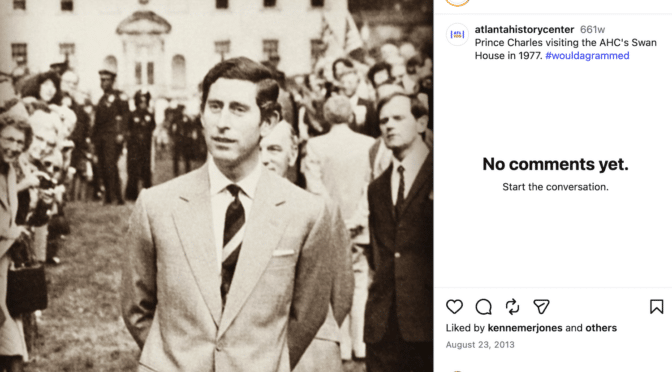
Charles, then 29 and still the Prince of Wales, swung through Georgia in October 1977 as part of an eleven-day, twelve-city U.S. tour. I had a talk show on Georgia public TV at the time and was tapped to do live commentary on his address to an A-list crowd in the State House Chamber.
It was the first royal visit to the former crown colony in its long history and lawmakers rolled out the welcome mat as only they knew how. Ashtrays that doubled as spittoons for the likes of House Speaker Tom Murphy, a tobacco chewer, were emptied and filled with clean sand. And if Charles wanted to see what they were used for, Murphy offered tutoring.
“If he wants to learn to chew, I’ll teach him how,” Murphy told Atlanta Constitution reporter David Morrison as he spat a brown stream.
It’s doubtful Murphy’s offer reached his ears. That afternoon Charles climbed a red carpet up the steps of the gold-domed Georgia capitol as a thousand onlookers applauded and an army band played “The Star Spangled Banner” and “God Save the Queen.” A standing ovation greeted him in the House Chamber, where legislators mingled the city council members and judges and their spouses.
Gov. George Busbee and Lt. Gov. Zell Miller applauded him at the podium of the state house chamber. They all looked as if they were enjoying one another’s company.
Georgia’s powers that be had tried to school the locals in royal behavior, They weren’t to expect handshakes with the prince. When he heard that, former Atlanta Hawks center Walt Bellamy and now the doorkeeper of the Georgia Senate, recalled that his Boston Celtics rival Bill Russell “don’t shake hands either. That’s business as usual for me.”
As I sat in the press area at the back of the room, earphones on and a microphone in front of me, it became clear as he spoke that the young prince was a natural. He mixed gravitas with humor, congratulating Georgia on a new British tobacco plant in Macon “to my horror as a non-smoker,” and promoted new air routes from Atlanta to London even though flyers “may never be able to get out again.”
He talked diplomatically of the threads linking his ancestor King George III, who ruled during the American revolution, with the United States and the state that bears his name. “I am utterly convinced,” he said, “that he would have been delighted to see what has happened — for once he realized that independence was inevitable, he was wise and sensible enough to appreciate that the two nations should live and work together in a growing spirit of mutual respect and harmony.”
There was the ritual gift-giving. Atlanta Mayor Maynard Jackson gave the prince a ceramic key to the city made of Georgia red clay. Speaker Murphy might have been expected to offer a pouch of Levi Garrett, his favorite chewing tobacco, but his gift instead was a pair of bobwhite quail, stuffed and mounted in a glass case. One wonders if they’re still in a dusty corner of the Windsor Castle basement.
Charles would be a king-in-waiting for a long time still to come. He finally acceded to the throne in 2022, upon the death of his mother, Queen Elizabeth II.
But when he spoke to Congress this recent Tuesday, April 28, — the first British king to address Congress in our nearly 250-year history — he still had “mutual respect and harmony” in mind. His remarks were diplomatic but pointed, a gentle rebuke to the combative pugilism preferred by President Trump and his top deputies. Charles reminded Congress and the rest of us that the alliance between the United States and the United Kingdom has been “one of the most consequential in human history.” He mentioned the roots of democracy in the Magna Carta. He cited the importance of NATO to a stable and democratic Europe. He spoke of the “unyielding resolve needed for the defense of Ukraine and her most courageous people.” He said the climate crisis is a threat that shouldn’t be moved to a back burner.
He spoke as a leader should speak, to bring people together, not to divide them.
I’ve been to every No Kings march here in New York, but I wouldn’t mind this one.