Should you take your pension in monthly payments or should you ask for a lump sum of money? Private employers increasingly offer this choice and that means you will face a tough decision.
Confusion about pension payouts can lead to a financially devastating mistakes, especially for older people who can’t get a do-over. That led the Consumer Financial Protection Bureau (CFPB) to step into the breach. It came up with a guide to help you navigate pension payment choices.
The guide provides answers about pension payouts and offers tips and warnings to help you protect and manage your money. CFPB Director Richard Cordray said, “Retirees are increasingly being faced with the difficult one-time choice to either take their pension payments in a lump sum or as a lifetime income stream. Clear information about the trade-offs they face can help consumers make the right financial decision for their retirement security.”
When you review your needs, key factors to consider include:
Consider the the length of time you need the income.
A monthly payment option offers steady lifetime income and substantially reduces a consumer’s risk of running out of money later in life. This is especially important if the consumer or their spouse is in good health or if either of the two has a family history of longevity.
With a monthly payment, you have the protection of the Pension Benefit Guaranty Corporation (PBGC). If your company declares bankruptcy or cannot make its pension payments, the PBGC guarantees those payments up to a certain amount. The CFPB says, “Pension payments are also protected against certain creditor claims or debt collectors. With a lump-sum payout, consumers lose these protections.”
In addition, if you choose the monthly payment, your benefit may include a surviving spouse clause.
A lump-sum payout, however, might make sense if you have terminal disease or illness. It also might work for you if you have a steady income stream from another source.
But the CFPB guide reminds that if you take a lump sum you can lose it all unless you have good money management skills
The lump sum also makes you a target for scammers. And you’ll want to triple check before taking advice from people or making investments with your retirement money.
You can find more on the CFPB website and you can see the guide for figuring out your pension here.
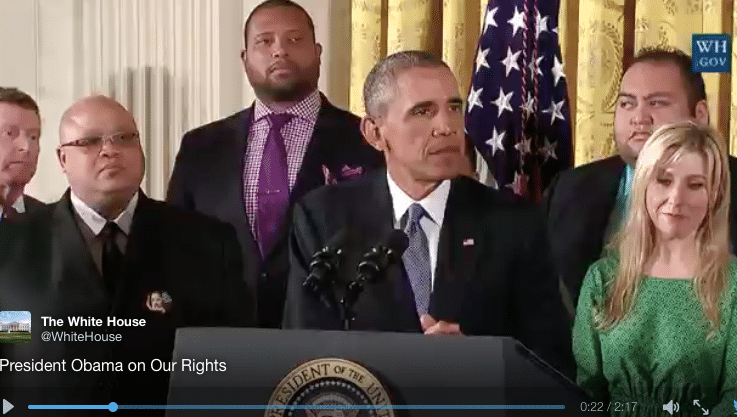
President Obama talked emotionally about why he issued a series of executive orders to close gaps in the background check system for people who buy guns at fairs, gun shows, or online. He also explained why he took other measures to reduce gun violence, including beefing up the Bureau of Alcohol, Tobacco and Firearms (ATF).
During his video address, the President wiped away tears several times as he recalled lives lost during recent shootings.
Here’s what President Obama plans to do, according to the White House press staff.
“The Bureau of Alcohol, Tobacco, Firearms and Explosives (ATF) is making clear that it doesn’t matter where you conduct your business—from a store, at gun shows, or over the Internet:If you’re in the business of selling firearms, you must get a license and conduct background checks.
ATF is finalizing a rule to require background checks for people trying to buy some of the most dangerous weapons and other items through a trust, corporation, or other legal entity.
Attorney General Loretta E. Lynch has sent a letter to States highlighting the importance of receiving complete criminal history records and criminal dispositions, information on persons disqualified because of a mental illness, and qualifying crimes of domestic violence.
The Federal Bureau of Investigation (FBI) is overhauling the background check system to make it more effective and efficient.The envisioned improvements include processing background checks 24 hours a day, 7 days a week, and improving notification of local authorities when certain prohibited persons unlawfully attempt to buy a gun.The FBI will hire more than 230 additional examiners and other staff to help process these background checks.
2.Make our communities safer from gun violence
The Attorney General convened a call with U.S. Attorneys around the country to direct federal prosecutors to continue to focus on smart and effective enforcement of our gun laws.
The President’s FY2017 budget will include funding for 200 new ATF agents and investigators to help enforce our gun laws.
ATF has established an Internet Investigation Center to track illegal online firearms trafficking and is dedicating $4 million and additional personnel to enhance the National Integrated Ballistics Information Network.
ATF is finalizing a rule to ensure that dealers who ship firearms notify law enforcement if their guns are lost or stolen in transit.
The Attorney General issued a memo encouraging every U.S. Attorney’s Office to renew domestic violence outreach efforts.
3.Increase mental health treatment and reporting to the background check system.
The Administration is proposing a new $500 million investment to increase access to mental health care.
The Social Security Administration has indicated that it will begin the rule making process to include information in the background check system about beneficiaries who are prohibited from possessing a firearm for mental health reasons.
The Department of Health and Human Services is finalizing a rule to remove unnecessary legal barriers preventing States from reporting relevant information about people prohibited from possessing a gun for specific mental health reasons.
4.Shape the future of gun safety technology.
The President has directed the Departments of Defense, Justice, and Homeland Security to conduct or sponsor research into gun safety technology.
The President has also directed the departments to review the availability of smart gun technology on a regular basis, and to explore potential ways to further its use and development to more broadly improve gun safety.
Congress should support the President’s request for resources for 200 new ATF agents and investigators to help enforce our gun laws, as well as a new $500 million investment to address mental health issues.
Because we all must do our part to keep our communities safe, the Administration is also calling on States and local governments to do all they can to keep guns out of the wrong hands and reduce gun violence.It is also calling on private-sector leaders to follow the lead of other businesses that have taken voluntary steps to make it harder for dangerous individuals to get their hands on a gun.In the coming weeks, the Administration will engage with manufacturers, retailers, and other private-sector leaders to explore what more they can do.”
More than a thousand graduates of the NYPD class of 2015 took the oath of office at Madison Square Garden, and immediately got a reminder about the challenges of their new jobs.
U.S. Homeland Security Secretary Jeh Johnson told the graduates they stand on the front line against domestic terrorism. “I encourage you to build bridges to the communities in this city that the Islamic state is attempting to target for recruitment. ‘If you see something, say something’ must be part of your constant message,” he said.
New York City Mayor Bill de Blasio told graduates that he considers this class the generation that closes the divide between the police department and the community. And he said the city has armed them with technology and “cutting-edge information to do your job every day.”
The city invested in iPads, smart phones, tablets and something called ShotSpotter that allows police to pinpoint where gun shots come from. They will also have the latest bulletproof vests.
Commission William Bratton welcomed the new officers, who swell the ranks to 36,000. He said, “I pledge to take care of you, to give you the resources and training that you need, because I am a cop, too.”
The 1,123 new police officers will hit the streets on New Year’s Eve as a force of 6,000 patrols the Times Square area. The crowd, estimated to reach one million, presents a challenge for the city. But at a news conference to discuss the city’s readiness, Chief of Department James O’Neill said, “Leave the worrying to the NYPD. People should feel safest this New Year’s Eve because we’re there.”
To that end, the NYPD bomb squad and a unit that specializes in chemical and biological threats will sweep hotels, parking lots and garages. They will also monitor the subways and close off key entrances and exits.
In addition, a special counterterrorism unit, newly created and trained to deal with emerging threats, will stand ready with 500 officers at or around Times Square to monitor the scene and respond to emergencies.
Last night, New York City’s streets emptied out as homebound travelers left to celebrate with family and friends. We decided to take a taxi to the beautiful, annual Christmas Eve party hosted by Nan, Gay, Pamela and Katherine Talese on the East Side, a planet away from our home in the Village.
A cab stopped on our street to drop someone off and we hailed it. A black jacket lay on the back seat. “Someone left this here,” I said to the driver.
“Oh. It must be the people I just let out. I want to give it to them. Do you mind?”
“Do you know where they went?” I asked. “Yes. 18. The building where you came from,” the cabbie said.
Nick grabbed the jacket. “I’ll take it,” he said and ran off.
I got in. Ayman, the driver, pulled over to wait, turned and smiled. “Merry Christmas,” he said.
“And Merry Christmas to you. But I’m like you, It’s not my holiday. I’m Jewish,” I explained, perhaps unnecessarily.
“Oh. It doesn’t matter what religion. I love New York City during this holiday. Everyone is so happy. I love the lights and the decorations. It’s beautiful,” he said.
Beautiful and happy. How right.
Photo by ConsumerMojo.com
So in this season of good will, we hope the message of peace, love and tolerance reaches beyond the walls of churches, synagogues, mosques, temples, taxis and subways and wherever people pray.
As we head into 2016, 20 percent of older people in New York live in poverty and housing is the number one issue, according to New York Mayor Bill de Blasio. The mayor spoke on a telephone conference call about affordable housing with a thousand members of AARP.
Callers’ questions for Mayor de Blasio reflected the widespread fear of older New Yorkers, and their relatives, about how they can stay in their apartments in a city where a luxury building boom and gentrification continue to transform neighborhoods.
One woman asked what she should do. She said, “$50,000 a year in rent is getting a little crazy.” The mayor suggested that she and others take advantage of this year’s historically low Rent Guidelines Board increase. For a one-year lease, landlords must offer a zero percent increase. But the mayor seemed to like the idea of a two-year lease with a 2 percent increase that, at least, offers security for a couple of years. “This is good for some,” he said.
Jean, an 80-year-old caller, said she’s been in her apartment for 46 years. She worries that the landlord may force her out as he converts the apartments to condos. She said, “He’s not renewing leases,” and while her lease isn’t up until next year, she’s not sure what to do.
Housing Preservation and Development Commissioner Vicki Been, who was with the mayor, suggested Jean and others in the same situation call 311 and ask to talk to a legal aid lawyer. She also suggested calling the New York Attorney General’s office to inquire about protecting her rights and to make sure the landlord follows the rules.
The mayor said the city invested $60 million in lawyers to offer free services for all New Yorkers in need.
Mayor de Blasio tried to assuage fears and repeatedly talked about his five- borough plan that will create 10,000 new units for seniors and preserve 120,000 existing apartments.
Those interested in new affordable apartments can find the information on the New York City Housing Connect site. Once you apply online your name goes into the hopper for a lottery and you may get lucky.
Typically affordable housing units will go to people who earn less than $20,000 a year.
The city is also reaching out to landlords of small buildings to join the city’s preservation program. It can help them upgrade their buildings’ infrastructure, water and energy, through a low-cost loan program.
The mayor closed the call by asking New Yorkers to contact their city council person and express support for his housing plan that would require landlords who build new high rises to make 20 percent of the units affordable. Many community boards oppose the plan because it allows landlords to build large buildings in low-rise neighborhoods.
Tell us what you think?
Stay in housing now.
Freeze on water bill. Make sure your water bill will not go up.
LifeLock tops the list of companies that seized the marketing opportunity to exploit our justifiable concerns about identity theft. Its aggressive advertising made it seem that LifeLock provided the answer to stop data breaches and protect Social Security numbers. Well, turns out the company did something else.
The Federal Trade Commission (FTC) alleged that from October 2012 through March 2014, “LifeLock failed to establish and maintain a comprehensive information security program to protect users’ sensitive personal information including their Social Security, credit card and bank account numbers.”
LifeLock violated an 2010 FTC agreement in which the company promised to protect private information. Consequently, in a record settlement, Lifelock will pay $100 million to consumers who signed on with the company expecting protection.
“This settlement demonstrates the Commission’s commitment to enforcing the orders it has in place against companies, including orders requiring reasonable security for consumer data. The fact that consumers paid LifeLock for help in protecting their sensitive personal information makes the charges in this case particularly troubling,” FTC Chairwoman Edith Ramirez said.
The FTC alleged that Lifelock:
Failed to maintain a comprehensive information security program to protect users’ sensitive personal information including their Social Security, credit card and bank account numbers.
Falsely advertised that it protected consumers’ sensitive data with the same high-level safeguards used by financial institutions.
Falsely advertised that it would send alerts “as soon as” it received any indication that a consumer may be a victim of identity theft. Finally, the FTC alleged that the company failed to abide by the order’s record keeping requirements.
LifeLock must deposit $100 million into the registry of the U.S. District Court for the District of Arizona. The FTC says, “Of that $100 million, $68 million may be used to redress fees paid to LifeLock by class action consumers who were allegedly injured by the same behavior alleged by the FTC. These funds, however, must be paid directly to and received by consumers, and may not be used for any administrative or legal costs associated with the class action.”
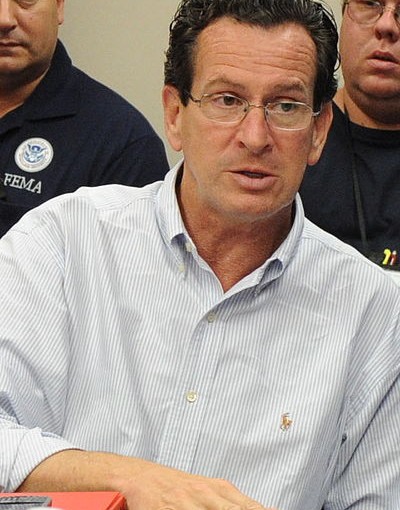
Connecticut Governor Dannel P. Malloy plans to make his state the first in the nation to prevent people on terrorists watch lists from buying guns. We applaud him and hope that other governors follow his lead.
Here’s what Malloy said when he announced he would sign an executive order to make a common sense idea law.
“Like all Americans, I have been horrified by the recent terrorist attacks in San Bernardino and Paris. They have been and should be a wake-up call to our nation. I am taking this common sense step with this executive order simply because it’s the right thing to do. It’s the smart thing to do. If you can’t fly without clearing government watch lists, you shouldn’t be able to buy a gun. Why anyone would stand idly by and knowingly allow those on government watch lists to purchase guns is truly unbelievable. Since Congress so far has failed to act, we will,”
A news release from Governor Malloy’s office details his plan.
“Pending federal approval, Governor intends to sign an executive order mandating that Connecticut State Police be required to cross-reference the names of those who wish to obtain a permit to own a firearm with the government watch lists. Those with existing permits who are found to be on those watch list would have their permits revoked, and if a new match is found, the permit would be denied and the purchaser would be unable to purchase handguns, shotguns, rifles and ammunition. Assault weapons are already outlawed in Connecticut.
The Governor is working directly with federal officials to use government watch lists for this purpose and, upon approval, will sign the executive order. He urged the U.S. Congress and other states to take action with similar commonsense steps. The Governor will work with the federal government to determine the specific lists – be it the “no-fly” list, terrorism watchlist, or some combination – used in this regard.
Among the many provisions in Governor Malloy’s 2013 gun safety legislation, the law outlaws the sale and possession of assault weapons and large capacity magazines and requires a clean record, safety training and a permit to buy rifles, shotguns and ammunition, whether from a gun store or private sale. Additionally, background checks and training are required for the purchase of all categories of guns.
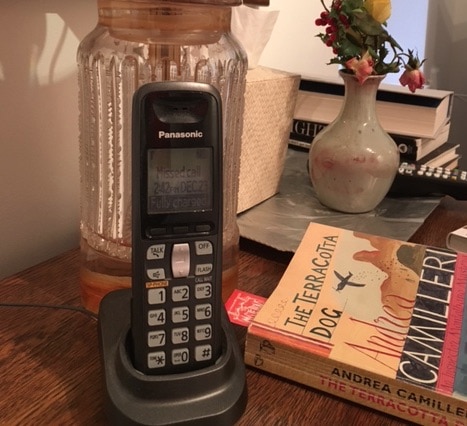
The New York Attorney General warns that phone scammers haven’t let up. He suggests that we need to take extra care and hang up on callers who threaten or bully.
Scammers frequently pretend they represent the attorney general, the IRS or the police and demand that you pay money, wire it or give bank account information immediately.
“The last thing families need is to be scammed out of their hard-earned money, Attorney General Eric Schneiderman said as his office issued the alert.
It’s bigger than a New York problem and every scam that we talk about here plays out in communities all across the U.S.
The IRS Scam tops the list.
IRS SCAM
Callers claim they work for the IRS, the attorney general’s office or the police. They say you owe back tax money and demand payment via a credit card, debit or pre-paid card. If you hesitate, the caller threatens to revoke your driver’s license, deport or arrest you unless the debt is paid.
They may even use something called “telephone spoofing” so that the “IRS” pops up on your caller ID.
Often a second person may call to verify that the first call is from an IRS worker. They tell you to wire money to pay the debt or use the prepaid
All phony.
Windfall
As part of the IRS scam, they may tell you that you will receive a big tax refund windfall. But first you must put up money via a prepaid card.If one call doesn’t get you to act immediately scammers often call again and continue to threaten and harass.
THINGS TO KNOW TO AVOID THE SCAM
1. Scammers use fake badge numbers and pretend to be IRS or government officials.
2. They may be able to recite the last 4 digits of your Social Security number.
3. The IRS does not call to threaten or demand money.
4. State tax departments don’t call to threaten or demand money.
5. You may hear noises in the background that make it seem as though it’s a call from an official center.
6. The IRS sends all requests by mail, not email.
7. State tax departments send all request by mail, not email.
GRANDPARENT SCAM
You’re likely to get an urgent phone call. And the caller claims he’s “your favorite grandson” or just says, “It’s me.”
Then, you may use your grandson’s name and say, “Jared?”
Or, often scammers pick up names from social media and target you that way. The pitch may vary.
But it basically goes like this: the “grandson” is out of town and needs money fast to pay for a plane ticket, to make bail, or pay for automobile repairs or medical expenses.The caller begs you not to tell his parents and asks you to wire the money immediately.
JURY DUTY SCAM
Someone calls and claims to be a court officer. He says that you failed to appear for jury duty and now there’s a warrant for your arrest.To avoid arrest you have to pay a fee immediately and you must wire the money.
New York City Police detectives tell ConsumerMojo that scammers urge people to pay with a prepaid Green Dot card.CONTINUE →or go to page 1 23
Someone calls and says you won a foreign lottery and requests that you, as the “winner,” send a check or wire money to cover taxes and fees.This is completely bogus.
If you win something you shouldn’t have to pay fees.The caller may ask for your banking information so money can be deposited electronically into your account. That’s the strategy to steal your identity and wipe out your bank account.Sometimes they use names that sound like a government agency or an official institution.
The bottom line: it’s a scam. Don’t give out any information over the phone.
UTILITY SCAM
Someone calls and pretends that he or she is from your local utility and says you owe money. If you don’t pay immediately, they say they will cut your service.Again, they ask you to wire money or use a prepaid Green Dot card.CONTINUE → or go to page 1 2 3
1. Don’t give out personal information on the phone. Banks, the IRS and utility companies don’t ask for personal information this way. So be very wary of someone who calls and seems to know a lot about you. They may have gotten the information from Facebook or some other social media site.
2. Hang up if you feel uncomfortable.
3. It’s okay to let the phone ring without answering.
4. If someone asks you to keep the call a secret or “confidential,” it’s a tip-off that he or she is a scammer.
5. Don’t bother to be polite. These are bad people who don’t deserve your courtesy. Don’t engage in conversation with them.
If someone attempts to scam you this way, file a complaint with the Federal Trade Commission at FTC.gov.If you live in New York State, the attorney general wants to hear from you at the Office’s website or by calling 1-800-771-7755.Go to page 12 3
Another mass shooting and we and our elected officials in the United States need to get serious about taking guns out of the hands of unstable people.
Details of the shooting in San Bernardino, California continue to emerge. We know that Syad Rizwan Farook, a 28-year-old county restaurant inspector and Tashfeen Malik, his 27-year-old Pakistani-born wife, armed with assault rifles, walked into a center for the disabled and opened fire.
Dressed in black paramilitary gear, they blasted as many as 75 rounds into a group of his county colleagues who had gathered in a big room for a holiday party. Farook had apparently been at the party, but left and returned suited up to kill.
Investigators told reporters the couple had enough bullets and bombs to kill hundreds more people. They left behind three pipe bombs with remote-control devices, but the bombs malfunctioned.
Four hours after the slaughter, police caught up with the couple two miles away and began a furious shoot-out. Farook and his wife fired 76 rounds and law enforcement officers blasted 380 rounds killing the couple.
The AP quoted an unnamed intelligence source who said Syed Rizwan Farook used social media to get in touch with extremists who were under FBI watch.
Los Angeles FBI Assistant Director David Bowdich told the AP, “There was obviously a mission here. We know that. We don’t know why. We don’t know if this was the intended target or if there was something that triggered him to do this immediately.”
Two days after the couple’s rampage, the FBI began to investigate this as a terrorist attack.
The couple dropped off their 6-month-old daughter with relatives before they went on the rampage.
Beyond the still emerging details, we grieve for the 14 dead and our hearts go out to their families and the injured.
President Obama continued his call for sensible gun reform. He told CBS News, in a previously scheduled interview, “….obviously our hearts go out to the victims and the families. The one thing we do know is that we have a pattern now of mass shootings in this country that has no parallel anywhere else in the world. And there are some steps we could take not to eliminate every one of these mass shootings, but to improve the odds that they don’t happen as frequently: common-sense gun safety laws, stronger background checks.”
The much-admired novelist writes bravely, fearlessly about sex and women, but here in this pale, monochromatic living room overlooking Fifth Avenue and the Metropolitan Museum of Art, she seemed to shrink from the wealthy art patrons standing in small clusters around her sipping white wine. She leaned in to us and whispered, “We live in terrible times.”
The terrorist attacks in Paris shook her as they did us all. But instead of getting angry, she got scared. “I keep wondering if I should grab my granddaughter and take her to the country,” she said.
My husband Nick looked perplexed. We had ridden the subway, walked in crowds, driven on the FDR under the U.N. right after the attack. “We can’t worry all of the time,” he said. I smiled and said, “Anything could happen anywhere. We can’t flee.” She considered us. Finally, she sighed and said, “I suppose I’ll write about it.”
And of course, that’s the thing.
The video and photos from Paris show Parisians at sidewalk cafes. They’re mourning, yes. But they’re also living as they say, “No!” to the terrorists.
Here in the U.S., we can’t escape the drum rolls of panic played by Donald Trump, Marco Rubio, Ben Carson, Ted Cruz and others who would have us close our borders, batten down the hatches and live in a heightened state of isolated hysteria. They continue stoking fear of terrorists and it keeps us in a heightened state of tension.
They pluck the chords of our very real concerns about personal safety, our children and everyone we love. But their appalling cynicism aims to control us, to steer us with demagoguery to the conclusion that we can’t be safe unless they take charge.
Isn’t that a fascist call to arms?
Surely we do have reason to worry. On Sunday, Belgian Prime Minister Charles Michel said a state of high alert would continue in Brussels because intelligence indicated terrorists plan to carry out attacks like those in Paris. A suspect in the Paris attacks, Saleh Abdeslam, is thought to have crossed from France into Belgium
The Daily Telegraph reports that the government sealed off downtown Brussels. And the Prime Minister urged people to stay inside and said schools, universities and public transportation in the city will remain closed as the hunt for the terrorists continue.
Intelligence, not irrational fear, provoked the warnings. At least three of the Paris attackers, including the man who planned the attacks, 27-year-old Abdelhamid Abaaoud, were from Molenbeek, a Brussels neighborhood.
Here in the U.S., despite the political rhetoric, the story appears different. U.S. Secretary of Homeland Security Jeh Johnson urged Americans to remain calm and continue with their plans for the Thanksgiving weekend.
On “Meet the Press” he said, “We have no specific credible intelligence about a threat of the Paris type directed at the homeland here.”
In New York, three million will gather at the annual Macy’s Thanksgiving Day parade and NYPD Police Commissioner William Bratton continues to describe the city as safe and prepared.
Also on “Meet the Press,” Bratton called upon Congress to block people who are on the terrorist watchlist from buying guns. “If Congress really wants to do something instead of just talking about something, help us out with that terrorist watchlist–those thousands of people that can purchase firearms in this country, ” he said.
Courtesy NYPD
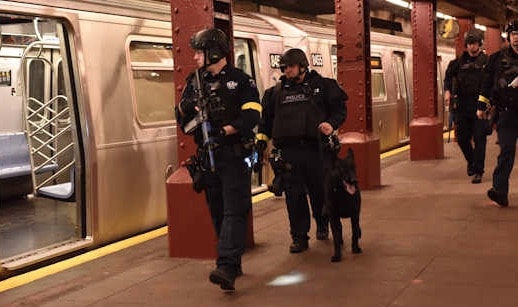
On Sunday, the NYPD conducted what it calls an active terrorist drill in a subway in lower Manhattan. Police, firefighters and other first responders participated in a simulated shootout and one involved a fake suspected terrorist wearing a suicide vest.
The police officers used new equipment including GoPro cameras to coordinate with others. Mayor Bill de Blasio praised the drill, saying, “This was an impressive display of the capacity of this city to respond to an incident.”
Courtesy NYPD
But none of this seems to matter to the demagogues running for President who, to make themselves stand out, use the power of the spotlight to continue to scare us all and shout about the need to halt legal immigration into the U.S.
They echo the angry and ugly rhetoric of their ideological antecedent Father Charles Coughlin. In the 1930s during the Great Depression, when people were down, millions listened to his radio shows, read his sermons and newspaper Social Justice. His attacks on the rich appealed to them. (An irony here for Trump). But things changed as he became virulently anti-Semitic. He claimed the Jews started World War II and expressed his support and admiration for Mussolini and Hitler.
In the 1940’s, the Catholic church finally pulled the plug on him and threatened to defrock him if he didn’t stop his political activities.
Wow. If only someone could control the Trumps, Rubios, Cruzes, Carsons and all the same way.
Here’s what we say about the Paris attacks. We stand with the French against terrorism.
From President Obama:
We stand prepared and ready to provide whatever assistance that the government and the people of France need to respond. France is our oldest ally. The French people have stood shoulder to shoulder with the United States time and again. And we want to be very clear that we stand together with them in the fight against terrorism and extremism.
Paris itself represents the timeless values of human progress. Those who think that they can terrorize the people of France or the values that they stand for are wrong. The American people draw strength from the French people’s commitment to life, liberty, the pursuit of happiness. We are reminded in this time of tragedy that the bonds of liberté and égalité and fraternité are not only values that the French people care so deeply about, but they are values that we share. And those values are going to endure far beyond any act of terrorism or the hateful vision of those who perpetrated the crimes this evening.
We’re going to do whatever it takes to work with the French people and with nations around the world to bring these terrorists to justice, and to go after any terrorist networks that go after our people.
We don’t yet know all the details of what has happened. We have been in contact with French officials to communicate our deepest condolences to the families of those who have been killed, to offer our prayers and thoughts to those who have been wounded. We have offered our full support to them. The situation is still unfolding. I’ve chosen not to call President Hollande at this time, because my expectation is that he’s very busy at the moment. I actually, by coincidence, was talking to him earlier today in preparation for the G20 meeting. But I am confident that I’ll be in direct communications with him in the next few days, and we’ll be coordinating in any ways that they think are helpful in the investigation of what’s happened.
This is a heartbreaking situation. And obviously those of us here in the United States know what it’s like. We’ve gone through these kinds of episodes ourselves. And whenever these kinds of attacks happened, we’ve always been able to count on the French people to stand with us. They have been an extraordinary counterterrorism partner, and we intend to be there with them in that same fashion.
Fay Radding of the MetLilfe Mature Market Institute says, “We think of retirement as a three-legged stool. We know that basically it’s built on the idea of having a pension, which many people don’t have, although many people have a 401 K, personal savings and Social Security.
Social Security is our basic benefit.
Although you qualify at 62, it’s suggested you wait until you’re at least 66 to claim the monthly payments.
Every year that you wait, you get an extra 8% up until 70 years old. For example: If you start to collect at: 62 you qualify for $650 a month 66 you’d get $1,000 a month 70 you’d get $1320. After you’re 66 you can work, earn an unlimited amount, and still collect Social Security without deductions from your monthly benefit.
Tip 7 – THINK ABOUT HOW YOU’LL USE YOUR HOME
Our homes are usually are biggest assets and as with everything else, it’s important to think about how you will use this asset and the money that it has made for you over the years.
Tax attorney Robert Barnett says, “The IRS code allows special exemptions for the sale of your house. They will allow a single person to say $250,000 will be exempt, and a married couple will double that to $500,000. So people who bought their homes years ago and have seen a large fluctuation in value need to protect the ability to maintain those exemptions.”
Lawyers suggest putting your home, stocks and other assets into a trust to avoid probate court fees after you die. A trust allows you to live in the home. But the house and assets go to your heirs. A trust also gives you the opportunity to lay out instructions about what to do with the money in the trust.
You can choose a revocable trust, which can be changed or an irrevocable trust, which can’t be changed.
Tip 8- PROTECT YOUR ASSETS CONSIDER SETTING UP A TRUST Protecting the assets become an issue if you become very ill, or go into a nursing home and need to use Medicaid to supplement Medicare.
In addition, putting assets in a trust early may help you qualify for what’s called “Community Medicaid.” That allows you to stay at home and get Medicaid help for care. Medicaid is primarily funded by the federal government, but administered by the states.
And each state has different income and asset requirements. In New York State, for example, the income limit for one person is $14,250. In New Jersey it’s about $5,000. It’s difficult to hide your money. Medicaid in every state does a five-year review for eligibility. Attorney Stuart Schoenfeld explains, “If you’ve transferred assets to a trust or children within five years, you’ll be disqualified from Medicaid for a period of time.
FIGURING IT OUT
Planning for your financial future involves making complicated, well-thought out choices and decisions, but it is not rocket science and you can conquer the information to take control of your destiny and your money.
Legal help is important, and a good geriatric care manager can be invaluable.
New York City-based geriatric care manager Joanne Lehman says, ”We come in and do an assessment of your needs and create a plan. We help you investigate all of the options, fill out the paperwork, work with attorneys and follow up to make sure that you have what you need.”
Many of us live pretty firmly in the now when it comes thinking about finances for the future. Retirement planning often seems like a good idea at a point way down the line. How many times have you told yourself or a friend, “I’m not ready to think about that yet.”
But optimism about the future needs a practical boost from a plan that you make now. And if you hate the word retirement, call it a plan for tomorrow, or a plan for the future. You make up your own labels.
A MetLife Mature Market Institute study found that a 65-year-old man today has a 41% chance of living to 85 and a woman has a 63% chance. With long lives ahead of us, we need to think about how we will support ourselves, protect ourselves and maintain control over our lives and assets.
Remember the saying, “Necessity is the mother of invention?” While no one is sure who said it, maybe Plato, necessity in this case means creating a blueprint for the way that you want to live the important years of your life.
We need to treat the inevitability of getting older the way we’d approach our business or professional lives.
Attorney Stuart Schoenfeld says, “The sooner you start to plan the more choices have. The longer you wait the more likely it is that you lose your independence and control.” You want to put your ideas about your future, and what comes later, on paper.
Here are the first steps to take:
Tip 1 – YOU NEED A WILL. Your will should clearly spell out how you would like to leave your assets to your heirs or others. Planning saves heartache and headaches for you, and eliminates any questions people may have later. It’s a good idea to consult a lawyer. If you can’t afford to do that ask your local bar association for a referral to a lawyer who may do this for free.
Tip 2 – YOU NEED A HEALTH CARE YPROXY. A health care proxy is extremely important. This document legally designates someone to help with doctors and hospitals if you get sick. Experts advisee it, and I know it it’s true because of my personal experiences caring for my mother, my husband’s parents and elderly relatives. If you don’t have a health care proxy, the current laws prevent medical professionals from discussing your case with anyone but you. And that’s okay to a point. But it’s imperative to have an advocate when you deal with doctors especially in an emergency setting. So a health care proxy designates the person you want to help you get the best care possible
Tip 3 – YOU NEED A LIVING WILL. This makes your wishes crystal clear about how you want medical personnel to treat you in extreme situations. You can choose to say that you want to be resuscitated and kept on life support, or say that you do not want extreme measures used to keep you alive. This is all up to you, and your wishes should be recorded in a legal document.
Tip 4 – YOU NEED A POWER OF ATTORNEY This designates someone to handle your personal and business affairs while you’re alive, if you cannot do things yourself. Even if you can do things, it’s always a good idea to have a trusted person assist. It’s smart to get a qualified estate lawyer to help make these plans and put them on paper. If you can’t afford a lawyer, some states and local bar associations offer online forms. But be careful. The American Bar Association, www.aba.org offers a state-by-state list of clinics and not-for-profits that offer affordable and even free legal help.
Tip 5- YOU NEED TO REVIEW YOUR MONEY AND SAVINGS Studies also indicate we don’t start thinking about saving money for retirement early enough. Many wait until their fifties, or later.
And more than 36% of Americans are not saving for retirement according to a recent Capital One Sharebuilder survey. It’s important to calculate what your benefits might be: Even if you are just starting out experts advise that you take advantage of every opportunity to save.
Your company 401 K.
A 401K is set up by your employer. It allows you to invest money regularly. This money is not subject to taxes, if you keep it in the plan until retirement. If you withdraw money before you are 59 ½ there’s a 10% penalty. The downside is that your company decides where the money should be invested.
Creating an IRA.
An IRA (Individual Retirement Account) allows you to put money, before it’s taxed, into an investment plan. You can choose how the money is invested, but if you withdraw it early there is a 10% penalty. You do pay taxes on your profits when you withdraw from an IRA at retirement. And you have to begin withdrawing money when you are 70 ½.
Roth IRA
A Roth IRA differs from a traditional IRA in that you pay taxes on the money before you invest in the plan and your contributions are not tax deductible. The upside is that your earnings are tax-free once you start to withdraw money. And the IRS says money from a Roth account does not have to be withdrawn until after the death of the owner.
Savings
Socking money away in a savings account is still a solid way to save. But when interest rates are low you won’t make much money by allowing a bank to hold it.
For more on the tax consequences of investing plans visit www.irs.gov
The Obama administration issued new rules to curb high fees and sneaky practices in the student loan prepaid and debit card world. The cards may seem like an easy way to deal with student loans, but other choices may cost you less.
The U.S. Department of Education (DOE) estimates that about 40 percent of all college students use these cards and nearly $25 billion in Pell Grant and Direct Loans get released to students through them.
The GAO found unreasonably high fees caused some to lose student aid. It also discovered that schools and financial institutions steered students into accounts that might not be in their best interests and it uncovered cozy relationships between schools and financial institutions, again not always in students’ best interests.
Education Secretary Arne Duncan said, “These regulations will help make sure student loan debt is affordable for all borrowers and bring overdue reforms to campus cards, a sector that too often puts taxpayer dollars and student consumers at risk.”
NEW RULES WILL:
Require institutions to give students a greater choice about how to receive their financial aid.
Prohibit schools from requiring students or parents to open accounts through specific institutions or banks.
Require the financial institution to clarify fees and make sure that students don’t face excessive charges.
Require schools and financial institutions to offer students a range of options about how they can get their money.
Require institutions to point out that students and parents can use existing accounts to receive deposits.
Lauren Saunders, Associate Director of the National Consumer Law Center (NCLC), said, “These new rules will stop schools and prepaid card companies from using unfair and deceptive tactics to push students into using cards that are heavy on fees.”
While the new rules cover a lot, they don’t include prepaid and debit programs linked to students’ ID cards. The NCLC’s Saunders says, “Some campus card programs charge high overdraft fees on electronic transactions, unlike most prepaid card or checkless checking accounts.”
That problem may get solved by new rules under consideration by the Consumer Financial Protection Bureau (CFPB). Stay tuned.