by Steve Dougherty
It could have been Bob Dylan’s big break. But the future Nobel laureate was caught in a cancelling controversy that six decades later sounds painfully familiar. It happened in the spring of 1963, four years before Jimmy Kimmel was born, when a major American television network feared the mere threat of retribution from a group of wealthy influencers said to hail from the lunatic fringe of American politics. And who espoused ideas that seemed far behind —and today, way ahead — of the times.
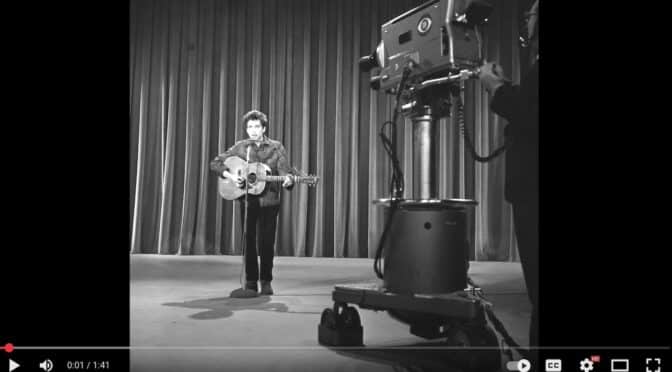
The then all-but utterly unknown 21-year-old Dylan was scheduled to sing a track from his upcoming album on The Ed Sullivan Show, the variety program that measured the audience for its Sunday night broadcasts in the tens of millions. Not bad for a folkie whose only previous album was a complete unheard bust. His new one, The Freewheelin’ Bob Dylan contained songs that were long-range career rocket fuel. But instead of performing since-enshrined masterworks like “Blowin’ in the Wind” or “A Hard Rain’s A-Gonna Fall,” Dylan chose a destined-to-be forgotten ditty titled “Talkin’ John Birch Paranoid Blues” that set CBS-TV network censors’ hair on fire.
As told in “How Many Roads: Bob Dylan and His Changing Times, 1961-1964,” a traveling exhibit on loan from the Bob Dylan Center archives in Tulsa and on view at NYU’s Gallatin Galleries at 1 Washington Place in Greenwich Village through October 15, Dylan showed up at dress rehearsal the day before the May 12, 1963 broadcast and warbled the satiric protest song mocking the John Birch Society.
Though just a decade past the Red Scare of the early 1950s, the rabidly anti-communist Birch Society espoused a conspiracy theory so all encompassing and that targeted public figures so unlikely it seemed pure lunacy to many.
Revered former President and World War II superhero Dwight D. Eisenhower, the Civil Rights Movement —easily the most galvanizing social issue of the day—and even Fluoride, a nature-produced mineral added to drinking water to prevent children from getting cavities, were all part of an international communist conspiracy to destroy America. According, that is, to the John Birch Society. It was founded in 1958 by the candy man himself, Robert Welsh, the enormously wealthy white business man who owed his fortune to selling Sugar Babies, Pom-Poms and Junior Mints to children of all ages. To Welsh and his well-heeled supporters— among them, according to Mathew Dallek, author of Birchers: How the John Birch Society Radicalized the American Right, was Fred Koch, father of the right wing billionaire Koch brothers— communists were as plentiful in America as kids with cavities.
Well I was feelin’ sad and kinda blue/I didn’t know what I was gonna do/Them communists was comin’ around/They was in the air and on the ground . . . So I run down most hurriedly/And joined the Birch Society. . .
The following verse of Dylan’s original lyrics, as published by the Greenwich Village folk music sheet Broadside in February 1962 — and on display at the Gallatin Gallery—might well be censored by some social media platforms today:
We all agree with Hitler’s views/Tho he killed 6 million Jews/It don’t matter if he was a fascist/At least he wasn’t no communist.
Likewise, anti-anti-fascist alerts might be triggered by a later verse, name checking as it did George Lincoln Rockwell, founder of the American Nazi Party:
Now Eisenhower, he’s a Russian spy/Lincoln and Jefferson and that Roosevelt guy/To my knowledge there’s just one man/That’s really an American/That’s George Lincoln Rockwell/I know for a fact he hates Commies/’Cause he picketed the movie Exodus. . .
As it happened, CBS-TV’s program practices censors needed no algorithm-produced prompt to demand that producers cut “Talkin’ John Birch Paranoid Blues” from the next night’s broadcast. “Despite getting initial approval to perform the song,” a text display at the “How Many Roads” exhibit explains, “Dylan was instructed to choose a different song due to CBS censors fearing legal repercussions from the John Birch Society. He refused and walked off the show.”
Ed Sullivan himself strongly objected to the network’s decision. “We fought for the song,” he told the New York Post’s long time TV critic and “On The Air” columnist Bob Williams. Referring, to the widely reported “lunatic behavior” of the Birchers, Sullivan said, “We pointed out that President Kennedy and his family are kidded constantly by comedians. But the John Birch Society—I said I couldn’t understand why they were given such protection.”
“In his song,” Sullivan continued, “Dylan talks about the fears of the John Birchers, looking for Reds everywhere, including the refrigerator,” not to mention the toilet bowl.
I finally started thinking straight/When I run out of things to investigate/I couldn’t imagine anything else/So now I’m investigating myself. . .
The Sullivan show went on without Dylan but whatever cachet was lost, it was regained and then some nine months later when 70 million viewers tuned in to see a previously unknown on these shores quartet from Liverpool, England, remembered today as the Beatles.
Dylan himself endured the cancellation of his performance and went on to do quite nicely career-wise. He did so despite the fact that his label, Columbia Records, itself a sister subsidiary of the Columbia Broadcasting System and possibly paranoid about the power wielded by the Birchers to smear as well as to sue, ordered that “Talkin’ John Birch Paranoid Blues” be removed from all future pressings of The Freewheelin’ Bob Dylan, set to be released on May 27, 1963, two weeks after the Sullivan broadcast.
Sixty-two years later, Dylan, now 84 and drawing new generations of fans in the wake of the hit 2024 biopic A Complete Unknown, continues to perform. And as it happens, the U.S. government is today in the hands of the Birchers’ direct descendants, heirs apparent who routinely smear all who disagree as communist lunatics.
As for Dylan’s censored song, “Talkin’ John Birch Paranoid Blues,” excised on all but a few, now exceedingly rare copies of Freewheelin’ and consigned to bootleg discs and deep tracks from the oeuvre released over the years by Columbia, it can be heard today with a click of the cursor. [Live at Carnegie Hall concert October 1963:
For details about the How Many Roads exhibit.