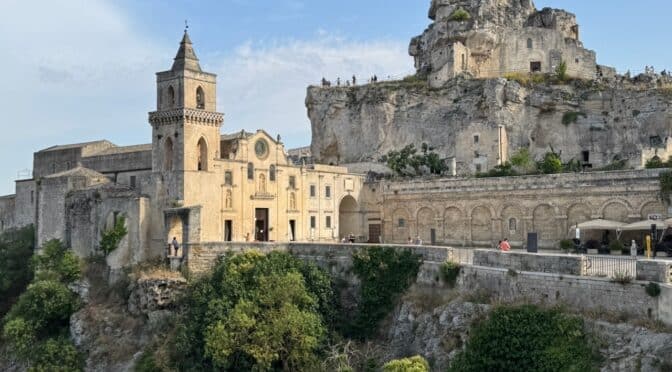
by Nick Taylor and Barbara Nevins Taylor
We arrived at the Hertz rental car office in Sorrento soggy from drizzle and eager for our trip to Matera in Basilicata. But we groaned when the agent offered us an SUV. Roads in many towns in Italy are narrow and we dreaded the idea of a big vehicle. “We’re small. Isn’t there anything else?” Nick asked.
The agent asked us to wait, went down a flight of stairs and came back up with a set of keys. “Good news. We have brand new Lancia,” he said. And that was that.
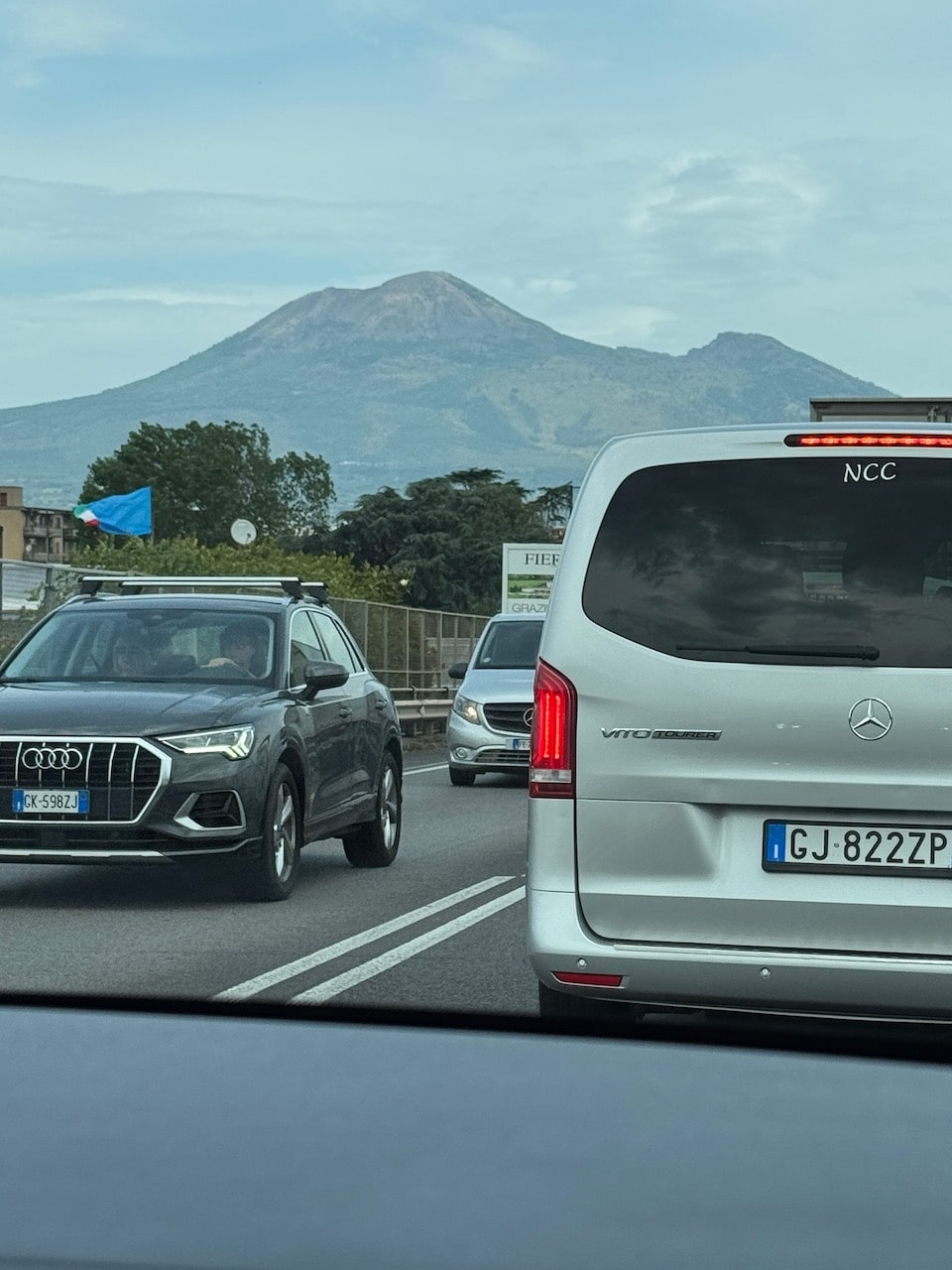
We set off, with Nick at the wheel, and found ourselves in the infamous traffic jam along the Sorrento coast. Our route took us back toward Pompeii and the traffic was particularly bad when we got to Castellemare di Stabia. That’s Mount Vesuvius up ahead. The mountain was quiet but many of the drivers seemed ready to erupt.
Matera was a little over three hours away and when we turned east toward Salerno the traffic lightened up. It was drizzling, and from the highway, we could see the old town of Salerno on the hillside. It looked appealing and like someplace we’d like to stop. But not in the rain.
Not far out from there, the steady drizzle became a noisy downpour and then turned into a drum of hail on the Lancia’s roof. Nick kept a steady hand on the wheel and the Lancia held the road nicely.
At a town called Potenza, we pulled into an Autogrill that offered restrooms and food. But once we hit the road again something happened and Nick followed a sign to Matera that took us on a winding adventure of backroads and farms and rich wheat fields. It wasn’t clear that we could get back on the highway if we turned around, and the GPS was urging forward motion. We don’t have photos. But the weather from the west followed us and the sky let the rain rip. The narrow farm roads quickly filled with sloshing water, and the edges of the road and the fields became a muddy mess. There was nowhere to pull over and no one to ask until we reached a crossroads with workmen sheltering from the rain. They said that we were headed in the right direction. So we continued. Finally, we reached the highway again, and it stopped raining. A sign pointing to Potenza, where we got off the highway, told us we’d come 80 kilometers. So, onward.
Finally, we made the turn off to Matera and drove into the main part of the new town created in the 1950s. It’s true we were a little shell-shocked from the ride, but as we circled around and looped down into old Matera we both exclaimed, “Oh my God. Look. Look!” Descriptions, even photos, fail to prepare you for the stark and shocking beauty of it. First there is a ravine and a cliffside of caves.
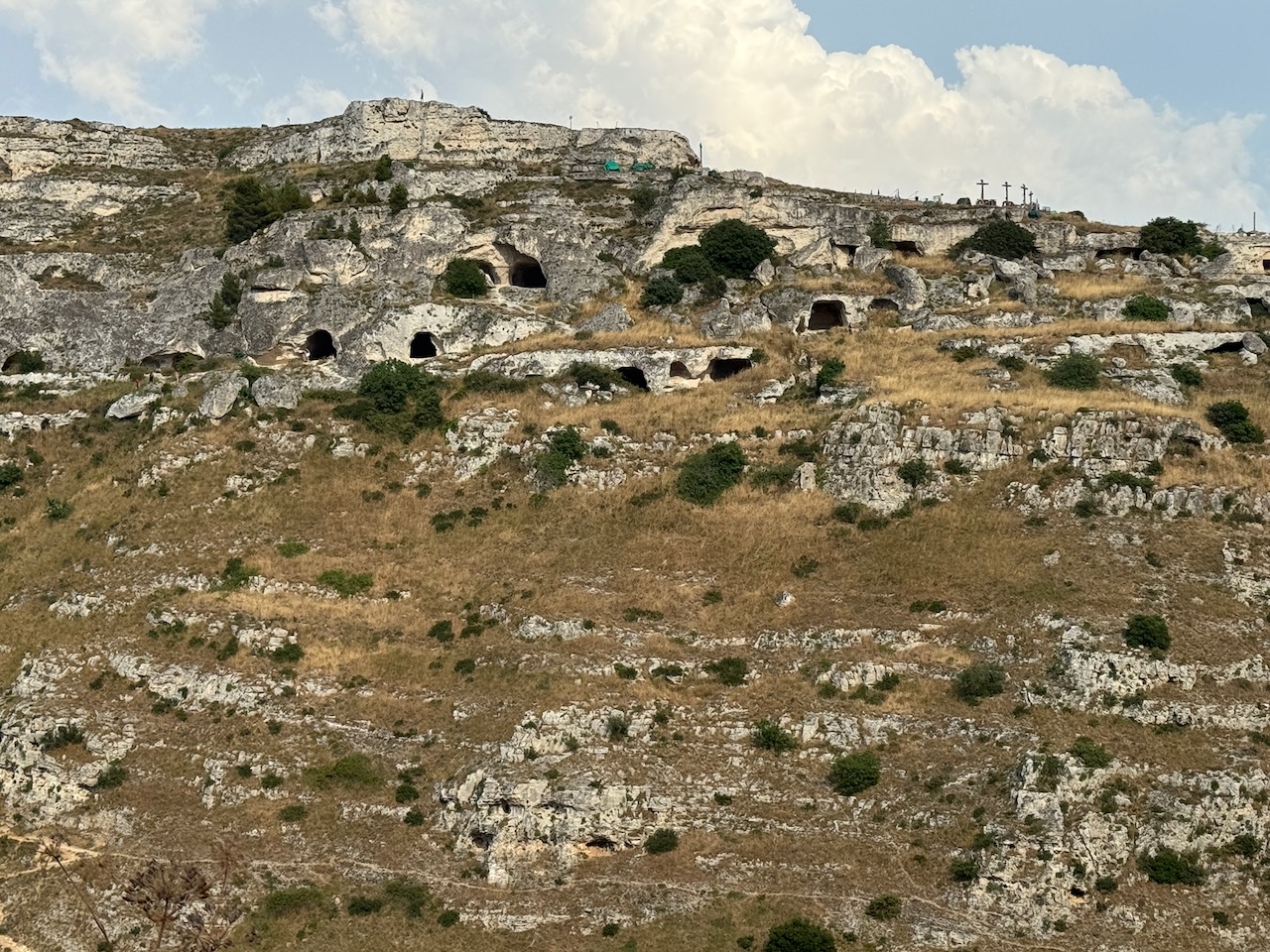
And then there was what we learned is called the Sassi, a town of limestone caves, structures built from caves, small buildings stacked on top of caves and churches rising from the rock.
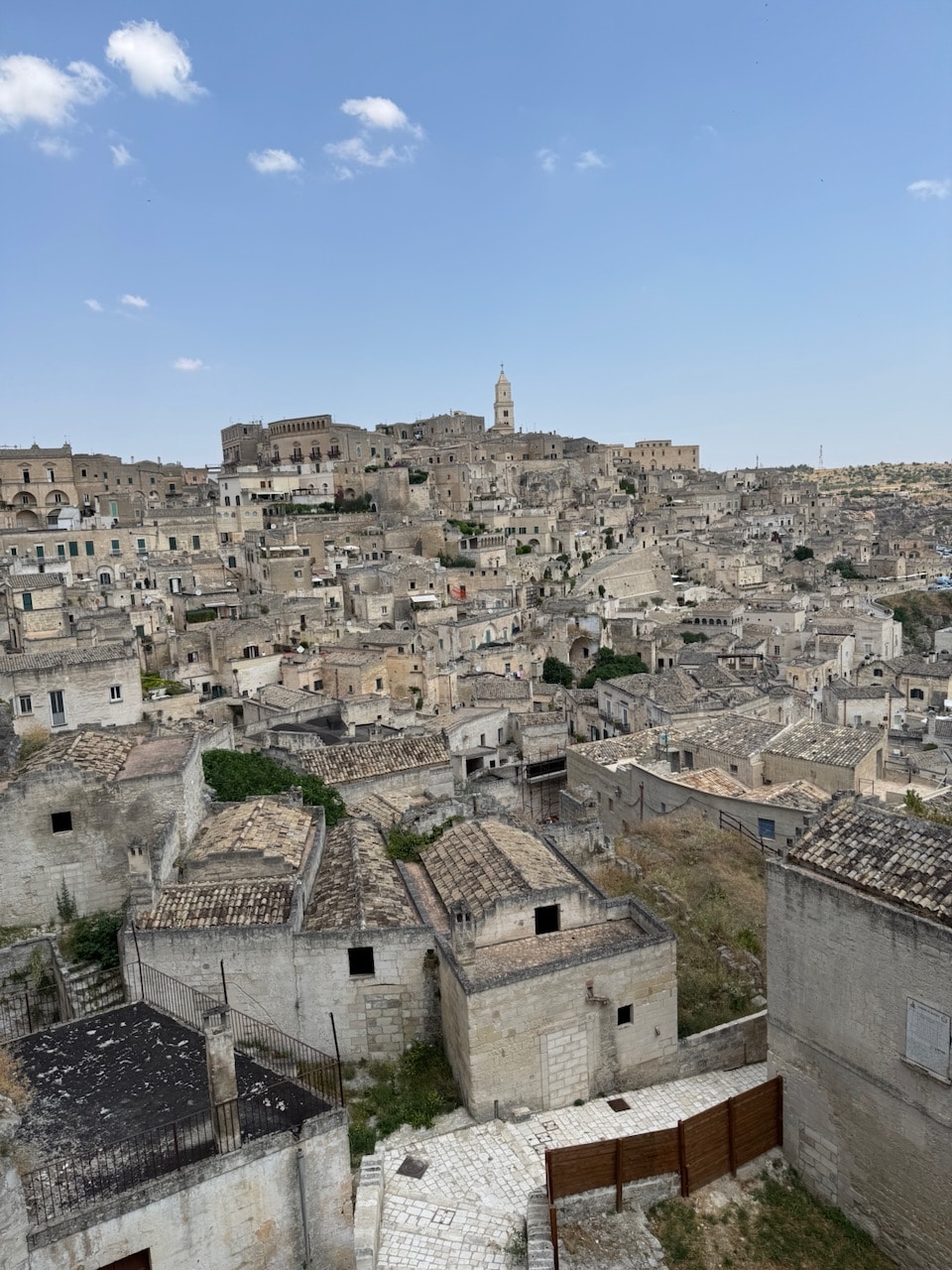
Matera’s history dates back 10,000 years or more to the Palaeolithic era and the Troglodytes — the word originally meant cave-dweller. It is one of the world’s oldest continuous settlements in the world and artifacts of Greek, Roman, and Norman life have been discovered here. Until the late 1950s, people lived in the more than 1,000 limestone caves without power, running water or basic sanitation. Typhoid, malaria, cholera and other diseases were rampant. Infant mortality was estimated at 40 percent. The extreme poverty and difficult living conditions were mostly ignored until 1945 and the publication of “Christ Stopped at Eboli,” by Carlo Levi. A doctor, artist and writer, Levi was among the political prisoners exiled to small towns in the south by Benito Mussolini. His memoir chronicled his experiences and the suffering of local people. His first impression of Matera was shocking. “Of children I saw an infinite number. They appeared from everywhere, in the dust and heat, amid the flies, stark naked or clothed in rags ; I have never in all my life seen such a picture of poverty,” he wrote.
After Mussolini was ousted, killed by partisans, and the Allies won and ended World War II, Italy slowly started to rebuild. Matera was on the agenda. In 1950 Italian Prime Minister Alcide De Gasperi visited Matera and called it “a national disgrace.” Matera then became known as “the shame of Italy.” With money from the US-backed Marshall Plan, star architects created a new housing development. Over a 17-year period more than 15,000 people were forcibly moved out of the Sassi.
The city of caves became a ghost town until the 1980s, when people rediscovered the beauty of the city. They renovated caves, rebuilt structures, and opened airbnbs, hotels and restaurants. In 1993, Matera became a UNESCO World Heritage site.
Our hotel in the Sassi, the Sant’Angelo Luxury Resort, is a collection of buildings carved out of caves and added on to. The hotel prides itself on having restored historic structures using local materials.
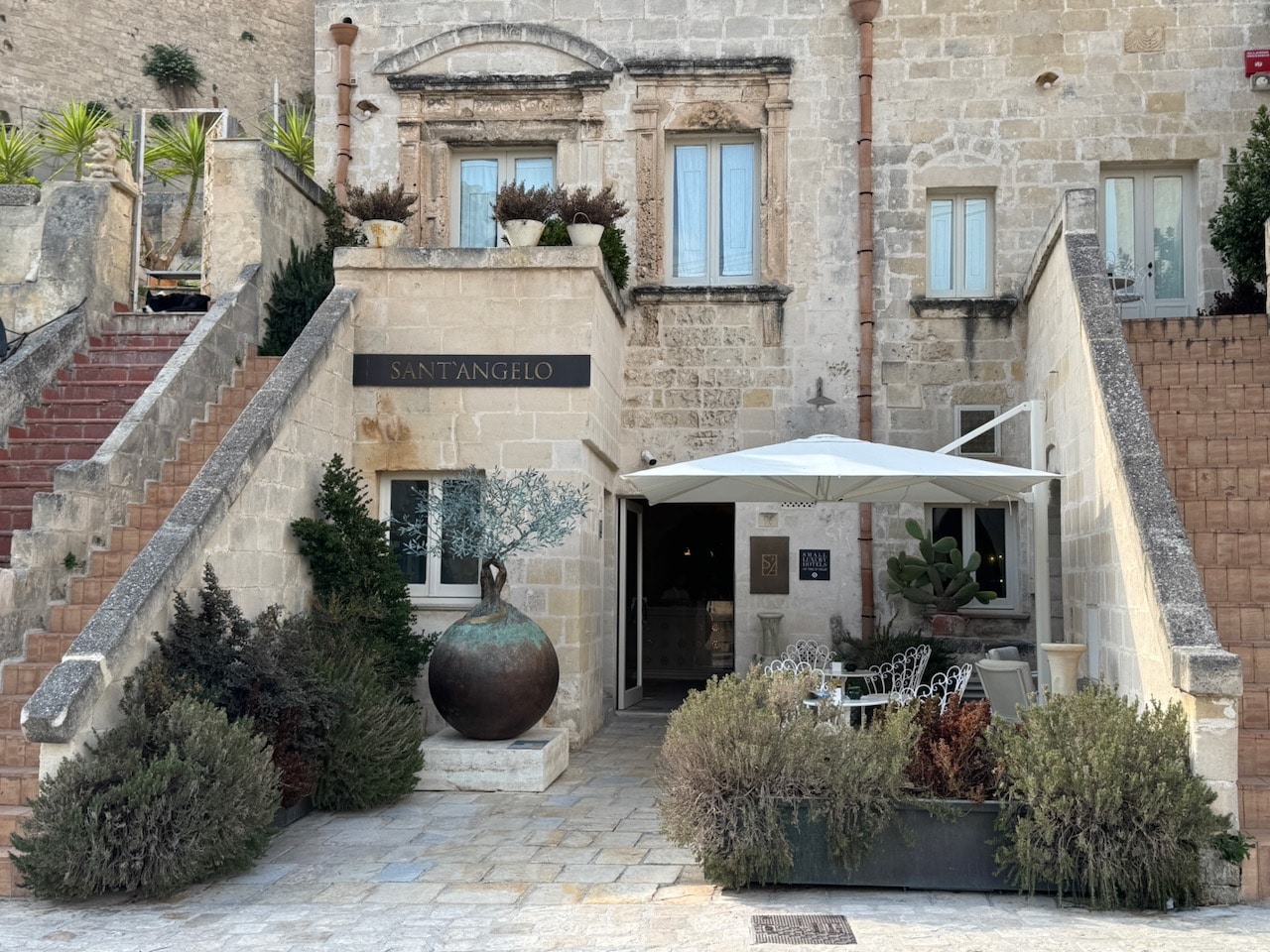
The rooms are tucked into the hillside and to reach most of them, and the dining room, you walk up and up and up.
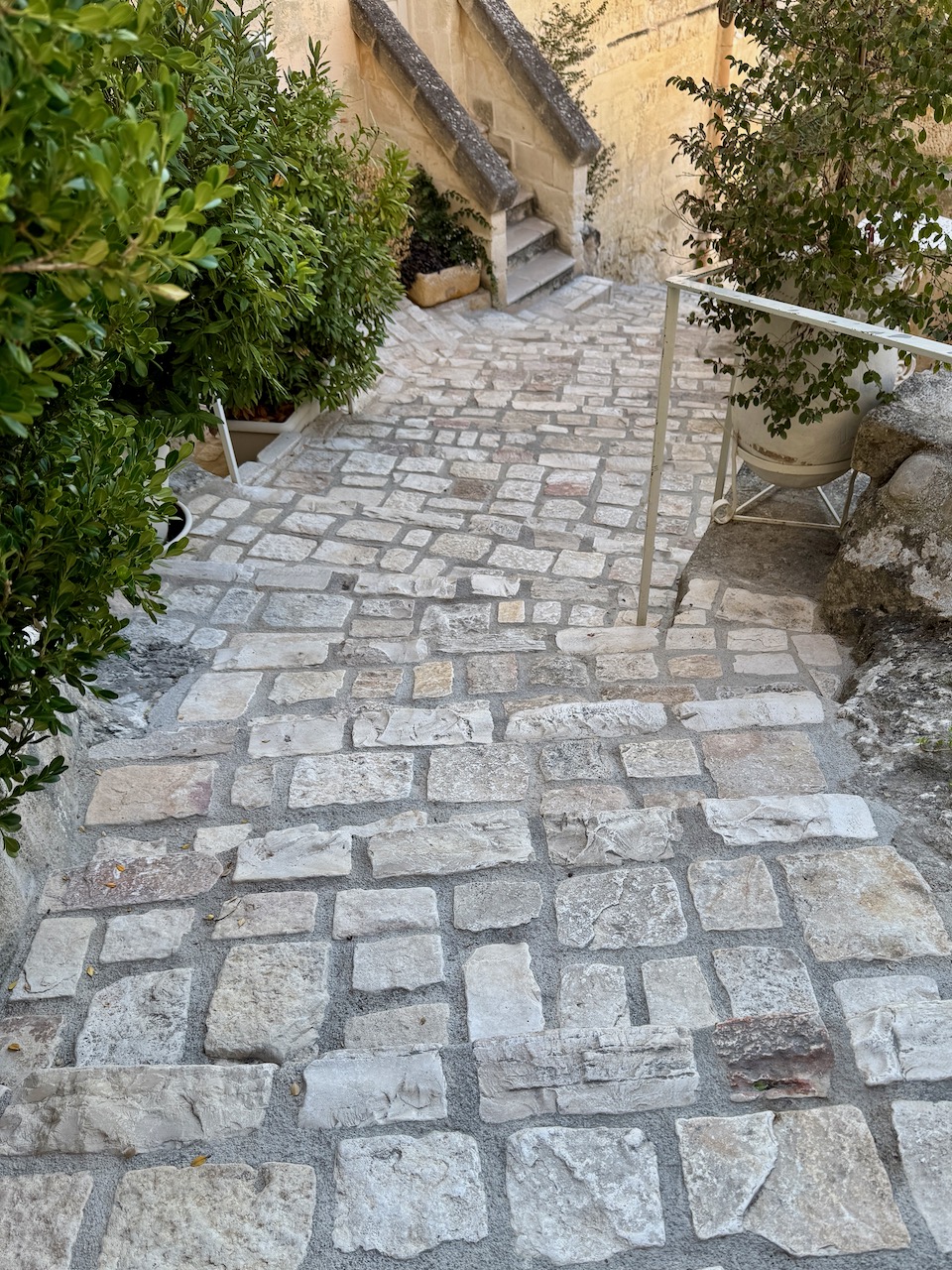
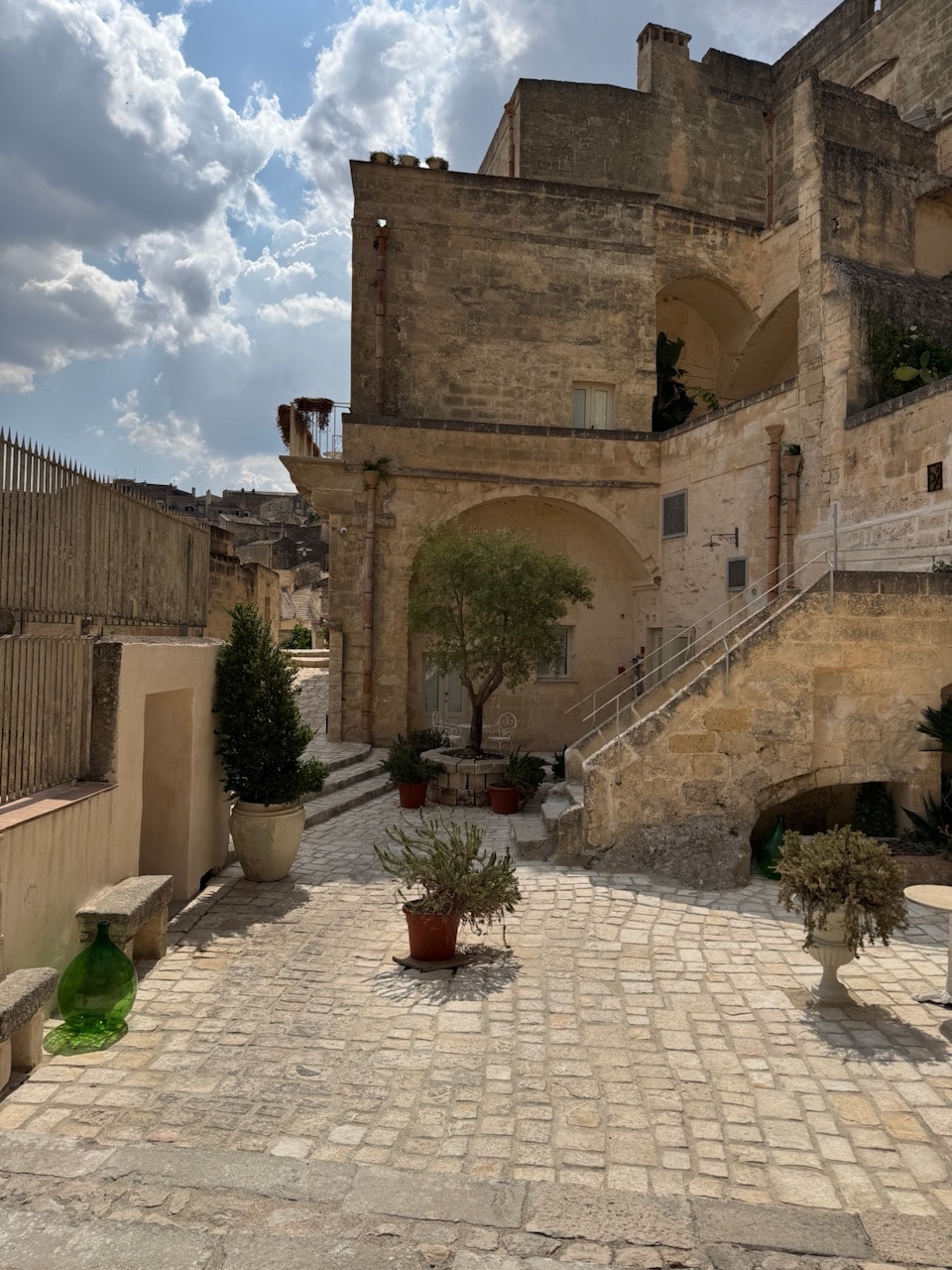
Climbing up and going down kept us feeling grateful that, for the moment, we are fit enough to handle it.
From the terrace of our lovely room we had a clear view. 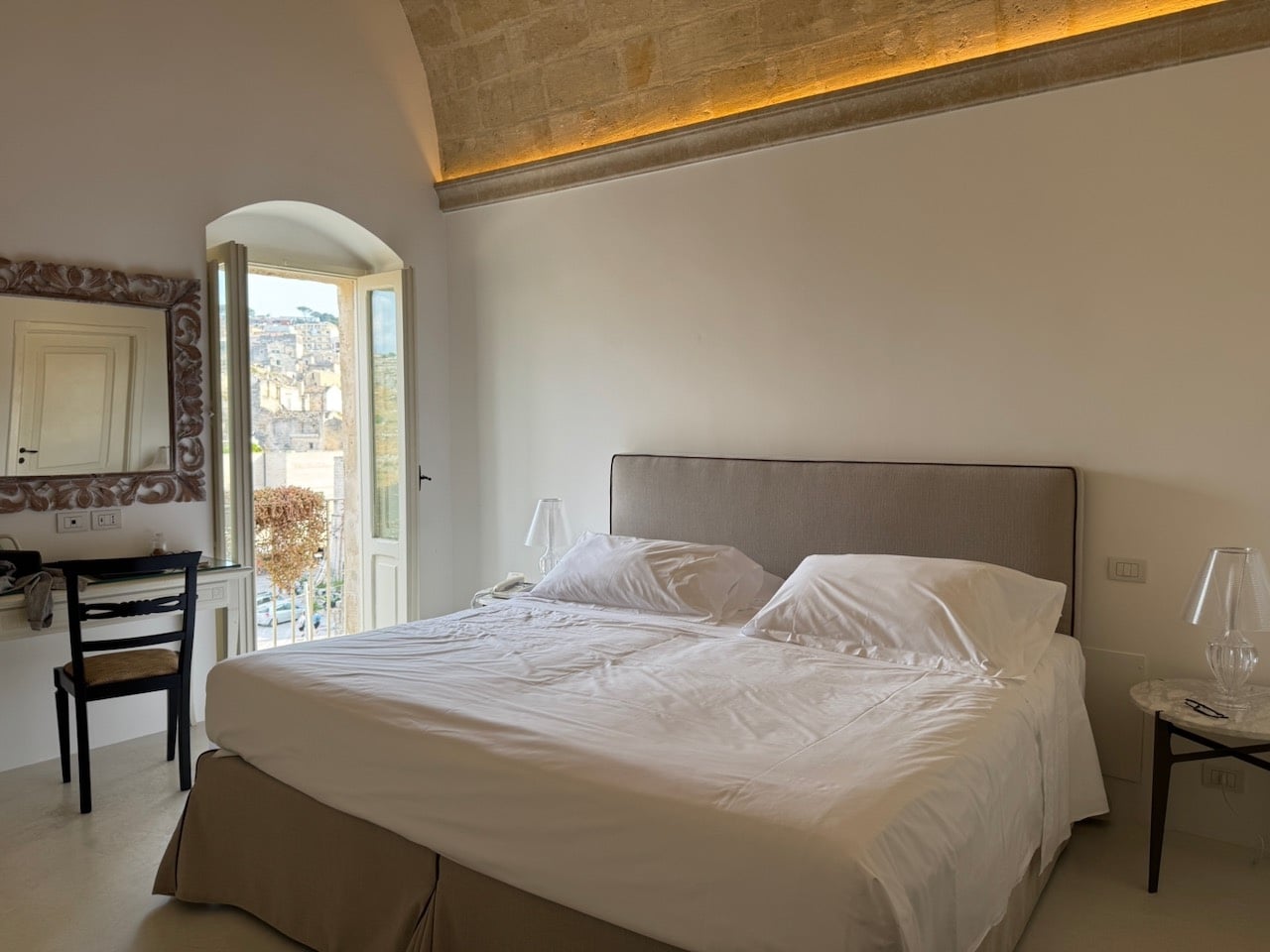
We could see how the caves blend into the mountain and how the city of caves curves around a deep ravine.
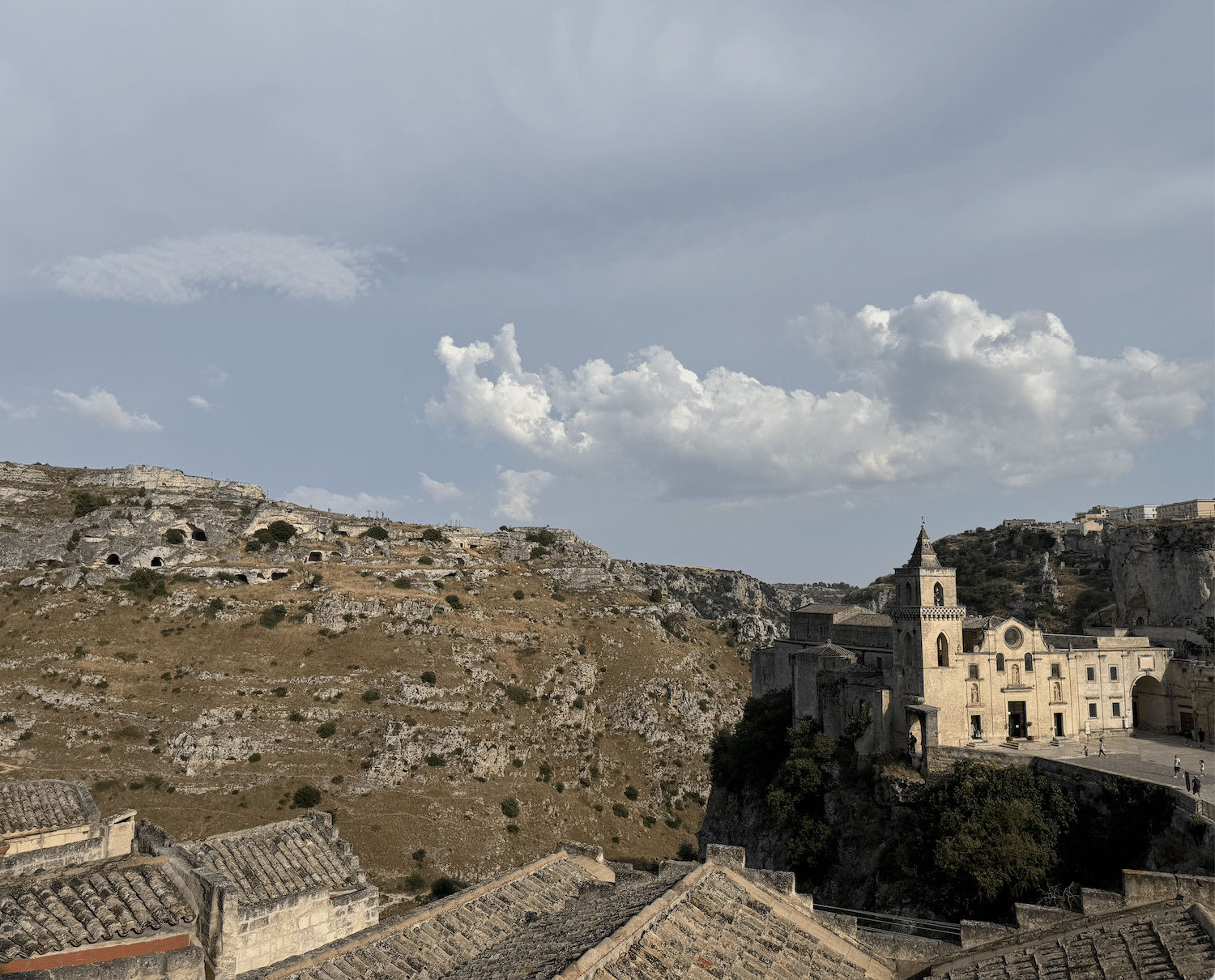
If you look closely at the photo below, you might see crosses on top of the mountain. A production company had erected them for a Christian themed film. We learned that producers often choose Matera as a location because the limestone is similar to Jerusalem stone and the city has the same ancient feel.
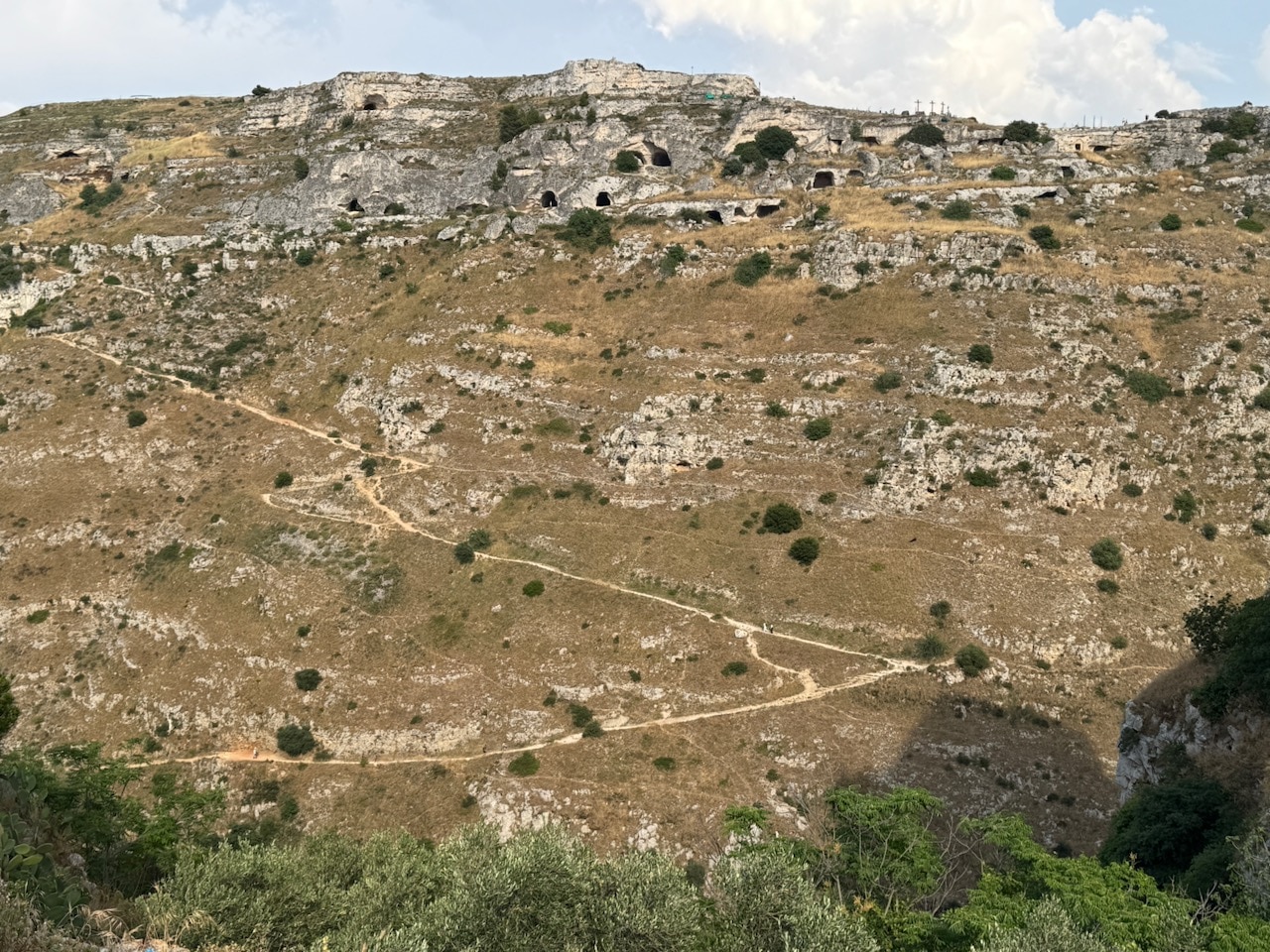
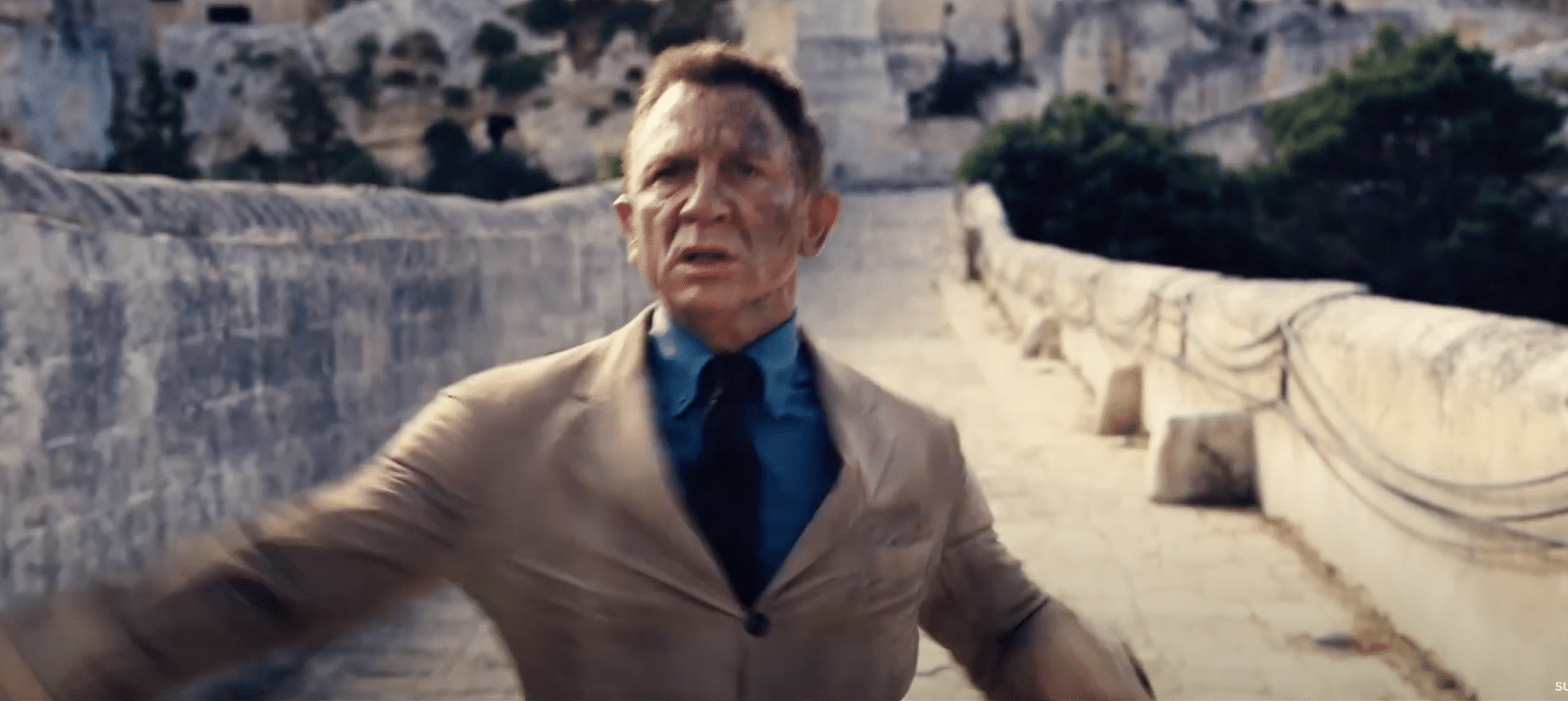
It’s an attractive location for other types of films, too. You may have caught a glimpse of Matera in the Daniel Craig James Bond film “No Time to Die.”
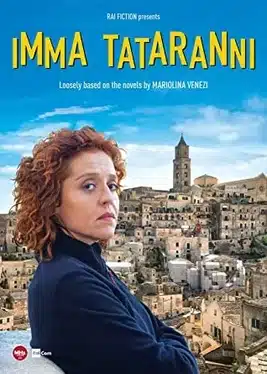
We learned that the women at the hotel reception desk, like us, are fans of the Italian police procedural “Imma Tattarani,” which is set in Matera. Even though we watch the show, we had no sense of the dramatic beauty of the city, or its history. We planned to fix that on a tour the next day.
Once we got settled, we took a short nap to recover from our harrowing drive from Sorrento. We felt ready for dinner and a drink. Luckily we didn’t have to walk far from our hotel to Ristorante Baccanti, where we had a reservation. Baccanti is set in a series of caves that feel oddly spacious and even elegant.
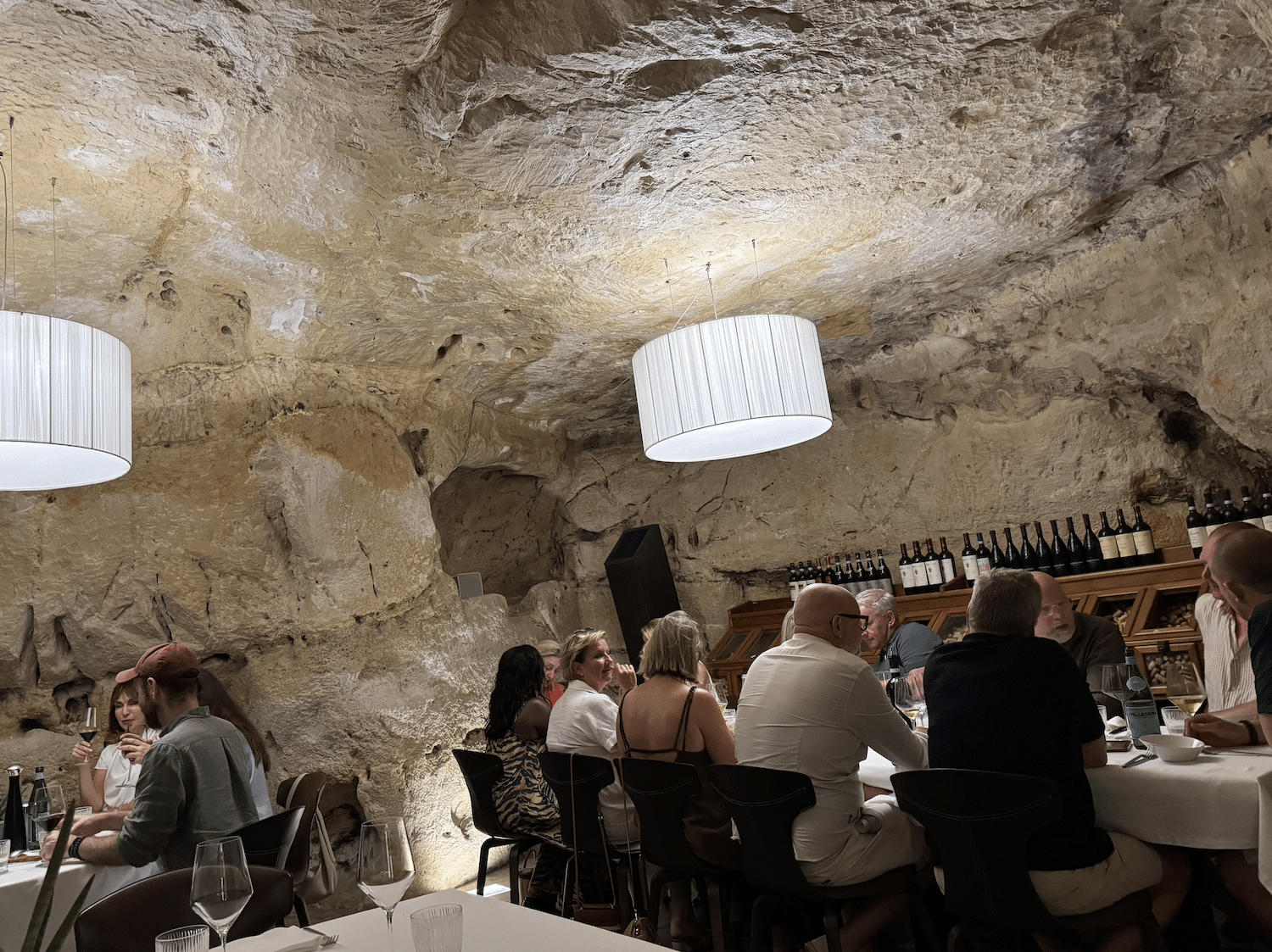
We were surprised that although there were large groups chatting away and enjoying dinner, the caves seem to provide a natural sound buffer and were quieter than most New York restaurants.
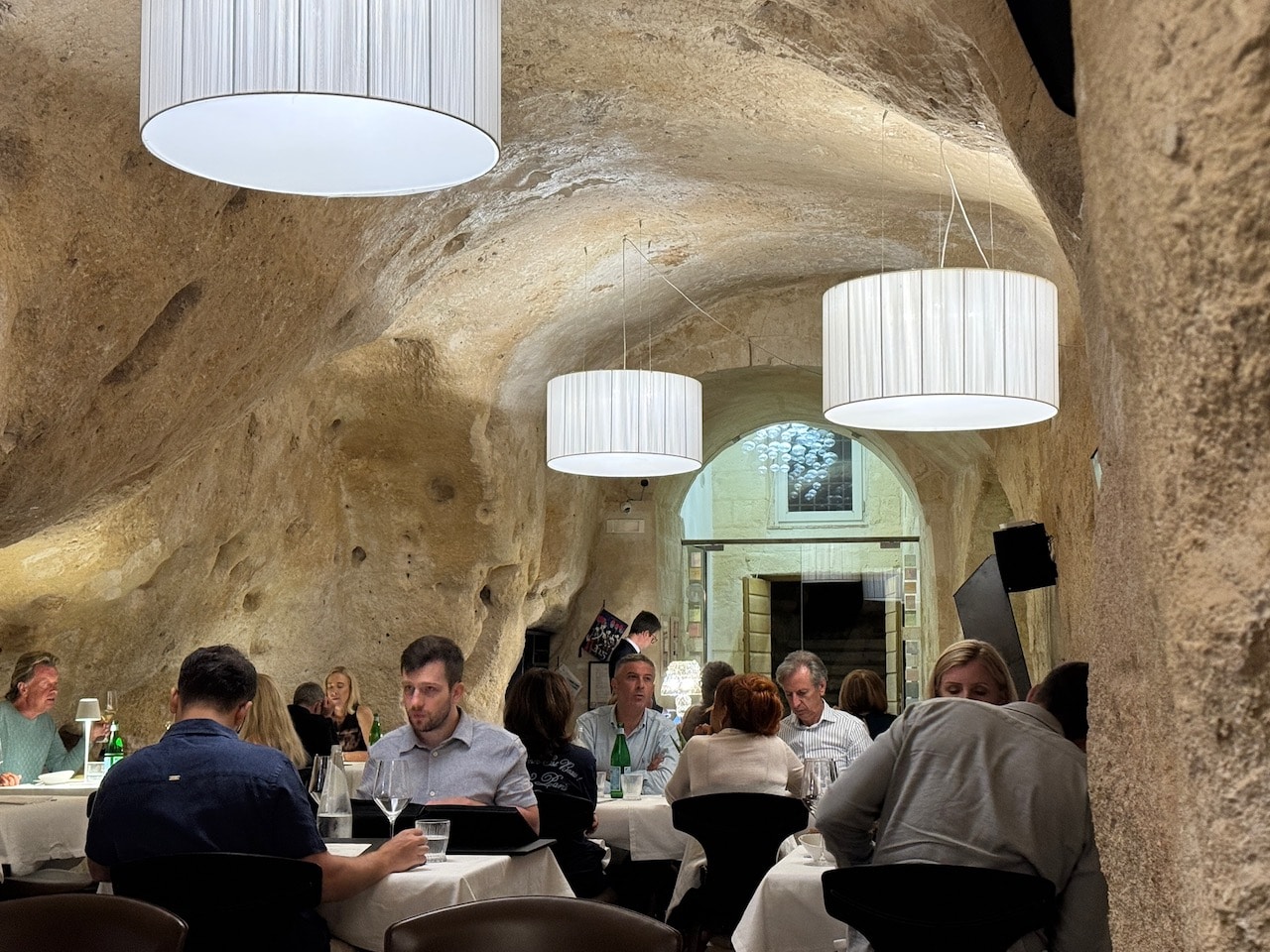
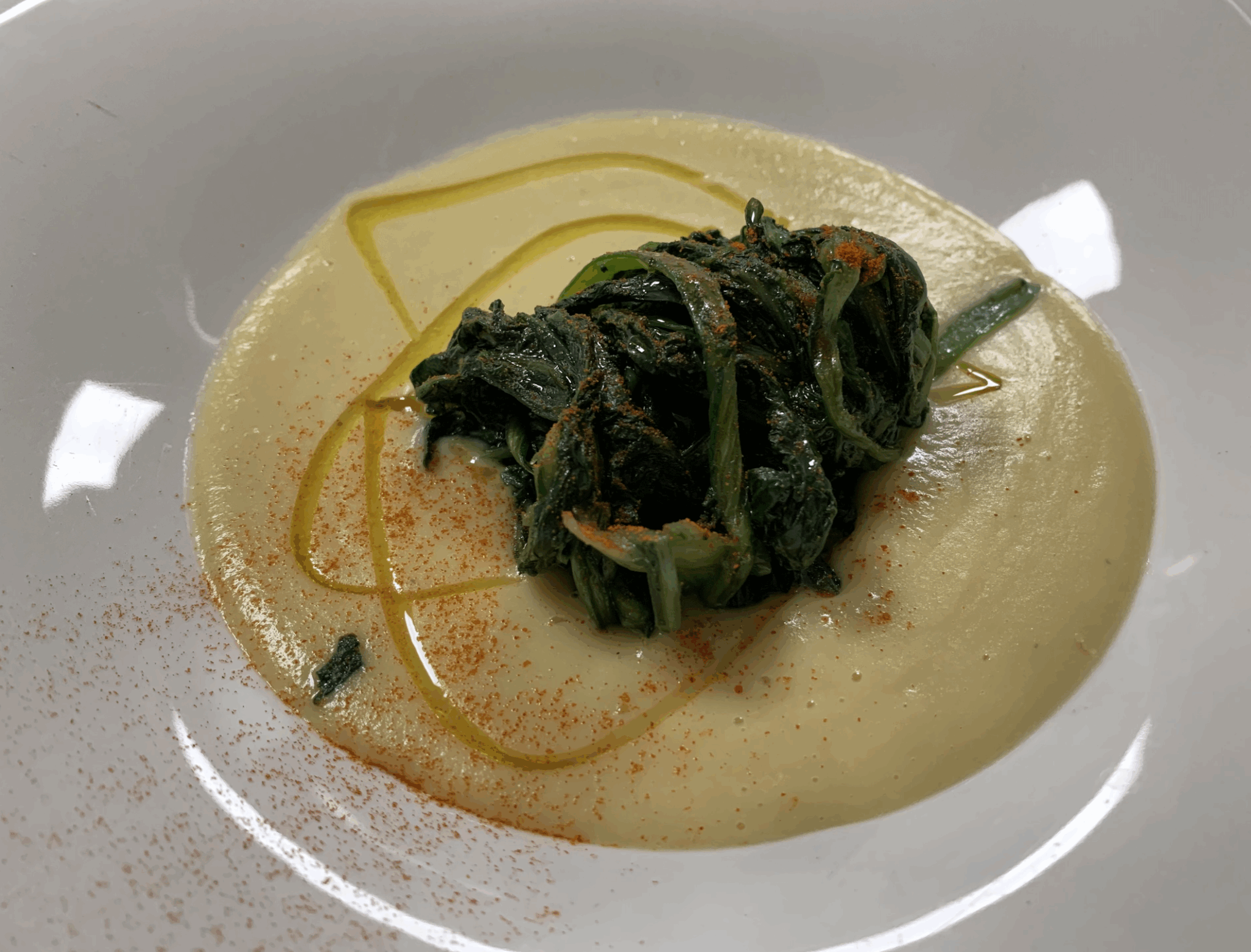
Michelin had recommended the restaurant for its food and ambience and we were happy that we chose it. We were introduced to the regional favorite starter of pureed fava beans and found the taste lighter and fresher than hummus–definitely a dish we wanted to try at home.
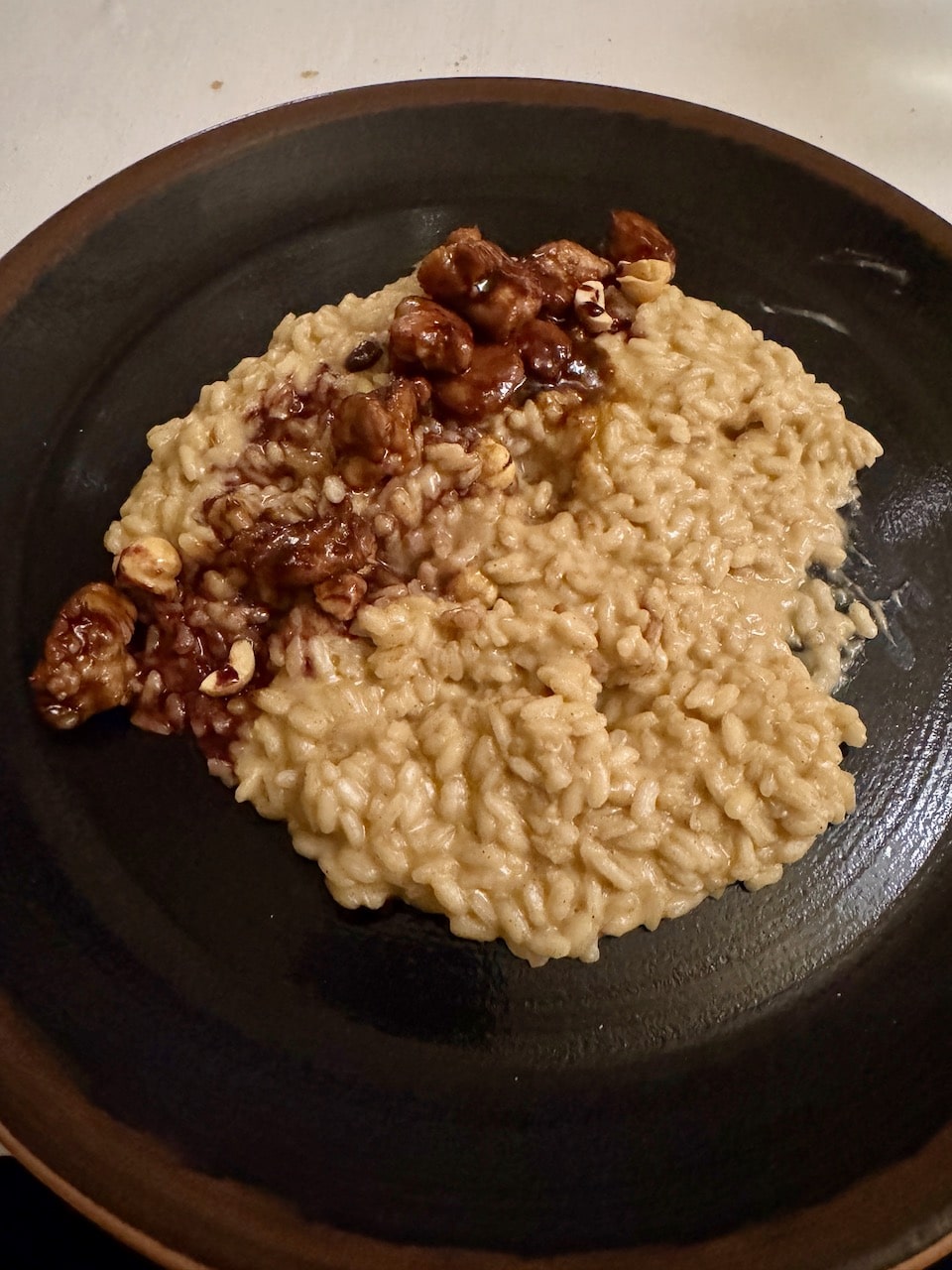
But the standout for us was risotto with lamb sweetbreads.
The next morning, the Sant’ Angelo’s front desk arranged a tour with the company Altieri Viaggi. We met our guide Terry in the upper part of the city and instantly realized how important the tour would be to understanding Matera. The small group included people from Switzerland, Miami, Puerto Rico, Spain, and Roseanne and Tony from New Jersey who had family roots in southern Italy and Sicily.
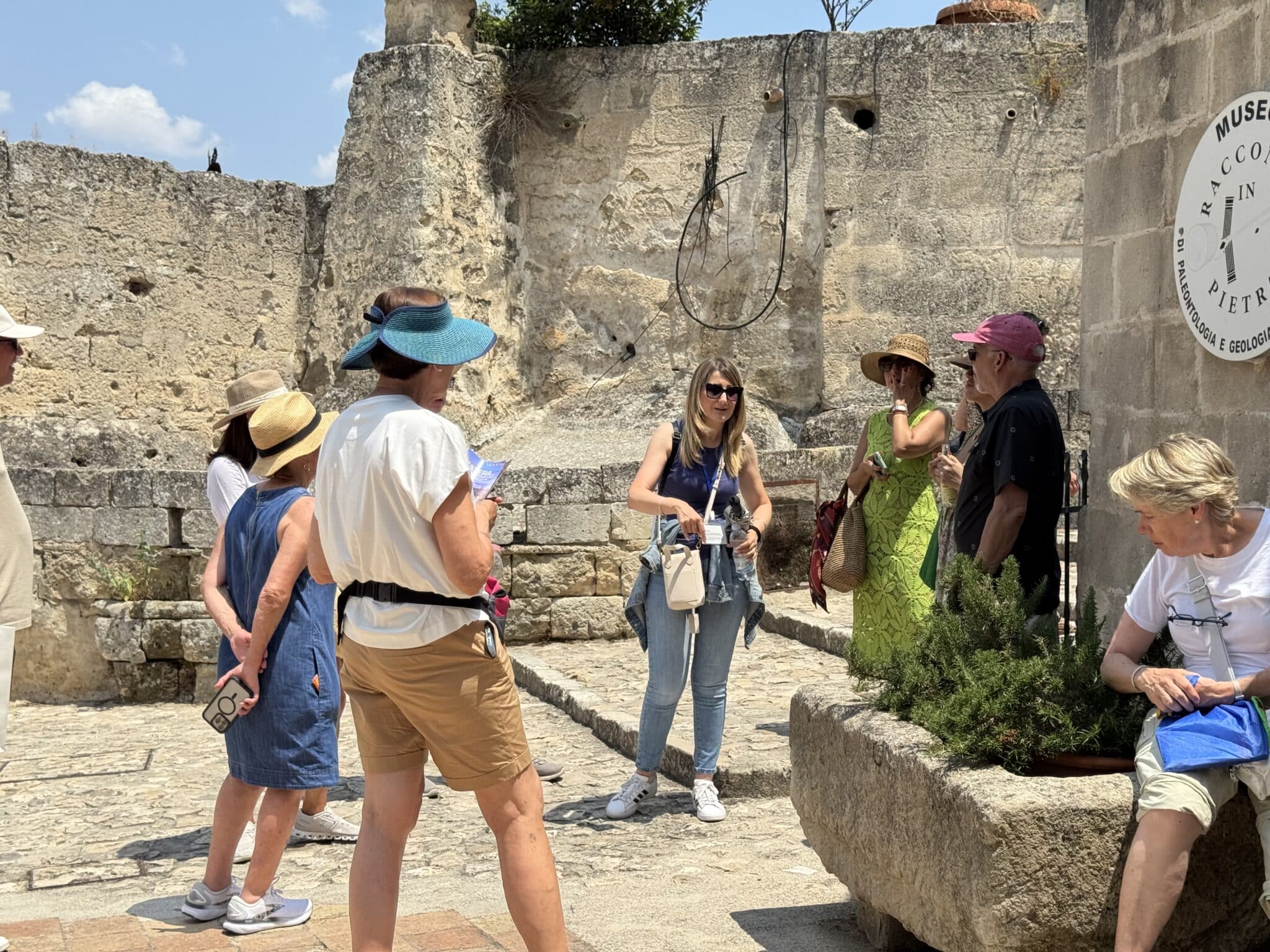
We started out above the Sassi, the area of the caves. Terry lived nearby and told us her grandfather had lived in the Sassi until the late 1950’s and had not been eager to move.
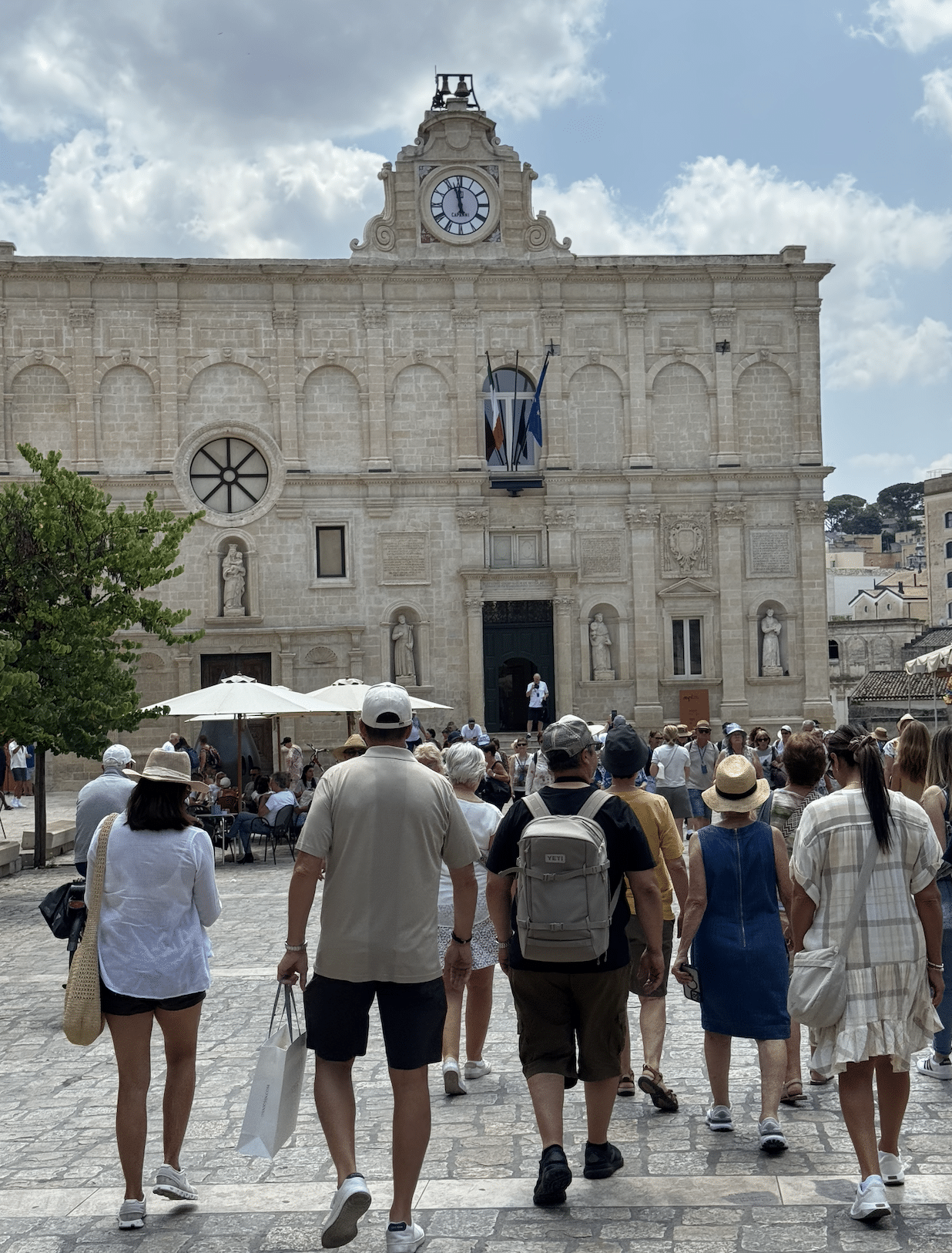
Terry gave us a crash course in the history of the Sassi. She explained that we were meeting in and would walk through the part of the city called the Civita, where the wealthy people historically lived.
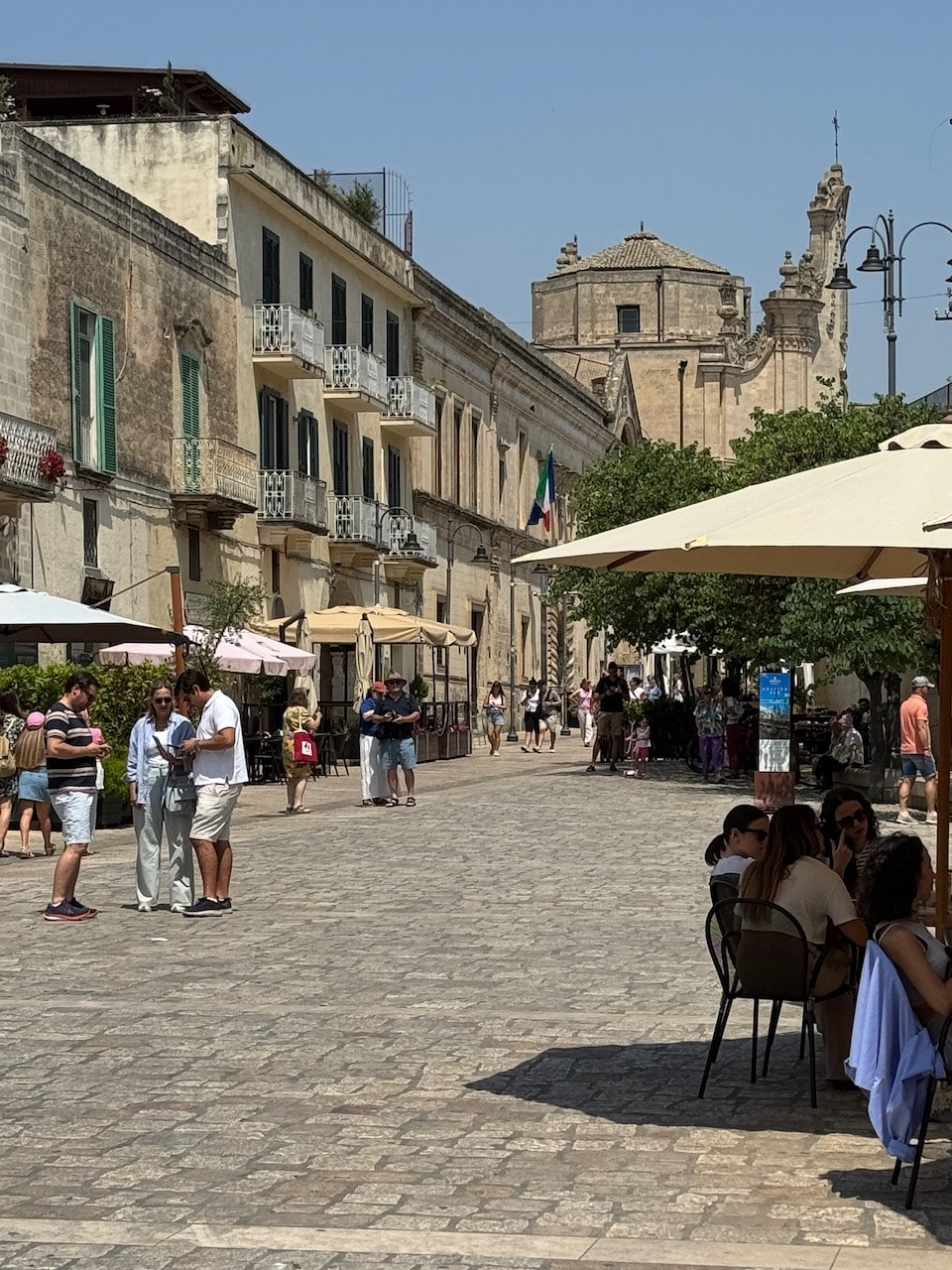
In the 17th century Matera became the capital of the Basilicata region. The elaborate Baroque architecture you see in the upper city is the legacy of that era.
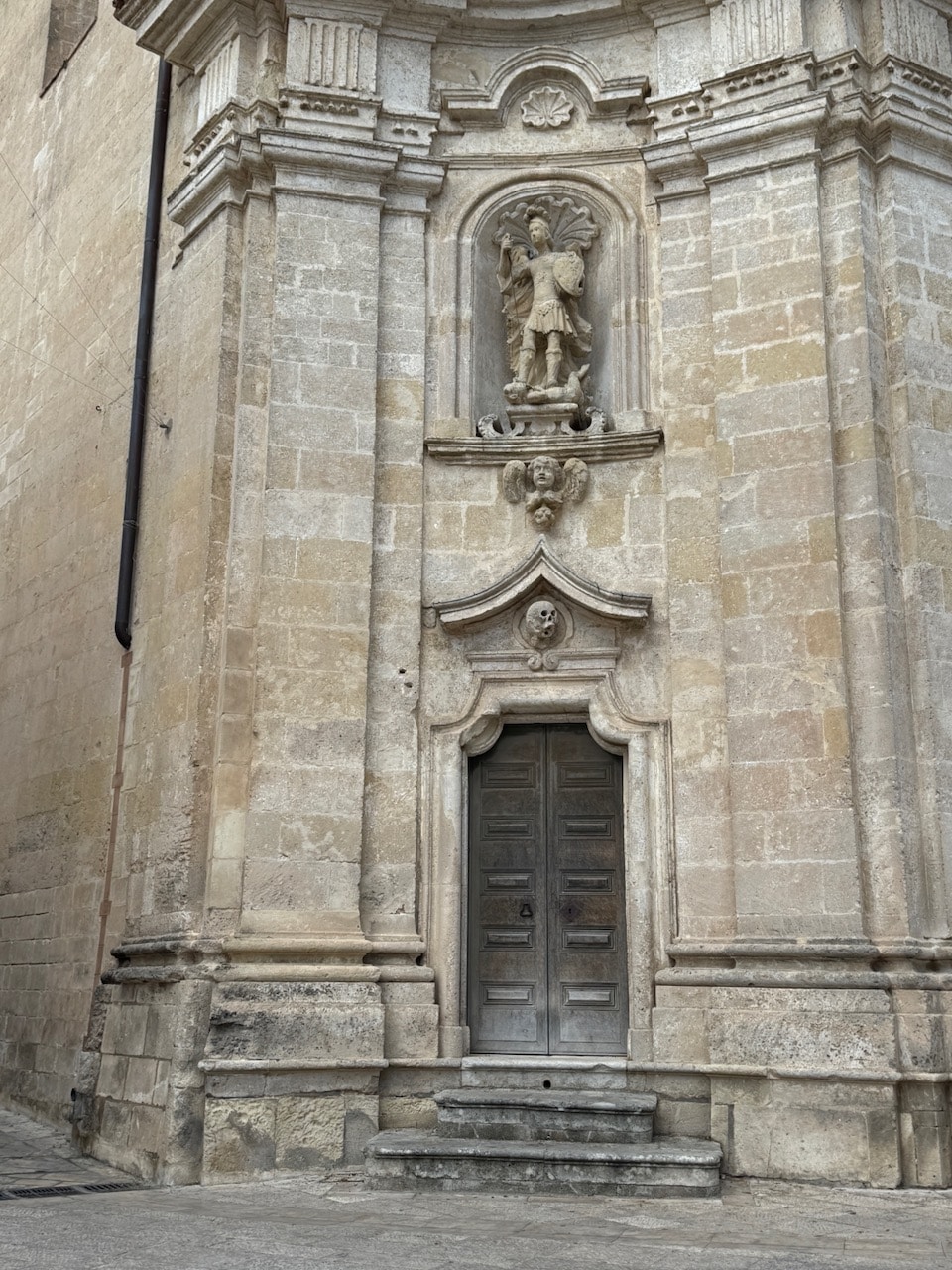
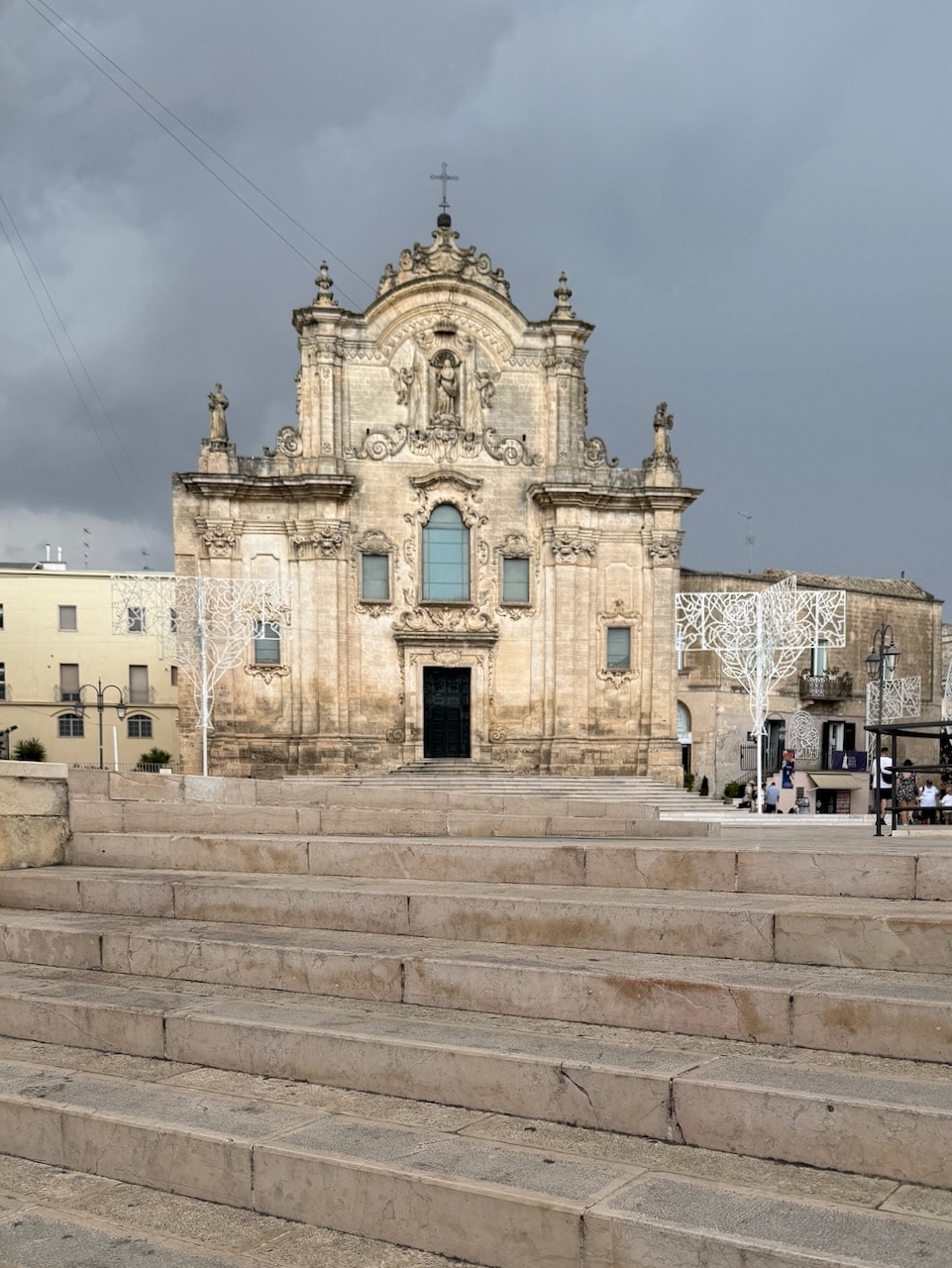
We headed past the 17th century and went down to explore the levels of the Sassi.
There was a clear delineation in class and attitude about the people who lived in the Sassi.
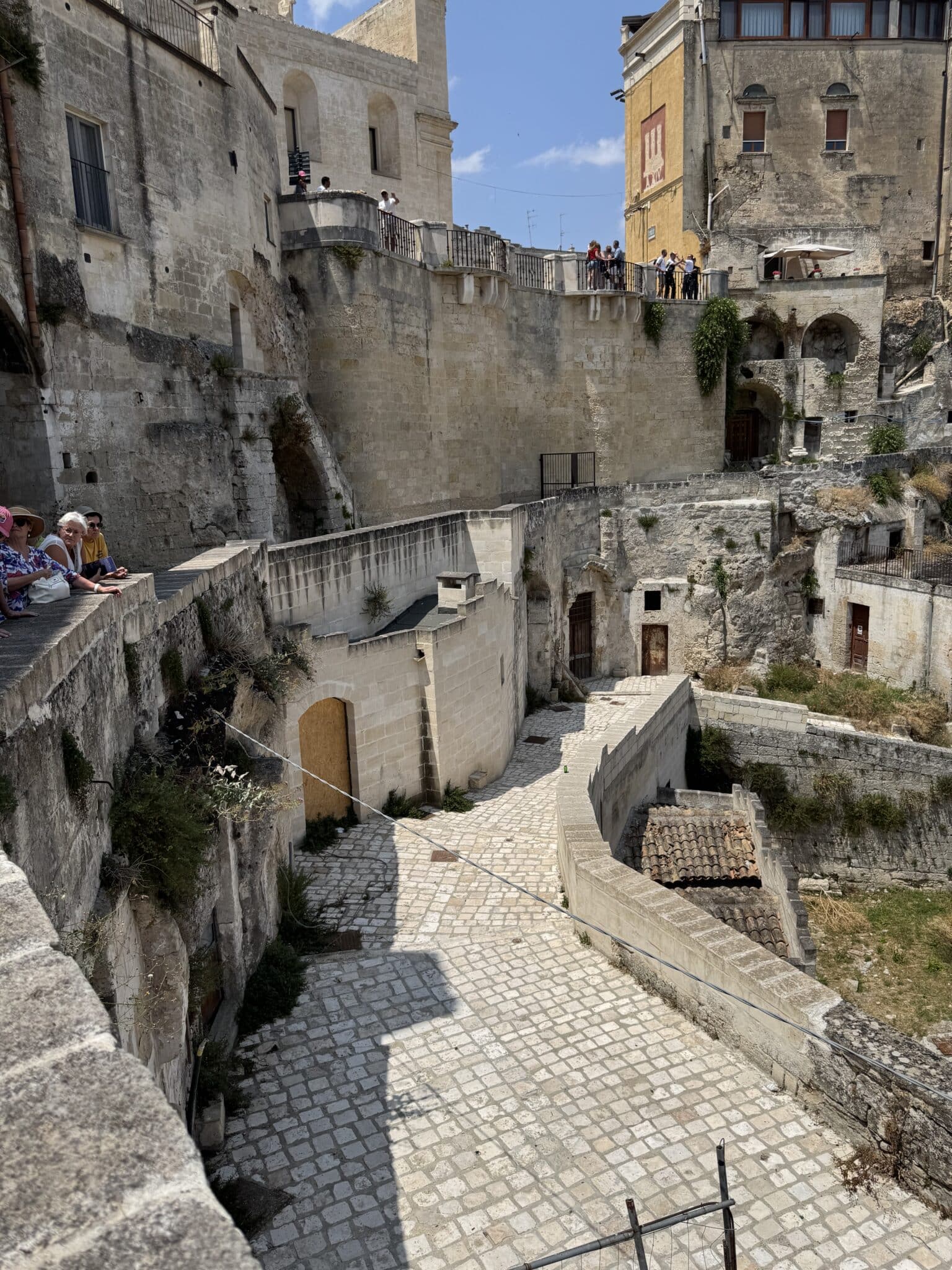
The people below, Terry said, were regarded as inferior and the people who lived up higher in the Civita would say, “No. I was not living in Sassi.” The rich people, she said, “. . . built on top, or in front of the caves.”
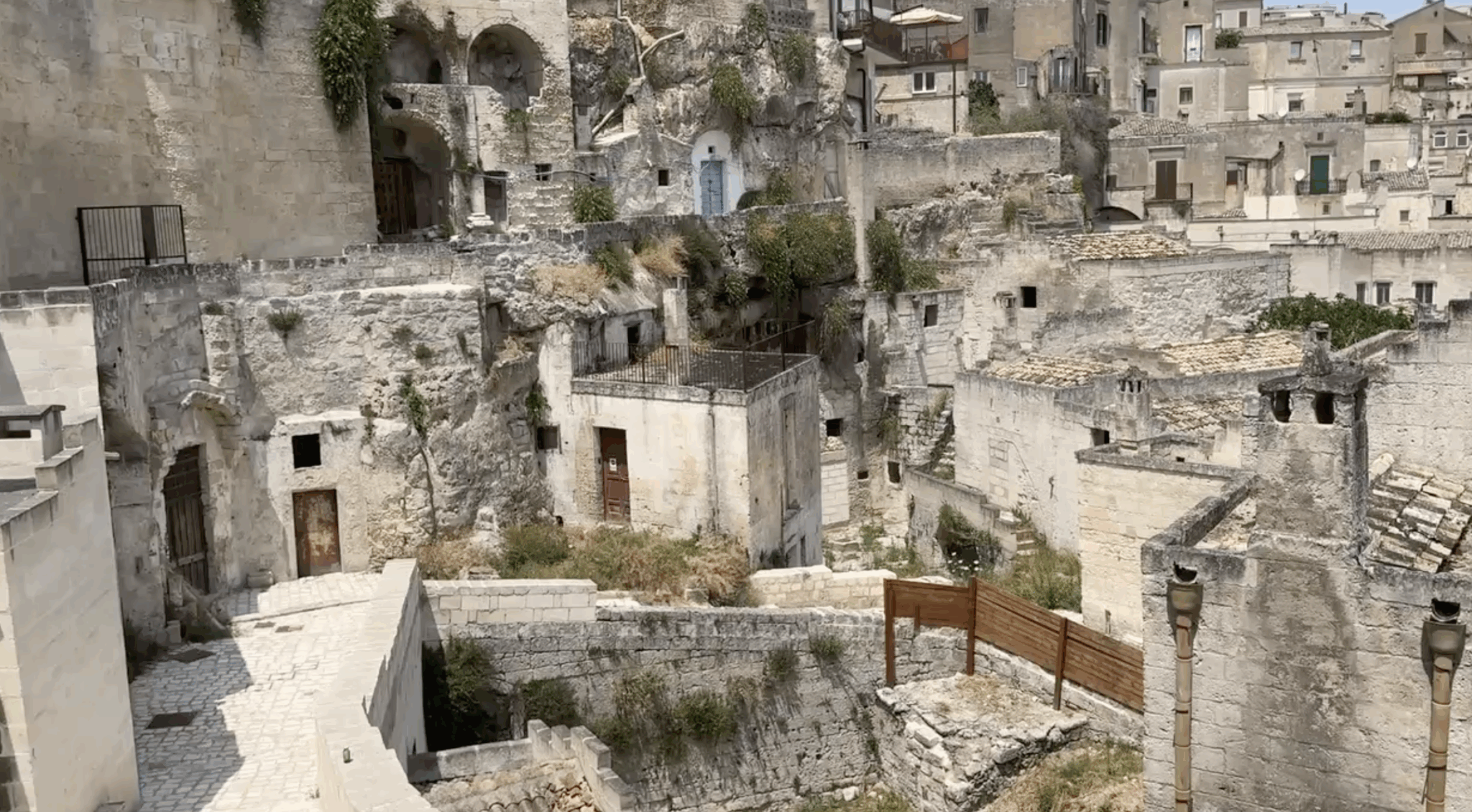
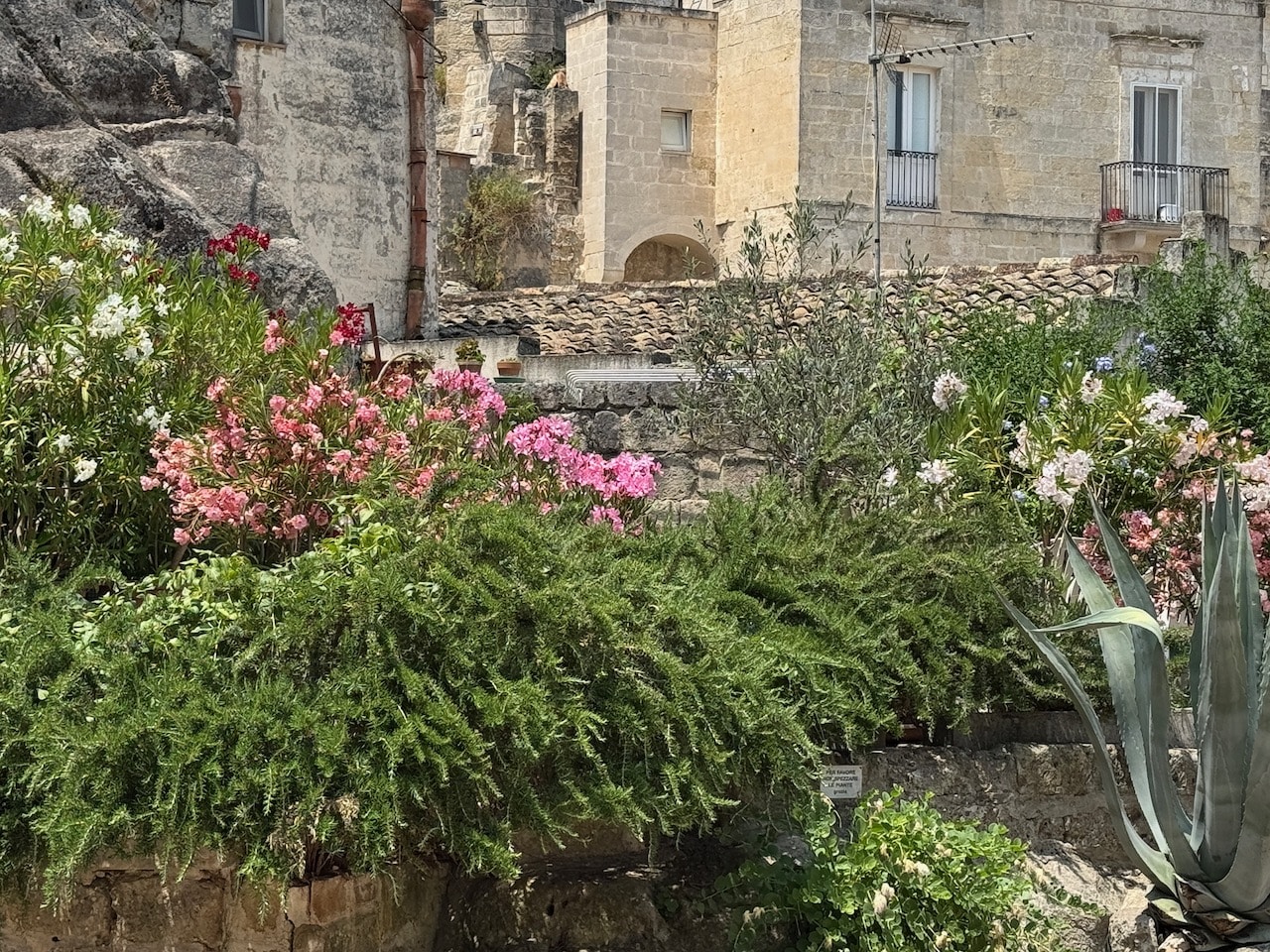
In the searing sun on a June day, the collection of white limestone structures, built into the hillside, vividly displayed the seemingly haphazard stacking she was talking about. We wound our way through the maze of the Sassi, where a beautifully planted garden stood out against the stone. It reminded us that development of restaurants, hotels and people who bought property here brought Matera back to life and helped it earn the designation of European Culture Capital in 2019. Terry said, “From the ‘shame of Italy’ to the European Culture Capital. We got the last laugh.”
The city has worked hard to please tourists, who keep the economy humming, and they try to tell their story in an appealing way.
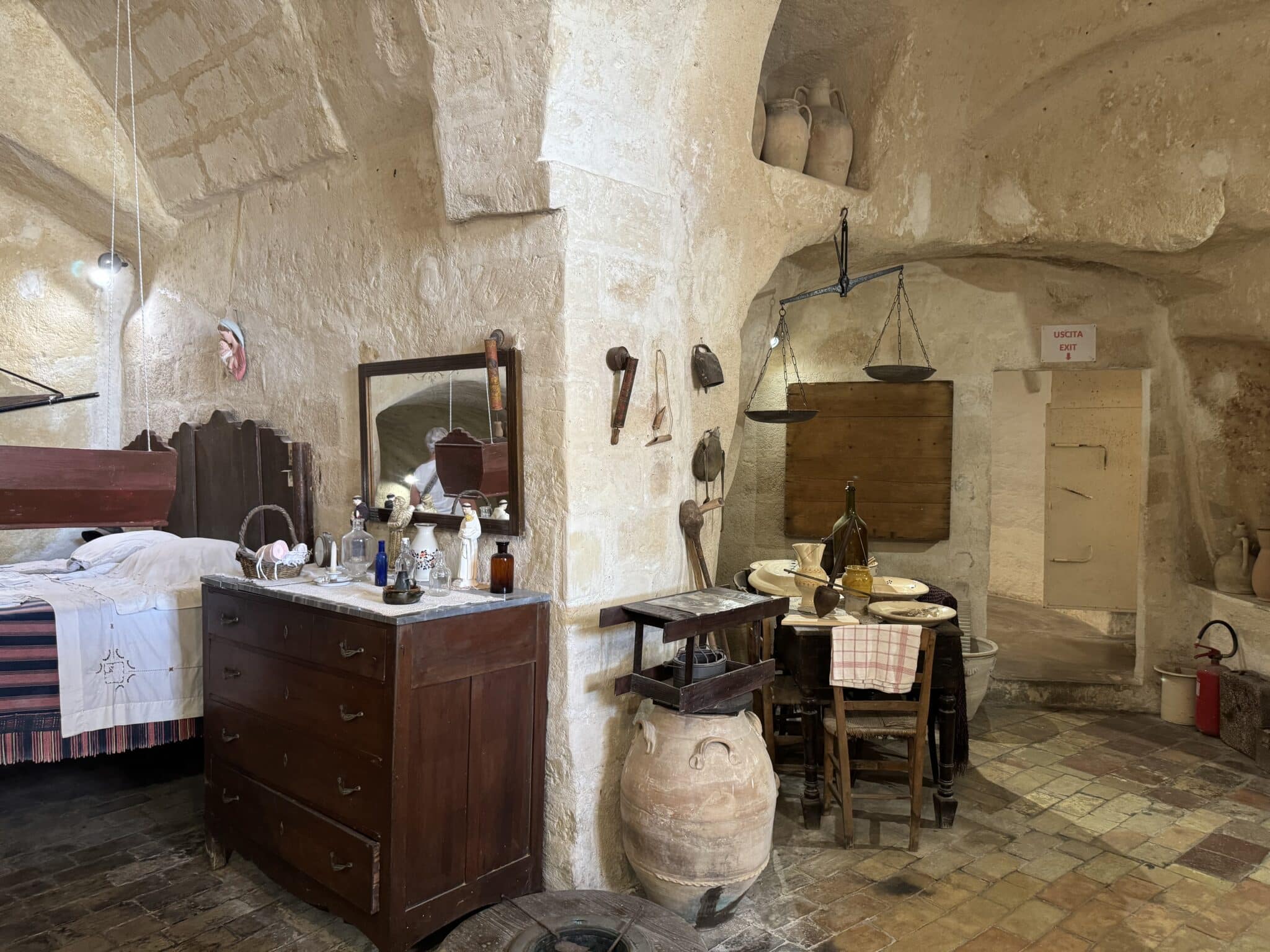
Several of the cave houses have been fitted out to display the way a typical Sassi family lived before they were moved out to modern housing.
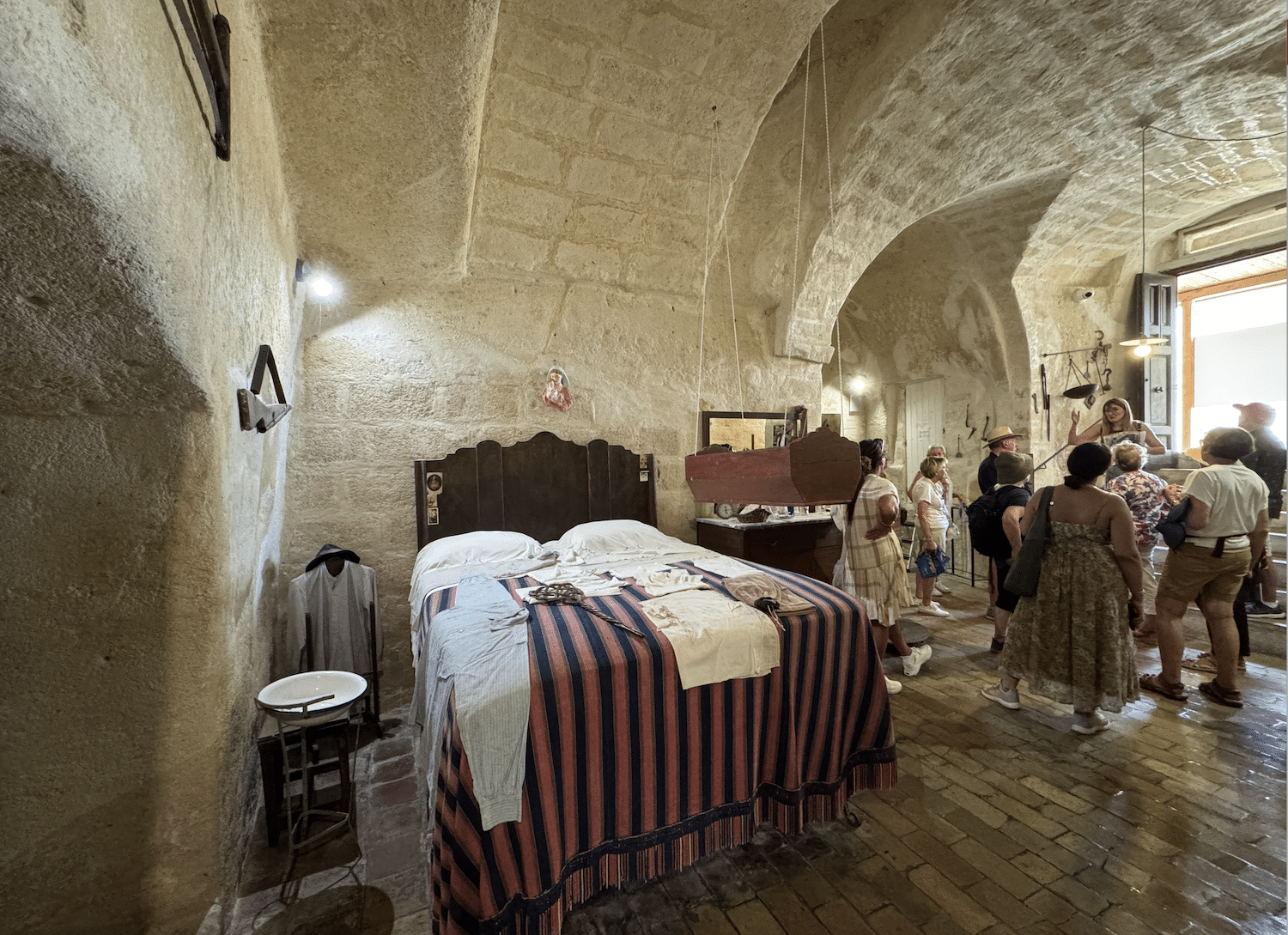
Terry explained that the big bed, at the center of the cave, was where everyone in the family slept. The cradle above the bed was intentionally high.
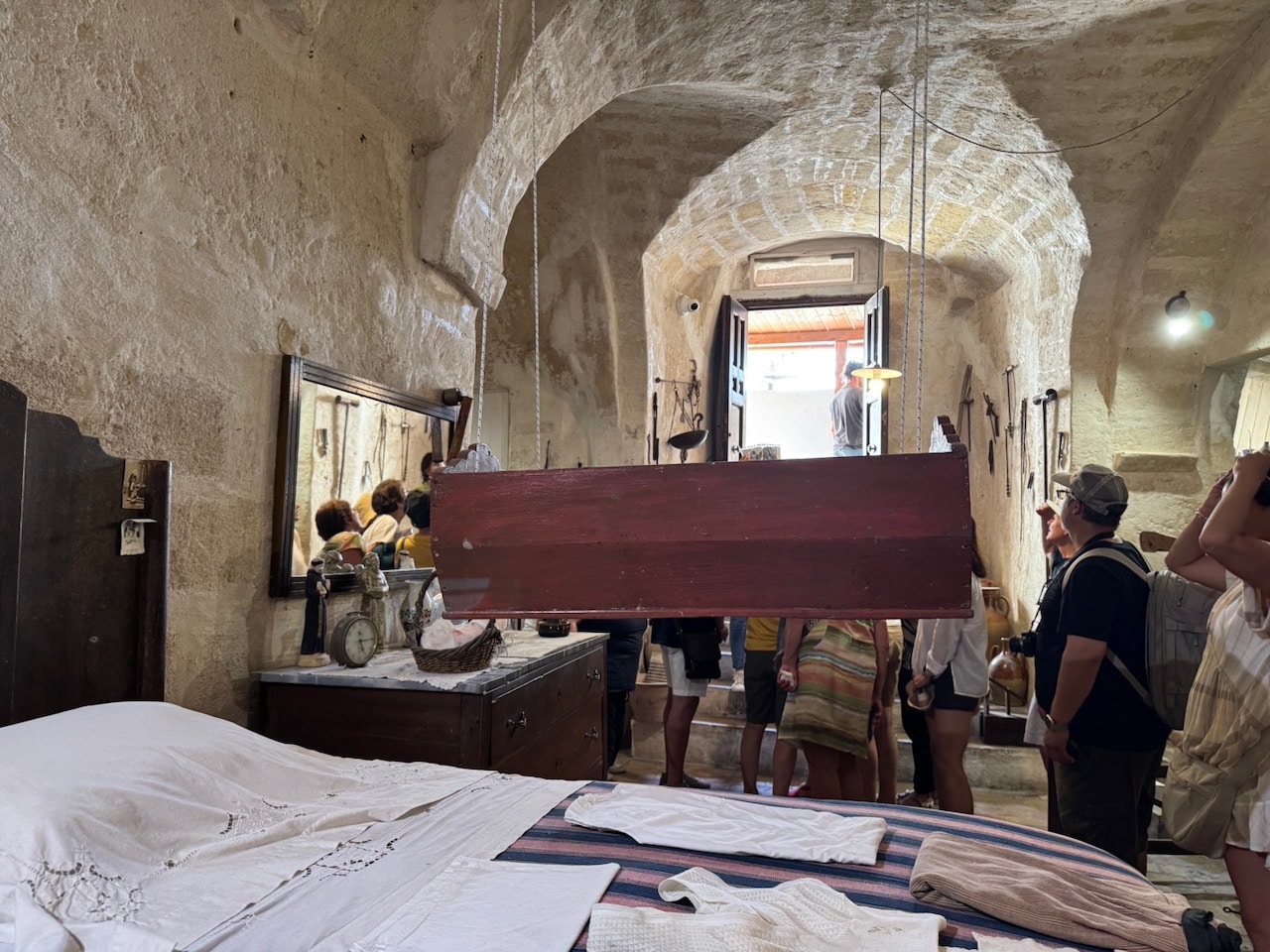
The elevation kept the rats from getting to the baby, or the child. And a rifle hung on the wall close by.
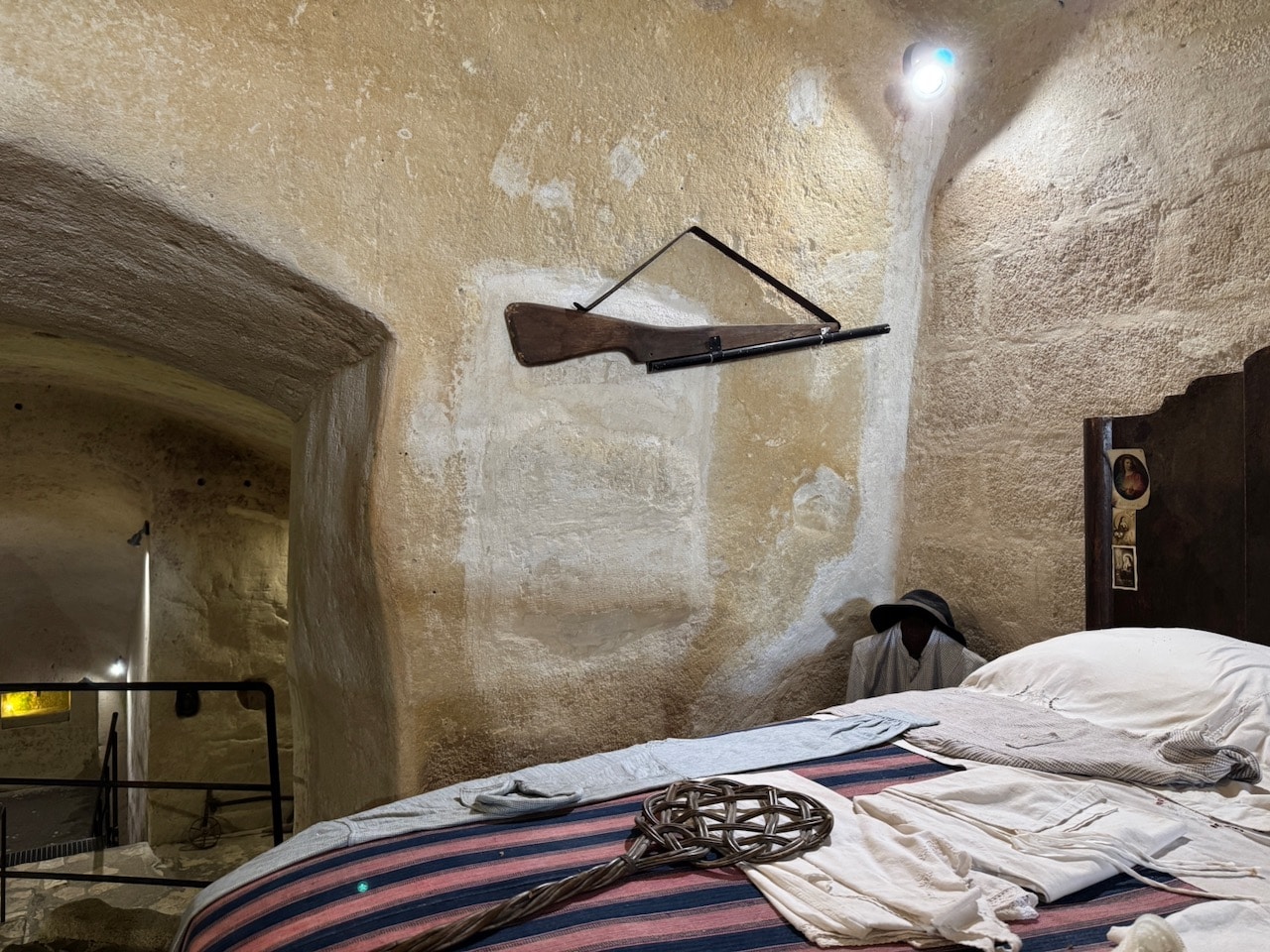
Through the arch, deeper into the cave, the family kept their livestock, donkeys, and chickens, if they had any. Many of those who lived in the Sassi farmed in the valley or in fields beyond the town walls.
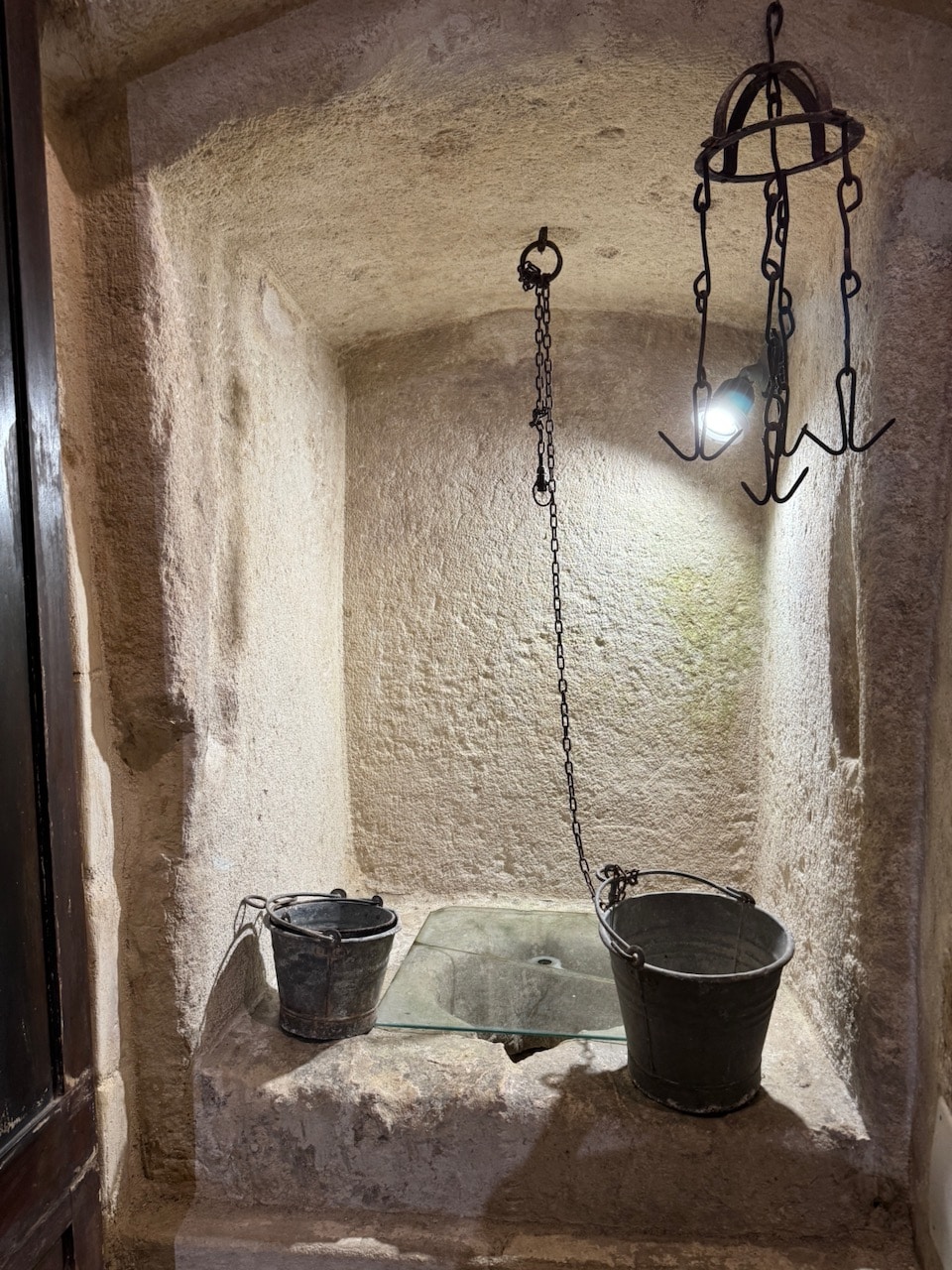
And what passed for plumbing was tucked into an alcove close to the foot of the bed.
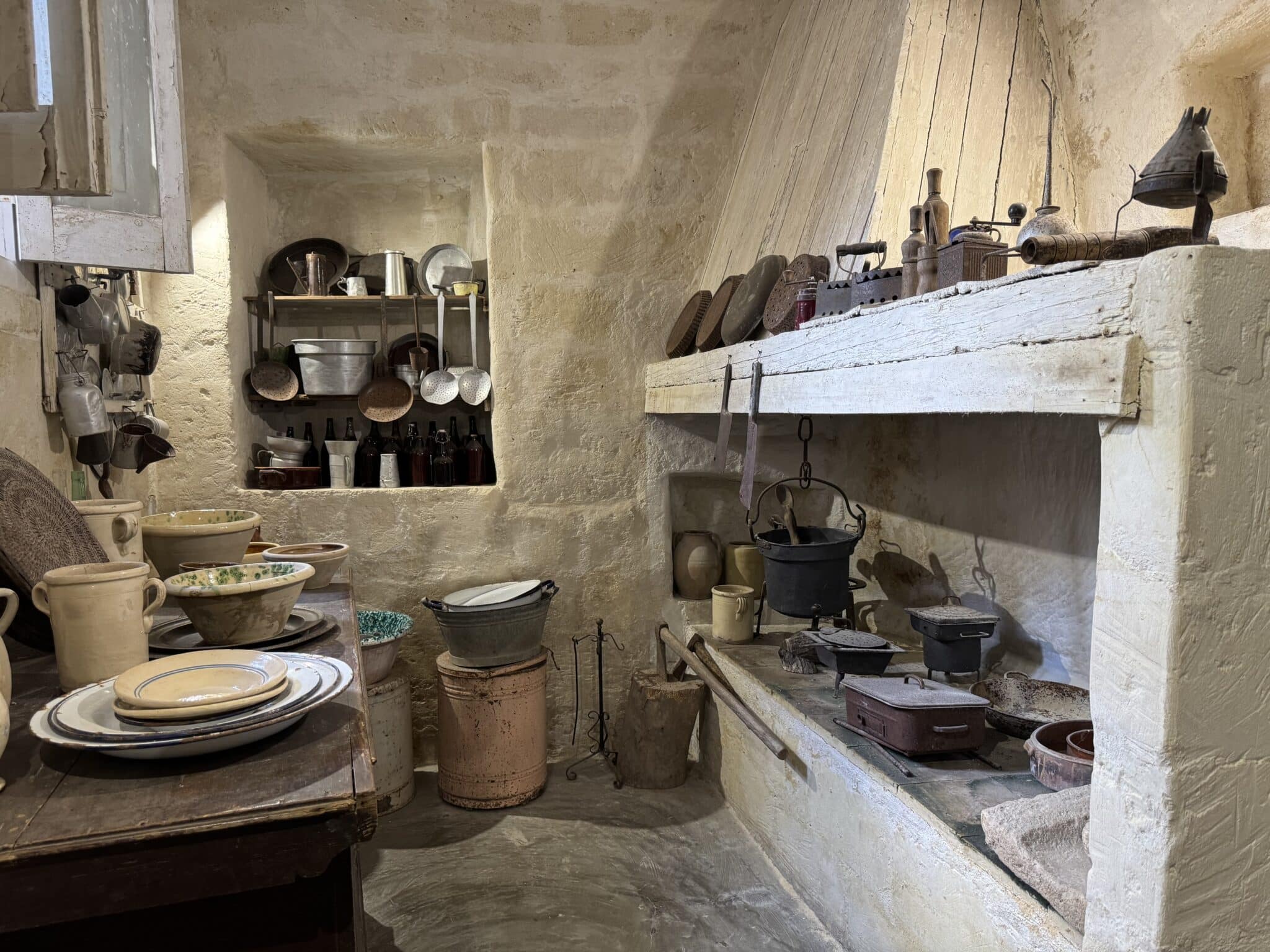
The kitchen was a separate area and you’ll notice that there are pots and pans, but no oven. Materans used communal ovens and had a system for collecting rain water and spring water for washing and bathing.
In the cave we visited, a place to sew was set up with a machine like Barbara’s grandmother used in New York. 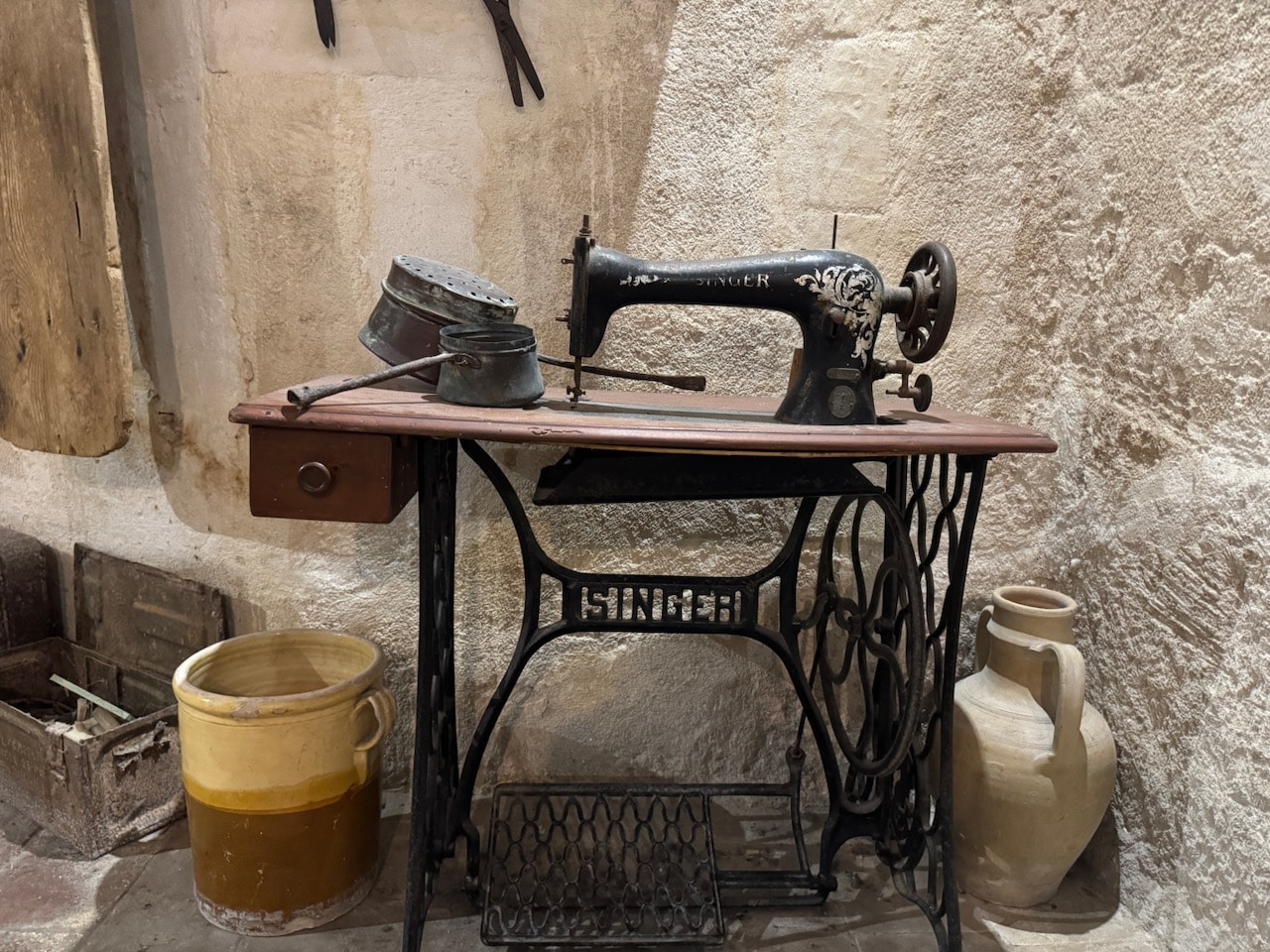
This is Italy, and just as there are churches that rise high from a mountain, there are churches below ground.
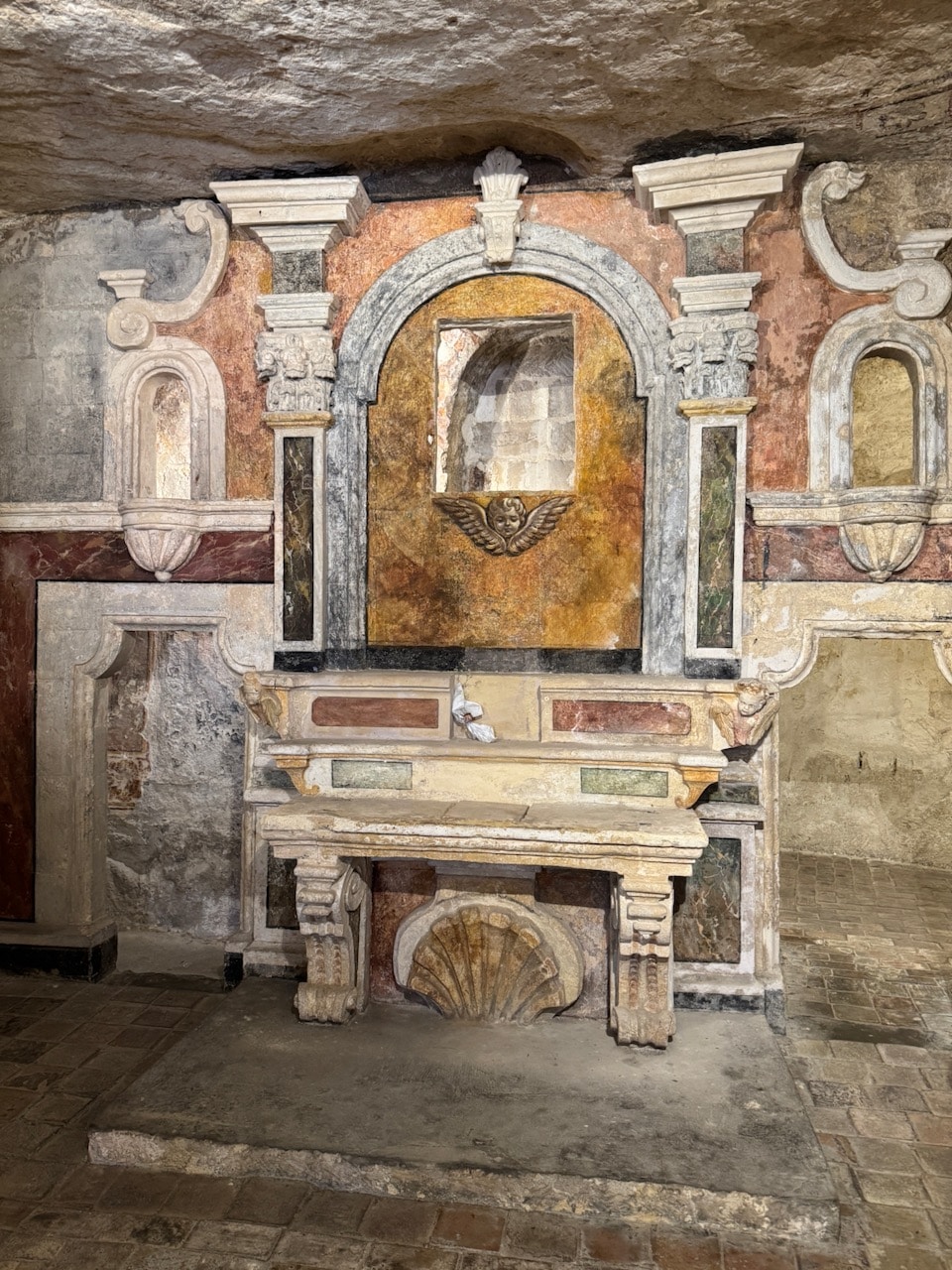
Cave churches are thought to have been created between the 8th and14th centuries by Benedictine and Byzantine monks.
Back out in the sunshine, Terry led us to what she called “the cemetery.” Archeologists digging here realized that these imprints were actually graves and stopped the dig. The church in the background is Santa Maria de Idris, carved out of rock, and one of Matera’s most famous.
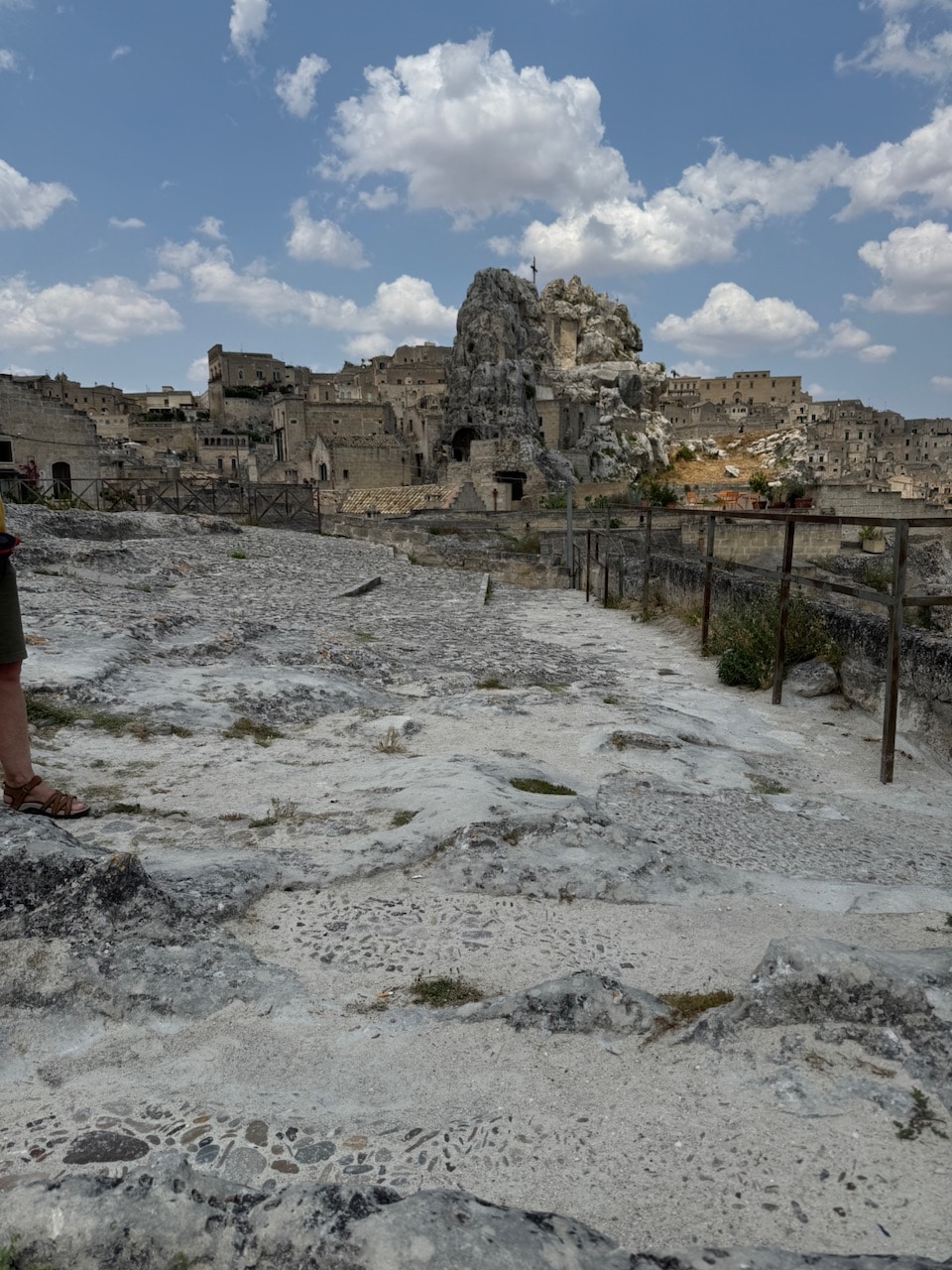
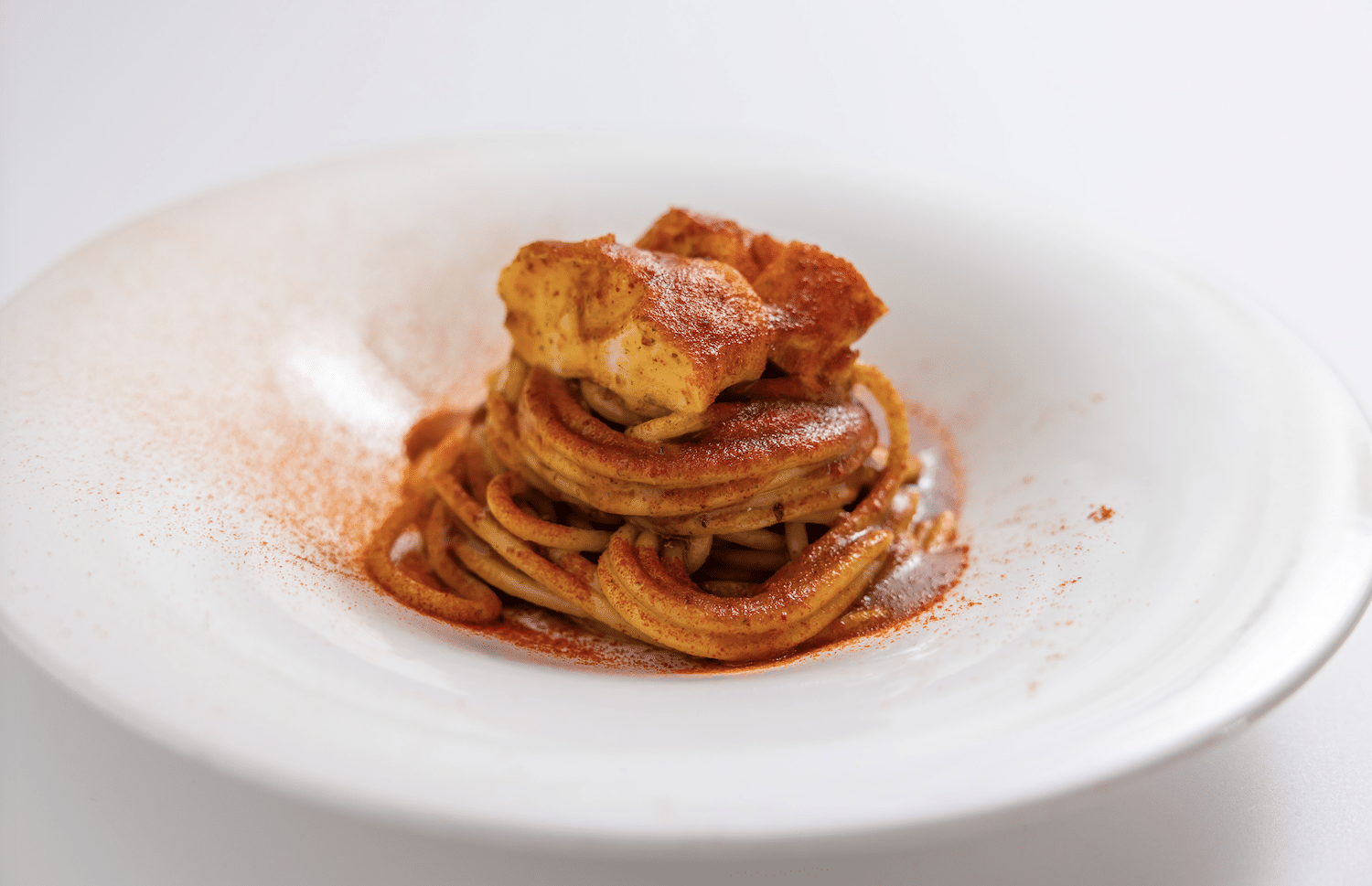
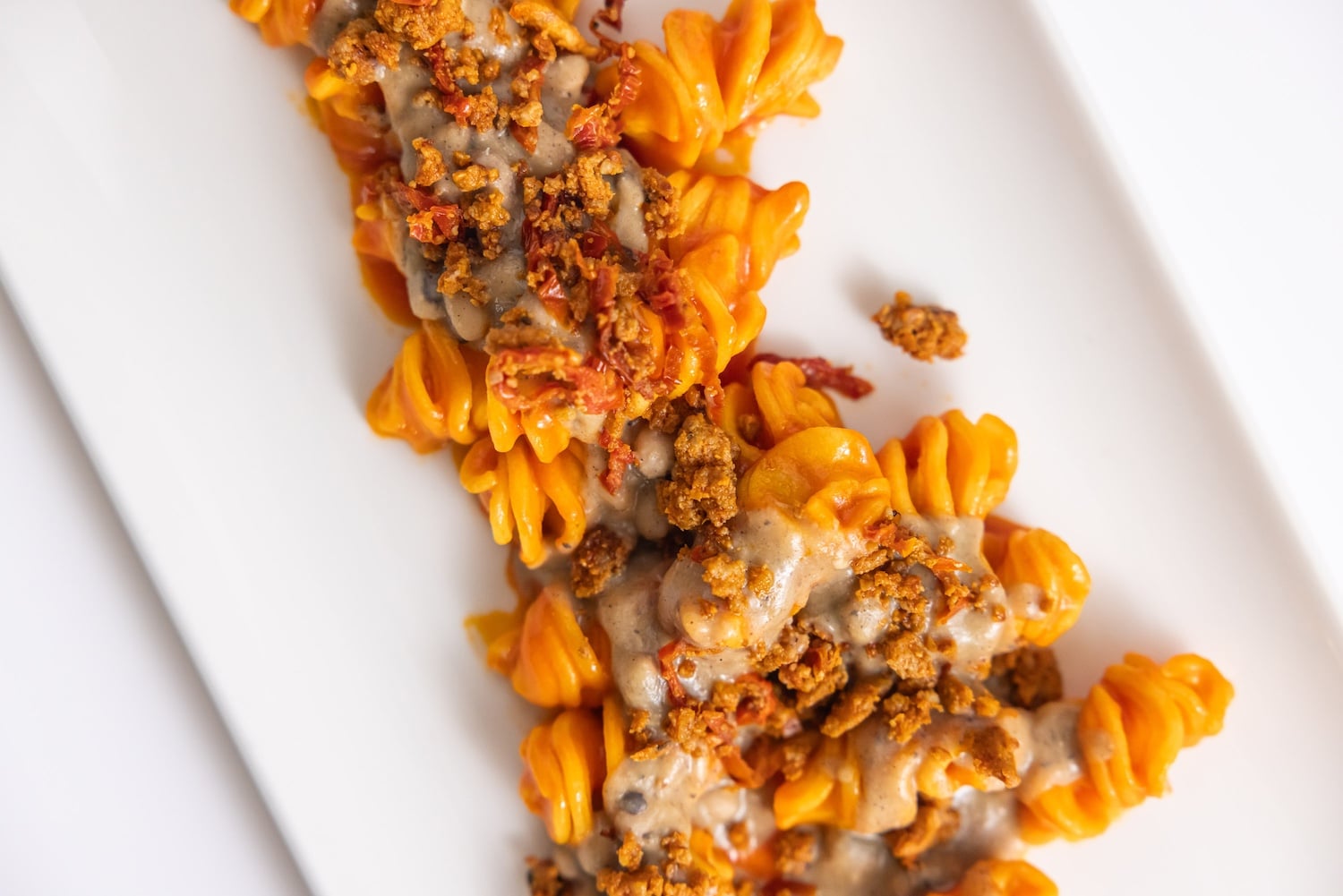
The ancient graves in the Matera stone ended Terry’s informative tour, and we headed back to the Sant’ Angelo to escape the heat and rest for another lovely dinner at Baccanti. Pasta was on our menu!
In the morning, we and our luggage piled into a hotel van that took us away from the Sassi into the new part of Matera and the parking garage where we had left our rental car. We were off to Taranto, with a stop in Alberobello and some cone-roofed trulli houses on the way.
And you can watch and listen to Terry the tour guide talk about the class distinctions in Matera.